Why Rockwell Wants Forklifts That Drive Themselves: The AGILOX Deal Explained
On 18 November 2026, Rockwell Automation, one of the biggest suppliers of factory control equipment, signed an agreement to buy AGILOX, an Austrian company that…

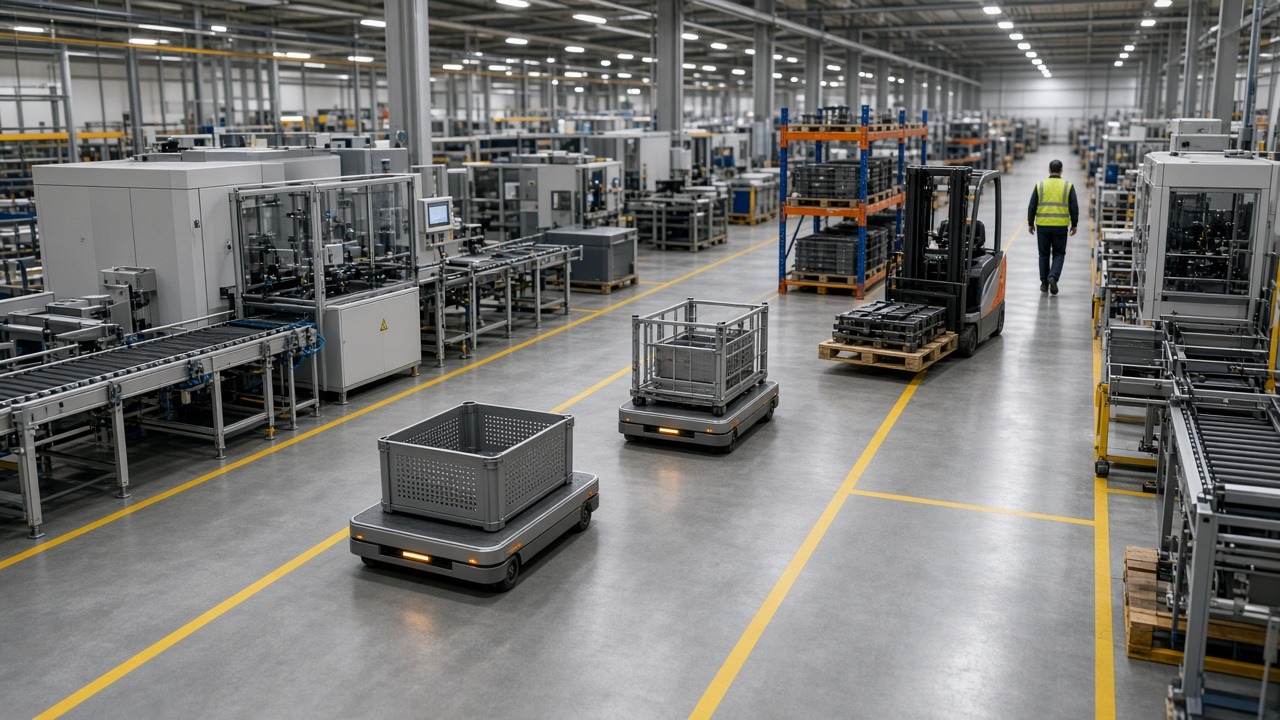
AI-generated illustration.
On 18 November 2026, Rockwell Automation, one of the biggest suppliers of factory control equipment, signed an agreement to buy AGILOX, an Austrian company that builds forklifts that drive themselves. The deal is not yet closed. According to Rockwell, it is expected to close in the second quarter of its fiscal year 2027, once closing conditions are met and regulators approve it. No price has been disclosed.
For anyone who works in a factory or a warehouse, the forklift is part of the scenery. It shuttles pallets from the loading dock to the storage racks, from the racks to the production line, and from the end of the line back to shipping. It is also a job that can be hard to staff around the clock, and a heavy vehicle that shares space with people on foot. Robots that can take over some of those trips have existed for years. What is changing is who sells them. When a company that already supplies the controllers, motors and software running many production lines also sells the robots that move material between them, plant managers deal with a different kind of supplier, and forklift drivers face a different future.
What was announced
The deal in Rockwell’s words
Rockwell’s press release says the company has signed a “definitive agreement” to acquire AGILOX. A definitive agreement is the binding contract that sets the terms of a purchase; it is a firm commitment, but the sale only takes effect at “closing”, when the remaining conditions have been met.
Rockwell describes AGILOX as a maker of high-end autonomous mobile robots, or AMRs. An AMR is a vehicle that finds its own way around a building using sensors and onboard software, rather than following wires or magnetic tape laid into the floor. Rockwell adds that AGILOX’s robots are driven by artificial intelligence the company developed itself and by “swarm networking”. Swarm networking means that the robots talk directly to each other and share out the work among themselves, instead of waiting for orders from one central computer.
The release makes four main points:
- Two product lines brought together. AGILOX’s forklift-style AMRs would be combined with Rockwell’s existing OTTO by Rockwell Automation robots, which are flatbed AMRs: low, flat platforms on wheels that carry carts, bins or pallets on top of them rather than lifting them on forks.
- Two regions brought together. Rockwell says OTTO has a strong presence in North America, while AGILOX has an established footprint across Europe.
- Target customers. Rockwell says AGILOX will gain access to its customer relationships in sectors such as consumer packaged goods (everyday products like food, drinks and toiletries) and life sciences (pharmaceuticals and medical products).
- Scale. Rockwell claims the acquisition will “more than double” its AMR business. This is Rockwell’s own claim. The release does not say whether it is measured in revenue, robots deployed or orders, and it gives no figure for the current size of that business.
Rockwell frames the deal as part of what it calls “production logistics”, meaning the movement of raw materials, parts and finished goods inside a plant, from the receiving dock through production to shipping. Blake Moret, Rockwell’s chairman and chief executive, says in the release that combining the two technologies creates a “best-in-class” platform. AGILOX’s co-founders and co-CEOs, Dirk Erlacher and David Niedermaier, say joining Rockwell gives them scale and market reach they could not build alone.
Timing, approval and price
The release states that the transaction is subject to closing conditions and regulatory approval. Regulatory approval here means that competition authorities in the countries concerned must check that the deal does not harm competition before it can go ahead. Rockwell expects completion in the second quarter of its fiscal year 2027. A fiscal year is the twelve-month period a company uses for its accounts; Rockwell’s runs to 30 September, as its latest annual results confirm. By our own calculation, the second quarter of fiscal 2027 therefore covers January to March 2027. Carlyle, the investment firm selling AGILOX, says in its own release that the deal is expected to close in the first half of 2027 and that the financial terms are not being disclosed. Rockwell’s release gives no price either.
Once the deal closes, AGILOX will report to Rockwell’s Intelligent Devices operating segment, one of the company’s three main business divisions, which covers much of its hardware. OTTO has sat in the same division since Rockwell completed its purchase of the Canadian company Clearpath Robotics, OTTO’s parent, in October 2023.
Who AGILOX is (vendor-reported)
The company description at the end of the release, and AGILOX’s own website, give the following details. All of them are reported by the companies themselves:
- AGILOX was founded in 2017 and is headquartered in Neukirchen bei Lambach, Austria, with subsidiaries in Europe, the United States and China and more than 250 employees.
- It says it has deployed more than 2,500 AMRs, with a strong base in the automotive industry and customers in logistics services, food and beverage, and pharmaceuticals.
- Its range includes the AGILOX OCF, a robotic counterbalanced forklift (the classic forklift design, in which a heavy weight at the back balances the load on the forks). AGILOX’s product page lists a maximum payload of 1,500 kg, a lifting height of up to 1.6 m and a top speed of 1.4 m per second.
- AGILOX says its “X-SWARM” technology removes the need for a master computer: the robots exchange their position and status several times a second and share out transport orders among themselves.
- Carlyle, which made a majority investment in AGILOX in 2021, says the company’s revenue has quadrupled since then, without giving figures.
Who OTTO is (vendor-reported)
On its own website, OTTO describes itself as having more than 16 million production hours and more than 100 AMR fleets in operation. Its range runs from the OTTO 100, for loads up to 150 kg, to the OTTO 1500, which OTTO says can carry up to 1,900 kg. These are vendor figures.
The safety standard both sides cite
Both companies refer to ISO 3691-4, the international safety standard for driverless industrial trucks. In plain terms, it sets out how a self-driving vehicle that moves goods in a factory or warehouse must brake, detect people in its path, stop in an emergency and switch between automatic and manual modes, and how those features must be checked. AGILOX says the OCF is certified to the standard; OTTO lists it among the standards the OTTO 1500 complies with. The current edition was published in 2023, and ISO’s page notes that a revision is in preparation.
Our analysis: what changes for a plant
The views in this section are AndBeyond.Tech’s own, not those of Rockwell, AGILOX or OTTO.
One supplier for the line and for the trips between machines
Today, many plants buy their production equipment from one set of suppliers and their material handling from another: manual forklifts, conveyors, and perhaps a few robots from a specialist. Rockwell’s pitch is that the same company could supply the control system on the line and the robots feeding it. The two robot types fit naturally together. Flatbed robots like OTTO’s are good at carrying carts and bins along fixed routes inside production areas. Forklift robots like AGILOX’s lift pallets off the floor, out of racks and onto conveyors, which is where much of the remaining manual driving takes place.
For a plant manager, the potential benefit is simpler coordination. If the robots and the production line share data, a line that is about to run out of parts could call for a pallet before an operator notices. The risk is dependence on one supplier. A plant that buys its controllers, its software and its mobile robots from one company has fewer ways to switch later. Rockwell has not yet said how, or whether, AGILOX and OTTO robots will run under a single fleet system. The Robot Report, a specialist news site (secondary source), notes that this integration plan was not disclosed.
Why mobile robots keep coming back: labour
The steady interest in mobile robots has a simple driver. Many warehouses and plants find it hard to recruit and keep forklift drivers and material handlers, especially for night shifts. Driving a pallet from point A to point B is repetitive work, and it is where robots are easiest to justify. The International Federation of Robotics (IFR), the industry federation that compiles global robot statistics, reports in its World Robotics 2026 Service Robots release, dated 30 September 2026, that 117,500 transportation and logistics robots were sold worldwide in 2025, up 21% on the previous year and 47% of all professional service robots. The IFR stresses that these figures come from a sample of suppliers, not a full market count. They still show that moving goods is by far the largest use of professional robots today. In the same release, the IFR points to a new position paper that examines how service robots are being used to address labour shortages.
For drivers, the change is unlikely to be overnight. Robots tend to take over the long, predictable runs first, while people keep the awkward loads, damaged pallets and exceptions. In the short term, the job shifts towards supervising fleets, clearing blocked routes and handling what the robots cannot.
Europe and North America, side by side
The geographic fit Rockwell describes matters for customers with plants on both sides of the Atlantic. A consumer goods company running sites in Ohio and in Poland could, in theory, standardise on one supplier for both. That only works if the robots, software and service teams are truly available in both regions, which the companies have yet to show in practice.
The limits
Approval is not a formality
Until the deal closes, AGILOX and Rockwell remain separate companies, and customers should not assume combined products or joint support. Competition reviews can take longer than planned, and authorities may ask questions or set conditions.
Safety around people
A forklift robot weighing several tonnes shares aisles with pedestrians and human-driven forklifts. A standard such as ISO 3691-4 sets requirements for the vehicle and for preparing the area where it operates, but each site must still assess its own layout, traffic rules and training. Certification of a product does not make a given installation safe by itself.
Integration with existing sites
Most plants are not new. Uneven floors, narrow aisles, worn pallets, automatic doors and older control systems all complicate a rollout. AGILOX says its robots can be set up quickly using the contours of the building rather than added markers, but those are vendor claims, and the real test is a crowded site that is already in operation.
An uncertain return on investment
The case for mobile robots rests on labour savings, fewer accidents and steadier flows of material. Against that come the cost of robots, site changes, software, staff training and the hours lost during the switchover. Our earlier look at where factories see a return on AI cobots and vision first found that returns depend heavily on choosing the right first task. Neither company has published independent case studies with costs and payback times for combined fleets.
What to watch next
- Regulatory filings and the closing date, expected by Rockwell in January to March 2027 by our calculation.
- Any product road map explaining whether AGILOX and OTTO robots will share one fleet manager and integrate with Rockwell’s control systems.
- Pricing and service models, including whether Rockwell keeps the subscription and financing options AGILOX already offers.
- Customer results published with figures, rather than only vendor-reported deployment counts.
Bottom line
Rockwell is betting that the forklift trip between machines is the next part of the factory to automate, and that one supplier offering both flatbed and forklift robots will be more attractive than a collection of specialists. The logic is clear, and sales of robots that move goods are growing, according to the IFR’s sample-based figures. But the deal has not closed, the price is unknown, the “more than double” figure is Rockwell’s own claim, and the hard parts (safe operation among people, integration into older sites and a convincing payback) are still to be demonstrated plant by plant.
References / Sources
- Rockwell Automation, “Rockwell Automation Signs Definitive Agreement to Acquire AGILOX”, press release, 18 November 2026. https://www.rockwellautomation.com/en-us/company/news/press-releases/Rockwell-Automation-Signs-Definitive-Agreement-to-Acquire-AGILOX.html
- Rockwell Automation, “Rockwell Automation Reports Fourth Quarter and Full Year 2026 Results; Introduces Fiscal 2027 Guidance”, 5 November 2026 (fiscal year ending 30 September). https://www.rockwellautomation.com/en-us/company/news/press-releases/Rockwell-Automation-Reports-Fourth-Quarter-and-Full-Year-2026-Results-Introduces-Fiscal-2027-Guidance.html
- Rockwell Automation, “Rockwell Automation completes acquisition of autonomous robotics leader Clearpath Robotics and its industrial offering OTTO Motors”, 2 October 2023. https://www.rockwellautomation.com/en-us/company/news/press-releases/Rockwell-Automation-completes-acquisition-of-autonomous-robotics-leader-Clearpath-Robotics-and-its-industrial-offering-OTTO-Motors.html
- AGILOX, “Press Releases & Download” (newsroom). https://www.agilox.net/en/press-releases-download/
- AGILOX, home page and X-SWARM technology. https://www.agilox.net/en/
- AGILOX, “AGILOX OCF” product page. https://www.agilox.net/en/product/agilox-ocf/
- AGILOX, “AGILOX OCF” datasheet, 02/2026. https://www.agilox.net/media/agilox-ocf-datasheet-en.pdf
- OTTO by Rockwell Automation, home page. https://ottomotors.com/
- OTTO by Rockwell Automation, “OTTO 1500”. https://ottomotors.com/1500/
- Carlyle (seller), “Carlyle Agrees to Sell AGILOX to Rockwell Automation”, 18 November 2026. https://www.carlyle.com/media-room/news-release-archive/carlyle-agrees-sell-agilox-rockwell-automation
- International Federation of Robotics, “Global Sales of Professional Service Robots Surge 24%”, 30 September 2026. https://ifr.org/ifr-press-releases/news/global-sales-of-professional-service-robots-surge-24-percent
- ISO, “ISO 3691-4:2023 – Industrial trucks – Safety requirements and verification – Part 4: Driverless industrial trucks and their systems”. https://www.iso.org/standard/83545.html
- Secondary source: The Robot Report, “Rockwell Automation acquiring mobile robot maker AGILOX”, 18 November 2026. https://www.therobotreport.com/rockwell-automation-acquiring-mobile-robot-maker-agilox/
Images: original illustrations generated for AndBeyond.Tech; no logos or real people depicted.