Who Pays for the AI Race? Anthropic’s IPO and SpaceX’s $44 Billion Chip Loan
On 20 November 2026, two very different answers to the same question landed on the same day: who pays for the chips and data centres…

On 20 November 2026, two very different answers to the same question landed on the same day: who pays for the chips and data centres that frontier AI now requires?
That morning, Anthropic, PBC said it had closed its initial public offering — the first sale of a company’s shares to the general public — and a concurrent private sale of stock to some of the same suppliers that sell it chips and cloud capacity. The same day, Apollo and Goldman Sachs said they had priced approximately $44 billion of notes to fund the purchase of graphics processing units, or GPUs — the specialised chips used to train and run AI models — and related equipment for SpaceX (NASDAQ: SPCX). SpaceX is to lease the hardware. The debt sits against it.
One deal raises permanent equity from public investors and from suppliers who now own a slice of their customer. The other raises private credit against machines that have not yet been delivered. The amounts are large either way. The risks are not the same.
Anthropic sells shares to the public — and to its suppliers
Anthropic’s closing release of 20 November states that it sold an aggregate of 1,127,000,000 shares of Class A common stock at $83.00 a share. That total includes the full exercise of the underwriters’ option to buy an additional 147,000,000 shares from Anthropic at the offering price. That option is commonly called a greenshoe, or over-allotment: it lets the banks running the sale buy extra shares at the IPO price if demand is strong.
Of the 1,127,000,000 shares, Anthropic itself sold 1,103,351,354. Certain selling stockholders sold the remaining 23,648,646. The company said the offering’s aggregate gross proceeds — the headline amount before fees — were approximately $93.5 billion, of which approximately $91.6 billion was received by Anthropic. Those figures are gross, and they include the greenshoe. Anthropic said it received nothing from the shares sold by the selling stockholders.
Net proceeds are what the issuer keeps after underwriting discounts — the banks’ fee — and other offering expenses. Anthropic’s closing release does not state a net figure. Its final prospectus, filed with the U.S. Securities and Exchange Commission on 19 November 2026, does. At the $83.00 price, Anthropic estimated that net proceeds from the Class A shares it sold in the IPO and from the concurrent private placement would be approximately $104.8 billion, or approximately $117.0 billion if the greenshoe was exercised in full, after deducting underwriting discounts and estimated offering expenses. The underwriters, the prospectus says, receive a discount only on the base IPO shares, not on greenshoe shares and not on the private placement. Because the greenshoe was exercised in full, the prospectus estimate that applies is the $117.0 billion figure. It remains an estimate: it was published the day before closing, and it includes estimated expenses.
Anthropic’s Class A common stock began trading on the Nasdaq Global Select Market on 19 November 2026 under the symbol “ANT”. Goldman Sachs & Co. LLC and Morgan Stanley acted as lead book-running managers. The registration statement was declared effective on 18 November.
The same morning, Anthropic closed a private placement: a sale of shares directly to chosen investors, rather than through the public offering. It sold 313,253,007 shares of Class N common stock at the same $83.00 price, for an aggregate purchase price of approximately $26.0 billion. The buyers, named in the closing release and in the prospectus, were Advanced Micro Devices, Broadcom, Google, Micron, Microsoft, NVIDIA and TSMC Partners. The prospectus breaks down that $26.0 billion as follows, all at $83.00 a share: Google LLC, 120,481,927 shares for approximately $10.0 billion; NVIDIA, 120,481,927 shares for approximately $10.0 billion; AMD, 30,120,481 shares for approximately $2.5 billion; Broadcom, Micron and Microsoft, 12,048,192 shares apiece for approximately $1.0 billion; and TSMC Partners, 6,024,096 shares for approximately $500 million. Anthropic receives all of those proceeds and pays no underwriting discount on them, the prospectus says. The Class N shares were not registered under the Securities Act. According to the prospectus, they have no voting rights except as otherwise required by law.
Aggregate gross proceeds from the IPO, including the shares sold by selling stockholders, and from the private placement were approximately $119.5 billion, before discounts and expenses, Anthropic said. That total includes the money that went to selling stockholders.
Anthropic said in the prospectus that it intends to use the net proceeds for general corporate purposes, including capital expenditures, “including investments in compute and infrastructure,” as well as hiring. That is a statement of intent, not a spending schedule.
SpaceX leases the chips; lenders fund the hardware
The same day, Apollo and Goldman Sachs announced the pricing of approximately $44 billion of senior and subordinated notes to fund the purchase of GPUs and related equipment for SpaceX (NASDAQ: SPCX). In a capital structure, senior notes are paid first if something goes wrong; subordinated notes stand further back in line. The two firms said the transaction was oversubscribed — more investors wanted to buy the notes than there was paper for sale — and upsized — made larger — as a result of strong demand. They said it will deliver the next generation of NVIDIA Vera Rubin chips for SpaceX’s “terrestrial compute buildout,” and they described it as “the largest GPU financing executed to date.” That “largest” wording is Apollo and Goldman’s claim.
This is lease financing backed by the equipment. The notes raise money to buy the chips; SpaceX is expected to lease them rather than purchase them outright with its own cash. Lease schedules, Apollo and Goldman said, are expected to start when the GPUs and related equipment are delivered in the first half of 2027. Financing was committed by funds and affiliates managed by Apollo and Goldman Sachs, with funds and accounts managed by BlackRock, Goldman Sachs Asset Management, and capital accounts advised by KKR providing anchor commitments. Apollo Global Securities and Goldman Sachs were co-global coordinators; Goldman Sachs was sole structuring agent.
A month earlier, SpaceX had already described the lease in a primary filing. In a Form 8-K filed on 26 October 2026, Space Exploration Technologies Corp. said that on 24 October it had entered into a binding commitment letter for a master finance lease with an entity managed by Apollo Global Management. Under that contemplated lease, the lessor would acquire and lease to SpaceX “certain graphics processing unit pods and related equipment” for use at data centres chosen by the company. Equipment would arrive in tranches, each on a lease of about five to five and one-quarter years, with rent payable quarterly. The fixed rate, the 8-K said, would be set at pricing, before SpaceX entered into the master lease. SpaceX said it expected aggregate principal payments under the lease schedules to total approximately $40 billion. Entry into the lease remained subject to specified closing conditions and was expected to close before year end, with schedules beginning in the first half of 2027 on delivery.
SpaceX’s own investor-relations release of the same day described an approximately $40 billion master finance lease and called it “the largest committed GPU financing.” That, too, is a company claim. The release said the lease would deliver next-generation NVIDIA Vera Rubin chips for SpaceX’s terrestrial compute buildout. Bret Johnsen, SpaceX’s chief financial officer, said the lease “diversifies our funding sources” and “addresses a notable portion of the funding required to deliver on our growth plans,” and that the company aims to get more compute online “to power Grok for enterprises and consumers, as well as serve existing and future cloud services customers.” Those are SpaceX’s statements.
The 20 November notes are approximately $44 billion. The October 8-K contemplated about $40 billion of lease principal. Apollo and Goldman said the notes transaction was oversubscribed and upsized. Neither their release nor a later SpaceX filing states the lease principal or the lease rate that follows from that pricing. As of 23 November, SpaceX had not filed a subsequent 8-K describing the November pricing. The $44 billion of notes and the $40 billion of expected lease principal are documented separately; the releases do not treat them as a single interchangeable figure.
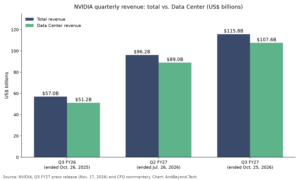
NVIDIA reported third-quarter fiscal 2027 revenue of $115.8 billion on 17 November 2026. In the same release, it said Vera Rubin racks were “coming online soon at SpaceXSI.” Read our full analysis of NVIDIA’s third quarter.
Who holds the risk if demand slows?

If demand for AI computing slows before this hardware has earned its keep, who is still on the hook?
In Anthropic’s case, the first line of risk sits with shareholders. Public buyers of Class A stock have paid $83.00 a share for an equity claim on a company that, in its own prospectus, says it will put a large part of the money into compute and infrastructure. If that spending does not produce the returns investors expect, the loss is theirs. The selling stockholders who sold 23,648,646 shares in the IPO have already transferred that slice of risk to the new public holders.
A second line of risk sits with the suppliers who bought Class N shares. AMD, Broadcom, Google, Micron, Microsoft, NVIDIA and TSMC Partners have together put approximately $26.0 billion of their own capital into their customer, at the same price as the public. If Anthropic’s business weakens, they can lose as shareholders even as they may still be selling it chips, networking gear, memory, cloud capacity or manufacturing services. The placement aligns them with Anthropic’s success. It also concentrates a new kind of exposure: a supplier can be owed money as a vendor and be underwater as an investor at the same time. Nothing in the prospectus presents the placement as a guarantee of future purchase volumes.
In the SpaceX structure, the first visible line of risk sits with the lenders who bought the notes. They have financed, or will finance, equipment that is scheduled to be delivered only in the first half of 2027. The October 8-K describes a lease whose rent is designed to repay the financed cost of each tranche, plus interest, over roughly five years. If the hardware is delivered and SpaceX pays the rent, the notes have a contractual path to repayment. If demand for the compute disappoints, SpaceX still owes the rent; the legal claim is on a lessee and on equipment, not on the profits of a model. That is the point of asset-backed lease financing: the chips themselves are the security. It is also the limit of that protection. GPU generations age quickly. Collateral sized to approximately $44 billion of notes at pricing may be worth less as a used fleet if the market for that generation deteriorates, or if delivery is late. Apollo partner Jamshid Ehsani called the structure “downside-protected” and “asset-based.” That is Apollo’s characterisation, not an independent appraisal of residual value.
SpaceX, as lessee, still has to pay. A finance lease of this size is a long, inflexible bill for capacity that must then be filled — with Grok, with cloud customers, or with both, in the terms SpaceX has used. If those uses fall short, residual risk is operational and financial for SpaceX, not only for the noteholders. The 8-K itself warns that the transaction may not close on the anticipated terms or timeline, or at all, and that actual deliveries, lease terms or principal payments may differ from expectations.
NVIDIA sits on both sides of this day’s financing, and that is the through-line. It is a Class N investor in Anthropic, with a prospectus allocation of approximately $10.0 billion. And the SpaceX notes, Apollo and Goldman said, will buy its Vera Rubin chips. If the AI build-out keeps growing, NVIDIA can be paid as a vendor and benefit as a shareholder. If it slows, the same company can face softer chip orders from one customer and a mark on an equity stake in another, while the chips sold into the SpaceX lease become the collateral standing behind someone else’s loan. That double position does not, on the public record of 20 November, make NVIDIA a lender to SpaceX, or a guarantor of Anthropic’s spending. It does mean that one supplier is exposed to both of the day’s answers to the same question: who pays, and who is still on the hook if the race costs more than it returns.
Sources
- Anthropic — “Anthropic announces closing of initial public offering, including full exercise of underwriters’ option to purchase additional shares, and closing of concurrent private placement,” 20 November 2026. https://www.anthropic.com/news/ipo-close
- Anthropic — Final prospectus (Form 424B4), filed 19 November 2026 (Registration Nos. 333-299633 and 333-300148). https://www.sec.gov/Archives/edgar/data/2130357/000162828026074944/anthropicpbc-424b4.htm
- Apollo — “Apollo and Goldman Sachs Announce Pricing of $44 Billion SpaceX GPU Financing,” 20 November 2026. https://www.apollo.com/insights-news/pressreleases/2026/11/apollo-and-goldman-sachs-announce-pricing-of-44-billion-spacex-gpu-financing-3407671
- Space Exploration Technologies Corp. — Current Report on Form 8-K, filed 26 October 2026 (event date 24 October 2026). https://www.sec.gov/Archives/edgar/data/1181412/000110465926118614/tm2628247d1_8k.htm
- SpaceX — “SpaceX Secures $40 Billion in the Largest GPU Financing Ever,” 26 October 2026. https://ir.spacex.com/updates/releases-details/2026/SPACEX-SECURES-40-BILLION-IN-THE-LARGEST-GPU-FINANCING-EVER-2026-EnDqGhTAB3/default.aspx
- NVIDIA — “NVIDIA Announces Financial Results for Third Quarter Fiscal 2027,” 17 November 2026. https://investor.nvidia.com/news/press-release-details/2026/NVIDIA-Announces-Financial-Results-for-Third-Quarter-Fiscal-2027/
Images: original illustrations generated for AndBeyond.Tech; no logos or real people depicted.