Atlas Goes to the Chip Factory: A Humanoid Robot’s First Trials Beyond the Car Plant
On 17 November 2026, Boston Dynamics and GlobalFoundries announced that they would begin testing the Atlas humanoid robot on site at GlobalFoundries facilities in early…
On 17 November 2026, Boston Dynamics and GlobalFoundries announced that they would begin testing the Atlas humanoid robot on site at GlobalFoundries facilities in early 2027. GlobalFoundries, a manufacturer of semiconductors — the chips that go into cars, phones, data centers and a great deal of other electronics — would be, the companies said, “the first customer outside the automotive industry” to test Atlas, and the first semiconductor manufacturer to do so as part of the robot’s early adopter program (Boston Dynamics, 17 Nov 2026; GlobalFoundries, 17 Nov 2026).
An early adopter program is a limited arrangement in which a customer starts trying a product before it is widely sold, often to help work out how it should be used. That is the right frame for this news. The two companies are not announcing a rollout of humanoid robots across chip plants. They are announcing on-site trials, run through that program and through a skills development workshop, with dates and goals that are their own. The announcement does not name which GlobalFoundries sites will host Atlas, how many robots will take part, or which jobs the machine will try first.
The same statement is more definite about a different machine. Spot, Boston Dynamics’ four-legged inspection robot, is to be rolled out more widely for what the companies call autonomous enterprise asset management: sending a mobile robot to check plant equipment and collect data so maintenance can be planned before something fails. For that work, the announcement names four sites and no others: Malta, New York; Burlington, Vermont; Dresden, Germany; and Singapore.
Two robots, two different commitments
The 17 November announcement is easy to read as a single robotics story. It is not. It is two commitments, written in different language, about two machines that do different work.
On Spot, the companies say they will expand deployments for autonomous enterprise asset management across the four sites already named. GlobalFoundries has, they say, used the robot at its Burlington, Vermont plant for more than four years and has more recently run the program in Singapore (Boston Dynamics, 17 Nov 2026).
On Atlas, the verbs change: the humanoid will be tested, not deployed, through the early adopter program and the skills development workshop, with on-site trials beginning in early 2027. Pradip Singh, GlobalFoundries’ chief manufacturing officer, keeps that distinction: “Scaling Spot and testing Atlas are the next steps in our journey to AI-enabled manufacturing, putting physical AI to work across our operations worldwide” (GlobalFoundries, 17 Nov 2026). Physical AI, as Singh uses the phrase, is AI that acts in the real world through robots. It is a claim about a direction, not a report that a humanoid is already doing useful work in a chip plant. The useful question remains whether a machine can hold a real shift, not whether a well-known name has signed a memorandum. For a broader reading of that gap, see Humanoids on the Factory Floor.
Why a chip factory is a hard place for a humanoid
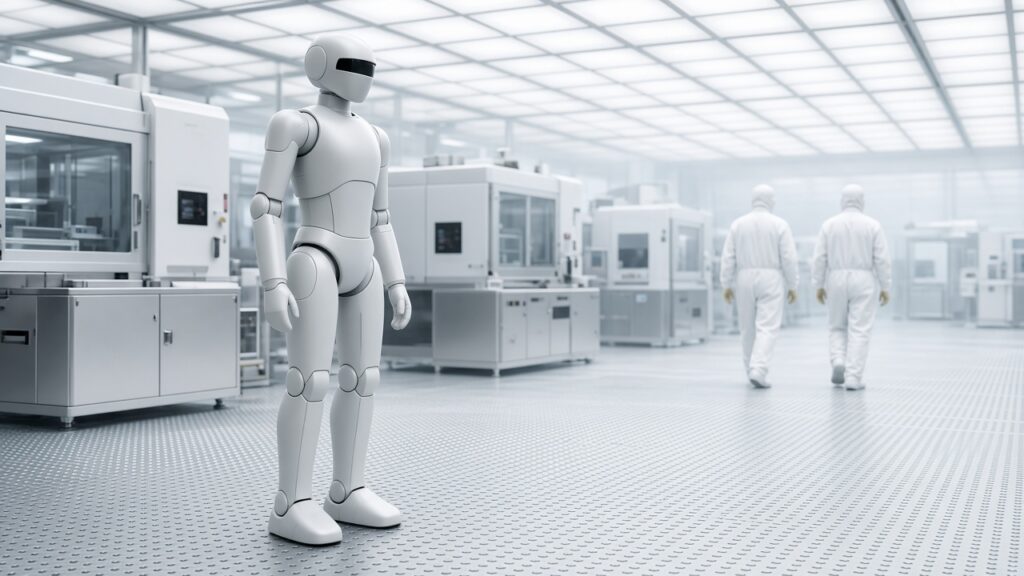
A semiconductor fab — the plant where chips are made — is an unforgiving workplace for a mobile robot, starting with dust. A clean room is a tightly controlled workspace where the air is continuously filtered and the people who enter it wear special gowns, hoods, masks and shoe covers, so that almost no particles settle on the wafers being processed. A wafer is the thin disc of semiconductor material, usually silicon, that is later cut into individual chips. A speck of dust, a flake of skin or a drop of oil that would be harmless on a car assembly line can ruin a chip. The room is designed to protect the product from the people and machines inside it, not the other way around.
The 17 November announcement does not say that Atlas will work inside a clean room. It says only that testing will take place on site at GlobalFoundries facilities, and it does not name the rooms, buildings or tasks. In the one place the companies do locate a robot in a chip plant today, the setting is more modest: in Singapore, they say, Spot has been running inspections in sub-fab areas. A sub-fab is the support space of a chip plant, often below or beside the production floor, where pumps, pipes, gas systems and other utility equipment live. Those rooms are still demanding, but they are not the same as the gowned production floor.
A humanoid is usually sold on the idea that it can use the same aisles, benches and tools as a person. Boston Dynamics’ Atlas product page says the robot is designed to work at the same workstations, with the same equipment, as a plant’s staff. The company lists a human-scale machine, about 1.9 meters tall and 90 kilograms, aimed at material handling — moving parts, totes or other items from one place to another rather than replacing a specialized process tool (Boston Dynamics, Atlas product page). Those are company specifications, not trial measurements.
In a fab, that is a harder promise than it is in a warehouse or a car plant. The tools are expensive and tightly packed, the aisles are built for people in bulky gowns, and the work often has to continue around the clock, because stopping a process tool can waste material and idle a line that is already booked. That is a reason to treat testing on site as the beginning of a question, not the answer.
The automotive comparison is the one the companies themselves invite. Boston Dynamics says Atlas is already in a customer facility with Hyundai, for field testing on real-world sequencing tasks (Boston Dynamics, Atlas product page). Sequencing, in a car plant, means lining up parts in the order the next step of assembly needs them. GlobalFoundries is, according to the 17 November release, the first customer outside that industry to begin testing the same platform. Leaving the car plant does not mean Atlas has finished its work there; it means a chip manufacturer is now being added to a still-early test program.
What Spot is already doing — and where it is going
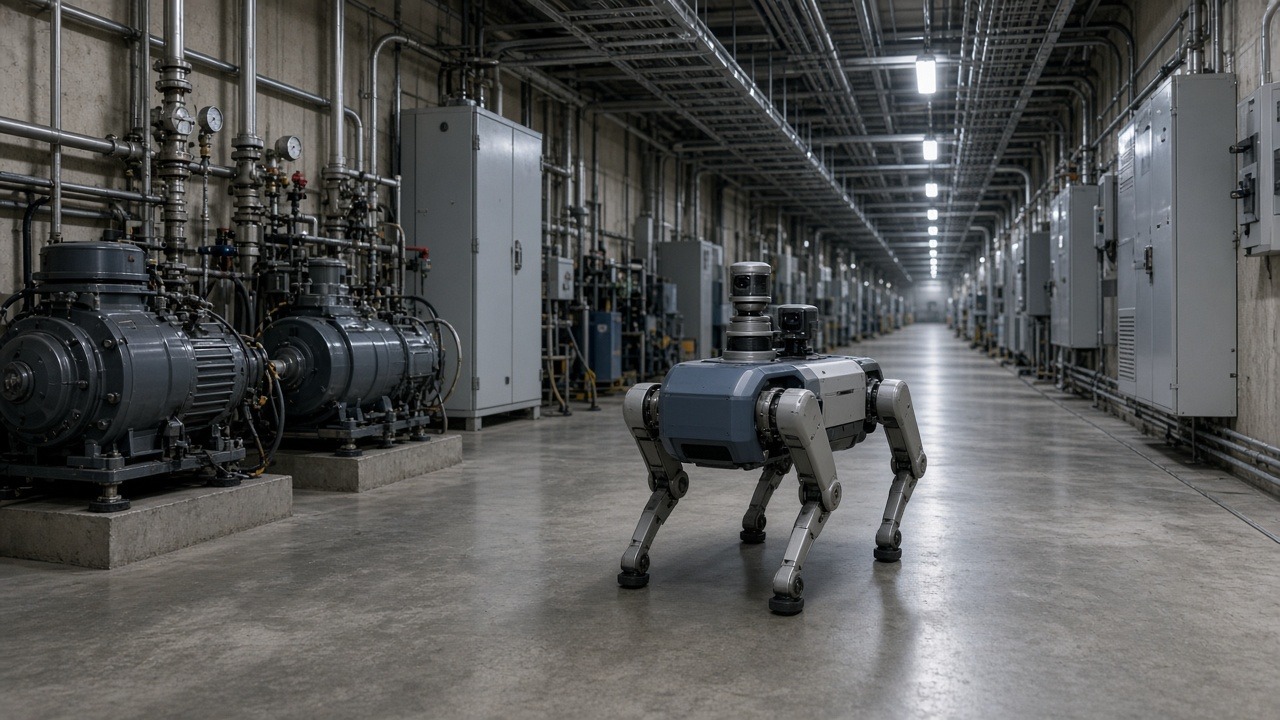
A 2022 Boston Dynamics case study describes the original use at the Burlington, Vermont plant, which the company said then made 200-millimeter semiconductors for communication devices and radio-frequency technology. Rather than fitting thousands of fixed sensors to long-lived equipment, GlobalFoundries used Spot as a mobile set of sensors, collecting thermal readings and analog gauge data from pumps, motors, compressed-gas systems and similar assets. Samantha Garrison, then deputy director of factory automation at GlobalFoundries, put the practical case this way: “It’s not economical for us to go and sensorize every piece of equipment in this really vast facility. It’s probably more practical and actually quite a bit easier for us to use the mobile robotics approach.” A partner, Levatas, built computer-vision models so the robot could read gauges and flag a motor that was running too hot. Those are claims from a company case study, not an independent audit, and they describe inspection rounds, not humanoid labor on a production tool (Boston Dynamics, GlobalFoundries case study).
The 17 November announcement adds newer company figures, most of them from Singapore. Two Spot robots there have, the companies say, traveled nearly 900 kilometers and completed more than 90,000 inspections in sub-fab areas since April (the announcement does not say which year), with a 99% mission success rate. In a separate sentence that does not name a site, GlobalFoundries says it redeployed 875 routine inspections in two weeks and has an immediate roadmap to more than double that number using Spot’s visual inspection capabilities (Boston Dynamics, 17 Nov 2026).
Those numbers should be read as company claims. The release does not define what counts as a successful mission, does not say how many inspections a person used to complete in the same period, and does not say where the 875 redeployed inspections ran. “Since April” is the companies’ wording in a mid-November 2026 announcement; they do not spell out the calendar year in that sentence. What the text does support is narrower: Spot is already being used for inspection rounds in at least some GlobalFoundries support areas, and the companies now intend to extend that work only to the four sites they name — Malta, New York; Burlington, Vermont; Dresden, Germany; and Singapore.
Singh said Spot has helped GlobalFoundries shift from reactive to predictive maintenance by collecting data across thousands of inspection points, to prevent downtime and keep the fabs running more efficiently (GlobalFoundries, 17 Nov 2026). Predictive maintenance means using those readings to plan a repair before a pump or motor fails, rather than waiting for it to stop. That is a job for technicians and maintenance planners. It is not evidence that a two-legged robot is ready to stand beside them on the production floor.
An early adopter program is not a factory tour
The release is clear about what the skills development workshop is for, and quiet about what success would look like. According to the companies, its goals are to evaluate potential humanoid use cases, assess customer readiness and integration needs, and begin early testing and training for specific task execution. In plain language, the two sides will look for jobs a humanoid might usefully do, check whether the plant and the robot can work together, and start teaching the machine particular tasks. A “use case” is simply a candidate job; “integration needs” are the practical connections a robot requires in a live plant — how it moves through the building, how people work around it, and how it hands off a result to a technician or to the plant’s existing software. None of those goals is a production target, and none of them names a task. The companies add that the work will complement GlobalFoundries’ global program to upskill its employees in AI (GlobalFoundries, 17 Nov 2026).
The announcement does not say that Atlas will replace technicians. It places the trials alongside a program to train GlobalFoundries staff in AI. The people most directly concerned are the technicians and engineers who already keep the fabs running — and who would, if the trials go anywhere, have to work around a new machine, help define its jobs, and judge whether it is helping.
Boston Dynamics’ Atlas page describes a longer customer path in four steps — prepare, evaluate, train and adopt — and says the company will later scale up initial deployments and expand with early adopter customers as Atlas becomes more widely available (Boston Dynamics, Atlas product page). That is product language, not a timetable for GlobalFoundries. The 17 November release does not say that GlobalFoundries has moved beyond evaluation and early training, or when, or whether, “adopt” would follow.
Zack Jackowski, Boston Dynamics’ chief product and technology officer, likewise stays on the existing Spot relationship and on future data, not on a humanoid already at work. He called GlobalFoundries one of Boston Dynamics’ earliest Spot customers and said companies like it are already getting operational value today while collecting data that will be useful for manufacturing innovation in the next few years (Boston Dynamics, 17 Nov 2026). The value today sits naturally with Spot; the next few years is the horizon he gives to whatever comes next.
What the announcement does not say
The main gaps are already visible in the announcement itself and should not be filled in from elsewhere. The companies do not name the GlobalFoundries sites that will host Atlas, how many robots will take part, which generation of the machine will be used, how long the early-2027 testing is expected to last, or what the commercial terms are. There is no contract value or volume commitment, and no description of whether GlobalFoundries is paying for a service, joining a joint development exercise, or some mixture of the two.
Boston Dynamics’ product page talks more generally about material handling, and about later applications that may include part sequencing, machine tending — looking after a process machine by loading or unloading it — and order building. Those are catalogue examples, not GlobalFoundries assignments, and they should not be read back into the 17 November news.
A first test, not a new shift
If the companies do what they have said they will do, early 2027 will bring a real change in where Atlas is being tried: a humanoid robot will be tested inside a semiconductor manufacturer’s facilities for the first time in this program, and GlobalFoundries technicians will have a new machine to assess, train and work around. It is not, on the evidence published on 17 November, a change in how chips are manufactured.
Chip plants will judge a humanoid on questions the release leaves open: whether the machine can move through a crowded, carefully controlled building without putting wafers, tools or people at risk; whether there is a task worth teaching it at all; and whether the work it gives back justifies the data and the labor hours it consumes. Those questions belong to the skills development workshop, not to a headline about leaving the auto industry. Until the trials produce results the companies are willing to publish — sites, tasks, and measures of what the robot actually did — the precise reading of this announcement is the one the two firms already wrote. Spot is being scaled to four named fabs for inspection and asset management. Atlas is being tested, from early 2027, in an early adopter program. The first of those is a deployment plan. The second is a trial.
Related reading
References / Sources
- Boston Dynamics — “Boston Dynamics & GlobalFoundries Expand Robotics Collaboration” (17 November 2026): https://bostondynamics.com/news/boston-dynamics-globalfoundries-expand-robotics-collaboration/
- GlobalFoundries — “Boston Dynamics and GlobalFoundries expand robotics collaboration” (17 November 2026): https://gf.com/news-and-events/news/boston-dynamics-and-globalfoundries-expand-robotics-collaboration/
- Boston Dynamics — Atlas product page (accessed 23 November 2026): https://bostondynamics.com/products/atlas/
- Boston Dynamics — GlobalFoundries case study, “Automating Predictive Maintenance” / GlobalFoundries (published as the 2022 case study cited in the 17 November 2026 announcement): https://bostondynamics.com/case-studies/globalfoundries/
Images: original illustrations generated for AndBeyond.Tech; no logos or real people depicted.