Cornelis CN6000 at 800G: Omni-Path’s Message-Rate Bid — and an Ethernet SuperNIC for Inference
On 12 November 2026, Cornelis Networks announced the CN6000 family: an 800G networking platform aimed at AI and high-performance computing. The package is unusually explicit…

On 12 November 2026, Cornelis Networks announced the CN6000 family: an 800G networking platform aimed at AI and high-performance computing. The package is unusually explicit about choice of fabric. There is a CN6000 Omni-Path SuperNIC, a 1U CN6000 Omni-Path switch, and a separate CN6000 Ethernet SuperNIC that speaks hardware-accelerated RoCEv2 into industry-standard 800G Ethernet switches. Cornelis says Ultra Ethernet will follow through software updates—a claim by the company, not an independent UEC certification result.
That combination is why this launch belongs in the AI Cluster Networking calendar during SC26 (15–20 November, Chicago, booth #1419). It is not a remake of the protocol primer in InfiniBand vs Ethernet for AI Clusters. The news is a third scale-out path—Omni-Path, the fabric Intel exited before spinning the business out as Cornelis in 2020—arriving at 800G with a parallel Ethernet endpoint for operators who will not leave the Ethernet they already run.
Every performance number in this article is a Cornelis figure from the company’s own testing or product materials, including the comparison with NVIDIA InfiniBand XDR. Independent cluster measurements are not yet public. Readers should treat job-completion promises accordingly.
What Cornelis actually launched
The 12 November announcement describes CN6000 as Cornelis’s second consecutive product generation to go from first silicon to production. SuperNICs, switches, and software are available from Cornelis now for evaluation and early deployments, with systems from OEM and system partners planned to begin in Q1 2027.
The family, as listed by Cornelis:
- Omni-Path SuperNIC — 800G connectivity, a claimed 1.6 billion messages per second, sub-microsecond MPI latency, multi-plane and multi-rail support, and credit-based lossless delivery. A dedicated hardware Root of Trust with SPDM 1.4 attestation and post-quantum (ML-DSA) signatures is specified to verify firmware before the SuperNIC joins the system.
- CN6000 Omni-Path switch — a 1U switch with 48 ports of 800G, adaptive routing, and native multi-plane support.
- Ethernet SuperNIC — low-latency RoCEv2 for industry-standard Ethernet switches, with Ultra Ethernet supported through software updates, according to Cornelis.
- Software — NCCL, RCCL, libfabric, MPI, and OpenSHMEM on Omni-Path, using the same software and host driver as the prior CN5000 generation.
Cornelis’s product pages add mechanical and electrical detail that matches the launch: both SuperNICs are described as low-profile PCIe 6.0 x16 adapters delivering 800 Gb/s over two independent 400 Gb/s data paths, typically with dual QSFP-DD ports. The Omni-Path product brief dated around the launch window lists copper, linear pluggable optics (DR8), and retimed optics (SR8) as media options, and air-cooled plus conduction-cooled SKUs. Those are vendor specifications, not third-party teardowns.
Lisa Spelman, Cornelis’s CEO, framed the problem in utilization language rather than protocol theology: “Every minute an accelerator waits on the network is capacity our customers paid for and didn’t use.” The company positions Omni-Path as its highest-performance option and the Ethernet SuperNIC as the standards-based on-ramp for Ethernet-first AI infrastructure.
The Omni-Path numbers—and how to read them
Cornelis’s headline comparison is aimed squarely at NVIDIA’s 800G InfiniBand XDR. In a footnote to the 12 November release, the company states that Cornelis internal testing of 8-byte MPI Ping-Pong latency using Intel MPI found 0.95 µs for the CN6000 Omni-Path SuperNIC versus 1.2 µs for NVIDIA InfiniBand XDR at 800 Gb/s—21% lower, in Cornelis’s arithmetic. The same release calls 1.6 billion messages per second the industry’s highest message rate at 800G and describes MPI latency as sub-microsecond.
Those are Cornelis internal-test claims. The Next Web’s 13 November write-up made the necessary caveat: a faster single small message does not mean jobs finish 21% sooner, because completion time depends on the workload. That caution is the right way to brief a procurement committee. Message rate and ping-pong latency matter most for tightly coupled HPC codes and for AI phases dominated by small, frequent synchronizations. Elephant AllReduces and storage inflows can be limited by other bottlenecks.
Cornelis’s product materials repeat the 1.6 billion messages/s (bidirectional) and sub-1 µs MPI latency figures, and they add a fabric-scale claim of more than 500,000 endpoints on a lossless Omni-Path fabric with credit-based flow control, link-level retry, fine-grained adaptive routing, and hardware congestion management. The company’s product FAQ also cites switch latency as low as 105 ns. All of those remain Cornelis-stated results or specifications; they should be re-measured in the buyer’s topology, with the buyer’s MPI or NCCL mix.
The comparison also should not be flattened into “Omni-Path beats Ethernet.” CN6000 explicitly sells an Ethernet SuperNIC for the many AI halls that standardized on RoCE. The interesting design question is when an operator would still build a native Omni-Path island—scientific MPI, national-lab continuity, or a disaggregated-inference fabric that Cornelis argues wants lossless small-message behavior—versus attaching Ethernet SuperNICs to switches already in the rack.
Dual planes: 800G per node without throwing away 400G radix
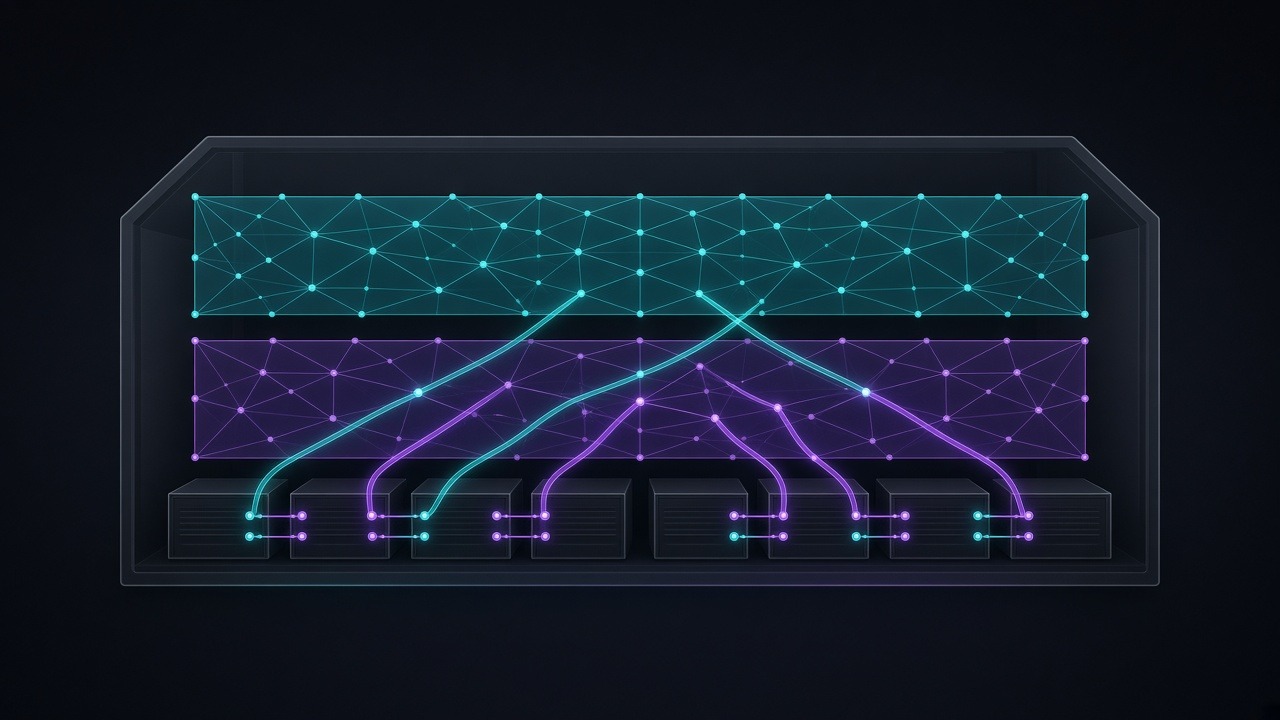
A distinctive architectural claim in Cornelis’s product story is multi-plane by design. Each Omni-Path SuperNIC, the company says, drives two independent 400 Gb/s data paths. The 1U Omni-Path switch is described as two independent 48-port 400G planes in one chassis, so a single cable per node can land on both planes at up to 800 Gb/s while each plane keeps the radix and hop count of a 400G fabric. A fault in one plane, in this telling, leaves the other running.
That is a serious answer to a real packing problem. Faster ports often shrink radix, which adds tiers, hops, and optics as GPU counts grow. Dual-plane designs try to keep hop counts down and to shrink the blast radius of a switch or link failure during multi-day training or simulation jobs. Whether the operational model is as clean as the diagram depends on cabling discipline, plane-aware routing, and how NCCL or MPI is pinned to rails—questions for the SC26 booth and for Q1 2027 OEM systems, not for a press-release footnote.
The Ethernet SuperNIC and the Ultra Ethernet caveat
Most new AI factories still speak Ethernet in the scale-out hall. Cornelis’s Ethernet SuperNIC is the concession to that installed base: hardware RoCEv2 on standard 400G/800G switches, aimed at latency-sensitive traffic such as KV-cache transfers in disaggregated inference and at bursty fine-tuning collectives.
On Ultra Ethernet, wording differs slightly across Cornelis properties, and this article follows the dated launch release. The 12 November announcement says Ultra Ethernet is supported through software updates. That is Cornelis’s claim of a software path to UEC-compatible behavior—not a statement that a UEC 1.1 compliance badge has been issued, and not a substitute for reading the specification itself. Cornelis’s product pages describe the SuperNIC as “Ultra Ethernet compliant (Preview).” For what the consortium actually published in October, see Ultra Ethernet 1.1. Buyers should ask Cornelis which UET features land in which software drop, and whether interoperability testing with the Ultra Ethernet Consortium has begun.
The Ethernet card does not require the CN6000 Omni-Path switch; Cornelis says it interoperates with industry-standard Ethernet switches. The Omni-Path SuperNIC, by contrast, is paired with the CN6000 Omni-Path switch, with a stated ability to run in existing CN5000 Omni-Path fabrics using the same OPX provider and host driver. Application compatibility from CN5000 to CN6000, and a roadmap mention of a future CN7000 “Active Compute Fabric,” are Cornelis’s own product-line statements.
Why inference traffic is in the launch, not just training
Cornelis is unusually direct that CN6000 is for disaggregated inference as well as training and scientific simulation. Splitting prefill from decode, and moving KV-cache handoffs plus per-token activations onto the network, changes the traffic shape: many small, latency-sensitive transfers rather than only periodic training collectives. The company argues that sub-microsecond latency and a high message rate on a lossless fabric reduce the chance that a transfer waits on a retransmit—raising, in its words, token yield per dollar.
That argument is directional and familiar across the industry; the quantitative support in the launch remains the same internal message-rate and MPI-latency tests, not a published time-to-first-token bake-off against a named Ethernet NIC on a named model. Operators evaluating the Ethernet SuperNIC should therefore demand KV-cache and prefill/decode traces from their serving stack, on their switch OS, under noisy-neighbor load. Message-rate leadership on a ping-pong test is a starting point, not an inference SLA.

Ecosystem, partners, and the SC26 week
CN6000’s commercial story is multi-vendor compute, not a single-accelerator stack. Cornelis says the family supports AMD, Arm-based, and Intel CPUs, and AMD, NVIDIA, and Qualcomm accelerators. OEM and system partners planning validation and support include Dell Technologies, Hyve Solutions, Lenovo, NEC, Penguin Solutions, Supermicro, “and more.” Partner systems are aimed at Q1 2027; evaluation hardware is available now.
The same week as the launch, Cornelis announced an expanded collaboration with AMD to help HPC and “AI for Science” customers design, validate, and deploy systems pairing AMD EPYC CPUs and Instinct GPUs with Cornelis networking. The company says it is validating CN6000 with AMD EPYC 9006 Series CPUs and next-generation Instinct GPU platforms, with OEM systems expected beginning in Q1 2027.
Intel remains in the story through the prior generation. Jeff McVeigh, vice president and GM of Data Center Strategic Programs at Intel, is quoted in the Cornelis release saying Intel Xeon and Cornelis Omni-Path have run together in production HPC systems for years, including at the Texas Advanced Computing Center (TACC), and that the companies are extending the work to CN6000 and next-generation Xeon over PCIe Gen6. That is a partnership statement, not a TACC procurement announcement for CN6000.
Lenovo says CN5000 is already qualified across ThinkSystem V3 and V4 servers and supported in Lenovo EveryScale, and that it is now qualifying Cornelis with new AMD EPYC-powered ThinkSystem servers. Supermicro has validated CN5000 across FlexTwin, BigTwin, and Hyper platforms and plans to extend that work to CN6000. Penguin Solutions’ CTO, Phil Pokorny, is quoted on the network as the determinant of how much of a compute investment is actually put to work.
SC26 is the immediate showcase: Cornelis will demonstrate the CN6000 family in Chicago, 15–20 November 2026, at booth #1419. For a week when the exhibit hall is dense with Ethernet and InfiniBand messaging, a live Omni-Path 800G island plus an Ethernet SuperNIC is the fact pattern worth walking to, tape measure and skepticism in hand.
How to evaluate CN6000 without relitigating the fabric war
A practical RFQ can keep protocol religion in a separate document and still test what Cornelis claims.
1. Repeat the small-message test, then add the job. Recreate the 8-byte MPI ping-pong if you must, but also measure NCCL/RCCL all-reduce, all-to-all, and a real training or simulation step. Cornelis’s 0.95 µs versus 1.2 µs XDR result is an internal ping-pong, not a job-time warranty.
2. Decide which SuperNIC you are actually buying. Omni-Path is an end-to-end Cornelis fabric. The Ethernet SuperNIC is a NIC for switches you may already own. Mixing the two in one RFQ without a traffic plan produces a muddled proof of concept.
3. Probe the software path to Ultra Ethernet. Treat “UEC-compatible via software update” as Cornelis’s claim. Ask for a feature matrix against UET, a timeline, and an interoperability plan. Do not assume Ultra Ethernet 1.1 scale-up or in-network collective features arrive automatically.
4. Stress dual-plane failure and cabling. If the 400G-plus-400G story is the reason you pay for 800G without extra tiers, pull a plane and measure job survival, not only brochure radix.
5. Bring an inference trace. If KV-cache handoff is the Ethernet SuperNIC’s reason to exist, test it. Fine-tuning bursts are a second, different pattern.
6. Check host and accelerator matrices. PCIe 6.0 x16, AMD/Intel/Arm hosts, and NVIDIA/AMD/Qualcomm accelerators are a wide net; the SKU that ships in a given OEM server in Q1 2027 may be narrower.
7. Security and firmware. SPDM 1.4 attestation and ML-DSA-signed firmware are concrete controls to verify in the lab, especially in multi-tenant AI clouds.
Where CN6000 sits in a heterogeneous hall
The launch is timed for a market in which many operators already standardized scale-out Ethernet and, in NVIDIA-heavy pods, InfiniBand or Spectrum-X. Cornelis is not asking those shops to relitigate the entire InfiniBand vs Ethernet choice in one purchase order. It is offering a fork.
On one fork, Omni-Path remains a complete fabric: SuperNIC, 48-port 1U switch, OPX software, credit-based lossless behavior, and a stated upgrade path from CN5000. That fork will appeal first to sites that already run Omni-Path in production—Intel’s quoted TACC example is about the prior generation—and to HPC centers that still measure success in MPI small-message latency. On the other fork, the Ethernet SuperNIC is a host adapter for switches the operator already trusts. The two forks share a PCIe 6.0 mechanical story and a vendor, not necessarily a control plane.
Heterogeneous accelerators complicate both forks. Cornelis’s support list (AMD, NVIDIA, and Qualcomm XPUs; AMD, Intel, and Arm CPUs) is broad on paper. NCCL and RCCL support on Omni-Path, using the CN5000 software path, is the practical compatibility claim to test first. A SuperNIC that speaks the collective library but stumbles on GPUDirect-style data paths will not survive an AI qualification, no matter how fast 8-byte ping-pong looks in an internal test.
Security features deserve a paragraph of their own in 2026 RFQs. A hardware Root of Trust, SPDM 1.4 attestation, and ML-DSA-signed firmware are Cornelis specifications intended to keep a compromised adapter from silently joining the fabric. They do not replace switch ACLs or tenant isolation, but they are the right class of control for multi-tenant AI clouds that have learned not to treat NICs as untrusted-but-ignored peripherals.
What this week at SC26 can actually settle
Booth demonstrations rarely settle job-completion arguments, but they can settle narrower ones. Visitors can reasonably ask to see: dual-plane failover while a collective is in flight; an Ethernet SuperNIC attached to a non-Cornelis 800G switch; a CN5000 and CN6000 Omni-Path endpoint on the same fabric, as the company says the software stack allows; and a KV-cache or prefill/decode flow that is more than a slide. If those demos exist, they should be described as demos, not as audited benchmarks.
The Q1 2027 OEM date is equally important. Evaluation hardware from the vendor now is not the same as a Dell, Lenovo, or Supermicro SKU with firmware support, thermal qualification, and a spare-parts path. Procurement calendars should assume that gap unless a partner says otherwise on the show floor.
Outlook
CN6000 is the most concrete Omni-Path moment in several seasons: 800G SuperNICs and a 48-port 1U switch, an Ethernet RoCEv2 twin, evaluation availability now, OEM systems targeted for early 2027, and a booth on the SC26 floor this week. The performance narrative is bold and, to the company’s credit, footnoted: the InfiniBand XDR comparison is Cornelis internal testing, and a 21% ping-pong gap is not a 21% shorter training run.
For AI Hyperscale Infrastructure buyers, the strategic question is not whether Ethernet or InfiniBand “won.” It is whether a lossless, high-message-rate Omni-Path island—or a Cornelis Ethernet SuperNIC on switches you already operate—reduces accelerator idle time enough to matter at 800G. For AI Accelerators & Silicon teams, the card is another PCIe 6.0 endpoint in a heterogeneous CPU/XPU matrix. Measure it like a fabric, not like a slogan, and keep Ultra Ethernet promises in the software-release column until they can be shown on the wire.
Sources
- Cornelis Networks — “Cornelis CN6000 Networking Platform Delivers Industry-leading 1.6 Billion Messages per Second at 800G…” (12 November 2026). https://www.cornelis.com/stories/cornelis-cn6000-networking-platform-delivers-industry-leading-1-6-billion-messages-per-second-at-800g-for-ai-and-hpc
- The Next Web — “Cornelis launches CN6000 800G networking to rival Nvidia InfiniBand” (13 November 2026). https://thenextweb.com/news/cornelis-cn6000-800g-networking-ai-supercomputers
- Cornelis — CN6000 product family page. https://www.cornelis.com/products/cn6000
- Cornelis — CN6000 800G Ethernet SuperNIC product page. https://www.cornelis.com/products/cn6000/800g-ethernet-supernic
- Cornelis — CN6000 Omni-Path SuperNIC product brief (PDF). https://www.cornelis.com/site/documents/products/cn6000_omnipath_supernic_product_brief_v111126_compressed.pdf
Images: original illustrations generated for AndBeyond.Tech; no logos or real people depicted.