AirTrunk Signs MoU for 1.8 GW of Proposed AI Campuses in Andhra Pradesh
On 16 November 2026, AirTrunk published a company announcement stating that it has signed a memorandum of understanding with the Government of Andhra Pradesh for…
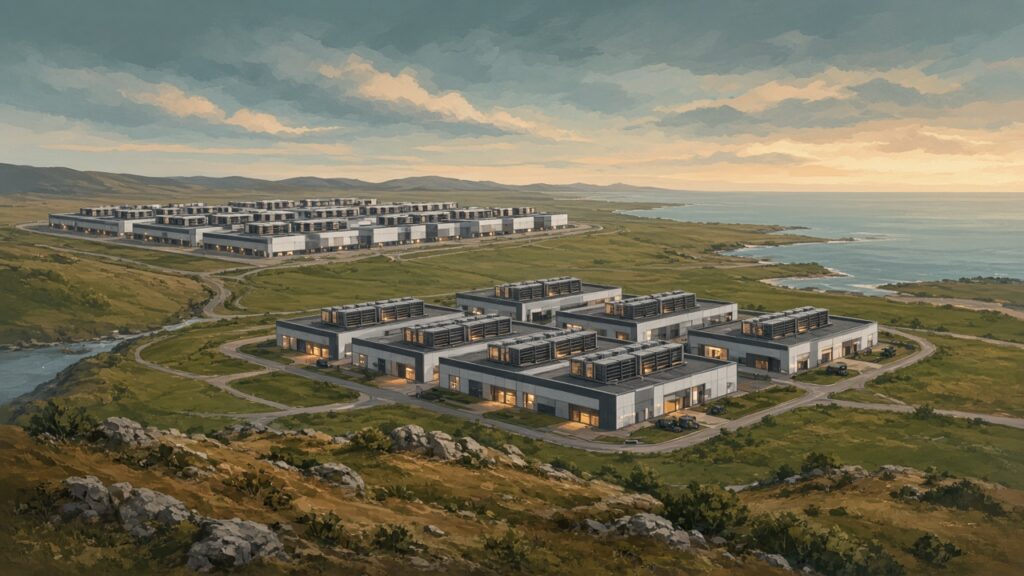
On 16 November 2026, AirTrunk published a company announcement stating that it has signed a memorandum of understanding with the Government of Andhra Pradesh for two proposed data-centre campuses in Anakapalli district: a 400 MW campus at Rambilli and a 1,400 MW campus at Tootipala. Taken together, the proposed campuses would total 1.8 GW.
That is a large number, and it is still only a number on an MoU. AirTrunk’s own language is consistently provisional. The campuses are “proposed.” The company will work with the government and local communities “as the proposal progresses.” Job figures are introduced with “could create.” A detailed project report “proposes” a water source. The renewable-power discussion is framed as an opportunity to explore, not as a signed supply contract. This article stays inside that frame. It asks how a gigawatt-class Indian cluster is being designed on paper, and what still has to be permitted and powered before any campus exists.
As of 16 November 2026, we have not found an official confirmation of this MoU on the websites of the Andhra Pradesh Economic Development Board, the Chief Minister’s Office, the state’s public-relations department, or the Information Technology, Electronics and Communications department. The primary public account remains AirTrunk’s own release. Figures that appear only in the press are labelled reported.
What the MoU actually says
AirTrunk is an Asia-Pacific data-centre platform. In the announcement it describes itself as “supported by our major investor Blackstone.” The agreement it has signed is an MoU, not a construction permit, a land-allotment order, a power-purchase agreement or an environmental clearance.
The geographic scope is specific. Both proposed campuses sit in Anakapalli district. One is described as a 400 MW campus at Rambilli; the other as a 1,400 MW campus at Tootipala. AirTrunk does not say whether those megawatt figures are IT load, facility load or a mix, and it does not give a site area, a building count, a construction start date or a target date for first power. Those details are simply not in the release.
The company does attach two claims about economic effect. The projects “could create more than 3,100 direct operational jobs and 4,700 indirect jobs.” AirTrunk “plans to work with local partners on hiring and skills development, including through ITIs and polytechnics in Anakapalli.” Those are company statements about a proposed project. They are not independently verified employment figures, and they are not a hiring schedule.
Carly Wishart, AirTrunk’s managing director, corporate and international, is quoted in the release: “We’re grateful to the Andhra Pradesh Government for its partnership. As the proposal progresses, we’ll work closely with the Government and local communities on responsible planning and ways to help local people access the opportunities these projects could create.”
The wording is careful, and it should be read that way. An MoU records an intention to work together. It does not, by itself, move dirt, reserve megawatts on a grid, or allocate water.
How the proposed campuses are being designed
The most concrete part of AirTrunk’s announcement is not the headline capacity. It is the short description of how the company says the campuses would be cooled, watered and, eventually, powered. Those choices matter because a 1.8 GW cluster, if it were built as described, would be large enough to show up on a state energy and water balance, not only on a data-centre map. We looked at a similar question — how a new campus chooses its energy — in Beyond Stargate: The New Gigawatt Map of AI Factories. The Andhra Pradesh MoU is an earlier-stage document than the filings and announcements in that map, but the design logic is the same: cooling, water and power have to be settled before a gigawatt campus is real.
Cooling. AirTrunk says it “prioritises low-water, air-cooled technologies” and that the proposed campuses “are designed to use water carefully.” That is a design preference stated by the operator, not a permitted cooling specification. The release does not name a cooling vendor, a water-usage effectiveness target, or whether any process water would still be required for humidification, testing or other uses. It also does not say whether air cooling would be applied to every hall at 400 MW and 1,400 MW, or only to a first phase. What can be said from the primary text is narrower: the company is presenting air cooling, rather than water-intensive evaporative cooling, as the intended approach.
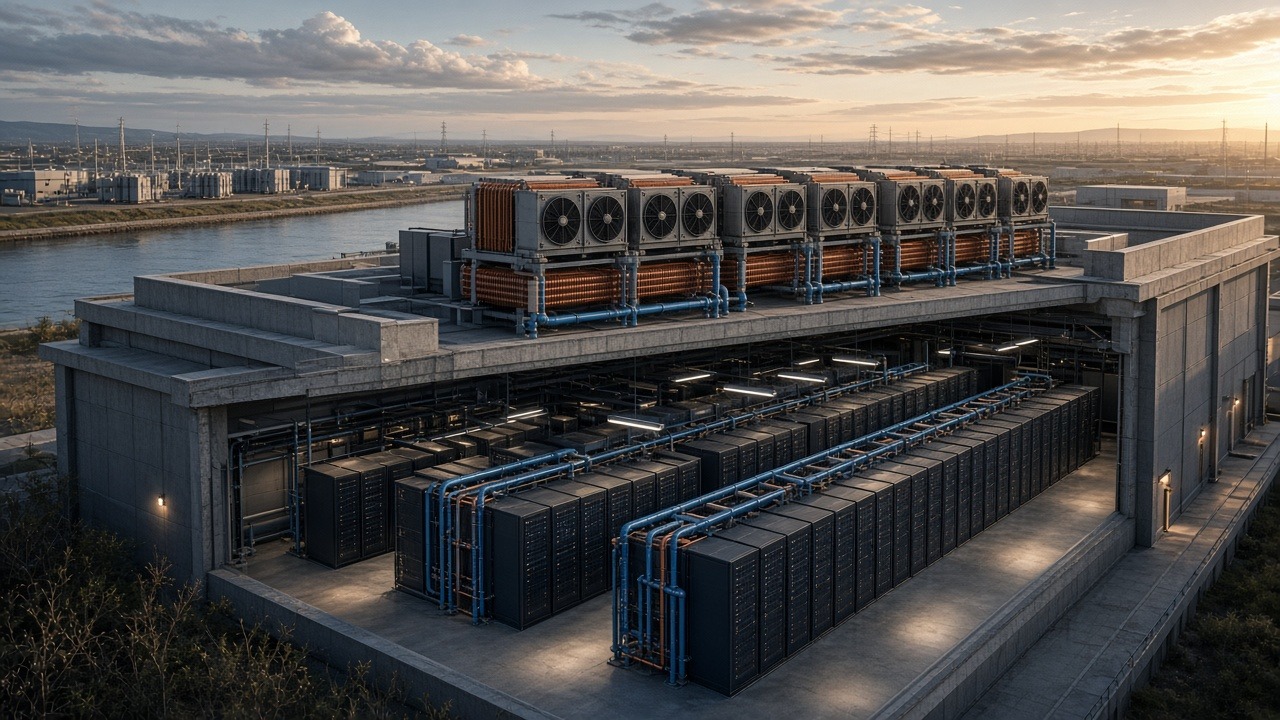
Water. The same paragraph goes a step further. AirTrunk says “the DPR proposes sourcing any required water from the Polavaram–Yeleru industrial allocation rather than municipal supplies.” DPR is the usual abbreviation for a detailed project report. The release does not publish that report, does not quantify the volume of “any required water,” and does not say whether the industrial allocation has been granted, applied for, or only identified as a preferred source. The distinction the company draws is nonetheless clear: it is proposing not to draw on municipal supplies used by local communities, and to take instead from an industrial allocation associated with the Polavaram–Yeleru system. Until the DPR is public, or a water authority confirms an allocation, that remains a proposal inside a company document, not a confirmed water right.
Power. AirTrunk states a global corporate target, then a local ambition. The company “is committed to matching 100% of its global electricity use with renewable energy by 2030.” Separately, “as plans for Andhra Pradesh develop, the company sees an opportunity to explore how renewable energy generated in the state could help power the proposed campuses and support its clean energy ambitions.” That is not a power-purchase agreement, a wheeling arrangement, or a claim that the campuses would be supplied entirely by in-state renewables from day one. It is a statement that AirTrunk intends to explore state-generated renewable energy as plans develop, against a company-wide 2030 matching target. The release is silent on who would build or own any new generation, how the campuses would be connected to the grid, what capacity is available at Rambilli and Tootipala, and how 1.8 GW would be phased.
Read together, the design is internally consistent: low-water air cooling, industrial rather than municipal water, and a renewable-matching target with an invitation to use in-state generation. It is also incomplete. A gigawatt-class campus is designed twice — once in a brochure or DPR, and again in interconnection studies, environmental reviews and construction drawings. Only the first of those is visible here.
What remains to be permitted and powered
Several things that a reader might expect in a campus announcement are not in AirTrunk’s release, and we have not found them in an official state note either.
There is no construction timetable. There is no statement that land has been acquired, leased or allotted. There is no named offtaker, no list of buildings, and no description of the electrical interconnection. There is no environmental-clearance status, no mention of a public hearing, and no phasing plan that would show when the 400 MW campus would come up relative to the 1,400 MW campus, or how either would ramp internally.
Those omissions are normal at MoU stage. They are also the difference between a proposed cluster and a campus under construction. For a project of this stated size, the remaining work is not a formality. It includes at least: land and local planning approvals; environmental and water clearances; a real allocation, if any, from the Polavaram–Yeleru industrial account; grid interconnection and, if the renewable exploration becomes a contract, generation and transmission to match; and a financing and construction plan that can be tested against the 1.8 GW headline.
Until those steps are documented, the right status line is the one AirTrunk used: proposed.
What the press adds — and where it diverges
Two secondary accounts circulated in the same week. They are useful for context and should not be blended into AirTrunk’s official text.
Data Center Dynamics, in a 14 November 2026 article, dates the signing to 14 November and reported that AirTrunk said in a LinkedIn post that it had signed the MoU that day with Nara Chandrababu Naidu, the chief minister of Andhra Pradesh, for the same two proposed campuses. DCD reported that Rambilli is a village some 60 kilometres southwest of Visakhapatnam and that Tootipala is some 70 kilometres west of the city. Those distances and the LinkedIn wording are not in the 16 November company page, so they are reported here. DCD also noted that full details of either project had not been shared, which is consistent with the official release.
Moneycontrol, in a 13 November 2026 article, reported a broader set of investment announcements on the second day of a CII Partnership Summit. According to that account, the state government announced 12 agreements, including 11 MoUs and one government order, involving proposed investments of Rs 1,41,585 crore. Moneycontrol reported that the largest commitment came from “AirTrunk India-JCK Infra to develop data centre campuses and associated infrastructure of 1,400 MW,” with a proposed investment of Rs 1,03,018 crore and 3,120 jobs.
Those reported figures should be kept separate from AirTrunk’s own statement, for three reasons. First, we have not found an official Andhra Pradesh press note that would let us check them. Second, AirTrunk’s announcement does not mention JCK Infra, does not give a rupee investment figure, and does not use the “AirTrunk India-JCK Infra” styling. Third, the capacities do not line up cleanly: Moneycontrol describes a 1,400 MW commitment, while AirTrunk describes two proposed campuses totalling 1.8 GW. The 3,120 jobs reported by Moneycontrol sit close to AirTrunk’s “more than 3,100 direct operational jobs,” but they are not the same claim, and Moneycontrol’s figure is not accompanied by the 4,700 indirect jobs in the company release. Until a state document or a fuller AirTrunk disclosure closes those gaps, the safe course is to treat the Moneycontrol numbers as reported and to treat AirTrunk’s 16 November text as the primary description of the two campuses.
A proposed cluster, not yet a campus
If the MoU were to become two operating campuses at the stated size, Anakapalli would join a short list of places where hyperscale AI infrastructure is being planned in gigawatt increments, alongside the energy-choice map we sketched in Beyond Stargate. The comparison is useful only if the difference in status is kept in view. Several of those projects already have filings, hearings or named generation partners. This one, on the public record we can verify, has a company MoU, a stated cooling preference, a proposed industrial water source, a 2030 renewable-matching target, and a willingness to explore in-state renewable generation.
That is enough to take the proposal seriously. It is not enough to count 1.8 GW as capacity. The next documents that would change the status are the ones this announcement does not include: a state confirmation, a public DPR or equivalent filing, water and environmental approvals, and a power-supply plan that is a contract rather than an exploration. Until then, AirTrunk has signed an MoU for 1.8 GW of proposed AI campuses in Andhra Pradesh. The campuses themselves remain to be permitted, powered and built.
Related reading
- Beyond Stargate: The New Gigawatt Map of AI Factories
- Power, Water, and Local Pushback: The Hidden Constraints on AI Campuses
- The Texas AI Factory Race: Why Hyperscalers Are Betting Tens of Billions on One State
References / Sources
Primary sources
Secondary sources
- Data Center Dynamics: “AirTrunk signs MoU for 1.8GW of data center capacity in Andhra Pradesh, India” (14 Nov 2026)
- Moneycontrol: “Andhra Pradesh signs Rs 1.42 lakh crore investment deals; AirTrunk-JCK Infra commits Rs 1.03 lakh crore” (13 Nov 2026)
Images: original illustrations generated for AndBeyond.Tech; no logos or real people depicted.