On-Device AI in 2026: NPUs, Local Models, and What Still Needs the Cloud
How on-device AI works in 2026: NPU silicon from Qualcomm, Apple, Intel, AMD and MediaTek, local LLMs, privacy limits and what still needs the cloud.
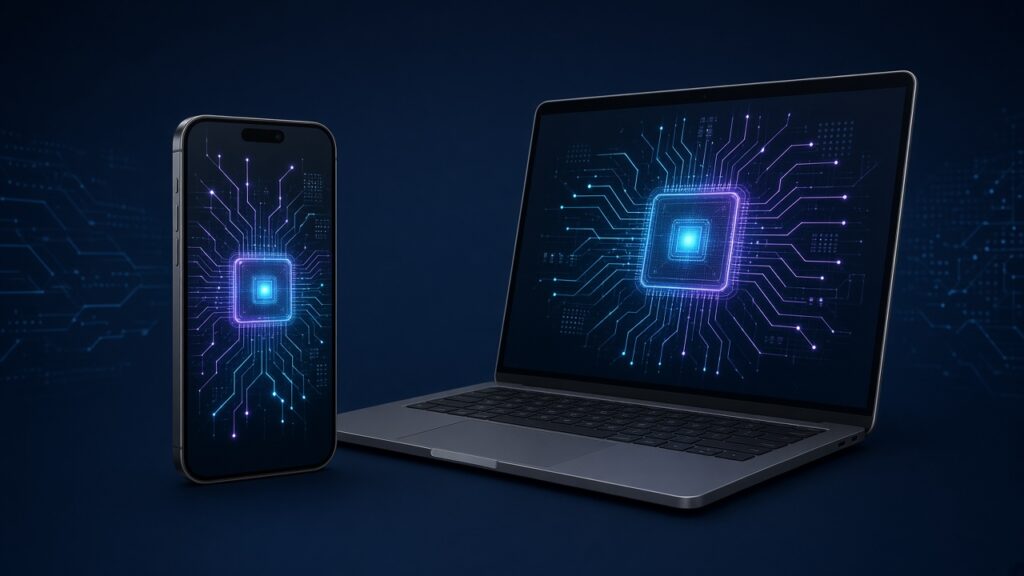
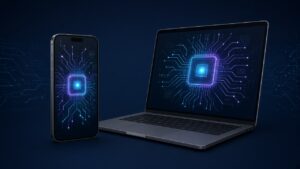
Hero: phones and PCs now carry dedicated neural silicon for private, low-latency inference.
For most of the generative AI boom, “smart” meant “online.” A prompt left your phone, crossed a data center, and came back as text or an image. In 2026 that pattern is no longer the default for everyday assistants. On-device AI—inference that runs on the phone or PC itself—has become a product category with its own silicon, its own model families, and its own privacy pitch.
The shift did not erase the cloud. Frontier multimodal models, long-context research agents, and heavy training still live in data centers. What changed is the split: a growing share of summarization, rewriting, translation, camera effects, and personal agents now runs locally on NPU AI hardware, often with a small local LLM as the brain. This article maps that landscape—what NPUs in current Qualcomm, Apple, Intel, AMD, and MediaTek chips actually claim; which workloads fit a local model; and what still needs the cloud.
Why on-device AI broke through
Three pressures pushed vendors in the same direction.
Latency and reliability. Features that must feel instant—live captions, always-on camera filters, offline translation—cannot wait on radio conditions. A Neural Processing Unit (NPU) is a specialized block for matrix and tensor math. Paired with a quantized model that fits in device memory, it can answer without a round trip.
Privacy and regulation. Users and enterprises increasingly prefer that drafts, photos, calendar context, and microphone audio stay on the device. Platform vendors now sell that story explicitly: Microsoft’s Copilot+ PC guidance centers a high-performance NPU for Windows AI features; Apple’s Apple Intelligence stack leans on Neural Engine and related accelerators for on-device tools.
Power. Running every request in the cloud burns radios and batteries. An NPU that vendors rate in tens of TOPS (trillions of operations per second) can keep interactive inference within a phone or laptop power envelope—provided the model is small enough and quantized aggressively enough.
Peak TOPS are marketing numbers, not user experience. Still, the industry coalesced around a practical threshold for Windows: Microsoft defines Copilot+ PCs as Windows 11 machines with an NPU above 40 TOPS, plus the usual memory and storage floor for advanced local AI features.
The silicon map in 2026
Qualcomm: Hexagon NPU AI on phones
Qualcomm’s flagship Snapdragon line treats the Hexagon NPU as the center of mobile agentic AI. In the official Snapdragon 8 Elite Gen 5 product brief, Qualcomm claims a 37% faster Hexagon NPU versus the prior Snapdragon 8 Elite, with 16% better AI performance per watt. The brief also lists broad numeric support—INT2 through FP16, including mixed precision—and a Sensing Hub with dual micro-NPUs for always-on audio, voice, and sensor graphs that feed a personal knowledge store on device.
Those relative gains matter more than a single TOPS headline. Phone OEMs care about sustained tokens per second for a 3–8 billion parameter local LLM, concurrency with camera pipelines, and whether an agent can keep working when the radio is off. Qualcomm’s messaging for Gen 5 explicitly targets agentic assistants that act from on-device context rather than only answering chat prompts.
By late 2026, follow-on Snapdragon 8 Elite Gen 6 materials emphasize larger on-chip NPU shared memory and a Hexagon Element Accelerator aimed at transformer math—again underscoring that memory locality, not only peak ops, limits local generative AI.
Apple: Neural Engine plus GPU Neural Accelerators
Apple was early to ship a dedicated Neural Engine and has kept expanding the surrounding AI fabric.
- The M4 Neural Engine is rated by Apple at up to 38 trillion operations per second, with CPU ML accelerators and GPU working as a combined on-device AI path.
- The M5 (announced October 2025) keeps a 16-core Neural Engine and adds a Neural Accelerator in each GPU core, with Apple claiming more than 4× peak GPU compute for AI versus M4 and unified memory bandwidth of 153 GB/s (about 30% above M4). Apple positions that bandwidth as enabling larger models to stay fully on device on MacBook Pro, iPad Pro, and Vision Pro.
- On iPhone, public reporting around the A18 / A18 Pro generation cited a 16-core Neural Engine in the mid-30s TOPS range for Apple Intelligence workloads; Apple’s own marketing for Apple Intelligence continues to stress a hybrid design—sensitive processing on device, with Private Cloud Compute when a larger model is required.
The Apple lesson for 2026 is architectural: NPU AI is necessary but not sufficient. Memory bandwidth and GPU tensor paths decide whether a local diffusion model or a mid-size local LLM feels usable.
Intel: Lunar Lake clears the bar; Arrow Lake often does not
On Windows PCs, Microsoft’s 40+ TOPS NPU requirement created a sharp product line.
Reporting based on Intel documentation put the Core Ultra 200V (Lunar Lake) NPU at about 48 TOPS, enough for Copilot+ certification. By contrast, many Arrow Lake Core Ultra 200H / 200HX parts were documented at about 13 TOPS on the NPU (around 11 TOPS on some 200U SKUs)—below the Copilot+ NPU floor—even when Intel marketed combined “platform TOPS” across CPU, GPU, and NPU near 99.
That split is the clearest consumer-facing proof that on-device AI is not “any AI PC sticker.” Buyers who want Windows Studio Effects, Recall-class features, and other NPU-gated experiences must check the NPU rating, not only the Core Ultra branding.
AMD: XDNA 2 and the 50 TOPS class
AMD’s Ryzen AI 300 series, announced at Computex 2024 and shipping widely into 2025–2026 laptops, put an XDNA 2 NPU at up to 50 TOPS (with higher-bin HX parts such as the AI 9 HX 375 listed by AMD materials at 55 TOPS). AMD explicitly positioned the line as Copilot+ ready and framed local AI as a privacy and responsiveness story for Windows laptops.
For this article’s purposes, AMD shows that once Microsoft set a numeric gate, x86 vendors raced to clear it with dedicated NPU silicon rather than relying on iGPU alone.
MediaTek: dual NPU thinking on Android flagships
MediaTek’s Dimensity 9500 (announced September 2025) pushes a dual-NPU narrative: a high-performance NPU 990 with Generative AI Engine 2.0, plus a Super Efficient NPU with compute-in-memory for always-on light models. MediaTek’s press materials claim the platform doubles compute versus the prior generation, introduces BitNet 1.58-bit large-model processing with up to 33% lower power for that path, 100% faster output for a 3 billion parameter LLM versus the previous generation, and 128K-token long-text processing, alongside on-device 4K image generation. Analyst coverage (for example Counterpoint) has summarized peak AI throughput in the ballpark of 100 TOPS for the 9500 class—useful context, but secondary to MediaTek’s own relative claims.
The design point is clear: flagship Android silicon now assumes concurrent always-on perception models and bursty generative local LLM work.
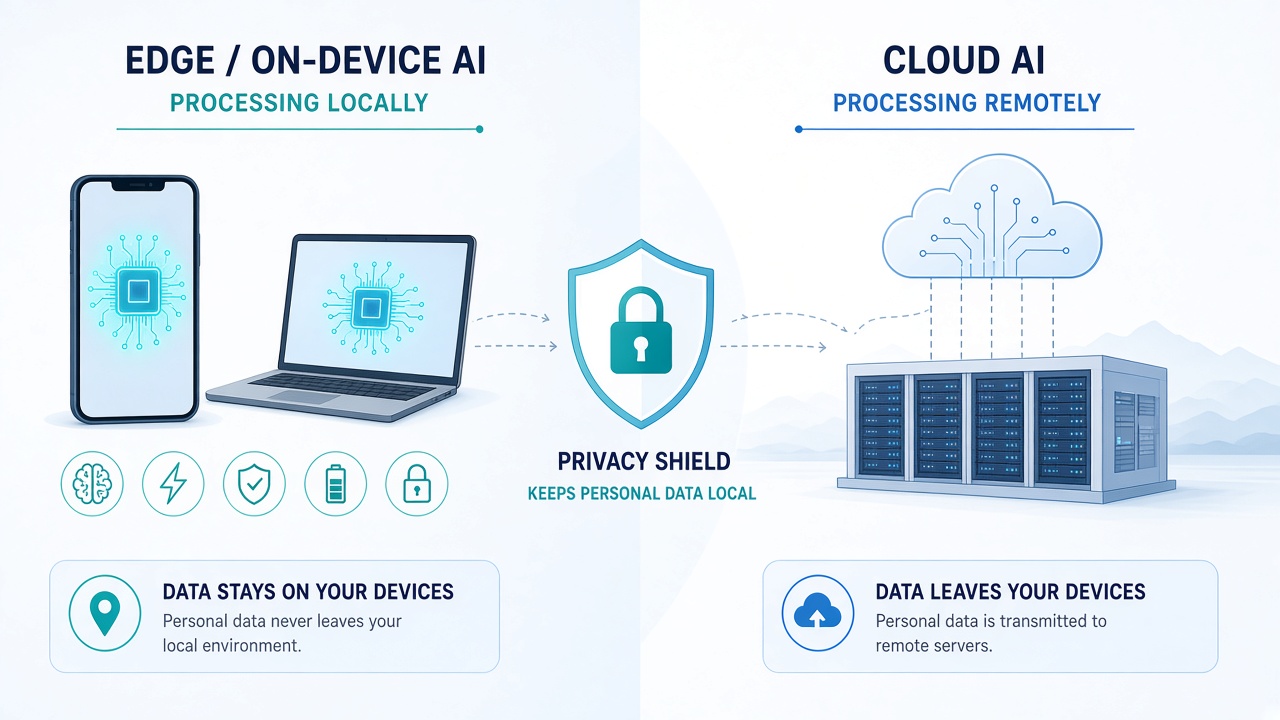
Local LLMs: what actually fits on a phone or PC
Hardware only matters if the software stack can place a useful model on it. In 2026, “local LLM” usually means a model in roughly the 1B–8B parameter band (sometimes larger on high-RAM PCs), quantized to 4-bit or lower, exported through ONNX, ExecuTorch, Core ML, MLX, or vendor AI hubs.
Typical on-device roles:
- Rewrite, summarize, and draft short documents or mail threads.
- Retrieve-augmented answers over on-device notes, messages, or a personal index.
- Multimodal helpers that caption a photo or extract text without uploading the image.
- Agent scaffolding that plans tool calls locally, then optionally escalates to the cloud.
Microsoft’s Windows ML / ONNX Runtime path, Qualcomm AI Hub packs, Apple’s Foundation Models framework, and Android’s on-device Gemini Nano-class deployments all chase the same idea: ship a small, quantized model that the NPU can sustain at interactive token rates.
What local models still struggle with—honestly—is frontier reasoning depth, up-to-date world knowledge, and very long multimodal contexts. A 3B–7B local LLM can feel excellent for personal productivity and still lose to a cloud frontier model on hard exams, multi-hop research, or studio-grade video generation. That is a feature of the edge/cloud split, not a failure of NPU AI.
Privacy: the real product, with caveats
Vendors sell on-device AI as privacy by default. The claim is partly true and partly marketing.
True: if inference never leaves the SoC, the raw prompt and sensor stream need not hit a third-party GPU cluster. Features such as Apple’s on-device Apple Intelligence tools or Windows features that Microsoft documents as NPU-local reduce the attack surface of “everything in the clear on someone else’s rack.”
Caveats:
- Hybrid by design. Apple, Google, Microsoft, and phone OEMs still route hard tasks to cloud models. Private Cloud Compute and similar designs try to narrow trust, but they are not the same as pure offline inference.
- Telemetry and accounts. Local inference does not erase analytics SDKs, backup sync, or account-linked features.
- On-device does not mean unstealable. A compromised phone can still read a local model’s context window. Encryption of model weights (Qualcomm’s Gen 5 brief mentions Gen AI model encryption) helps IP protection more than user privacy against malware.
- Enterprise policy. Regulated industries care about data residency and audit logs; a local LLM helps, but compliance teams still need controls around what may escalate to the cloud.
Treat privacy as a data-flow diagram, not a badge. Ask: which tokens stay on the NPU, which embeddings sync, and which prompts leave the device.
What still needs the cloud
A useful 2026 rule of thumb:
| Workload | Prefer on-device | Prefer cloud |
|---|---|---|
| Live captions, blur, noise reduction | Yes | Rarely |
| Short rewrite / summarize of local text | Yes | Optional |
| Personal agent over calendar/mail index | Mostly local | Escalate if stuck |
| Frontier coding / research agents | Assist locally | Yes |
| Training / fine-tuning large models | Tiny LoRA only | Yes |
| Studio image/video generation | Drafts / 4K mobile demos | High-end quality |
| Fresh web knowledge | RAG cache | Live retrieval |
Cloud remains superior when you need scale (huge models), freshness (live search), collaboration (shared agents), or burst compute you would never fit in a handset thermal envelope. The winning products in 2026 are explicit about the handoff: run a local LLM for the private, latency-sensitive layer; call the cloud when the user opts in for deeper reasoning.
Platforms and interfaces: how developers reach the NPU
Silicon without APIs is a dormant feature. Three interface layers dominate:
- OS AI runtimes — Windows ML (ONNX Runtime under the hood with automatic execution providers), Apple Core ML / Foundation Models / Metal, Android AICore-style paths.
- Vendor hubs — Qualcomm AI Hub and similar catalogs of already-quantized models validated on specific NPUs.
- Cross-device frameworks — ONNX, ExecuTorch, MLX, and llama.cpp-class stacks for developers who bring their own local LLM.
Microsoft’s Copilot+ developer guidance is unusually concrete: many signature Windows AI experiences expect that 40+ TOPS NPU; Task Manager exposes NPU utilization; Windows Performance Recorder includes neural-processing profiles. That tooling maturity is as important as TOPS charts for whether on-device AI becomes a real application platform.
How to choose a device in late 2026
Practical checklist for readers:
- Read the NPU number, not the slogan. For Windows, look for Copilot+ / 40+ TOPS class silicon (Ryzen AI 300-class, Snapdragon X Elite-class, Intel Core Ultra 200V / later Copilot+-qualified parts)—not every Core Ultra SKU.
- Check RAM. Local LLMs and vision models are memory-hungry; 16 GB is a common floor for serious PC on-device AI, with more headroom helping larger contexts.
- Ask which features are offline. Marketing blurbs blur hybrid and local. Prefer vendor pages that state what runs without network.
- Prefer open export paths if you care about bringing your own model (ONNX, GGUF, Core ML packages).
- Budget thermals. Phones throttle; sustained token rates matter more than a demo’s first reply.
The bottom line
On-device AI in 2026 is real infrastructure, not a demo reel. NPUs from Qualcomm, Apple, Intel, AMD, and MediaTek now sit beside CPU and GPU as first-class compute. Small local LLM stacks deliver private, low-latency assistants for everyday work. Microsoft’s 40 TOPS Copilot+ bar, Apple’s Neural Engine plus GPU Neural Accelerators, AMD’s 50 TOPS-class XDNA 2, Intel’s uneven Lunar Lake vs Arrow Lake story, and MediaTek’s dual-NPU Dimensity 9500 all point the same way: edge inference is a product requirement.
The cloud did not lose. It specialized. Frontier intelligence, training, and the hardest creative jobs still need racks of accelerators. The mature architecture is a deliberate edge/cloud split: keep personal context and interactive inference on NPU AI silicon; send only the work that truly needs a frontier model upstairs—and make that handoff visible to the user.
That division—not a fantasy of “everything offline” or “everything in the cloud”—is the durable shape of consumer AI platforms as 2026 closes.
Related reading
- Embodied Edge: Offline AI for Robots and Vehicles
- Consumer Humanoids: Price, Timeline, and Home Use Cases
- Vision-Language-Action Models: The New Foundation Layer for Robots
References / Sources
- Microsoft Learn — Copilot+ PCs developer guide (NPU > 40 TOPS definition and Windows ML guidance): https://learn.microsoft.com/en-us/windows/ai/npu-devices/
- Apple Newsroom — Apple introduces M4 chip (Neural Engine up to 38 TOPS): https://www.apple.com/newsroom/2024/05/apple-introduces-m4-chip/
- Apple Newsroom — Apple unleashes M5 (GPU Neural Accelerators, Neural Engine, 153 GB/s unified memory): https://www.apple.com/newsroom/2025/10/apple-unleashes-m5-the-next-big-leap-in-ai-performance-for-apple-silicon/
- AMD press release — AMD Unveils Next-Gen “Zen 5” Ryzen Processors… (Ryzen AI 300 / XDNA 2 up to 50 TOPS): https://ir.amd.com/news-events/press-releases/detail/1202/amd-unveils-next-gen-zen-5-ryzen-processors-to-power-advanced-ai-experiences
- Qualcomm — Snapdragon 8 Elite Gen 5 product brief (37% faster Hexagon NPU; 16% better AI perf/watt; precision list): https://www.qualcomm.com/content/dam/qcomm-martech/dm-assets/documents/Snapdragon-8-Elite-Gen-5-product-brief.pdf
- Qualcomm newsroom — Snapdragon 8 Elite Gen 5… announcement: https://www.qualcomm.com/news/releases/2025/09/snapdragon-8-elite-gen-5–the-world-s-fastest-mobile-system-on-a
- MediaTek press room — Dimensity 9500 (NPU 990, BitNet 1.58-bit, 128K context, dual/CIM NPU claims): https://www.mediatek.com/press-room/mediatek-dimensity-9500-unleashes-best-in-class-performance-ai-experiences-and-power-efficiency-for-the-next-generation-of-mobile-devices
- Counterpoint Research — MediaTek Dimensity 9500… (analyst summary including ~100 TOPS class context): https://www.counterpointresearch.com/en/insights/mediatek-dimensity-9500-powering-powering-next-gen-smartphones
- The Register — Intel’s new Arrow Lake chips can’t make the Copilot+ PC cut (Lunar Lake ~48 TOPS NPU; Arrow Lake H/HX ~13 TOPS / U ~11 TOPS): https://www.theregister.com/on-prem/2025/01/07/intels-new-arrow-lake-chips-cant-make-the-copilot-pc-cut/529267
- Gadgets 360 — Apple Introduces A18, A18 Pro… (16-core Neural Engine / ~35 TOPS reporting): https://www.gadgets360.com/mobiles/news/apple-iphone-16-series-a18-pro-chipset-details-6530448
- RCR Wireless News — Snapdragon 8 Elite Gen 6 splits on-device AI two ways (Element Accelerator; Extreme shared-memory focus): https://rcrtech.com/semiconductor-news/snapdragon-8-elite-gen-6-on-device-ai/
Images: original illustrations generated for AndBeyond.Tech; no logos or real people depicted.