Consumer Humanoids: Timeline, Price Reality, and the Home Use Cases That Stick
Consumer humanoid robots in 2026: 1X NEO price and pre-order, Unitree, Figure and Tesla timelines, home use cases that stick, privacy and safety.
Every few months a new video promises that a consumer humanoid robot is about to move into your home: it loads the dishwasher, folds the laundry, greets guests at the door. Some of those robots are real machines with real order pages. None of them, as of early November 2026, has a publicly confirmed delivery to a paying household.
That gap is the story. This guide separates what you can actually buy from what has only been announced, explains what a humanoid robot price really covers, looks at which household jobs are likely to survive contact with a real home, and sets out the safety, privacy and regulatory questions any buyer should ask. It is written to stay useful as the dates move — because they will.
Where things stand: orderable, pre-order, announced
It helps to sort consumer humanoids into three buckets.
Orderable today — but not chore robots
The cheapest humanoid with a public, add-to-cart price comes from Unitree. Its online store lists the R1 at $4,900, with shipping of $300 to $1,200 and customs duties paid by the buyer (Unitree). That is a remarkable number for a walking, bipedal machine, but Unitree positions R1 and its larger G1 as platforms for developers, education and entertainment rather than household help. If you buy one, you are buying a programmable robot, not a housekeeper.
Pre-order with a price — the 1X NEO
The clearest example of a chore-focused home humanoid with a real price is NEO from Norway-founded, California-based 1X. Its order page lists two options: $20,000 to own under “Early Access”, with a three-year warranty and priority delivery, or a $499-per-month subscription, both reserved with a fully refundable $200 deposit. The page states “US Deliveries start 2026” (1X order page). 1X’s launch announcement said it would deliver primarily in the US in 2026 and expand to other markets starting in 2027 (1X).
How close is that to reality? IoT News, which reviewed 1X’s own pages, reported that as of November 4, 2026, 1X had begun production at its Hayward, California factory but had not announced a delivery to any customer’s home, and that early units were being prioritized for 1X’s internal testing (IoT News). With under two months left in 2026, buyers should treat the delivery date as a company target until 1X confirms shipments.
Announced, no price — Figure and Tesla
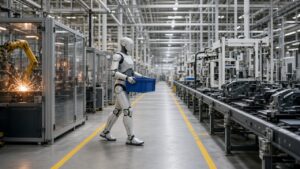
Figure AI introduced Figure 03 in October 2025 with explicitly home-oriented design choices, including soft, washable coverings and wireless charging, and described a factory line, BotQ, initially able to make up to 12,000 humanoids a year (Figure AI). But Figure has not opened consumer orders or published a price. Its documented commercial work so far is industrial, at BMW.
Tesla said on its Q3 2026 earnings call that it had begun early Optimus production on a high-volume line in Fremont. The Verge reported that Elon Musk also listed the hands, safety, reliability, durability and AI as areas still needing work, and pointed to the end of 2027 for first deliveries to outside companies — not households (The Verge). When reports of an imminent Optimus consumer waitlist spread at the start of November 2026, Musk replied “No” on X to a question about whether consumers could order that month, and Tesla has published no consumer price, according to Motor1 (Motor1). The $20,000–$30,000 Optimus figures that circulate online are targets and projections, not prices.
Price reality: what $20,000 or $499 a month buys
Sticker price versus total cost
A humanoid robot price has more parts than the headline. For NEO, the $20,000 Early Access price bundles a three-year warranty and premium support; the subscription is $499 a month, or $5,988 a year (1X order page). Over three years, subscribing would cost about $17,964 — close to the purchase price — but without the ownership, and with whatever terms the subscription carries at renewal. Developer-class robots look cheaper, but Unitree’s listing makes clear that shipping, taxes and import duties come on top (Unitree).
Practical extras rarely appear in launch coverage: home Wi-Fi coverage good enough for a robot that moves between rooms, space to charge, repair logistics for a 30-plus-kilogram machine, and insurance. None of those has a standard answer yet.
The industrial yardstick
A useful sanity check comes from the factory side. Agility Robotics’ investor materials model a leased Digit warehouse humanoid at $8,500 a month, about 17 times NEO’s monthly subscription, according to a pricing survey by There’s A Robot For That (There’s A Robot For That). Industrial customers can justify that by running a robot across multiple shifts against fully burdened labor costs. A household cannot run that math: the robot’s value is measured in hours of chores saved, not wages replaced. That is why consumer pricing has to fall much further — or the robot has to do much more — before mass adoption makes sense.
Why so few prices are public
The same survey found that, in August 2026, only 12 of 58 tracked humanoid robots had a manufacturer-verifiable price; Tesla Optimus, Figure 03, Boston Dynamics Atlas and Apptronik Apollo published none (There’s A Robot For That). For buyers, the rule is simple: a price exists only when there is a page where you can pay it.
The home use cases that stick
What vendors promise on day one
1X’s launch materials say NEO can open doors for guests, fetch items and turn off lights from the first day, and that it “arrives with basic autonomy for early owners and grows in capability over time” (1X order page; IoT News). Its product page also emphasizes conversation: a built-in large language model, voice interaction, memory across conversations, reminders and grocery lists (1X).
Read carefully, that day-one list is modest — and that is a good sign. The household tasks most likely to stick share three traits.
1. Fetch-and-carry and tidying
Moving objects between rooms, picking things up off the floor, carrying laundry baskets: these tasks tolerate imprecision, can be retried, and rarely cause harm if done slowly. They also play to a humanoid’s main advantage over a robot vacuum — arms and the ability to work in spaces designed for people.
2. Laundry and soft goods
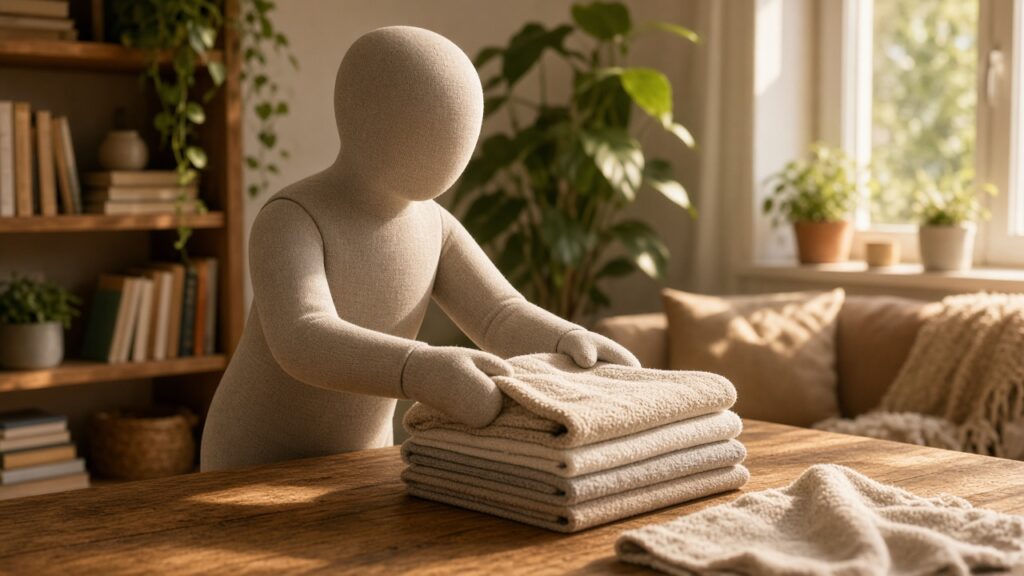
Folding is the canonical demo for a reason: it is repetitive, low-risk and genuinely tedious for people. It is also hard for robots, because fabric deforms unpredictably. Expect laundry to be one of the first “learned” skills to improve across a fleet — and one of the tasks where early units still need human help.
3. Presence, voice and reminders
The least glamorous use case may be the stickiest. A robot that answers questions, keeps a shopping list and reminds you about an appointment is mostly a smart speaker on legs — but it uses home robot AI the owner already understands, and it works even when manipulation fails.
What does not stick (yet)
Cooking with heat and knives, caring for children, and lifting or assisting people are high-risk tasks with little tolerance for error. No consumer humanoid vendor has published evidence that its robot does them safely and autonomously in homes. Plan on these arriving last, if ever, in general-purpose humanoids.
Teleoperation, privacy and the “Expert” in your living room
How much is the robot, and how much is a person?
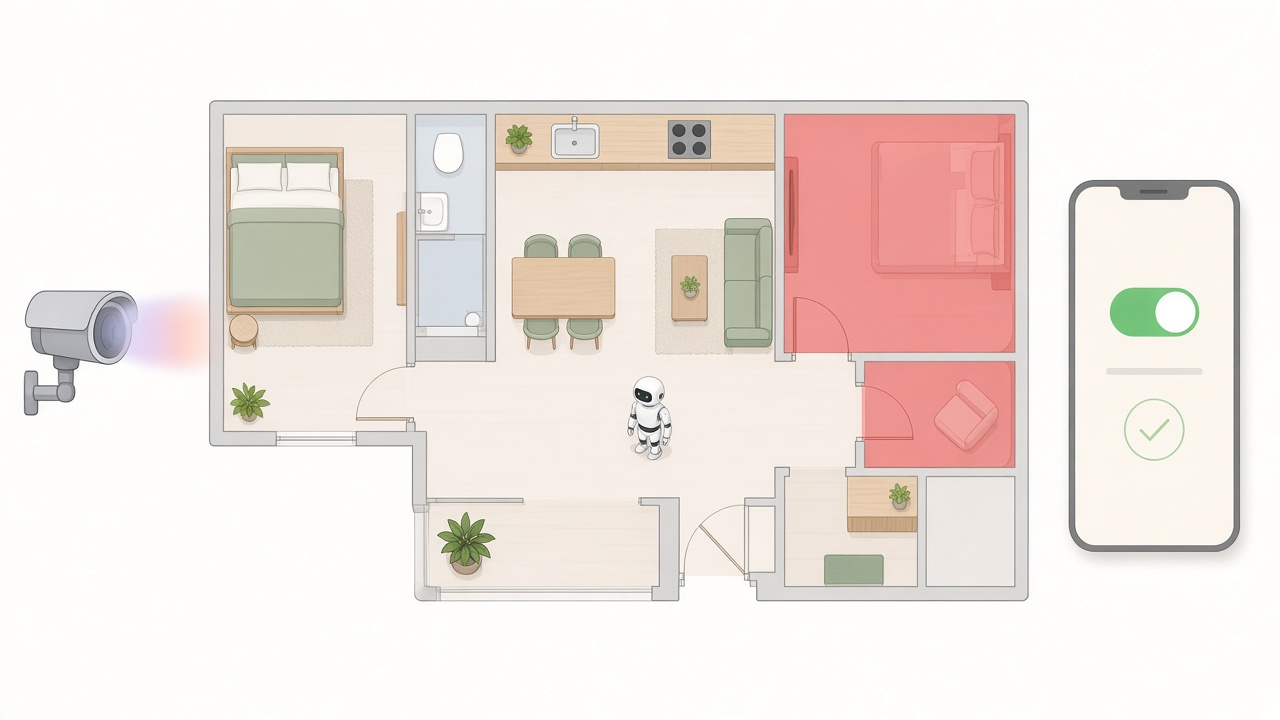
The most important question to ask about any home humanoid is who is actually in control. 1X is unusually explicit: for complex tasks NEO does not know, “an Expert from 1X can remotely supervise its actions at scheduled times,” and owners can also pilot the robot themselves through a mobile app and VR headset (1X order page). IoT News notes that 1X says NEO “works autonomously by default” but does not publish how often an Expert is needed (IoT News).
Teleoperation is not a scandal; it is how robots learn and how early products stay useful. But it changes what you are buying: part machine, part remote service, with a stranger occasionally seeing through cameras in your home.
Questions to ask before you sign
- Approval: Can a remote operator ever take control without you accepting a session?
- Zones and blurring: Can you mark rooms off-limits and blur people from the operator’s view?
- Retention: How long is video kept, who can view it, and can you delete it — including from training data?
- Opt-out: Can you refuse to have your home data used to train the company’s models without losing features?
- Offline behavior: What still works if the internet drops?
This is where Edge & On-Device AI matters. The more perception and control a robot can run locally, the less raw video has to leave the house, and the more it can keep working through outages. Buyers should prefer vendors that say clearly what is processed on the robot and what goes to the cloud.
Safety and regulation: the rules lag the robots
Standards are written for factories first
Most humanoid-specific safety work so far targets industry. ISO’s draft standard for dynamically stable industrial mobile robots, ISO/CD 25785-1, covers legged and self-balancing robots in workplaces where the public is excluded or restricted, and explicitly excludes consumer and household use, pointing instead to ISO 13482 for robots outside industrial settings (ISO). ISO 13482:2014 covers personal-care robots such as mobile servant robots, but it predates today’s general-purpose humanoids, and a broader second edition is under development, as safety consultancy SRES notes (SRES). In other words, there is no finished, humanoid-specific safety standard for homes.
The core risks are easy to state. A bipedal robot needs active balance; if it loses power, it can fall. In a home, it will meet children, pets, stairs, rugs and clutter that no factory floor contains. Buyers should ask how the robot behaves on power loss, how much force its arms can exert, and whether any independent body has tested it.
Europe: the Machinery Regulation arrives in January 2027
In the EU, Regulation (EU) 2023/1230 on machinery replaces the old Machinery Directive and applies from 20 January 2027. EU-OSHA notes that it is designed to better cover autonomous mobile machinery, connected equipment and AI modules that ensure safety functions, and that high-risk machinery products face third-party conformity assessment (EU-OSHA). The European Commission’s advanced-manufacturing platform adds that, under the 2026 Digital Omnibus agreement, machinery is being removed from the AI Act’s own high-risk list, with AI embedded in machinery to be addressed through delegated acts under the Machinery Regulation instead (European Commission – Transition Pathways).
For European readers, that is one reason home humanoids are reaching the US first: 1X itself says international deliveries come later (IoT News). Privacy rules such as the GDPR will also shape how remote-operator video and training data can be handled.
The AI power players and the timeline
Who is positioned
The consumer humanoid race is being shaped by a few AI power players with very different strategies:
- 1X is the first to put a price and a pre-order on a chore-focused home humanoid, and leans on remote Experts to bridge today’s autonomy gap.
- Figure AI is designing for homes while proving reliability in factories first.
- Tesla is betting on manufacturing scale, with outside deliveries targeted for around the end of 2027 and no home date.
- Unitree is already shipping affordable humanoids, but for developers and education rather than chores.
A realistic timeline
Based on what companies have actually published, a cautious reading looks like this:
- 2026: Early-access deliveries promised by 1X in the US; no confirmed customer delivery as of early November (IoT News).
- 2027: 1X targets other markets; Tesla targets first outside deliveries to companies around year-end; the EU Machinery Regulation applies from January 20.
- Beyond: Broad consumer availability depends on autonomy improving enough to reduce teleoperation, prices falling, and home-specific safety standards maturing.
Every date above is a company target or a legal deadline, not a delivery record.
The bottom line
A consumer humanoid robot is no longer science fiction: you can pay $4,900 for a developer humanoid today and reserve a chore robot for $20,000 or $499 a month. What you cannot yet do — publicly, verifiably — is have one delivered to your home and doing your chores on its own. The home use cases that stick will be modest at first: fetching, tidying, laundry help and voice assistance. The deciding factors will not be the demo videos but four plain questions: what it really costs, how often a person takes over, where your data goes, and who has certified it as safe.
Related reading
- Humanoids on the Factory Floor: From Demo Videos to Full Shifts
- On-Device AI in 2026: NPUs, Local Models, and the Cloud
- Embodied Edge: Offline AI for Robots and Vehicles
References / Sources
- Unitree — Unitree R1 product page: https://shop.unitree.com/products/unitree-r1
- 1X — Order NEO: https://www.1x.tech/order
- 1X — NEO Home Robot launch announcement: https://www.1x.tech/discover/neo-home-robot
- IoT News — “1X NEO explained: what the home humanoid is, whether it exists, and who controls it”: https://internetofthingsnews.com/robotics/1x-neo-explained/
- Figure AI — “Introducing Figure 03”: https://www.figure.ai/news/introducing-figure-03
- The Verge — “Just because Tesla’s Optimus is in production doesn’t mean it’s actually ready”: https://www.theverge.com/tech/1016492/tesla-optimus-robots-production-musk-q3-earnings
- Motor1 — “Tesla Optimus Reservation Confusion Explained”: https://www.motor1.com/news/814187/tesla-optimus-reservation-confusion-explained/
- There’s A Robot For That — “Humanoid Robot Prices 2026”: https://theresarobotforthat.com/blog/humanoid-robot-prices/
- ISO — ISO/CD 25785-1, Safety requirements for dynamically stable industrial mobile robots: https://www.iso.org/standard/91469.html
- SRES — “Safety Standards for Humanoid and General-Purpose Robots”: https://sres.ai/robotics-and-physical-ai/safety-standards-for-humanoid-and-general-purpose-robots-a-practical-guide/
- EU-OSHA — Regulation 2023/1230/EU on machinery: https://osha.europa.eu/en/legislation/directive/regulation-20231230eu-machinery
- European Commission, Transition Pathways — “EU Machinery Regulation: the safety baseline for AI-enabled and robotic machinery”: https://transition-pathways.europa.eu/adv-man/legislation/eu-machinery-regulation-safety-baseline-ai-enabled-and-robotic-machinery
Images: original illustrations generated for AndBeyond.Tech; no logos or real people depicted.