Humanoids on the Factory Floor: From Demo Videos to Full Shifts
Humanoid robots in factories in 2026: Figure at BMW, Agility Digit shifts, safety under ISO 25785-1 and the real cost per hour versus people.
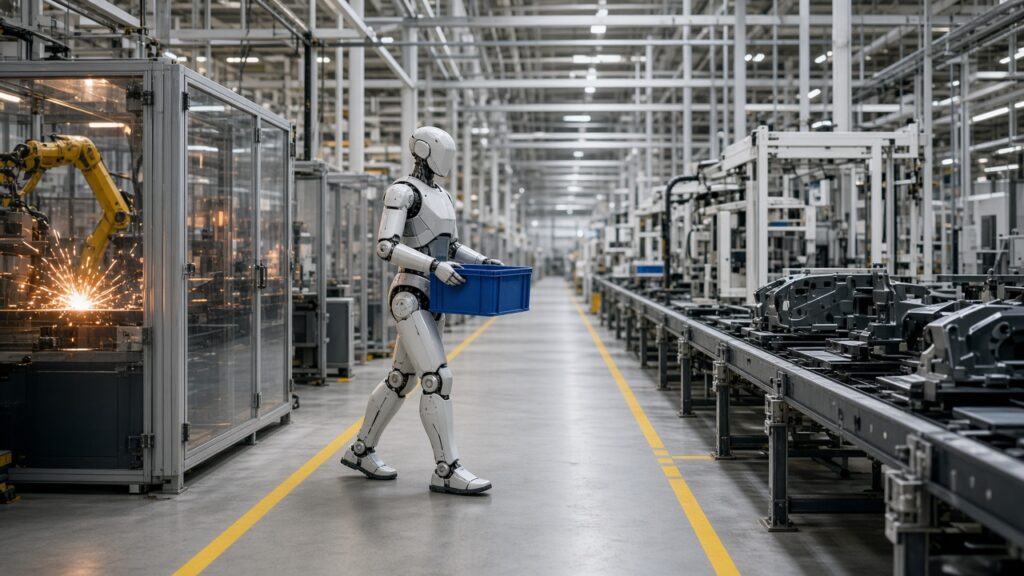
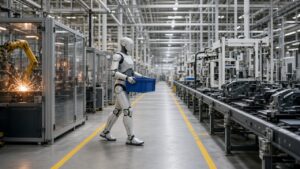
For three years, the public story of humanoid robots has been told in short videos: a robot folds a shirt, sorts a bin, walks past a car body and hands a part to a colleague. The clips are impressive, and many are genuine. But a factory does not buy a clip. It buys a shift: eight or ten hours of work at the speed of the line, with a known error rate, a known number of stoppages, a safety case that an inspector will sign, and a cost per hour that beats the alternative.
By November 2026, the gap between those two things — the demo and the shift — has become the most useful lens for judging humanoid robots in the factory. A handful of programs now publish operating hours, part counts and cycle-time targets. Many more remain announcements. This article sorts one from the other, looks at the safety rules that are still being written, and works through what a humanoid actually costs per hour compared with a person.
Why “demo-ready” is not “shift-ready”
A demonstration has to succeed once, on camera, in conditions the team controls. A production deployment has to succeed thousands of times in a row, in conditions the plant controls. That difference shows up in four places.
Cycle time and takt
Automotive lines run to a takt time. If a station takes longer than its slot, the line waits or the part goes elsewhere. A humanoid that completes a task correctly but slowly is not production-ready for that station; it is a research platform parked next to one.
Interventions per shift
Every time a human has to pause, reset or rescue the robot, the economics change. A robot that needs a technician every hour effectively costs a robot plus a fraction of a person. Intervention rate is therefore the number plant managers ask for first — and the one vendors publish least often.
Uptime and charging
Battery-powered bipeds must stop to charge or swap packs. The ratio of robots working to robots charging determines how many units a site must rent to keep one station staffed.
Safety sign-off
A demo can happen behind a rope. A shift happens next to forklifts, tuggers and people. Without a safety case acceptable to the site and its regulators, a humanoid stays behind a fence, which removes much of the reason for choosing a human-shaped robot in the first place.
The pilots that published numbers
Figure 02 at BMW Spartanburg: the best-documented case
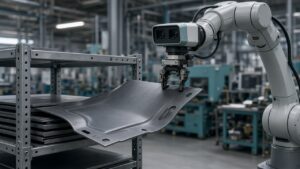
The most detailed public record still comes from Figure AI’s work at BMW Group Plant Spartanburg in South Carolina. In a November 2025 report, Figure said its Figure 02 robot ran an 11-month deployment on 10-hour shifts, Monday to Friday, loading more than 90,000 sheet-metal parts over more than 1,250 hours of runtime and contributing to the production of more than 30,000 BMW X3 vehicles. Figure also published the KPIs it set for the job: an 84-second total cycle with a 37-second load window, placement accuracy above 99% per shift, and a goal of zero interventions per shift (Figure AI).
That is a genuine humanoid robot shift — a scheduled, repeated workday on a live line. It is also narrower than the headline suggests. Trade publication Rockingrobots pointed out that the robot handled one sheet-metal loading sub-process, that it worked the same daytime schedule as people rather than around the clock, and that Figure did not report whether the zero-intervention goal was actually met (Rockingrobots). Both readings are fair: this is the strongest evidence yet that a humanoid can hold a station for months, and it is still one task at one station.
The program has moved on. Figure 03 has been reported in a BMW logistics workflow at the same plant, handling sequencing — picking and staging parts in order for downstream assembly — according to the secondary tracker Augusta Dynamics, citing Figure’s June 2026 update (Augusta Dynamics, secondary tracker).
Agility Digit at GXO, Toyota and Schaeffler: robots paid by the hour
If Figure has the deepest single case study, Agility Robotics has the broadest commercial footprint. Digit began working at GXO’s Flowery Branch, Georgia, distribution center under a multi-year robots-as-a-service (RaaS) agreement signed in June 2024, lifting totes off autonomous mobile robots and placing them on conveyors (Augusta Dynamics, secondary tracker). Agility announced on November 20, 2025 that Digit had moved more than 100,000 totes at that site (Agility Robotics), and on November 2, 2026, GXO signed for two more US facilities, in Statesville, North Carolina, and Lebanon, Tennessee, with operations expected to begin in early 2027 on Digit 4 before moving to Digit 5. Agility also reports a pipeline of more than 30 prospective customers (Robotics & Automation News).
Across customers, Digit has logged, according to Agility figures compiled by Augusta Dynamics, more than 65,000 operating hours at sites including GXO, Schaeffler, Amazon and Toyota Motor Manufacturing Canada, which signed a commercial agreement in February 2026 after a pilot (Augusta Dynamics, secondary tracker; Augusta Dynamics, site list). At Schaeffler’s Cheraw, South Carolina plant, the same secondary tracker reports a Digit tending a stamping press about eight hours a day since early 2025, citing Agility and Futurism.
Digit’s jobs are deliberately modest: totes, carts, presses. That modesty is the point. The tasks are repetitive, physically taxing and measurable, which is exactly where industrial humanoids can show reliability before they attempt anything dexterous.
Apptronik Apollo at Mercedes-Benz: a pilot, explicitly
Mercedes-Benz has been piloting Apptronik’s Apollo since March 2024 on intralogistics work — collecting parts, assembling kits and delivering them to the line — at sites including Berlin-Marienfelde and Kecskemét in Hungary, and expanded the program in 2025 alongside an investment in Apptronik (Augusta Dynamics, secondary tracker; CNBC TV18). Apptronik raised a Series A of more than $935 million by February 2026, but neither company has published operating hours or task metrics for the pilot (Augusta Dynamics, secondary tracker). Until it does, Apollo belongs in the “promising pilot” column, not the “full shift” column.
Tesla Optimus: production of robots, not yet production by robots
Tesla is the loudest voice in the category and the hardest to assess. On its Q4 2025 earnings call in January 2026, Elon Musk said the few hundred Optimus units inside Tesla were used for training and R&D rather than useful work, according to a comparison published by RobotOps (RobotOps). In October 2026, Tesla said it had begun early production of Optimus on a high-volume line in Fremont, but, as The Verge reported, Musk also listed the hands, safety, reliability, durability and AI as areas still needing work, and said outside deliveries could start around the end of 2027. Tesla did not disclose unit counts, autonomous tasks or intervention rates (The Verge).
Building robots at scale is a real milestone. It is a different milestone from robots doing a measured shift of factory work.
UBTech Walker S in Chinese plants: scale ambitions, thin shift data
In China, UBTech’s Walker S robots have appeared at Zeekr, Dongfeng Liuzhou Motor, Foxconn and others. Secondary deployment trackers list tasks such as inspection, fluid filling, emblem application and parts feeding, but generally without published operating duration or counts; one exception is a reported 21 consecutive days of packing work at Zeekr’s Ningbo factory (Technia HQ, secondary tracker; Augusta Dynamics, secondary tracker). On the supply side, UBTech’s new Liuzhou plant has been reported, citing Xinhua, at a capacity of 10,000 humanoids a year. The manufacturing capacity is ahead of the public evidence of what the robots do once delivered.
Safety: the rulebook is still being written
Why a humanoid is not just another cobot
Conventional industrial robots are bolted down and governed by ISO 10218. Collaborative robots added rules for working close to people, including power-and-force limiting and speed-and-separation monitoring, the latter built on separation-distance methods such as those in ISO 13855:2024, as Analog Devices engineers explain in a technical overview (Analog Devices EngineerZone). Autonomous mobile robots added rules for moving platforms.
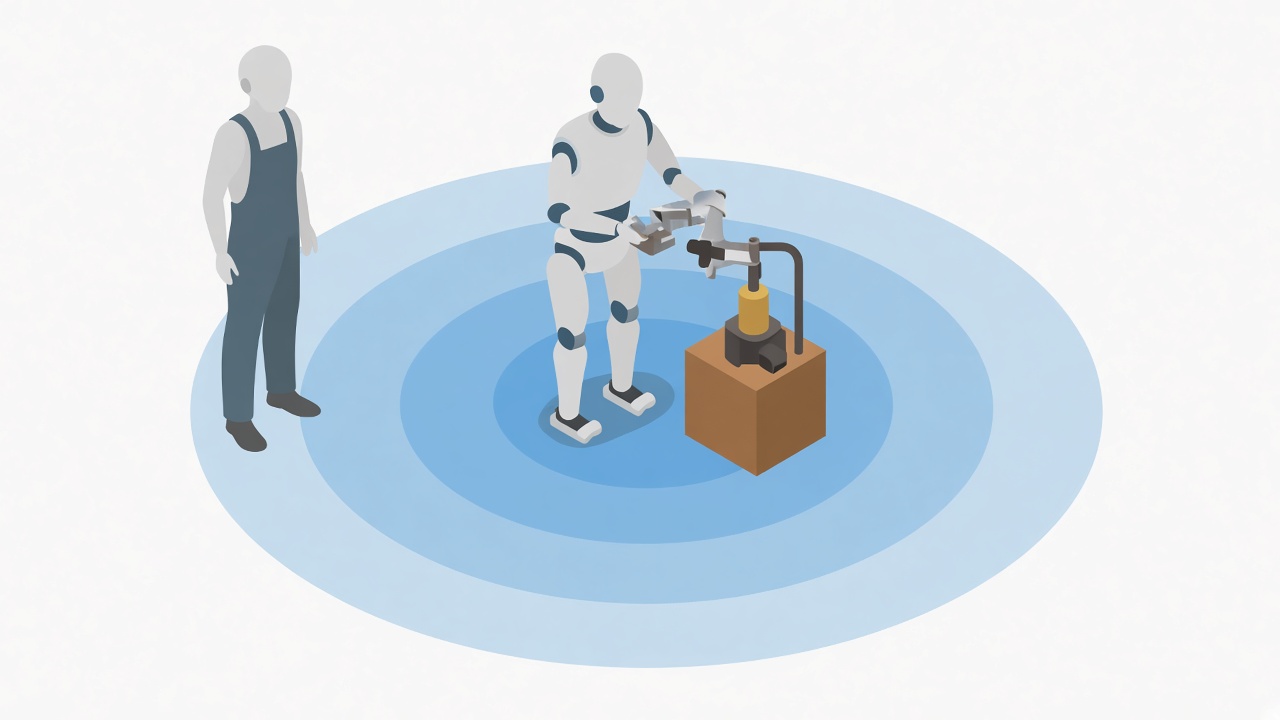
A biped breaks a basic assumption behind all of these: when you cut its power, it does not simply stop where it is. It needs active control to stay upright. An emergency stop that drops a 60-kilogram machine onto a worker is not a safe state.
ISO 25785-1: the first standard for dynamically stable robots
That is the gap ISO/TC 299 is filling with ISO 25785-1, Safety requirements for dynamically stable industrial mobile robots (legged, wheeled, or other forms of locomotion) — Part 1: Robots. The ISO catalog lists it as a committee draft under development. Its scope covers industrial mobile robots with “actively controlled stability” — robots that could become unstable in the absence of power — whether bipedal, quadrupedal or wheeled balancing platforms, used in industrial environments where the public is excluded or restricted. Consumer and other non-industrial uses are out of scope and pointed toward ISO 13482, and a separate Part 2 will address integration of applications (ISO).
Secondary summaries of the draft describe the main themes as controlled falling, behavior on power loss and emergency stop, contact limits and zones around people, stability monitoring, and documented testing such as repeatable push tests (TrendingTesla, secondary source). European consultancy Uniform Studio notes that the committee-draft comment period closed in July 2026, that Part 2 has not yet been drafted, and that the standard will not be harmonized when the EU Machinery Regulation begins to apply — meaning integrators must build their own conformity argument for now (Uniform Studio).
What this means on the floor today
In practice, most humanoids still work in fenced or zoned cells. According to The Conveyor, every Digit working today needs a fenced cell until Digit 5 arrives in 2027 (The Conveyor). Agility has said Digit passed an OSHA-recognized NRTL field inspection at a live customer site in November 2025 — a site-specific field label rather than a blanket product certification, as the review site RoboZaps notes (RoboZaps, secondary source). That is progress, but “cooperative safety” without fences remains a next-generation promise rather than today’s norm.
The cost-per-hour question
What a humanoid rents for
Pricing is the area with the most myths. The clearest public figures come from Agility’s investor materials as it prepares to go public. According to The Conveyor’s reading of the prospectus, a leased Digit costs $8,500 a month including software and maintenance, plus a one-time setup fee of about $25,000; buying one costs about $200,000, plus roughly $20,000 to deploy and about $36,000 a year for software and support (The Conveyor).
What it costs per hour — and when it beats a person
The Conveyor’s math puts the lease at about $17 per hour on two 10-hour shifts, six days a week — the schedule Agility uses in its own pitch — and about $51 per hour on a single 40-hour week. Agility’s human comparator is $30.50 an hour fully burdened, built from a $21.49 median wage. Against that rate, the lease only wins above roughly 68 robot-hours a week (The Conveyor). Agility’s CEO Peggy Johnson had framed the target in 2024 as “under 2 year ROI vs a human at a fully loaded $30 an hour” (The Robot Report) — a figure frequently misread as the robot’s price rather than the worker’s cost.
The fine print
Three caveats decide whether those numbers hold:
- Throughput parity. The hourly comparison assumes a robot does as much work per hour as a person. Agility has not published a totes-per-hour rate; throughput targets are set contract by contract (The Conveyor). At BMW, Rockingrobots estimated from Figure’s published totals that the robot averaged roughly 72 parts per hour, and argued that trained humans would still be faster on that task (Rockingrobots).
- Utilization. The economics depend on multi-shift operation. Figure 02 at BMW ran one 10-hour weekday shift, not 24/7. A robot that works 40 hours a week costs well above the human benchmark in the figures above.
- Charging ratios. The pricing-analysis site UsagePricing notes that Digit currently runs on roughly two robots working while one charges, and that Agility is targeting much higher ratios — a factor that directly changes how many units a site must pay for to keep one station covered (UsagePricing, secondary source).
In short, the cost case for industrial humanoids is credible on paper for long, repetitive, multi-shift tasks — and unproven for anything else.
Robot learning: from one task to many
The bigger long-term bet is not any single task but transfer. Every hour on the line is training data. Figure says the BMW deployment generated data that informed the build procedures and mechanical design of Figure 03 (Figure AI), and Tesla’s stated plan, as reported by The Verge, is to build a fleet that practices tasks and feeds what it learns back into the system (The Verge).
That is where the “general-purpose” argument lives. A fixed automation cell does one job forever; a humanoid running a learned policy could, in principle, be retasked by software. The evidence so far shows single-task reliability improving, and a first step from loading (Figure 02) to sequencing (Figure 03). Whether learned skills transfer between plants without weeks of site-specific tuning is the question the next two years should answer.
A checklist for reading the next humanoid announcement
When the next video or press release arrives, ask:
- Is there a named customer and site? Anonymous “automotive partners” are a weaker signal.
- Are hours, units or parts published? Figure’s 1,250 hours and Agility’s 100,000 totes are the bar.
- What is the intervention rate? If it is missing, assume supervision is significant.
- How many shifts a day? Single-shift operation rarely beats human cost.
- Fenced or collaborative? Until ISO 25785-1 is final, most deployments will be zoned.
- Who pays, and how? A RaaS contract with a renewal or expansion — like GXO’s new sites — says more than an investment or MoU.
The bottom line
Humanoid robots in the factory have crossed an important line in 2025–2026: a few now work real, scheduled shifts with published numbers, and at least one customer is expanding to new sites on commercial terms. They have not yet crossed the next lines — round-the-clock operation, fence-free collaboration under a finished standard, and published intervention rates that let a plant manager compare them honestly with a person. The demo era is ending. The shift era has started, one station at a time.
Related reading
- Consumer Humanoids: Price, Timeline, and Home Use Cases
- AI Cobots and Vision: Where Factories See ROI First
- Embodied Edge: Offline AI for Robots and Vehicles
References / Sources
- Figure AI — “F.02 Contributed to the Production of 30,000 Cars at BMW”: https://www.figure.ai/news/production-at-bmw
- Rockingrobots — “Figure Publishes Results of the BMW Pilot”: https://www.rockingrobots.com/figure-publishes-results-of-the-bmw-pilot/
- [Secondary tracker] Augusta Dynamics — “Humanoid robot companies, by deployment stage”: https://augustadynamics.com/en/resources/humanoid-robot-companies
- [Secondary tracker] Augusta Dynamics — “Humanoid robot deployments, site by site”: https://augustadynamics.com/en/resources/humanoid-robot-deployments-in-industry
- Robotics & Automation News — “Agility Robotics expands Digit humanoid robot operations with GXO” (Nov 2, 2026): https://roboticsandautomationnews.com/2026/11/02/agility-robotics-says-more-than-30-companies-considering-digit-humanoid-robot/106595/
- CNBC TV18 — “Humanoid robots are clocking in, workers are pushing back”: https://www.cnbctv18.com/technology/humanoid-robots-are-clocking-in-workers-are-pushing-back-19969244.htm
- RobotOps — “Figure vs Tesla Optimus: Who Is Actually Shipping Humanoid Robots?”: https://robotops.pro/blog/figure-vs-tesla-optimus
- The Verge — “Just because Tesla’s Optimus is in production doesn’t mean it’s actually ready”: https://www.theverge.com/tech/1016492/tesla-optimus-robots-production-musk-q3-earnings
- [Secondary tracker] Technia HQ — “Humanoid Factory Deployments: Real, Pilot or Announced?”: https://www.techniahqservice.com/robotics-news/humanoid-factory-deployments
- ISO — ISO/CD 25785-1, Safety requirements for dynamically stable industrial mobile robots, Part 1: https://www.iso.org/standard/91469.html
- Analog Devices EngineerZone — “Balancing Innovation and Safety in Humanoid Robotics”: https://ez.analog.com/ez-blogs/b/engineerzone-spotlight/posts/balancing-innovation-and-safety-in-humanoid-robotics
- [Secondary source] TrendingTesla — “ISO 25785-1 explained”: https://trendingtesla.com/iso-25785-1-humanoid-robot-safety-standard-what-it-means-for-tesla-optimus/
- Uniform Studio — “Standards for Humanoids: ISO 25785-1”: https://www.uniform-studio.eu/en/blog/standards-for-humanoids-iso-25785-1
- The Conveyor — “Agility’s Digit humanoid robot costs $8,500 a month”: https://www.theconveyor.co/p/agility-robotics-digit-humanoid-robot-cost
- The Robot Report — “Here’s what it could cost to hire a Digit humanoid”: https://www.therobotreport.com/heres-what-it-could-cost-to-hire-a-digit-humanoid/
- [Secondary source] RoboZaps — “Agility Digit Review 2026”: https://blog.robozaps.com/b/agility-robotics-digit-review
- [Secondary source] UsagePricing — “Agility Robotics Pricing”: https://www.usagepricing.com/blueprint/agility-robotics
- Agility Robotics — “Digit Moves Over 100,000 Totes in Commercial Deployment” (Nov 20, 2025): https://www.agilityrobotics.com/content/digit-moves-over-100k-totes
Images: original illustrations generated for AndBeyond.Tech; no logos or real people depicted.