Embodied Edge: When Robots and Vehicles Need Inference Without the Cloud
Why robots and vehicles need offline AI inference: edge AI robotics, VLAs on-device, humanoids and AV stacks that stay competent when the cloud drops.
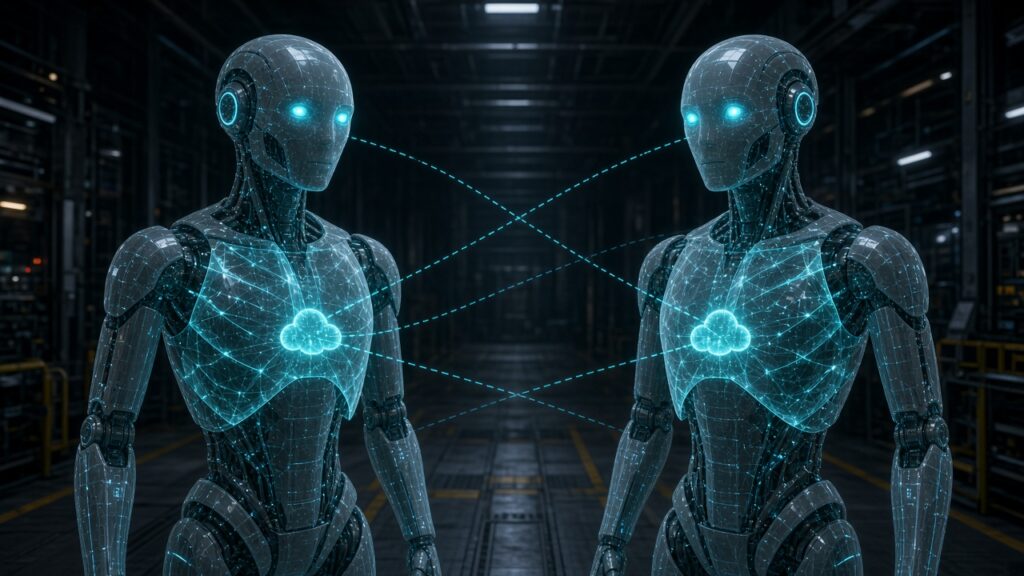
Embodied systems win or lose on milliseconds: perception and action have to live where the sensors and motors are.
A chatbot can wait half a second for a cloud reply. A robot arm cannot. Neither can a vehicle closing a gap at highway speed, nor a humanoid catching a slipping part on a factory line. That timing gap is why edge AI robotics has become a discipline of its own: keep the closed loop—sense, decide, act—on the machine, and treat the cloud as a teacher, a fleet brain, and a backup—not as a real-time co-pilot.
This evergreen guide explains why offline AI inference matters for robots and autonomous vehicles, how vision-language-action (VLA) models are being reshaped for the embodied AI edge, and where a nearby factory or roadside edge still helps without putting safety-critical control on the public internet.
Latency is a physics problem, not a product slogan
In digital assistants, latency is inconvenience. In embodied systems, latency is kinematics.
Control engineers budget milliseconds for perception, planning, and actuator commands. Miss the budget and you do not get a “slow answer”—you get overshoot, dropped objects, unstable walking, or a late brake decision. As EE Times reporting on STMicroelectronics’ robotics leads notes, when joints must coordinate, round-trip delay to a central processor (let alone a distant cloud) can turn small tracking errors into failed grasps or unsafe whole-body motion.
Three constraints make the cloud a poor default for the innermost loop:
- Propagation and jitter. Even a “fast” 5G hop adds variable delay. Safety cases care about worst-case latency, not median latency.
- Connectivity gaps. Warehouses, mines, tunnels, rural roads, ships, and disaster sites routinely lose uplink. A robot that freezes without the cloud is not autonomous.
- Bandwidth asymmetry. Multi-camera, lidar, and tactile streams are expensive to ship upstream continuously. Compressing them for the cloud often destroys the very detail the policy needs.
Functional-safety practice therefore treats network partition as a design condition. Consultant guidance on ISO 26262 / IEC 61508-style edge AI deployments (for example Hyperion Consulting) states the rule cleanly: training, monitoring, and update orchestration may live in the cloud; the real-time inference path must keep working offline.
That is the definition of embodied AI edge: intelligence that remains competent when the radio dies.
What “edge” means in robotics (three layers)
Practitioners usually mean one of three places—sometimes all three in one fleet:
| Layer | Where it runs | Typical jobs |
|---|---|---|
| Onboard / on-robot | SoC or GPU modules in the chassis | Reflexes, tracking, low-level VLA action chunks, emergency stops |
| Near-edge | Factory cell, depot, MEC node | Heavier VLAs, multi-robot coordination, battery-friendly offload |
| Cloud | Regional data center | Training, simulation, fleet learning, non-real-time planning |
Microsoft Research’s 2026 study of offloaded inference for physical AI makes the trade-off explicit. Onboard-only GPUs can limit model size, cut battery life, and degrade task success; moving inference to an on-premise or cloud GPU can raise success rates and stretch runtime—but only if network latency and bandwidth stay inside the control budget. In their mobile-manipulation measurements, lighter onboard GPUs slowed mapping/planning dramatically versus a strong data-center GPU, hurt timely obstacle detection in navigation, and were associated with large drops in VLA accuracy when the model ran too slowly. Offloading helped—yet the same paper warns that the right split is workload-specific, not dogmatic.
The evergreen architecture is layered autonomy: keep hard real-time and fail-safe behavior onboard; offload only what your latency SLA and radio reliability can honestly support.
Vision-language-action models meet the edge
VLA models are the current bridge between “robots that follow scripts” and “robots that follow language.” A VLA takes camera frames (and often proprioception) plus a natural-language instruction and outputs actions—joint targets, end-effector twists, or discrete action tokens.
From RT-2 to on-device VLAs
Google DeepMind’s RT-2 (2023) showed that web-scale vision-language models could be co-fine-tuned to emit robot actions as tokens, improving generalization on unseen objects and scenes. In DeepMind’s reporting, RT-2 roughly doubled success on novel scenarios relative to RT-1 in their evaluations (about 62% versus 32% on the unseen-scenario suite they highlight). That research proved the idea of VLAs. It did not prove that a multi-billion-parameter transformer belongs in every robot’s thermal envelope.
By 2025–2026 the field split into two tracks:
- Flagship VLAs optimized for capability (often cloud- or server-backed during demos).
- On-device VLAs optimized for local latency and intermittent connectivity.
DeepMind’s Gemini Robotics On-Device (announced June 2025) is explicit about the second track: a VLA “optimized to run locally on robotic devices,” useful for latency-sensitive work and environments with “intermittent or zero connectivity.” DeepMind reports strong dexterity (examples include unzipping bags and folding clothes), adaptation with as few as 50–100 demonstrations, and embodiment transfer experiments (including Franka FR3 and Apptronik’s Apollo humanoid) under a trusted-tester program. A later Gemini Robotics On-Device 2 product line continues the same thesis: built for network constraints and local execution.
Open stacks: OpenVLA, π₀, and Jetson-class silicon
Open ecosystems matter because fleets cannot depend on a single API key.
- OpenVLA-class models (7B-scale VLA built on a Prismatic VLM stack with Llama-class language backbones and modern vision encoders) popularized action-token control for research arms. NVIDIA’s Jetson AI Lab documents running such VLAs on camera streams with TensorRT-oriented tooling—useful, but autoregressive token decoding is often too slow for high-rate control unless heavily optimized.
- Physical Intelligence’s π / OpenPi line (including π₀ and π₀.₅ flow-matching VLAs) pushed a different generation style: predict action chunks with few denoising steps instead of token-by-token decoding. NVIDIA Jetson AI Lab tutorials for π₀.₅ on Jetson AGX Thor report end-to-end latency around ~49 ms with TensorRT FP8 + NVFP4 (versus ~132 ms in PyTorch BF16 in their table for a
pi05_liberosetting)—the kind of number that starts to look like closed-loop manipulation rather than a slide demo. - Independent systems work (for example the “Running VLAs at Real-time Speed” line of research) shows that careful engineering can push π₀-class multi-view inference into the low tens of milliseconds on a single high-end GPU—evidence that edge AI robotics is as much compiler and runtime craft as model research.
- The VLA-HWBench preprint (measuring many open VLAs on Jetson AGX Thor and AMD Ryzen AI Max-class hardware) reinforces a practical lesson: how a VLA generates actions (flow-matching chunks versus autoregressive tokens) dominates latency more than raw parameter count.
For builders, the evergreen checklist is simple: prefer action representations that emit a short horizon of continuous controls in a handful of steps; quantize aggressively (FP8 / NVFP4 / INT4 where accuracy holds); fuse kernels; and profile CPU preprocessing—because after GPU kernels get fast, host-side image handling becomes the new bottleneck.
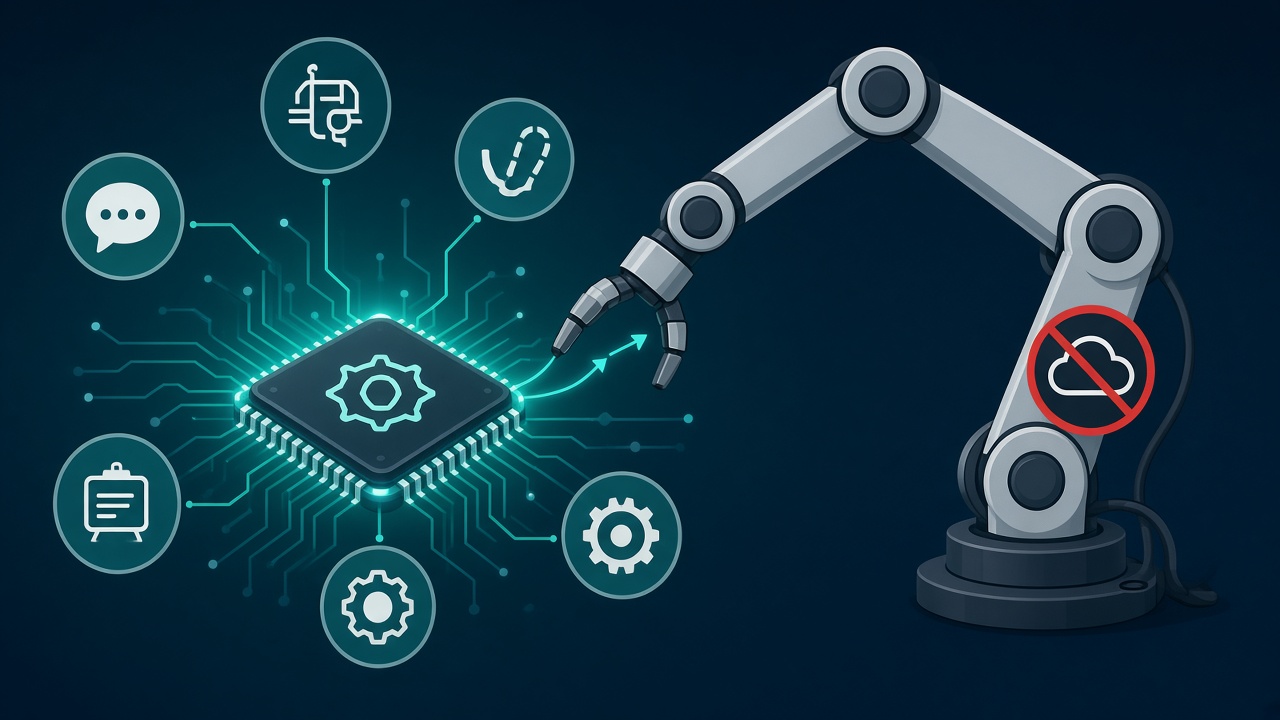
Humanoid robots: pixels to torque without a tether
Humanoids amplify every edge constraint. They combine balance, dexterous hands, multi-camera perception, and people nearby—so a stalled policy is not just a failed pick; it is a safety event.
Figure’s Figure 03 (October 2025) is a concrete commercial example of hardware designed around a proprietary VLA stack (Helix). Figure’s own announcement emphasizes:
- Camera architecture aimed at high-frequency visuomotor control—citing 2× frame rate, ¼ the latency, and ~60% wider field of view per camera versus its prior generation.
- Palm cameras for close-range control when torso cameras are occluded.
- Fingertip tactile sensing sensitive enough to detect forces on the order of three grams, for slip anticipation.
- 10 Gbps mmWave data offload for fleet learning—important nuance: high-bandwidth offload is for training data and improvement, not for substituting the real-time control loop.
- Wireless inductive charging (Figure cites 2 kW docking) so commercial cells can keep robots in rotation.
Those details matter for embodied AI edge storytelling because they show the industry pattern: put high-rate sensing and policy execution on the robot; use fat pipes when docked to improve the next model.
Industry analyses of humanoid compute (including coverage of NVIDIA/Arm stacks in humanoid deployments) repeatedly return to the same architecture: onboard inference for locomotion and manipulation; optional nearby edge for heavier reasoning; cloud for fleet learning. Whether a given demo is fully offline should be verified from primary vendor notes—marketing livestreams are not safety cases—but the direction of travel is unambiguous.
Autonomous vehicles: the original offline AI inference machines
Cars and robotaxis solved the “no cloud in the loop” argument years before VLAs had a name. You cannot phone a data center to classify a cut-in in a tunnel.
Modern AV platforms industrialize that lesson:
- Research and production perception stacks on NVIDIA DRIVE Orin-class SoCs have published multi-camera bird’s-eye perception pipelines with total measured latency on the order of ~19 ms (about 53 FPS) for an eight-camera NVAutoNet-style network on Orin’s embedded GPU—illustrative of the real-time bar perception must clear before planning and control consume the rest of the budget.
- NVIDIA DRIVE AGX Thor, GA in 2025 materials, scales the onboard story for generative and multimodal in-vehicle AI. NVIDIA’s developer documentation compares Thor to Orin with roughly 1,000 versus 254 peak INT8 deep-learning throughput (NVIDIA’s published units), higher CPU performance, and safety targeting up to ISO 26262 ASIL-D, with DriveOS software explicitly discussing VLAs, LLMs, and VLMs running in the vehicle. Supported edge LLM/VLM examples in DriveOS LLM SDK tables include Llama 3.x and Qwen2-VL variants under FP16 / INT4 / FP8 / NVFP4 quantization.
Vehicles still phone home for maps, telemetry, and model updates. They do not outsource the collision-avoidance loop. That separation—offline AI inference for driving policy, online services for everything else—is the template factories now copy for mobile manipulators and humanoids.
Designing for offline competence (evergreen playbook)
Whether you ship a warehouse AMR, a humanoid, or a vehicle stack, the durable design rules are the same.
1. Separate safety from “smart”
Keep emergency stops, geofences, torque limits, and watchdog timers outside the neural policy. Edge AI runtimes used in industry robotics increasingly advertise safety enforcement that continues even when models misbehave. Standards-oriented writing on edge AI under functional safety stresses worst-case (for example high-percentile) latency budgeting—not average demo timings.
2. Budget the loop, then choose the model
Start from required control frequency (for example tens of Hz for manipulation chunks, higher for inner torque loops). Work backward to maximum model latency. If a VLA cannot meet the budget after TensorRT/quantization, shrink the model, shorten the action horizon, or move only the heavy planner to a near-edge GPU with a deterministic network—not to a best-effort cloud region.
3. Make connectivity a feature, not a dependency
Use the cloud for:
- imitation / RL training and simulation;
- fleet dataset offload (Figure-style dock uploads);
- non-critical semantic helpers;
- staged OTA of signed models.
Keep onboard for:
- perception used in collision and balance;
- short-horizon VLA action generation;
- local fail-operational modes.
4. Measure what operators feel
Track end-to-end: camera exposure → preprocess → model → command → actuator. Tools and papers in the VLA systems literature show that after GPU optimization, CPU preprocessing can dominate. Edge AI robotics teams that only watch model FLOPs miss the regression.
5. Plan the split deliberately
Microsoft’s offload results are a warning against both extremes. All-onboard can starve batteries and force weaker models. All-offboard can strand the robot when Wi-Fi blips. The winning fleets document which modules may leave the chassis and under what SLAs.
What still belongs in the cloud
Even a fiercely offline robot needs the cloud for the long game:
- Foundation-model training on multi-thousand-hour corpora (Open X-Embodiment-scale datasets and vendor teleoperation fleets).
- Simulation at a volume no single robot can experience overnight.
- Cross-fleet learning and evaluation dashboards.
- Human oversight at scale—remote monitoring that escalates only the ambiguous cases.
DeepMind’s own robotics messaging still offers larger Gemini Robotics models when developers want maximum capability without on-device limits. That honesty is useful: embodied AI edge is not anti-cloud; it is anti-cloud-in-the-inner-loop.
Bottom line
Robots and vehicles do not get a free pass on network weather. The physics of contact, inertia, and traffic demand offline AI inference for anything that touches motors and brakes. VLAs—from RT-2’s proof that language can become action, to Gemini Robotics On-Device, OpenVLA-class research models, and π₀.₅-style flow-matching policies on Jetson Thor—are converging on the same deployment truth: capability must be compressed into the latency and power envelope of the body that carries the sensors.
Call that stack what it is: edge AI robotics at the embodied AI edge. Put reflexes and short-horizon VLAs onboard. Use near-edge GPUs when batteries and model size demand it and the network is engineered, not hoped for. Keep the public cloud for learning and fleet intelligence. Design every product so that when the uplink vanishes, the machine remains a machine—not a thin client waiting for permission to move.
Related reading
- On-Device AI in 2026: NPUs, Local Models, and the Cloud
- Vision-Language-Action Models: The New Foundation Layer for Robots
- Humanoids on the Factory Floor: From Demo Videos to Full Shifts
References / Sources
- Google DeepMind — RT-2: New model translates vision and language into action: https://deepmind.google/blog/rt-2-new-model-translates-vision-and-language-into-action/
- Google DeepMind — Gemini Robotics On-Device brings AI to local robotic devices: https://deepmind.google/blog/gemini-robotics-on-device-brings-ai-to-local-robotic-devices/
- Google DeepMind — Gemini Robotics On-Device 2 model page: https://deepmind.google/models/gemini-robotics/on-device/
- Figure AI — Introducing Figure 03 (Helix-oriented sensing, tactile, offload, charging claims): https://www.figure.ai/news/introducing-figure-03
- NVIDIA Technical Blog — Accelerate Autonomous Vehicle Development with the NVIDIA DRIVE AGX Thor Developer Kit (Thor vs Orin AI throughput, DriveOS, in-vehicle VLAs/LLMs): https://developer.nvidia.com/blog/accelerate-autonomous-vehicle-development-with-the-nvidia-drive-agx-thor-developer-kit/
- NVIDIA DRIVE AGX Thor platform PDF (peak INT8 performance claims): https://developer.download.nvidia.com/drive/docs/nvidia-drive-agx-thor-platform-for-developers.pdf
- NVIDIA Jetson AI Lab — OpenPi π₀.₅ on Jetson AGX Thor tutorial (TensorRT latency table): https://www.jetson-ai-lab.com/tutorials/openpi_on_thor/
- NVIDIA Jetson AI Lab — OpenVLA archive overview: https://www.jetson-ai-lab.com/archive/openvla.html
- Microsoft Research — Offloaded inference for real-world physical AI robotics (onboard vs edge/cloud trade-offs): https://www.microsoft.com/en-us/research/blog/offloaded-inference-for-real-world-physical-ai-robotics/
- arXiv — NVAutoNet multi-camera BEV perception latency on DRIVE Orin (~18.72 ms / ~53 FPS table): https://arxiv.org/pdf/2303.12976
- arXiv — Running VLAs at Real-time Speed (π₀ optimization latencies on RTX 4090): https://arxiv.org/html/2510.26742
- arXiv — VLA-HWBench: Where the Time Goes When VLA Models Run on Edge Hardware: https://arxiv.org/abs/2610.34717
- EE Times — STMicroelectronics on edge inference latency for humanoid coordination: https://www.eetimes.com/stmicroelectronics-weighs-developing-more-powerful-mcus-mpus-for-humanoid-robots/
- Hyperion Consulting — Edge AI Under Functional Safety (offline inference path; latency budgets): https://hyperion-consulting.io/en/resources/edge-ai-safety-critical-iso26262-iec62443
Images: original illustrations generated for AndBeyond.Tech; no logos or real people depicted.