Orbital Data Centers for AI: Promise, Physics, and the Cost Reality Check
Orbital data centers for AI: Starcloud, Google Suncatcher and ASCEND vs physics—radiators, launch $/kg and when space AI compute could compete.
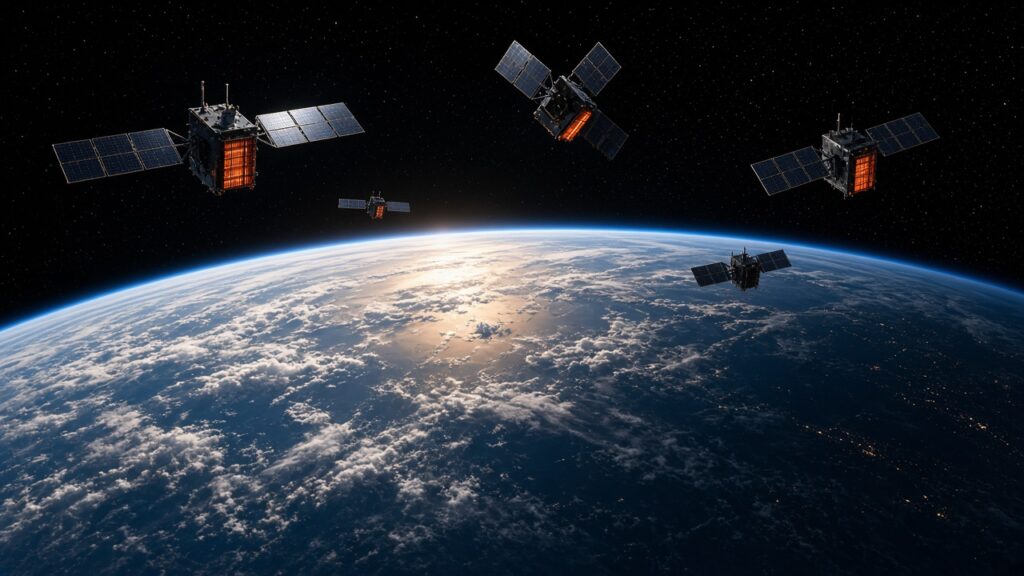
Terrestrial AI infrastructure is running into hard limits that money alone cannot erase overnight: grid interconnection queues, land and water permitting, and the sheer rate at which new megawatts of firm power can be built. That pressure has revived an old idea in a new form—orbital data centers—where solar power is abundant, cooling does not consume freshwater, and compute rides above national grids.
The pitch is real enough to attract startups, hyperscalers, and European industrial consortia. The physics is also unforgiving. Vacuum rejects heat only by radiation. Launch still prices every kilogram. Radiation, debris, latency, and maintenance rewrite the reliability model that hyperscale operators take for granted on Earth. This article separates what current programs have actually demonstrated from the multi-gigawatt visions, and what cost curves would have to do before space AI compute competes with ground sites for general workloads.
Why space looks attractive for AI compute
Two physical advantages dominate the case for data centers in space.
Near-continuous solar power. In a dawn–dusk sun-synchronous orbit (SSO), a satellite can ride the terminator and remain in sunlight for most of each orbit. Google’s Project Suncatcher research notes—as a company/research estimate—that, in the right orbit, a solar panel can be up to about eight times more productive than on Earth and can generate power nearly continuously, cutting the need for heavy batteries. Starcloud’s public case (company framing) makes the same orbital choice for the same reason: remove night-time storage and weather variability that constrain terrestrial solar-plus-battery designs.
Radiative cooling without water. On Earth, many large facilities still depend on evaporative cooling and large volumes of water. In orbit there is no convective air and no cooling tower. Heat must leave as infrared radiation into deep space. That is an engineering burden (see below), but it is also an environmental selling point repeatedly cited by European ASCEND work and by U.S. startups: no freshwater draw for heat rejection once the facility is on orbit.
Those two facts do not by themselves make orbital facilities cheap. They explain why the concept keeps returning whenever launch costs fall and AI load forecasts rise. The International Energy Agency’s Energy and AI work projects global data-centre electricity use rising from about 415 TWh in 2024 to roughly 945 TWh by 2030—approaching about 3% of world electricity demand—with AI a major driver. That trajectory is the terrestrial backdrop every orbital pitch is written against.
Who is actually building what (2025–2026)
The field is no longer only paper studies. It is still far from hyperscale.
Starcloud — data-center-class GPUs in LEO
Washington-based Starcloud flew Starcloud-1 in November 2025: a roughly 60 kg smallsat carrying an NVIDIA H100-class GPU—widely reported as the first data-center-grade GPU of that class in orbit. Company and press accounts describe subsequent in-orbit training of a small NanoGPT-style model and inference with Google’s open Gemma model. In a May 2026 McKinsey interview, CEO Philip Johnston described—company estimates, not independent audits—the first platform as on the order of one kilowatt with multiple embedded GPUs, framed the next generation (about a year out) as a roughly 10 kW rack-scale system, and pointed to Starcloud-3 around 2028 as an approximately 200 kW, multi-ton vehicle sized for Starship-class deployment. Starcloud’s longer-term roadmap (company estimate) discusses a constellation that could reach on the order of tens of thousands of satellites and multi-gigawatt aggregate capacity, primarily for inference—ambitious figures that remain contingent on launch cadence, reliability, and demand.
Google Project Suncatcher — TPU moonshot research
Google Research announced Project Suncatcher as a long-horizon moonshot: solar-powered satellite clusters carrying Tensor Processing Units (TPUs), linked by free-space optical interconnects. A November 2025 research post and preprint argued that core concepts are not blocked by fundamental physics, while listing remaining barriers in thermal management, high-bandwidth ground links, and on-orbit reliability. Google reported proton-beam testing of Trillium (Cloud TPU v6e) hardware, with high-bandwidth memory subsystems showing irregularities only after doses several times a shielded five-year LEO estimate in their test campaign (Google-reported results). Bench work demonstrated 800 Gbps each way (1.6 Tbps aggregate) on a single optical transceiver pair—a Google lab demonstration—as a building block for close-formation inter-satellite links. A learning mission with Planet was described as targeting prototype satellites for early 2027; subsequent Google communications in 2026 described a prototype flight and early on-orbit ML exercises as steps on that roadmap. Treat Suncatcher as research infrastructure validation, not a production cloud region.
Axiom Space — orbital data center nodes for space users
Axiom Space has pursued Orbital Data Centers (ODCs) aimed first at space and national-security users: on-orbit storage, processing, AI/ML, and cyber functions that reduce dependence on ground clouds. The company reported deploying a prototype Data Center Unit (AxDCU-1) to the International Space Station in 2025, then launching initial dedicated ODC nodes to LEO with Kepler Communications’ optical relay constellation (Axiom stated a January 2026 launch for the first two nodes). A further ISS-hosted optically interconnected node has been discussed for around 2027 with partners including Spacebilt and Skyloom. Axiom’s public roadmap speaks of growing from kilowatts toward megawatts of on-orbit processing later in the decade—still orders of magnitude below a single modern terrestrial AI campus, but aligned with edge and sovereign space workloads rather than replacing Earth hyperscale overnight.
Lonestar — storage and resilience, including lunar demos
Lonestar Data Holdings has emphasized off-Earth storage and disaster-recovery more than GPU training clusters. The company reported flying lunar-pathfinder payloads (including the Freedom payload on Intuitive Machines’ IM-2 mission in early 2025) and later announced StarVault, a commercial space-based sovereign storage service, with Sidus Space payloads as the near-term LEO path. Lonestar’s relevance to the orbital-compute story is architectural: not every “data center in space” is an H100 training barn; some are air-gapped backups and edge stores for governments and critical industries.
ESA / ASCEND — European feasibility, not a flying farm
ASCEND (Advanced Space Cloud for European Net zero emission and Data sovereignty), coordinated by Thales Alenia Space under Horizon Europe, published feasibility results in June 2024. The consortium compared environmental footprints of space versus Earth data centers and sketched modular in-orbit assembly concepts. Key published conclusions: space facilities would need a launcher roughly ten times less carbon-intensive over its life cycle to deliver the intended climate benefit; they avoid water for cooling; a minimum viable product on the order of 10 MW was studied, with an ambition toward 1 GW before 2050 against a cited ~23 GW terrestrial data-center capacity market figure for 2030. ASCEND is a study-and-roadmap exercise, not an operating constellation.
Engineering barriers the marketing slides understate
Heat rejection is area-limited
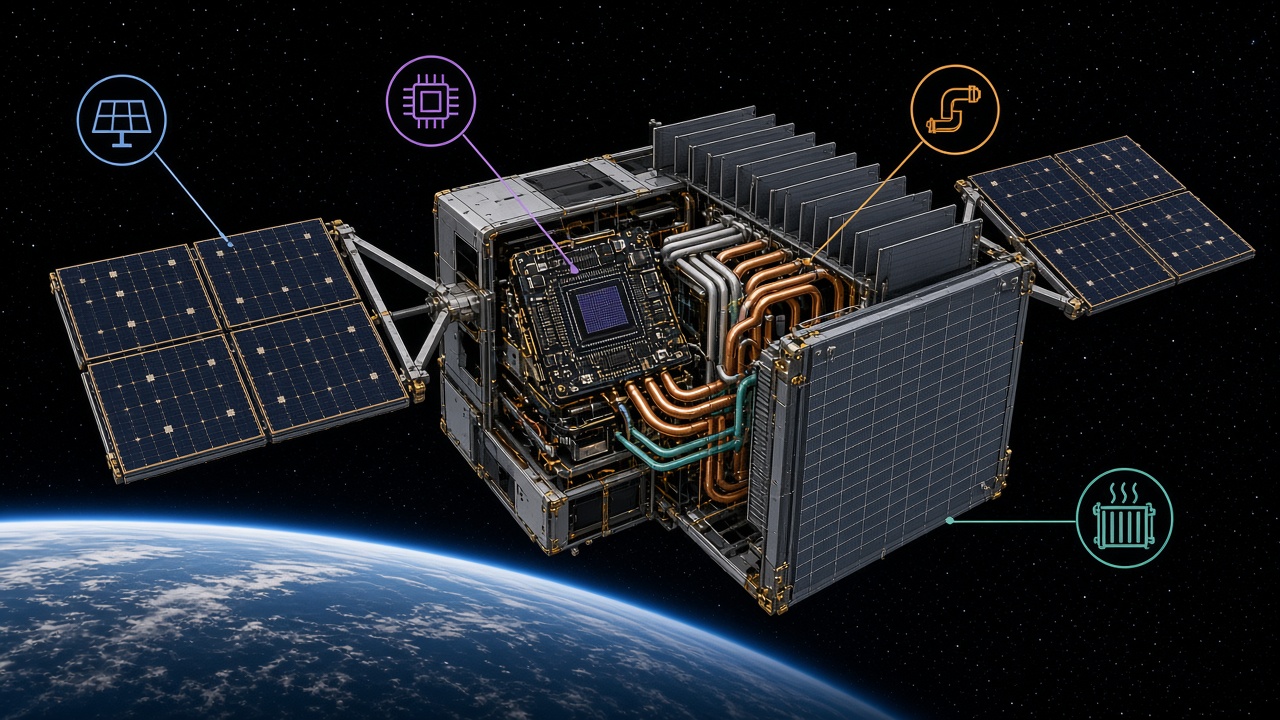
In vacuum, the Stefan–Boltzmann law governs radiative heat rejection: emitted power scales with surface area and with the fourth power of absolute temperature. Practically, every kilowatt of sustained chip heat needs radiator area, structural mass, and a coolant loop that moves heat from dense accelerators to those panels. Starcloud’s public descriptions emphasize coolant-to-radiator designs and the surface-area trade against solar arrays. Google likewise flags thermal management as a first-class open problem. There is no free lunch from “space is cold”: the cosmic microwave background is cold, but you still need large, lightweight, sun-shielded radiators that survive launch and micrometeoroids.
Radiation and commercial silicon
Radiation-hardened processors traditionally used in spacecraft are far less capable—and far more expensive—than terrestrial AI accelerators. Both Starcloud and Google describe a strategy of flying commercial GPUs/TPUs with shielding, scrubbing, and extensive beam testing rather than waiting for rad-hard equivalents of H100 or Trillium. That can work for multi-year LEO missions if total ionizing dose and single-event effects are characterized and mitigated, but it is not the same reliability envelope as a fortified terrestrial hall with easy board swaps.
Launch mass, structure, and power aperture
Gigawatt-class visions imply kilometers-scale solar and radiator structures or enormous numbers of smaller satellites. MIT and other academics quoted in coverage of Suncatcher have stressed the mass problem: moving from meter-scale arrays to kilometer-scale apertures is a logistics and manufacturing challenge, not a slide-deck detail. Even “small” 100–200 kW nodes (company-estimate class for late-decade vehicles such as Starcloud-3) imply tons of payload and careful packaging for heavy-lift vehicles.
Maintenance: design for five years, then replace
Unlike a terrestrial hall, you generally cannot send a technician. Starcloud’s McKinsey interview states—as a company estimate—that early generations are expected to run autonomously for a full life cycle on the order of about five years, with redundancy and software failover instead of robotic repair. Failed capacity is bypassed and eventually deorbited. That model works for disposable smallsats; it is expensive if every node carries cutting-edge GPUs whose terrestrial depreciation cycles are already short.
Latency, bandwidth, and the right workloads
LEO round-trips to a single ground station are often compatible with human-facing inference (hundreds of milliseconds can be acceptable for chat), but they are a poor fit for ultra-low-latency trading or tightly coupled training that expects multi-terabit east-west fabrics inside one building. Google’s analysis (company/research estimate) stresses that data-center-class inter-satellite links may need tens of terabits per second and therefore very tight formations (kilometer-scale or less) so optical links close. Ground downlinks remain a bottleneck for moving large training datasets up and results down. Near-term commercial sense concentrates on: (1) processing Earth-observation and other space-generated data where it is collected, and (2) inference or batch jobs that tolerate orbital visibility and queueing.
Morgan Stanley and other sell-side notes (as summarized in trade press) have also flagged debris risk, spectrum and traffic coordination, and data-governance questions—non-physics issues that still gate insurance and enterprise contracts.
Economics: launch dollars per kilogram still set the floor
Today, orbital compute is generally more expensive than terrestrial capacity. The variable that founders watch is launch cost per kilogram to LEO, plus replacement cadence.
- Starcloud’s Johnston has argued publicly (company estimates) that competitiveness with terrestrial alternatives appears around launch costs near about $500/kg, with lower figures tipping further in space’s favor, and that avoiding batteries, chillers, and cooling towers could pull space-side infrastructure cost toward under about $5 million per megawatt versus roughly $12–15 million per megawatt cited for U.S. terrestrial builds in the same interview—company estimates, not independent audits.
- Google’s Suncatcher economic sketch (company/research estimate) suggests that if launch prices fall toward under about $200/kg by the mid-2030s under sustained learning curves, launch-plus-operate costs for space compute could approach reported terrestrial energy costs on a per-kilowatt-year basis (see their preprint assumptions).
- Published commercial Falcon 9 pricing in the mid-2020s remains on the order of tens of millions of dollars per dedicated flight; implied dollars-per-kilogram at realistic reusable payload fractions are still thousands of dollars per kilogram—far above the sub-$500 vision. Starship’s eventual commercial price is not a settled public tariff; optimistic $/kg targets should be treated as scenarios, not current invoices.
- ASCEND’s European analysis adds a carbon constraint: climate leadership claims require a dramatically cleaner launcher life cycle, not only a cheaper one.
Lifetime hours are not free either. Even if solar energy in SSO looks “unlimited,” every watt still paid for launch mass, pointing accuracy, degradation, and the communications tax to reach users on the ground. Lifetime matters: a five-year replace cycle multiplies launch and chip spend compared with a ten-to-fifteen-year terrestrial shell.
A realistic horizon (without the science fiction)
Putting the public roadmaps next to the physics yields a staged picture:
Now through ~2027 — pathfinders and edge. Single-digit to low tens of kilowatts per vehicle; proof that commercial AI accelerators survive LEO; optical crosslinks and customer demos on Earth-observation inference, sovereign storage, and space-to-space cloud services (Starcloud-1 class, Axiom ODC nodes, Lonestar storage, Google/Planet prototypes).
Late 2020s — first “real” orbital nodes. Hundreds of kilowatts per heavy vehicle if Starship-class deployment and thermal designs mature (Starcloud-3-class company estimates); still niche versus terrestrial GW campuses; strongest product-market fit remains space-native and latency-tolerant inference, not replacing Northern Virginia.
2030s — conditional scale. Multi-megawatt aggregates become plausible only if launch $/kg and cadence move into the bands Google and Starcloud cite as company estimates, radiator and formation-flying engineering leave the lab, and regulators manage traffic and debris. ASCEND’s 1 GW-by-2050 European ambition is an industrial policy target, not a forecast of market share.
What will not happen soon. Relocating the majority of global AI training to orbit in this decade. Training’s appetite for east-west bandwidth, rapid hardware iteration, and hands-on maintenance still favors Earth. Orbital facilities are better understood as a complement: a way to place watts where grids and water are scarce, to process space data in situ, and—if costs fall—to add inference capacity with a different environmental profile.
Bottom line
Orbital data centers sit at the intersection of genuine physics advantages (SSO solar continuity, water-free radiative rejection) and equally genuine constraints (radiator area, radiation, launch mass, replace-not-repair operations, and downlink economics). In 2026 the sector has crossed from slides into flying prototypes—H100- and TPU-class hardware in LEO, ISS and Kepler-hosted nodes, lunar storage demos, and funded European feasibility work. It has not crossed into cost parity with terrestrial hyperscale for general AI.
Watch three numbers, not the renderings: dollars per kilogram to orbit, kilograms of radiator and solar aperture per kilowatt, and years of useful life before disposal. When those three move together, space AI compute stops being a moonshot narrative and becomes an infrastructure option. Until then, treat every gigawatt constellation announcement as a hypothesis under active test.
Related reading
- AI Workloads That Actually Make Sense in Orbit
- The Texas AI Factory Race: Why Hyperscalers Are Betting on One State (planned)
- Microsoft Fairwater and the Rise of the Distributed AI Superfactory (planned)
Sources
- Google Research — “Exploring a space-based, scalable AI infrastructure system design” (Project Suncatcher), 4 November 2025. https://research.google/blog/exploring-a-space-based-scalable-ai-infrastructure-system-design/
- Google — Project Suncatcher facts / prototype mission communications (TPU radiation tests, thermal approach, 2027 twin-satellite milestone). https://blog.google/innovation-and-ai/models-and-research/google-research/google-project-suncatcher-facts/
- McKinsey & Company — “The case for data centers in space” (interview with Starcloud CEO Philip Johnston), 8 May 2026. https://www.mckinsey.com/industries/technology-media-and-telecommunications/our-insights/the-case-for-data-centers-in-space
- NVIDIA Blog — “How Starcloud Is Bringing Data Centers to Outer Space” (Starcloud-1 H100 mission context, company claims on orbital energy). https://blogs.nvidia.com/blog/starcloud/
- CNBC — coverage of Starcloud-1 in-orbit Gemma inference and NanoGPT-style training (December 2025). https://www.cnbc.com/2025/12/10/nvidia-backed-starcloud-trains-first-ai-model-in-space-orbital-data-centers.html
- Starcloud — Starcloud-2 product page (commercial GPU-cluster satellite targeting operations by 2027). https://www.starcloud.com/starcloud-2
- Axiom Space — Orbital Data Centers overview; April 2025 ODC nodes announcement; AxDCU-1 / Kepler node updates. https://www.axiomspace.com/orbital-data-center
- Axiom Space / Spacebilt — ISS optically interconnected ODC node collaboration (September 2025). https://www.axiomspace.com/release/axiom-space-spacebilt-announce-orbital-data-center-node
- Lonestar Data Holdings — Freedom lunar-pathfinder operations (March 2025 PR); StarVault commercial storage announcement (April 2026). https://lonestar.space/
- Thales Alenia Space — ASCEND feasibility study results (27 June 2024). https://www.thalesaleniaspace.com/en/press-releases/thales-alenia-space-reveals-results-ascend-feasibility-study-space-data-centers-0
- ASCEND Horizon Europe project site / CORDIS reporting (objectives, 10 MW MVP, 1 GW / 2050 framing). https://ascend-horizon.eu/ · https://cordis.europa.eu/project/id/101082517/reporting
- International Energy Agency — Energy and AI (data-centre electricity projections to 2030). https://www.iea.org/reports/energy-and-ai
- Scientific American — reporting on Project Suncatcher scale challenges and IEA context. https://www.scientificamerican.com/article/google-tests-plan-for-ai-data-centers-in-space-project-suncatcher/
Images: original illustrations generated for AndBeyond.Tech; no logos or real people depicted.