The Texas AI Factory Race: Why Hyperscalers Are Betting Tens of Billions on One State
Why hyperscalers are betting tens of billions on Texas AI data centers: ERCOT power limits, jobs, local pushback and what an AI factory really means.
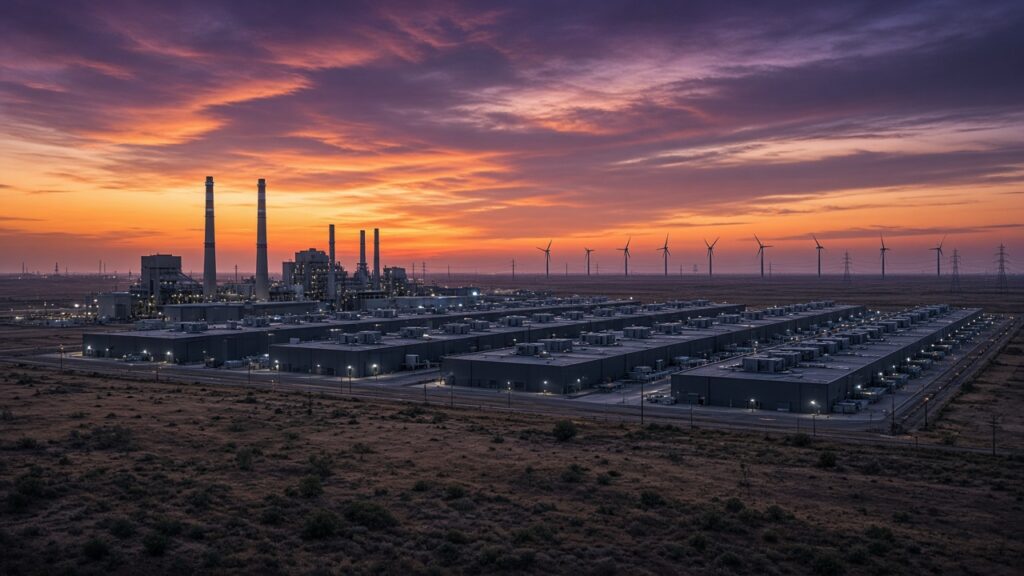
Drive west out of Abilene and the scrubland gives way to something that did not exist three years ago: a row of enormous, windowless halls, a gas-fired power plant humming beside them, and cranes still swinging over the next phase. This is one of the most consequential pieces of hyperscale AI infrastructure on the planet, and it is only one of dozens of projects now competing for land, power and political goodwill across Texas.
For two years the Lone Star State sold itself as the easiest place in America to build an AI factory: cheap land, an independent grid, a pro-business governor and generous local tax breaks. The money followed. Industrial Info Resources reported more than $89.5 billion worth of data center construction actively underway in Texas, with far more in planning. Google alone has committed $40 billion through 2027, according to the company’s own announcement. The OpenAI–Oracle Stargate flagship, Microsoft’s adjacent campus, and Meta’s $14 billion El Paso build all sit inside the state’s borders.
Then, in August 2026, the music changed. Governor Greg Abbott ordered a statewide audit of every data center seeking grid power, and the state’s grid operator paused energizing new large AI data centers. The Texas AI factory race is no longer simply about who can build fastest. It is now about who can prove they deserve the electrons.
Why Texas, and why now
Three structural advantages made Texas the default destination for AI data centers.
An island grid with a fast lane. The Electric Reliability Council of Texas (ERCOT) runs the grid serving roughly 90% of the state’s electric load, and it is largely insulated from federal interstate transmission oversight. That has historically meant quicker interconnection decisions than in the multi-state markets of the East and Midwest.
Space and generation. West Texas and the Panhandle offer vast tracts of flat, cheap land close to some of the country’s largest wind and solar fleets, as well as abundant natural gas. For a developer who needs a gigawatt on a single site, few places offer both acreage and fuel at this scale.
Incentives. Local governments have been eager. Abilene’s city council approved 85% ten-year property tax abatements for the Stargate site in 2025, reported by project trackers. El Paso’s city and county granted Meta an 80% break on local taxes for 25 years in 2023, plus $12.5 million for road works; the city itself values the package at about $550 million, El Paso Matters reports. Forbes has described the state as having “gone out of its way” to be the friendliest jurisdiction for data centers, citing property and sales tax relief.
The result is a market that has grown faster than its own grid could digest. Forbes estimated in August that hyperscale computing in Texas already draws about 12 GW, roughly 15% of ERCOT’s load.
The map of the big bets
Stargate Abilene: OpenAI, Oracle and Crusoe
The flagship of the Stargate initiative, the OpenAI, Oracle, SoftBank and MGX venture announced in January 2025, is Crusoe’s eight-building campus on the Lancium site in Abilene, Taylor County. It is designed for about 1.2 GW across roughly 4 million square feet, with each building sized for Nvidia GB200 NVL72 systems. Crusoe, Blue Owl Capital and Primary Digital Infrastructure assembled a $15 billion joint venture to finance it.
Progress has been rapid. Crusoe says its first two 100 MW buildings were built and energized in under a year. On its September 2026 earnings call, Oracle said six of eight buildings, about 618 MW, had been delivered, and that it shipped 131,000 GPUs to the site in that quarter alone, as reported by the American Buildout tracker’s summary of the call. Oracle has also reportedly said construction logged nearly 20 million worker hours with up to 9,000 workers on site at peak.
Stargate is not stopping at Abilene. Industrial Info reported a second campus under way in Shackelford County, about 40 miles to the northeast, eventually planned for ten more server buildings, and a further Stargate site planned for Milam County. Power for the Taylor and Shackelford campuses is reported as being paired with more than $1 billion of gas-fired generation: a 1,015 MW simple-cycle plant near Abilene nearing completion, and a 700 MW plant planned for Shackelford.
Microsoft: the neighbour that took the leftover site
In March 2026, Crusoe announced a separate 900 MW “AI factory” campus for Microsoft directly adjacent to Stargate Abilene. Bloomberg and AP reported that Microsoft picked up capacity that OpenAI and Oracle had decided not to pursue. The new campus comprises two buildings, each designed for 336 MW of critical IT load, plus a dedicated behind-the-meter power plant paired with battery storage and closed-loop, non-evaporative liquid cooling. Crusoe expects the first building to be energized in mid-2027; once complete, the whole Abilene complex is projected at about 2.1 GW.
Google: $40 billion through 2027
Google has announced a $40 billion investment in Texas through 2027 on its company blog, covering new cloud and AI campuses in Armstrong and Haskell counties among other sites. In that same post, the company says it has contracted more than 6,200 MW of new generation and capacity in Texas through power purchase agreements, that one Haskell County data center will be built alongside a new solar-plus-storage plant, and that it created a $30 million Energy Impact Fund for the state.
Industrial Info reported that Google’s campus near Pampa in Gray County, in the Panhandle, has propelled that county to second place statewide by data center spending. Each of its four planned buildings is reported at about 750,000 square feet and roughly 210 MW, with total investment estimated at $14 billion. Notably, Gray County sits on the Southwest Power Pool grid, not ERCOT, a reminder that geography can be a hedge against a single grid operator’s rules.
Meta: El Paso, outside ERCOT
Meta’s El Paso campus began life in 2023 as an $800 million project and has since grown to an announced $14 billion, now financed in partnership with BlackRock, according to El Paso Matters. It is served by investor-owned El Paso Electric, outside ERCOT, which is why the governor’s August directive appeared to have no direct effect on it. El Paso Water estimates average use of 400,000 to 500,000 gallons a day, against a contractual maximum of 2.5 million gallons.
Amazon, OpenAI and the rest
Amazon and OpenAI both wrote to the governor in August pledging to comply with his new standards, Houston Public Media reported, with OpenAI promising to fund its own infrastructure, support new generation and minimise water use. Beyond the household names, crypto-turned-AI developers such as Galaxy Digital (whose Helios campus in West Texas Forbes cites) and a long tail of speculative projects fill out a queue that dwarfs anything the grid has seen. Crusoe alone reports contracts for two further Texas campuses, including a site in Claude that local reports have linked to Google, though Crusoe has not named tenants.

The ERCOT constraint: a 474 GW queue on a 91 GW grid
The numbers coming out of ERCOT explain why the state blinked.
By June 2026, roughly 474 GW of large loads were seeking interconnection to ERCOT, about 90% of them data centers, according to ERCOT figures as compiled and reported by LoadAtlas and Houston Public Media. RBN Energy notes that the large-load queue more than tripled in a year, from 136 GW in Q3 2025, and that the number of data center projects quadrupled. For context, ERCOT’s all-time peak demand is 91.1 GW, set on 22 July 2026. The queue is more than five times the biggest load the grid has ever served.
Reality is far smaller. ERCOT’s operational data show about 9.5 GW of large loads approved to energize, drawing a peak of roughly 4.1 GW in September 2026. Much of the queue is plainly speculative, and that is precisely what regulators now want to flush out.
The legal framework is Senate Bill 6, signed in June 2025. It defines a “large load” as 75 MW or more at a single site and directed the Public Utility Commission of Texas (PUCT) to write the rules. The final interconnection standard, adopted in September 2026, requires a study fee and refundable security of $50,000 per MW, makes large loads subject to curtailment during emergencies, and adds fault ride-through requirements for computational loads. Withdraw after ERCOT has allocated transmission capacity and you forfeit part of that security.
ERCOT’s one-time “Batch Zero” study is the sorting hat. On 3 September it gave conditional classifications: 204 projects (66.4 GW) treated as base load, 158 projects (127.9 GW) as studied load, and roughly 302 GW excluded, according to ERCOT’s board update as reported via LoadAtlas. Final determinations hinge on the audit, with ERCOT due to file its Batch Zero eligibility and community impact reports with the PUCT by 10 December 2026, ahead of a PUCT open meeting on 17 December.
Bring your own power
The clearest engineering response is behind-the-meter generation. ERCOT’s September materials show 11 Batch Zero projects studied with their own generation, totalling about 9.5 GW of load and 15.4 GW of generation. Crusoe’s Microsoft campus, the Stargate gas plants and Google’s solar-plus-storage pairing in Haskell all point the same way: the hyperscale AI factory of 2027 increasingly arrives with its own power plant. Forbes calls this the “Texas-sized loophole”: projects that do not lean on the grid are largely untouched by the pause.
That shift has a climate dimension. Gas turbines are the fastest firm power to permit and build, which is why so much of the Abilene buildout relies on them, even as hyperscalers tout renewable PPAs. Whether batteries, solar and eventually nuclear can displace that gas at the pace AI demand grows is one of the open questions of the decade.
Jobs versus backlash
Supporters point to tangible local gains. Abilene’s mayor, Weldon Hurt, credited Crusoe’s campus with “thousands of direct jobs” in a Crusoe announcement. Crusoe says the first eight buildings are expected to generate up to 32% of Abilene’s and up to 25% of Taylor County’s FY2025 budgeted property tax revenue. The Microsoft expansion promises “thousands” of construction jobs and “hundreds” of permanent ones.
That last phrase captures the tension. Construction peaks are huge, but permanent staffing at a gigawatt campus runs to hundreds, not thousands, and critics argue that this is thin return on decades-long tax abatements. Across 2025 and 2026, residents from El Paso to the Hill Country raised concerns about water, rising electricity bills, noise, light and air emissions. Forbes noted that Texas residential power prices have risen about 25% over five years, a trend critics tie partly to new load.
The politics shifted accordingly. Abbott, long a champion of the industry, issued his directive on 3 August 2026, requiring ERCOT and the PUCT to audit each project’s power demand, on-site generation plans, water sources and cooling technology, community mitigation, ownership and every public incentive it receives. “I established clear guardrails to ensure data centers protect our electric grid, conserve our water, respect our neighborhoods, and pay their own way,” the governor said in announcing Meta’s commitment to comply. In September he extended the push, ordering the Texas Water Development Board to enforce water-use reporting and, as reported by compliance trackers, halting related state environmental permits pending the audits.
Opposition also crossed party lines. Democratic gubernatorial candidate Gina Hinojosa called for a special legislative session on data centers and vowed to void any contract that “denies Texas residents the water that they need to live,” El Paso Matters reported. Inside Climate News wrote at the end of October that new development is “essentially on pause until after November’s elections,” and that some companies are rethinking Texas investments.
What “AI factory” really means for hyperscale infrastructure
The term AI factory is more than marketing. Crusoe, Nvidia and others use it to describe facilities whose single product is tokens, trained models and inference, and whose design is driven by GPU power density rather than general-purpose cloud flexibility. The Microsoft buildings in Abilene illustrate the shift: 336 MW of IT load per building is an order of magnitude above a traditional enterprise data hall, and it demands direct liquid cooling, dedicated substations or on-site generation, and battery systems to smooth the violent load swings of synchronous training runs.
That is why ERCOT’s new ride-through requirements matter. A training cluster that drops hundreds of megawatts in milliseconds during a grid fault can destabilise the system around it. Texas is effectively becoming the first large market to treat AI factories as grid participants with obligations, not passive customers, and other U.S. regulators are watching.
Outlook: the stakes of December
Construction already under way, the $89.5 billion Industrial Info reported, is largely unaffected by the pause, and campuses with their own power or on non-ERCOT grids (Google in Gray County, Meta in El Paso) have room to keep moving. The real question is the next wave: hundreds of gigawatts of requests whose fate depends on ERCOT’s 10 December reports and the PUCT’s decisions that follow.
Three scenarios stand out:
- Disciplined growth. The audit culls speculative projects, credible hyperscalers post security and bring their own generation, and Texas remains the leading U.S. AI factory market with stricter rules.
- Diversion. Tougher conditions and election-year politics push marginal projects to other states, while the giants already in Texas consolidate their position.
- Gridlock. Prolonged political fights over water and power prices stall approvals, and capital moves to markets that offer faster certainty.
For the AI power players, Texas has become a test of whether hyperscale AI infrastructure can scale with a social licence, not just a utility connection. The companies that win will be those that arrive with power, water plans and transparent incentives, because in Texas, the AI factory race is now as much about trust as it is about megawatts.
Update (Nov 2026): Gina Hinojosa, the Democratic candidate who had called for a special legislative session on data centers, won the 3 November 2026 governor’s race against incumbent Greg Abbott, with 5,230,789 votes to 4,524,527, according to unofficial returns published by the Texas Secretary of State (results are not final until the canvass). The audit and the energization pause described above were set in motion by Abbott’s August directive, so the ERCOT and PUCT decisions due in December now land during a change of administration. That makes the policy uncertainty behind the “Diversion” and “Gridlock” scenarios more pronounced, rather than resolving it.
Three scenarios stand out:
- Disciplined growth. The audit culls speculative projects, credible hyperscalers post security and bring their own generation, and Texas remains the leading U.S. AI factory market with stricter rules.
- Diversion. Tougher conditions and election-year politics push marginal projects to other states, while the giants already in Texas consolidate their position.
- Gridlock. Prolonged political fights over water and power prices stall approvals, and capital moves to markets that offer faster certainty.
For the AI power players, Texas has become a test of whether hyperscale AI infrastructure can scale with a social licence, not just a utility connection. The companies that win will be those that arrive with power, water plans and transparent incentives, because in Texas, the AI factory race is now as much about trust as it is about megawatts.
Related reading
- Microsoft Fairwater and the Rise of the Distributed AI Superfactory
- Power, Water, and Local Pushback: The Hidden Constraints on AI Campuses
- Can Nuclear Power AI in Time?
References / Sources
- Google: “Google announces new $40 billion investment in Texas”
- Industrial Info Resources: “Abilene’s Stargate Project Campus Leads Texas’ $89.5 Billion in Active Data Center Construction”
- ERCOT: Batch Zero Update, Board materials (Sept. 2026)
- ERCOT Market Notice M-A080326-01 (3 Aug. 2026)
- Forbes: “There’s A Texas-Sized Loophole For Some Data Centers In Lone Star State”
- RBN Energy: “Texas Moratorium on Data Center Grid Connections Disrupts U.S. Project Pipeline”
- NFM Consulting: “Texas SB 6 Large Load Rules: What Data Centers Must Know”
- LoadAtlas: Texas Data Center Power: Queue, Pause and SB 6
- Interconnection.fyi: “Large Loads: What Are They And How Are They Being Regulated?”
- Office of the Texas Governor: “Governor Abbott Announces Meta Commits To Comply With His Data Center Standards”
- El Paso Matters: Abbott’s agreement with Meta and the Northeast El Paso project
- El Paso Matters: Gina Hinojosa calls for data center special session
- Houston Public Media: Abbott touts tech company cooperation on data centers
- Inside Climate News: “Texas Used to Be ‘the Best Place’ to Build Data Centers—But Not Anymore”
- Crusoe: New 900 MW AI Factory Campus in Abilene for Microsoft
- American Buildout: Stargate Abilene tracker
- Bloomberg: “Microsoft Rents Data Center Project Developed for Oracle, OpenAI”
- AP News: Microsoft takes over a Texas AI data center expansion after OpenAI backs away
- Data Center View: Crusoe reports 4.9 GW of contracted capacity
Images: original illustrations generated for AndBeyond.Tech; no logos or real people depicted.