AI Workloads That Actually Make Sense in Orbit
Which AI workloads belong in orbit: EO satellite inference, optical relays and autonomy—plus which training and latency-critical jobs still stay on Earth.
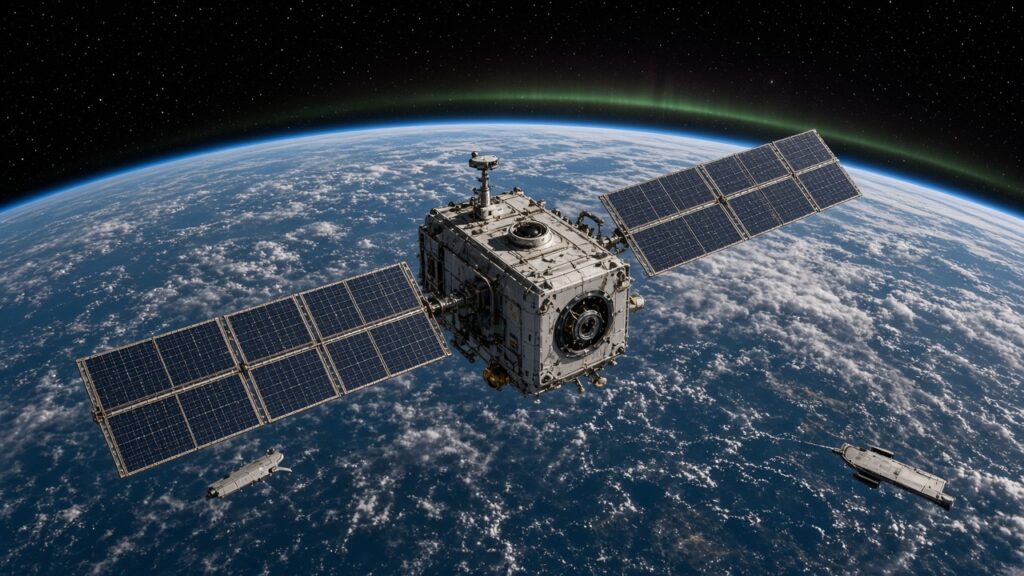
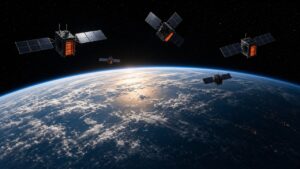
Not every AI job belongs in space. The industry conversation often jumps from “data centers struggle on Earth” to “put the GPUs in orbit,” as if orbit were simply a colder, sunnier rack hall. For space computing workloads, the useful question is narrower: which inferences create more value when they run next to the sensor—or next to another spacecraft—than when they wait for a ground pass?
This evergreen guide separates space edge AI that already has a physics and economics rationale from workloads that still belong on terrestrial clouds. The pattern that keeps winning is not “train GPT in LEO.” It is satellite AI inference for triage, alerts, compression, and autonomy—paired, when needed, with optical relays and ground archives.
The bottleneck is not imagination; it is the pipe
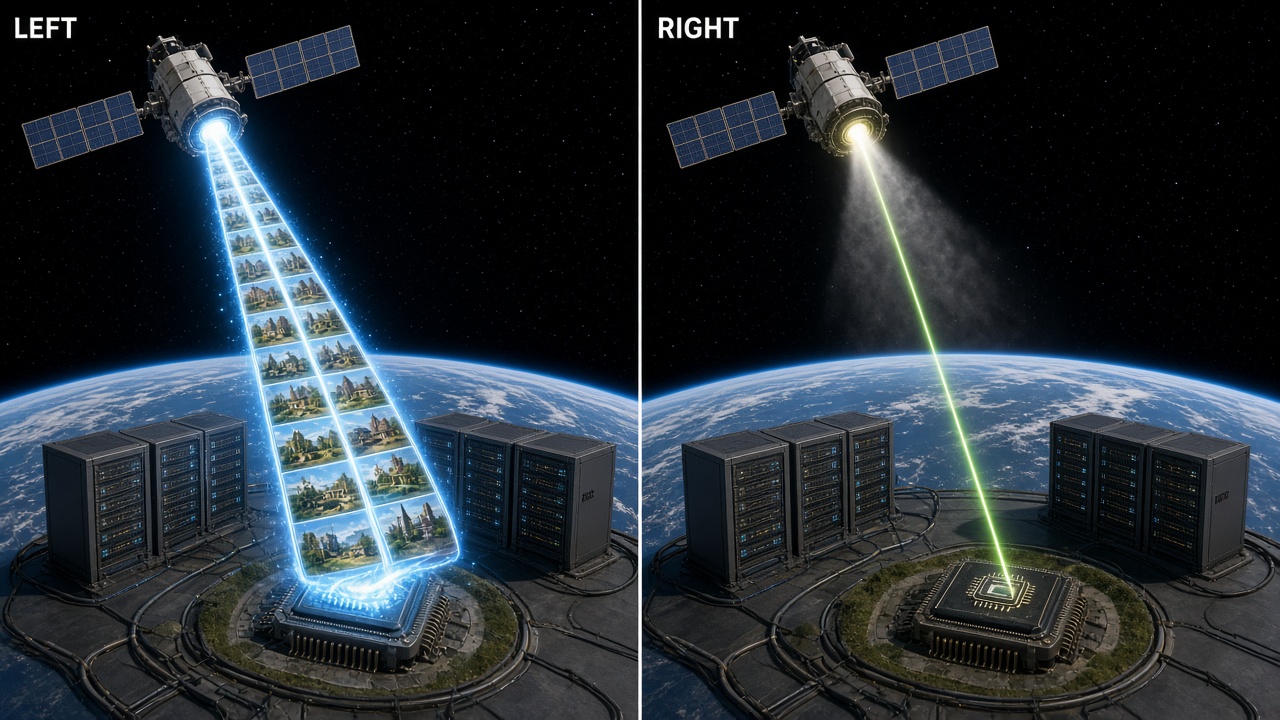
Modern Earth-observation (EO) instruments can collect far more bits than a typical LEO spacecraft can dump during short contact windows. Academic and systems papers on orbital edge computing repeatedly describe the same constraint: intermittent ground contacts measured in minutes, contested queues when many satellites share stations, and first-in-first-out downlinks that let low-value cloudy scenes delay urgent ones. Research frameworks such as EARTHSIGHT (MLSys 2026) summarize the traditional pipeline bluntly—capture everything, downlink everything, analyze later—and note that end-to-end delays of hours to days are common when raw imagery waits its turn.
Faster optical downlinks help, but they do not erase the case for onboard intelligence. Weather over optical ground sites, pointing geometry, storage limits, and customer latency requirements still favor deciding which bits move first. The European Space Agency’s Φsat series was built around that insight: use AI at the source so limited bandwidth carries usable information rather than opaque pixels.
Workload class 1 — Onboard EO inference and filtering
Cloud screening and scene triage
ESA’s Φsat-1 (part of the FSSCat mission, launched 2020) demonstrated hardware-accelerated AI inference on hyperspectral imagery using Ubotica technology powered by an Intel Movidius Myriad 2 vision processor. ESA and Ubotica reported successful automatic cloud detection that sorted scenes into cloudy versus usable classes so that only relevant images needed to be prioritized for downlink. That is the canonical space edge AI win: a cheap classifier prevents worthless data from consuming scarce RF time.
Φsat-2, a 6U cubesat launched 16 August 2024 on a SpaceX Falcon 9 rideshare, extended the idea. ESA describes a multispectral imager (seven bands plus panchromatic) and a suite of onboard AI applications, including cloud detection and classification (developed with KP Labs) configured as a service that other onboard apps can call; street-map generation from imagery for emergency road accessibility (CGI’s Sat2Map, demonstrated over Southeast Asia); marine vessel detection for monitoring such as illegal fishing; deep image compression; plus challenge-derived apps for marine pollution and wildfire detection. Open Cosmos led the platform; Ubotica’s CogniSAT SPACE:AI stack provided the AI compute. The mission’s public framing is not “replace the ground cloud.” It is “smarter observation”: discard or deprioritize useless frames, shrink files, and emit products that responders can use sooner.
Object and event detection (ships, fires, floods, RF anomalies)
Once cloud masks exist, the next natural step is event detectors: vessels in a box, hotspots consistent with wildfire, flooded roads, RF emitters. Spire Global has described onboard AI/ML modules that reprocess radio-frequency data before downlink—for example, extracting AIS messages with classical signal processing, then running machine learning to recover additional messages in congested ship-dense regions. Spire’s “Brain in Space” programme (supported by ESA’s Earth Observation Science for Society work and Φ-lab) created a ground testbed mirroring the LEMUR 3U platform so customers can schedule and trial edge AI apps—an institutional admission that satellite AI inference is becoming a product surface, not only a demo.
Commercial SAR operators such as Capella Space still emphasize encrypted downlink into cloud environments (for example AWS GovCloud) for full product generation, while partnering for AI analytics on the ground. That hybrid is instructive: all-weather collection does not automatically imply all-weather onboard deep learning. Large SAR products, calibration chains, and customer SLAs often still favor terrestrial pipelines—with onboard steps reserved for prioritization or quick-look cues when power and compute allow.
“Summarize first, download later”
Research presented around IGARSS 2026 explores quantized onboard vision-language models that first downlink short natural-language scene summaries, then answer targeted visual questions, and only then fetch full-resolution imagery when relevance is confirmed. Evaluations on Jetson-class edge hardware are lab/bench results, not fleet statistics—but the protocol matches operations reality: turn the downlink into a dialogue instead of a firehose. Treat reported bandwidth savings as experimental results, not guaranteed constellation KPIs.
Workload class 2 — In-orbit relay, mesh filtering, and space-to-space cloud
Onboard inference on the collecting satellite is only half the architecture. The other half is moving already-reduced products through space networks so they reach users without waiting for the collector’s next ground pass.
Optical data relay constellations such as Kepler Communications’ network are built for that hop. Kepler has publicly described SDA-compatible optical inter-satellite links, IP mesh networking on orbit, and commercial optical relay services after its January 2026 tranche launch and subsequent commissioning (company announcements). Company materials cite bidirectional optical rates scaling from gigabit-class links toward higher rates (company-stated figures of up to 2.5 Gbps in earlier datasheets and up to 100 Gbps as a future/expansion capability—treat as vendor specifications, not measured third-party benchmarks). Axiom Space’s Orbital Data Center nodes have been described as riding with Kepler optical infrastructure so that storage and compute sit on the relay fabric—useful for PED (processing, exploitation, dissemination) of multi-satellite feeds, cyber endpoint functions, and AI/ML for space assets that should not depend on a terrestrial cloud path.
Starcloud’s early customer narrative likewise emphasizes inference on Earth-observation imagery (for example Capella-sourced data in company/press accounts) and space-to-space users before mass-market terrestrial chatbots. In McKinsey’s May 2026 interview, Starcloud’s CEO framed near-term demand as onboard inference for other spacecraft at premium pricing, with latency-tolerant terrestrial inference as a later market—and explicitly excluded ultra-low-latency niches such as high-frequency trading (company positioning).
AI cluster networking in orbit—free-space optical links between compute nodes—matters when a single smallsat cannot host the model. Google’s Project Suncatcher research argues that data-center-class east-west bandwidth may require very tight formations so optical link budgets close (Google research estimates of tens of terabits per second and kilometer-or-less separations). That is a long-horizon design for distributed TPU clusters, not a requirement for today’s cloud-screening Cubesat. For current space computing workloads, “cluster networking” more often means relay meshes and tasking networks than a full Clos fabric in vacuum.
Workload class 3 — Autonomy, retasking, and health
Edge AI also earns its mass budget when it closes a control loop that cannot wait for Earth:
- Sensor retasking: If a wildfire detector fires, slew or raise priority for the next overlapping collector in the constellation.
- Quality-aware compression: Spend bits on sharp, cloud-free tiles; starve haze.
- Fault detection: Classify anomalies in telemetry before a pass so operators receive a watchlist instead of a raw dump.
- Crew and station science edge: NASA/HPE Spaceborne Computer missions on the ISS showed that commercial servers can run meaningful workloads in orbit with software-centric resilience; Spaceborne Computer-2 added GPU-class acceleration for machine-learning-style tasks and hybrid offload to terrestrial cloud (HPE/NASA public descriptions). That is edge compute for exploration latency, not a template for hyperscale training farms.
Dynamic model selection under power and deadline constraints—surveyed in SmallSat research such as RADMA on Coral Edge TPU payloads—is another evergreen theme: static “always run the biggest CNN” policies waste energy or miss passes; schedulers that pick width/depth against predicted energy and contact windows improve correct-inference counts in simulation studies (treat percentages in papers as experimental, not flight guarantees).
What does not make sense in orbit (yet—or ever, for some jobs)
Large-scale model training and tightly coupled distributed training
Training foundation models thrives on multi-terabit east-west fabrics, rapid hardware swaps, and engineers who can walk into a hall. Orbit offers none of those routinely. Occasional demos—such as training a small NanoGPT-style model on Starcloud-1’s H100-class GPU (company/press accounts)—prove that commercial accelerators can run learning codes in LEO. They do not prove that orbit is a competitive training venue. Keep training on Earth; fly distilled or quantized inference graphs.
Ultra-low-latency interactive systems
Anything that needs single-digit or low-double-digit millisecond responses to terrestrial users—certain trading stacks, cloud gaming, industrial closed loops on the ground—belongs on terrestrial edges near the user. LEO adds propagation, scheduling, and handover variability. Starcloud’s own public positioning (company estimate/positioning) excludes sub-~50 ms classes and notes that many human-facing apps tolerate on the order of ~200 ms; even that assumes healthy ground infrastructure and does not make orbit the default.
Science-grade archives and reprocessable Level-2+ products
NASA processing-level practice exists for a reason. Atmospheric correction, cross-calibration, provenance, and multi-year reprocessing need big disks, expert pipelines, and reference datasets. Onboard AI can emit alerts and quick-looks; it should not silently discard the only copy of raw or minimally processed data that science and insurance markets will want to reanalyze later. Hybrid rule: triage in orbit, archive on the ground (or in deliberate off-Earth storage services when sovereignty demands it).
“Move the whole hyperscale region to SSO because solar is free”
Continuous solar in dawn–dusk SSO and water-free radiative cooling are real physical advantages discussed by Google Suncatcher and Starcloud (company/research framing). They do not erase radiator area, launch dollars per kilogram, five-year-class replace cycles (Starcloud company estimate for early generations), or downlink taxes. Until those costs clear published competitiveness bands—Starcloud has cited roughly $500/kg launch as a company-estimate crossover, Google research has sketched under about $200/kg by the mid-2030s as a company/research scenario—general-purpose hyperscale inference remains a terrestrial problem with orbital supplements, not a wholesale relocation.
Blind trust in onboard models without validation paths
A wrong cloud mask wastes a pass; a wrong vessel detector can create operational or legal risk. Edge deployments need update channels, telemetry for false-positive/false-negative rates, and the ability to fall back to raw downlink when confidence is low. Φsat-style “apps you can upload” architectures help, but governance is part of the workload definition.
A practical decision checklist
Use orbit for AI when most of these are true:
- Data is born in space (EO, RF, space-domain sensors) and the alternative is a congested downlink.
- Value decays in minutes to hours, not days (disaster response, maritime dark activity, tip-and-cue).
- The model is inference-sized under SWaP-C: vision classifiers, detectors, compressors, small language/vision heads—not full training runs.
- Outputs are small relative to inputs: masks, bounding boxes, embeddings, alerts, compressed tiles, map vectors.
- A ground or relay path exists to deliver the product to the decision-maker (direct to user terminals, optical relay, or next pass).
- Raw or intermediate data can still be archived when required for audit and science.
Keep the job on Earth when the opposite holds: massive reusable archives, heavy training, ultra-low latency to ground users, or models that change weekly and need hands-on ops.
How the pieces fit together
Think in layers, not slogans:
- Sensor edge (on the collector): Φsat-class cloud screens, vessel/fire detectors, Spire-style RF ML, compression.
- Network edge (relays and ODCs): Kepler-class optical meshes, Axiom-style orbital data-center nodes, hosted inference for multiple customers’ satellites.
- Terrestrial cloud: calibration, archives, model training, heavy analytics, human review.
- Optional future compute layer: larger orbital GPU/TPU clusters for latency-tolerant inference if launch and thermal economics mature (Starcloud/Google company roadmaps—estimates, not guarantees).
Optical links and onboard AI are complements. Faster pipes reduce the need to discard data; onboard AI still decides priority and enables autonomy when the pipe is closed. Research and operator commentary (including New Space Economy analyses of orbital computing versus optical downlinks) converge on that hybrid, not on a binary choice.
Bottom line
Space edge AI is already a working category: filter clouds, detect events, compress smartly, retask sensors, and relay insights through optical meshes. Satellite AI inference earns its keep when it shrinks the pipe or shortens the loop. Space computing workloads that ignore the pipe—giant training jobs, hyperscale chat regions, millisecond terrestrial UX—remain science projects or marketing slides.
Design for the hybrid. Fly the model that fits the contact window. Downlink the truth you still need to keep. And measure success in minutes-to-insight and bits-per-decision—not in who launched the largest GPU first.
Related reading
- Orbital Data Centers for AI: Promise, Physics, and the Cost Reality Check
- Embodied Edge: Offline AI for Robots and Vehicles
- On-Device AI in 2026: NPUs, Local Models, and the Cloud
Sources
- ESA — Introducing Φsat-2 (mission description, AI apps, 16 August 2024 launch). https://www.esa.int/Applications/Observing_the_Earth/FutureEO/Phsat-2/Introducing_Phsat-2
- ESA — AI for cloud detection (Φsat-2). https://www.esa.int/Applications/Observing_the_Earth/FutureEO/Phsat-2/AI_for_cloud_detection
- ESA — Φsat / FSSCat facts and figures (Φsat-1 orbit, Myriad 2 AI processor, partners). https://www.esa.int/Applications/Observing_the_Earth/FutureEO/Phsat/Facts_and_figures
- Ubotica — Φsat-1 in-orbit AI cloud detection announcement (Myriad 2 / CVAI). https://www.ubotica.com/news/satellite-successfully-applies-ai-to-process-earth-observation-imagery-in-flight-in-historic-first-for-space
- Ubotica — Φsat-2 / CogniSAT SPACE:AI launch coverage. https://www.ubotica.com/news/esas–cf-86sat-2-powered-by-uboticas-cognisat
- Spire Global — “Brain in Space” edge AI testbed and onboard ML for sensors. https://spire.com/blog/space-services/brain-in-space-new-satellite-testbed/
- Aerospace America — “5 executives on how AI powers their Earth observations” (Spire onboard RF ML remarks). https://aerospaceamerica.aiaa.org/features/5-executives-on-how-ai-powers-their-earth-observations/
- Capella Space — sensor / encrypted downlink & AWS GovCloud processing description. https://www.capellaspace.com/solution/sensor-technology
- Capella Space — AI analytics partnership framing for SAR. https://www.capellaspace.com/resources/how-ai-supercharges-sar-intelligence
- Kepler Communications — optical data relay commercial service / January 2026 tranche commissioning announcements. https://kepler.space/kepler-delivers-optical-infrastructure-for-real-time-space-operations/
- Kepler Communications — Connect / optical relay capability page (company-stated rates and coverage). https://kepler.space/connect/
- Axiom Space — Orbital Data Centers overview and Kepler collaboration context. https://www.axiomspace.com/orbital-data-center
- McKinsey — “The case for data centers in space” (Starcloud CEO on workloads, latency classes, company estimates), 8 May 2026. https://www.mckinsey.com/industries/technology-media-and-telecommunications/our-insights/the-case-for-data-centers-in-space
- Google Research — Project Suncatcher system design (optical ISL bandwidth and formation estimates). https://research.google/blog/exploring-a-space-based-scalable-ai-infrastructure-system-design/
- NVIDIA Blog / CNBC — Starcloud-1 H100-class GPU mission and in-orbit inference/training demos (company/press accounts). https://blogs.nvidia.com/blog/starcloud/ · https://www.cnbc.com/2025/12/10/nvidia-backed-starcloud-trains-first-ai-model-in-space-orbital-data-centers.html
- HPE / NASA Spinoff — Spaceborne Computer / Spaceborne Computer-2 edge computing on ISS. https://spinoff.nasa.gov/Cutting-Edge_Computing_Goes_Spaceborne
- EARTHSIGHT — MLSys 2026 paper on constellation-aware onboard filtering and latency (academic). https://proceedings.mlsys.org/paper_files/paper/2026/file/26289c647c6828e862e271ca3c490486-Paper-Conference.pdf
- “Summarize First, Download Later” — onboard VLM bandwidth-efficient EO (arXiv / IGARSS 2026). https://arxiv.org/html/2608.06959
- New Space Economy — orbital computing vs high-speed optical downlinks (hybrid architecture analysis). https://newspaceeconomy.ca/2026/06/21/orbital-computing-for-earth-observation-satellites-versus-high-speed-optical-downlinks/
- USENIX ATC 2025 — SpaceExit (adaptive onboard EO computing; downlink bottleneck framing). https://www.usenix.org/conference/atc25/presentation/liu-jiacheng
Images: original illustrations generated for AndBeyond.Tech; no logos or real people depicted.