When AI Memory Outgrows the Rack: Marvell’s Photonic Fabric and CXL Bets at SC26
On 13 November 2026, Marvell Technology announced its Supercomputing 2026 program: booth #4003 at McCormick Place in Chicago, 15–20 November, built around a blunt diagnosis….

On 13 November 2026, Marvell Technology announced its Supercomputing 2026 program: booth #4003 at McCormick Place in Chicago, 15–20 November, built around a blunt diagnosis. As AI and HPC workloads grow, more memory-intensive infrastructure is hitting connectivity and memory bottlenecks at once, leaving accelerators underused. Marvell’s stated response is to advance switches and interconnects on one side, CXL memory expansion and acceleration on the other, and to “unify these domains and scale memory and interconnect as a single system.”
This article stays inside that memory scale-up frame: the Photonic Fabric memory module and its optical memory fabric; the Structera CXL portfolio (including add-in cards, near-memory compute, and expansion/compression, with partner demos of Structera X on DDR4 and DDR5); Alaska A DSP-based 1.6T and 800G active electrical cables (AECs) for short in-row reach; and SC26 floor demos on Teralynx switch silicon, including multipath reliable connection (MRC) on Teralynx 10. It is not a recap of co-packaged optics in Ethernet switches—that packaging debate lives in Inside the AI Switch: Co-Packaged Optics—and it does not reopen campus-to-campus interconnect.
A Birds of a Feather session, “Photonics for AI & HPC Clusters: Breaking the Bandwidth and Power Barrier,” is scheduled for Wednesday, 18 November 2026, 12:15–1:15 p.m. in room W184bcd, with Preet Virk, SVP and GM of Marvell’s Photonic Fabric Business Unit, as a listed participant. As of this writing (16 November), no published proceedings or transcript of that session are available. This article therefore does not attribute claims to the panel.
The bottleneck Marvell is selling against
Marvell’s August 2026 Photonic Fabric technology brief, which the SC26 showcase is clearly built to demonstrate, describes inference as a memory consumer that has outgrown the classic hierarchy. HBM on the accelerator is fast and capacity-constrained. System DRAM is larger but does not economically scale beside every XPU. NVMe is capacious but too slow for active inference state. Growing KV caches, embeddings, and model parameters push working sets toward hundreds of gigabytes and, Marvell says, increasingly terabytes.
The company’s proposed fix is an intermediate memory tier—much more capacity than HBM, much lower latency than storage—and a way to reach it without a long electrical hop. Once memory leaves a single server, the interconnect is the memory system. That is why this belongs under AI Cluster Networking as well as AI Accelerators & Silicon: pooling, optical reach, cable reach, and switch-assisted multipath all decide whether a disaggregated DIMM looks like memory or like a remote disk.
Marvell’s language about “optical interconnect technologies allow memory and compute to scale together across multiple racks, growing the size of the scale-up domain” should be read in that rack-and-aisle sense: stretching a memory-semantic domain, not building a WAN.
Photonic Fabric: shared memory on light, as Marvell specifies it
The SC26 demo list leads with the Marvell Photonic Fabric memory module. Official product architecture, as published in Marvell’s 4 August 2026 technical blog, centers on three pieces: the Photonic Fabric Memory Module (PFMM), a Photonic Fabric NIC (PF-NIC), and a Photonic Fabric chiplet. Together, Marvell says, they enable memory sharing across multiple AI racks up to 30 meters apart, so operators can increase available memory without scaling compute in proportion.
Marvell’s published PFMM specifications, which should be treated as vendor claims, include:
- Up to eight DDR5 DIMMs of shared memory, plus 72 GB of HBM cache.
- 7.2 Tbps of optical fabric bandwidth.
- A system-on-chip that Marvell calls the first with optical I/O integrated into the middle of the silicon die.
- Approximately < 350 nanoseconds of “near-NUMA” memory access across multiple racks.
The PF-NIC is described as a CXL 3.1 and PCIe Gen 6 optical network interface that attaches AI servers to the shared memory fabric. Marvell positions the pair as a way for third parties to build shared-memory appliances that hold larger KV caches and longer contexts while remaining compatible with existing AI software frameworks.
Those latency and bandwidth figures are Marvell’s. “Near-NUMA across multiple racks” is an aggressive marketing comparison; buyers should measure load-to-use latency from their accelerator, through the PF-NIC, into DDR5 behind the HBM cache, under concurrent KV-cache traffic—not only quote the 350-nanosecond line. The 30-meter reach, if it holds in a real plant, is the physically interesting number: it is aisle-and-row scale, enough to pull memory out of the densest GPU tray without walking into long-haul optics.
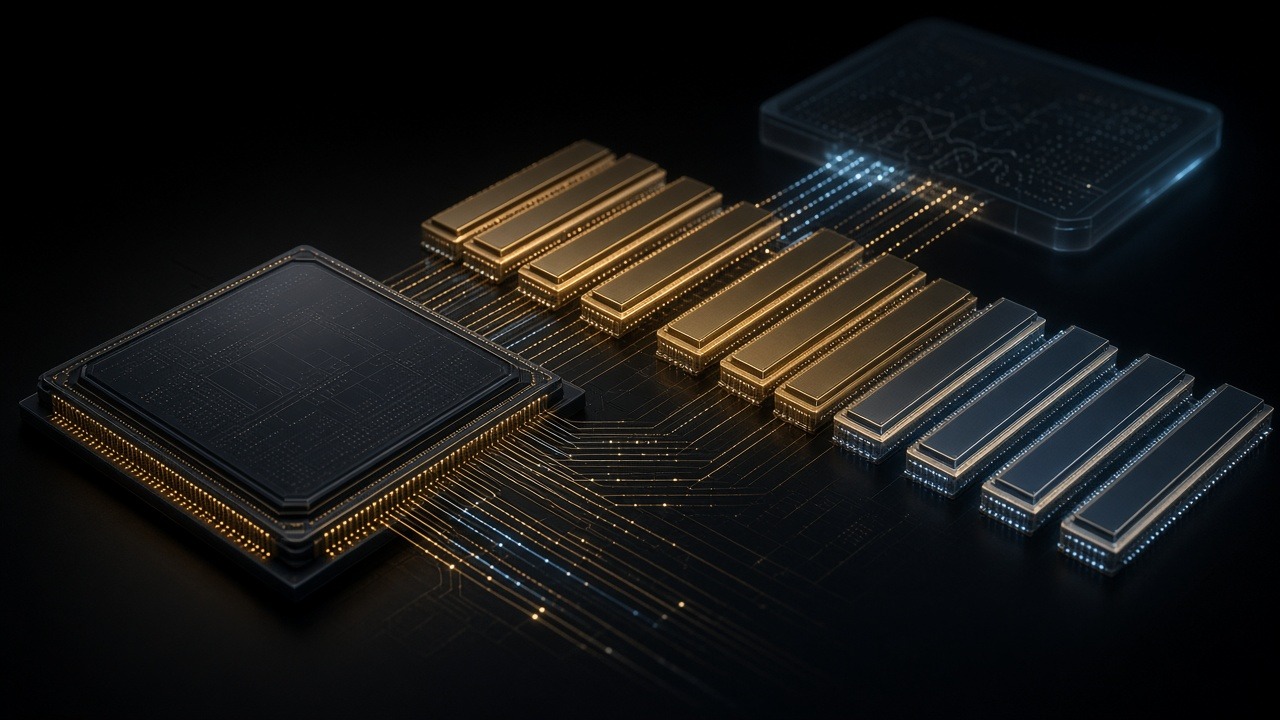
Structera CXL: expansion, near-memory compute, and DDR4/DDR5 demos
Marvell’s SC26 release is specific about what is on the floor for CXL: Structera add-in cards, near-memory compute, and expansion/compression solutions, plus partner memory demonstrations with Structera X memory-expansion controllers featuring both DDR4 and DDR5. A virtual rack at the booth pairs Teralynx T100 ODM switch trays with CXL solutions—useful as a packaging context, not as a reason to drift into switch-CPO territory.
The CXL product line, as documented on Marvell’s Structera pages and October 2026 second-generation blog, splits into familiar roles:
- Structera X — memory-expansion controllers.
- Structera A — near-memory accelerators (first-generation materials describe a CXL 2.0 / PCIe 5.0 design with Arm Neoverse V2 cores and inline LZ4).
- Structera S — CXL switches for pooling memory outside a single server.
The second-generation expanders, Structera X 3406 (DDR4) and Structera X 3506 (DDR5), were detailed by Marvell on 14 October 2026 and are the natural hardware behind this week’s “DDR4 and DDR5” partner demos. Marvell says both are CXL 3.2 devices on PCIe Gen 6 x16, co-developed with hyperscalers, with up to four-host connectivity and 256 GB/s of host bandwidth. The 3406 is specified with six DDR4 channels, up to 18 DIMMs (3 DPC) and 9 TB maximum capacity; the 3506 with six DDR5 channels, up to 12 DIMMs (2 DPC) and 6 TB. Marvell claims 5× higher LZ4 compression throughput versus the prior generation, with up to 250 GB/s of compression/decompression and 2–3× more effective capacity depending on the workload. Those multipliers are Marvell’s.
The DDR4 SKU is a supply-chain story as much as a silicon story. Marvell argues that a DDR5 crunch is disrupting expansion plans, and that X 3406 lets operators redeploy decommissioned DDR4 DIMMs as CXL-attached capacity. SC26 partner demos of both DRAM generations are the right place to ask how software sees that pool, what the coherent/non-coherent sharing model is across four hosts, and how compression interacts with KV-cache access patterns. “2–3× effective capacity” will not apply to incompressible cache state.
First-generation Structera X devices (X 2504 for DDR5, X 2404 for DDR4) remain on the public product page with CXL 2.0 / PCIe 5.0 ratings and lower channel counts. Operators already on Gen 1 should treat Gen 2 as a stated software-compatible upgrade path—again, Marvell’s claim—and verify it.
AECs: the unglamorous meters that still matter
Not every memory scale-up hop needs photonics. Marvell’s SC26 list includes Alaska A AEC DSP-based 1.6T and 800G active electrical cables. AECs are the short-reach workhorses that keep high-rate lanes alive between adjacent trays and racks when copper without DSP runs out of steam and optics would be overkill.
In a memory-centric design, those cables are part of the same latency budget as a CXL expander sitting one rack over. A Photonic Fabric link at up to 30 meters and an AEC across a cold aisle are complementary tools, not competing manifestos. The SC26 mention of both 800G and 1.6T AECs is also a reminder that electrical interconnect roadmaps are still moving even as optical memory fabrics get the keynote lighting.

Teralynx demos, and Dorado as a supporting act
Marvell’s booth is not only memory modules. The company lists a data-center simulator on Teralynx T100 switch silicon, a virtual rack of Teralynx T100 ODM switch trays with CXL gear, and multipath reliable connection (MRC) with Teralynx 10 switch silicon. Those demos matter here only insofar as they support memory and tight-domain traffic: multipath behavior, congestion, and a place to hang CXL trays. They are not an excuse to wander into long-distance fabrics.
A supporting, independently announced demo at the same Marvell booth (#4003) comes from Dorado Software, which said on 11 November 2026 that it would show live congestion detection and traffic re-steering during SC26 (it lists November 17–19 at the booth). Dorado describes its Cruz AI Fabric Controller as monitoring path timing, detecting congestion, and dynamically re-steering traffic across independent fabric planes; MRC as allowing traffic to use multiple paths and planes; Keysight (IXIA) as measuring throughput, latency, and packet loss; and Marvell Teralynx 10 as the switching silicon underneath. That is a useful floor illustration of multipath and congestion on Teralynx. It is not a source for Photonic Fabric or Structera performance numbers, and this article does not treat Dorado’s orchestration claims as Marvell specifications.
What this week’s showcase does—and does not—prove
SC26 is a demonstration week, not a shipment audit. The 13 November release confirms what Marvell intends to show. It does not, by itself, document customer production deployments, pricing, or independent latency bake-offs against electrical CXL switches or GPU-local HBM-only baselines.
A responsible reading of the portfolio:
- Photonic Fabric is the long-reach memory-semantic bet (Marvell: 30 m, <350 ns class, 7.2 Tbps per module, DDR5 plus HBM cache).
- Structera X/A/S is the electrical CXL bet, now with a second generation that leans into DDR4 reuse, DDR5 density, multi-host sharing, and compression—figures as published by Marvell in October and demoed this week with partners.
- Alaska A AECs fill the short, high-rate electrical gap at 800G and 1.6T.
- Teralynx demos (and the Dorado supporting exhibit) show multipath and operations around the same booth, not a new memory protocol.
Software compatibility claims—“preserving compatibility with existing AI software frameworks,” a “proven software stack” from Structera Gen 1 to Gen 2—need lab confirmation with the actual serving or training framework the buyer runs. Memory pooling that is invisible to the allocator is a different product from a pool that requires application changes.
A buyer’s checklist for the booth and the lab
1. Measure the memory path, not the slogan. For Photonic Fabric, instrument load-to-use latency and bandwidth from the accelerator through the PF-NIC into pooled DDR5, with and without the 72 GB HBM cache hot. Compare to local DRAM and to a conventional CXL expander.
2. Separate capacity marketing from KV-cache reality. Structera’s 9 TB / 6 TB maxima and 2–3× compression uplift are Marvell figures and workload-dependent. Incompressible KV state will not compress on cue.
3. Ask who owns the directory. Multi-host CXL (up to four hosts on Gen 2 X, in Marvell’s spec) and optical sharing across racks both require a coherent story for allocation, failure, and teardown.
4. Walk the 30 meters. If Photonic Fabric’s reach is a reason to pull memory out of the GPU rack, look at plant fiber, connectors, and repair. AECs will cover the shorter hops; do not force optics onto a one-meter problem.
5. Keep switch-CPO and campus DCI out of the same RFQ. Memory scale-up can share a booth with other interconnects and still be a distinct design decision.
6. Do not wait on unpublished panels. The 18 November photonics BoF may eventually produce slides or a recording; until they are published, they are not sources.
How the pieces are meant to stack in one aisle
It is easy to treat Photonic Fabric, Structera, and AECs as three brochure items. Marvell’s own framing is a stack.
Closest to the accelerator, HBM remains the hot tier; nothing in the SC26 list pretends otherwise. The next electrical step is a Structera X expander or Structera A near-memory card in the server or in a sibling tray, reached by PCIe/CXL and, where the run is short and the rate is 800G or 1.6T, by Alaska A active electrical cables. When capacity or reach outgrows that electrical envelope, Photonic Fabric is the proposed optical memory tier: PF-NIC at the host, PFMM appliances in a nearby rack, optical plant out to the 30-meter figure Marvell publishes. Structera S, in the broader CXL catalog, is the electrical pooling switch for operators who are not ready to light a memory fabric.
That stack only works if software addressing, failure domains, and telemetry line up. A KV cache that lives partly in HBM, partly in compressed DDR4 behind a 3406, and partly in a Photonic Fabric pool is three different reliability stories. SC26 is the right week to ask Marvell and its partners how a single inference job is supposed to place and evict data across those tiers—and to decline answers that skip telemetry.
Power is part of the same spreadsheet, even though this article does not wander into facility design. Optical hops exist in part to avoid spending watts on long electrical equalization; AECs exist in part to avoid spending watts and complexity on optics for a two-meter run. Operators should ask for joules per useful gigabyte moved, under a KV-cache trace, for each tier. Vendor architecture blogs will not substitute for that measurement.
What to ignore until it is written down
Two categories of material are easy to over-weight this week. The first is booth adjacency: storage controllers and DPU-based storage appear on Marvell’s SC26 demo list (Bravera SSD controllers, OCTEON DPU-based storage). They may share a cabinet with memory expanders; they are not Photonic Fabric. The second is the 18 November photonics Birds of a Feather. The session is on the program, with a Marvell executive listed. It has not, as of 16 November 2026, produced a public paper, slide deck, or transcript that can be cited. If a recording appears later, it can be added in a revision. It should not be invented here.
Outlook
Marvell’s SC26 message is that AI memory scale-up is now a networking problem: CXL controllers and add-in cards for electrical expansion, Photonic Fabric for an optical shared-memory tier, AECs for the last meters, and Teralynx silicon as the demo substrate for multipath. The dates are tight and checkable—an 13 November booth announcement, October Structera Gen 2 specs, an August Photonic Fabric architecture note, and a Chicago floor this week.
What remains unproven in public is the thing operators actually buy: predictable time-to-first-token and tokens per watt when a model’s working set no longer fits in HBM. That proof will come from instrumented pods, not from a scheduled Birds of a Feather session. For AI Hyperscale Infrastructure teams, the useful move this week is to walk booth 4003 with a latency budget in hand and to keep memory-semantic scale-up in its own workstream—beside, not mixed into, the switch-optics and long-haul debates.
Sources
- Marvell — “Marvell Scales Connectivity to Address AI Infrastructure’s Next Bottleneck at Supercomputing 2026” (13 November 2026). https://www.marvell.com/company/newsroom/marvell-connectivity-ai-infrastructure-supercomputing-2026.html
- Marvell — “Photonic Fabric Technology: How Optical Connectivity Enables the Next Generation of AI Infrastructure” (4 August 2026). https://www.marvell.com/blogs/photonic-fabric-technology-optical-connectivity-ai-infrastructure.html
- Marvell — “Scaling AI Inferencing with the Second Generation of Marvell Structera X…” (14 October 2026). https://www.marvell.com/blogs/scaling-ai-inferencing-with-the-second-generation-of-marvell-structera-x.html
- Marvell — Structera CXL product page. https://www.marvell.com/products/cxl.html
- Marvell — Supercomputing 2026 event page (BoF listing). https://www.marvell.com/company/events/supercomputing-sc26.html
- Dorado Software — “See us at SC26 – Chicago” (11 November 2026). https://www.doradosoftware.com/about/news/sc26
Images: original illustrations generated for AndBeyond.Tech; no logos or real people depicted.