Microsoft Fairwater and the Rise of the Distributed AI Superfactory
How Microsoft Fairwater links Wisconsin and Atlanta into one AI superfactory: liquid cooling, AI WAN cluster networking and the shift to multi-campus AI.
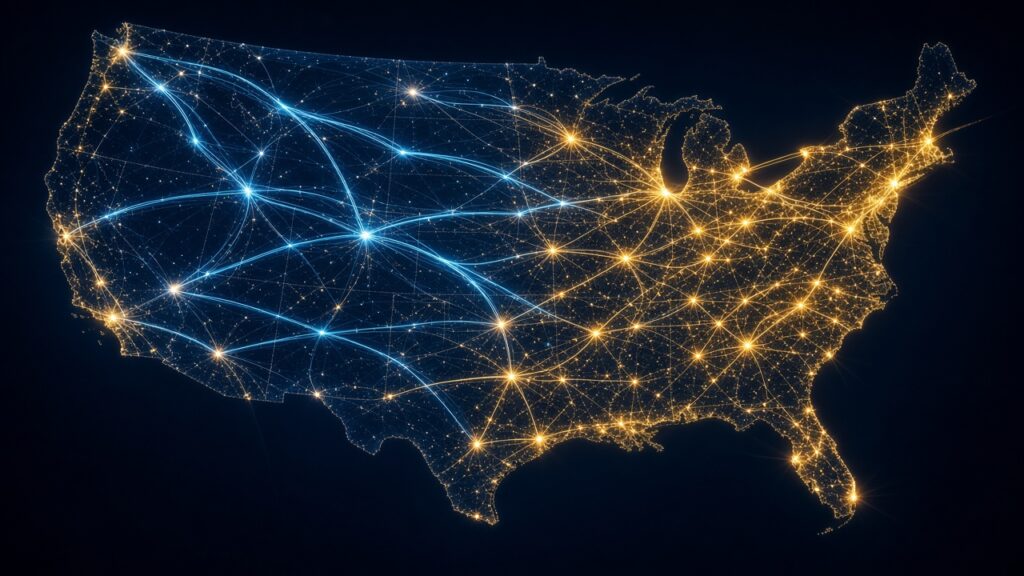
For most of the cloud era, the data center was the unit that mattered. You built a building, filled it with servers, connected it to the internet, and many unrelated customer workloads shared the space. Frontier AI broke that model once, when training clusters became single machines the size of a building. Now it is breaking it again. With Fairwater Microsoft, the company is betting that the next unit of compute is not a building, or even a campus, but a network of campuses hundreds of kilometres apart that behave as one machine. Microsoft calls it an AI superfactory.
This article looks at what Fairwater actually is, how a distributed AI data center differs from a single giant campus, what it takes to network GPUs across state lines, and why the real driver may be electricity rather than silicon.
What Fairwater is
Microsoft first revealed Fairwater in September 2025 with a site in Mount Pleasant, Wisconsin. In a post on the Official Microsoft Blog, Scott Guthrie, Executive Vice President of Cloud + AI, called it the largest and most sophisticated AI factory the company had built so far. He also said several identical Fairwater data centers were under construction elsewhere in the US.
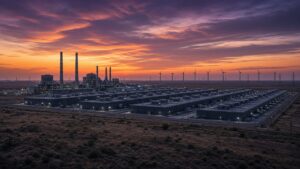
The Wisconsin campus is big even by hyperscale standards. Microsoft says it covers 315 acres, with three buildings totalling 1.2 million square feet under roof. Building it took 46.6 miles of deep foundation piles, 26.5 million pounds of structural steel, 120 miles of medium-voltage underground cable and 72.6 miles of mechanical piping. Microsoft says the site runs one cluster of interconnected NVIDIA GB200 servers on a single flat network spanning hundreds of thousands of GPUs. The company also claims it will deliver ten times the performance of today’s fastest supercomputer. That is Microsoft’s own comparison, and it gave no benchmark methodology in the post.
Two months later, in November 2025, Microsoft announced the second Fairwater site, in Atlanta, Georgia. Guthrie’s post on the architecture says Atlanta connects to Wisconsin, to earlier generations of Microsoft AI supercomputers, and to the wider Azure footprint, forming what the company calls “the world’s first planet-scale AI superfactory.” A companion feature on Microsoft’s Source newsroom says, as reported in its published extract, that the Atlanta facility started operating in October 2025. It shares Wisconsin’s architecture, and further Fairwater sites under construction will join the same network over time.
Microsoft also tied Fairwater to its wider AI build-out abroad. The September post mentioned a planned hyperscale AI data center in Narvik, Norway, with nScale and Aker JV, and a partnership with nScale in Loughton, UK, to build what Microsoft called the UK’s largest supercomputer. Microsoft says those sites will use similar clusters based on NVIDIA’s GB300. They are not branded Fairwater in that post, but they belong to the same story: purpose-built AI capacity designed to plug into a global network of more than 400 data centers in 70 regions.
Design goals: density, cooling and a two-story hall
The engineering behind Fairwater starts with one constraint. In Guthrie’s words, the speed of light has become a key bottleneck. When tens of thousands of accelerators have to exchange gradients many times a second, every metre of cable adds latency. So the first design rule is density: put as much compute as possible as close together as possible.
That shows up in three ways.
Rack-scale accelerators. Each Fairwater rack holds up to 72 NVIDIA Blackwell GPUs in a single NVLink domain. Microsoft cites 1.8 TB of GPU-to-GPU bandwidth per rack and more than 14 TB of pooled memory available to each GPU. The company says a GB200 rack can process 865,000 tokens per second, which it calls the highest throughput of any cloud platform. That is a vendor claim.
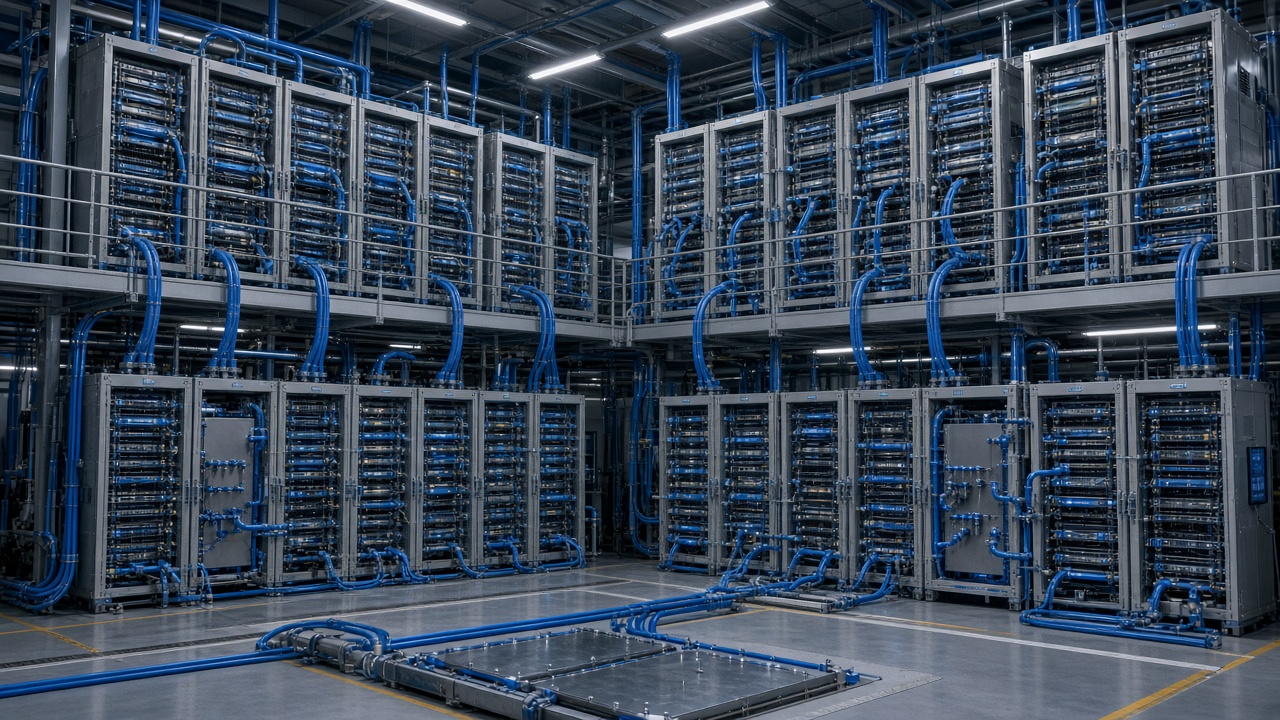
Liquid cooling at facility scale. Air cooling cannot remove heat at these densities. Fairwater uses closed-loop liquid cooling that delivers coolant to cold plates on the servers. According to Microsoft, the liquid is reused continuously after the initial fill, with no evaporation. That initial fill is about what 20 homes use in a year, and the system is designed to last six years or more before the water chemistry might require replacement. The Wisconsin post describes the site as backed by the second-largest water-cooled chiller plant on the planet, with 172 twenty-foot fans on the cooling “fins” on either side of the buildings. Liquid cooling lets Microsoft push rack power to about 140 kW, and row power to 1,360 kW.
Building in three dimensions. Fairwater halls are two storeys high. Racks connect to neighbours above and below as well as beside them, which shortens the longest cable runs. Microsoft says this improves latency, bandwidth, reliability and cost, a reminder that floor plans have become a networking decision.
The compute halls are only part of the picture. Microsoft says Wisconsin also relies on a separate storage-and-compute data center whose storage systems are “five football fields in length.” The company also says it re-engineered Azure Blob Storage so each account can sustain more than two million read/write transactions per second. A frontier training run is a data-logistics problem as much as a FLOPS problem.
Superfactory vs. single mega-campus
A single-campus strategy is straightforward: find one site with enough land, water and, above all, power, then build the largest coherent cluster possible. The model has clear strengths. Latency between any two GPUs is bounded by the size of the building, synchronous training is well understood, and operations are concentrated.
Its weakness is that power, land and grid interconnection do not scale smoothly. Guthrie’s November post says it directly: compute demand for large training jobs, now measured in trillions of parameters, is “quickly outpacing the power and space constraints of a single facility.”
Fairwater keeps the single-campus idea inside each site. Every Fairwater data center runs one coherent cluster. The superfactory then adds another layer on top. Microsoft describes three tiers of networking:
- Scale-up inside the rack (NVLink, 72 GPUs).
- Scale-out across the site, on a flat back-end network spanning hundreds of thousands of GPUs.
- Cross-site, over a dedicated AI WAN linking Fairwater campuses and older supercomputers.
The important change is that workloads can be placed on the tier that suits them. Microsoft points out that “training” is no longer one monolithic job. It now covers pre-training, fine-tuning, reinforcement learning, evaluation and synthetic data generation, each with different communication patterns. Before, Guthrie writes, all traffic had to use the scale-out network regardless of need. In a superfactory, a latency-sensitive tensor-parallel job stays inside a rack, a large data-parallel pre-training run can spread across a site, and looser-coupled jobs such as synthetic data generation or RL rollouts can run in other locations. Microsoft calls the goal fungibility: keeping GPUs busy across the whole system, not just within one building.
This is what distinguishes a true distributed AI data center from a set of large data centers that happen to share an owner. The sites are designed to be scheduled as one pool.
Cluster networking across sites
Inside the site: Ethernet at extreme scale
Microsoft’s descriptions of the in-site fabric have changed between posts, and the change matters. The September Wisconsin post says Azure uses both InfiniBand and Ethernet fabrics at 800 Gbps in a non-blocking full fat-tree to connect racks into pods. The November superfactory post, which focuses on Fairwater’s architecture, describes a two-tier, Ethernet-based back-end network with 800 Gbps GPU-to-GPU connectivity. It runs on SONiC, Microsoft’s own open network operating system, on commodity switches. Microsoft presents this as a way to avoid vendor lock-in and control costs, and says the design scales “beyond traditional Clos network limits” with current-generation switches.
To make Ethernet behave at that scale, Microsoft cites packet trimming, packet spraying, high-frequency telemetry and closer control over network routes. Together, these provide congestion control, fast loss detection and retransmission, and adaptive load balancing. These are the same problems the industry’s Ultra Ethernet efforts target. Fairwater shows a hyperscaler betting that an open, Ethernet-based stack can carry frontier training without proprietary fabrics.
Between sites: the AI WAN
The cross-site layer is the novel part. Microsoft says it built a dedicated AI WAN optical network to extend Fairwater’s scale-up and scale-out networks across regions. It also says it deployed more than 120,000 new fiber miles across the US in the year before the November 2025 post. The Source feature describes the AI WAN, as reported in its extract, as letting data move between sites many states apart with minimal bottlenecks, so that multiple sites can cooperate on near-real-time training. The same piece says the distributed design targets models with hundreds of trillions of parameters and could cut some training jobs from months to weeks. Both are forward-looking claims from Microsoft.
On bandwidth, HPC engineer Glenn K. Lockwood’s public notes on multicluster training quote Guthrie saying the AI WAN supports up to 400 terabits of network bandwidth. This figure is as reported via that secondary source; the original transcript was not located for this draft.
The physics problem
Microsoft has not published latency figures for the Wisconsin–Atlanta link. The trade-offs are clear in principle, though. Light in fiber covers roughly a kilometre every five microseconds, so sites hundreds of kilometres apart add round-trip delays measured in milliseconds. Inside a rack or a hall, delays are measured in microseconds. A secondary trend briefing from the 311 Institute, citing The Register, puts the distance between Mount Pleasant and Atlanta at about 1,000 km, as reported.
That gap shapes what can run across sites. Tightly synchronous operations such as tensor parallelism cannot tolerate WAN latency and have to stay inside a site. Data parallelism is more forgiving, especially with hierarchical gradient reduction, overlapping communication with computation, or less frequent synchronisation. This is the “hierarchy of fabrics” pattern Lockwood describes: within-site communication is fast and dense, cross-site communication is slower and needs to be used sparingly, and training software has to be built around that asymmetry. The superfactory works only if schedulers and frameworks respect those boundaries.
The energy and power systems angle
Microsoft does not put it this way, but the strongest argument for distribution may be electrical. The same 311 Institute briefing summarises, as reported, that a single site struggles to get enough power for the largest training runs. It also says Microsoft’s argument is that linking sites lets it choose locations with cheaper land, cooler climates and ample power. Distribution turns one impossible grid interconnection request into several difficult but achievable ones.
Fairwater’s power design reflects that thinking. For Atlanta, Microsoft says it picked the site for resilient utility power that can deliver “4×9 availability at 3×9 cost.” Because the grid supply is so reliable, Microsoft says it can drop traditional resiliency layers for the GPU fleet: no on-site generation, no UPS systems, no dual-corded distribution. That is a significant departure from conventional data center practice. It also shows how site selection becomes a power-engineering decision once compute can live anywhere on the WAN. Another implication follows: if one site has a problem, part of the resilience can come from the network of sites rather than from diesel generators in the yard. Microsoft does not say this explicitly, but Google’s Thomas Kurian made the same point about multi-site training, as discussed below.
A second power issue is less obvious: load oscillation. Large synchronous training jobs draw power in waves as thousands of GPUs move together between compute and communication phases. At hundreds of megawatts, those swings can become a grid stability problem. Microsoft says it co-developed three mitigations with partners:
- a software approach that runs supplementary workloads during low-activity periods to smooth demand;
- a hardware approach in which GPUs enforce their own power thresholds; and
- on-site energy storage to absorb fluctuations without wasting extra power.
Distribution helps here too. The swings in a 2 GW job are much easier for a utility to handle when they are split across several grids. The cost is complexity: every site still needs to manage its own power profile, and the WAN becomes a critical dependency.
Water is the third part of the energy picture. Microsoft says more than 90% of its data center capacity uses the closed-loop system, and the remaining traditional servers use outside air, switching to water only on the hottest days. Communities near hyperscale campuses usually ask about water and power first, and Fairwater’s messaging leads with both.
Industry context: everyone is going multi-site
Microsoft brands the AI superfactory, but it did not invent multi-site training.
Google got there early. In a Data Center Dynamics interview, as reported in the published extract, Google Cloud CEO Thomas Kurian said Gemini Ultra was trained “across multiple sites, and multiple clusters within those sites.” He explained that distribution provides resilience if one location has power problems and allows a bigger overall cluster given space and power limits. DCD notes that Google links TPU SuperPods of 4,096 chips through intra- and inter-cluster networks, using model parallelism within a SuperPod and data parallelism across SuperPods. That is the same hierarchy Fairwater formalises.
OpenAI has, as reported by Lockwood and the 311 Institute, confirmed training GPT-4.5 across multiple clusters. NVIDIA announced Spectrum-XGS Ethernet in August 2025 to connect data centers across cities and continents into what it calls giant AI factories, with CoreWeave among the early adopters, as reported. Cisco and Broadcom have reportedly released routers designed to link AI data centers up to about 1,000 km apart, as reported by The Register via the 311 briefing. I have not checked these vendor claims against primary NVIDIA, Cisco or Broadcom pages for this draft.
Taken together, this points to a clear direction. The industry is building the hardware, protocols and software for training runs that span regions, and Microsoft’s AI WAN is the most visible example so far.
2026 status: from blueprint to live campus
Trade and local reporting in 2026 filled in the timeline that the 2025 Microsoft blogs left open. As reported by MLQ News and Inside the Datacenter, Microsoft declared the first Mount Pleasant Fairwater building fully operational on 23 June 2026, after roughly two years of construction that employed nearly 10,000 workers at peak. Those accounts place the campus on the former Foxconn site in Racine County and describe a second adjacent facility targeted for 2028, with local approvals earlier in 2026 for a much larger multi-building expansion.
Data Center Frontier’s Fairwater blueprint feature (updated after filing) reported Wisconsin investment of about $7.3 billion in state filings reviewed via Data Center Dynamics, with Phase 1 peak demand near 400 MW and full build-out approaching about 900 MW—figures that remain secondary to Microsoft’s own blog claims and should be treated as reported, not as audited Microsoft disclosures. The same piece notes prepaid grid upgrades, temporary gas generation for early reliability, and community programmes such as a Datacenter Academy with Gateway Technical College.
Separately, Bloomberg reported in September 2026 that Microsoft plans to grow global data-center capacity from roughly 12 GW to more than 38 GW by 2032, citing people familiar with the plans; Reuters relayed the figure the same day and said Microsoft did not comment. That capacity roadmap is not Fairwater-specific, but it is the corporate backdrop against which multi-campus AI superfactories make sense: Microsoft is sizing a fleet, not a single hall.
Outlook
Several questions will show whether the AI superfactory becomes the default architecture or stays a niche approach for the largest labs.
How tightly can sites couple? If cross-site training stays limited to loosely coupled phases, the superfactory is mainly a utilisation and scheduling improvement. If new training algorithms and network gear cut the cost of synchronising across 1,000 km, it becomes a true scale multiplier.
How many sites join? Microsoft has said more Fairwater sites are under construction in the US. The 311 Institute lists more sites joining the linked cluster beyond Wisconsin and Atlanta as a signal to watch. Each new site tests whether the model holds up operationally.
Will power stay the binding constraint? If on-site generation or large new grid connections make single gigawatt campuses easy again, some of the case for distribution weakens. For now, interconnection queues and local opposition suggest the opposite.
Who builds the long-haul fiber? Microsoft’s reported 120,000 new fiber miles in one year suggests that private optical backbones dedicated to AI traffic could become as strategic as GPU allocations.
The bigger point is that frontier AI infrastructure is turning into a distributed system in the computer-science sense: partitioned, hierarchical, latency-aware and scheduled as a whole. Fairwater is Microsoft’s first serious attempt to run one at continental scale. The data center is no longer the computer. The network of data centers is.
Related reading
- The Texas AI Factory Race: Why Hyperscalers Are Betting Tens of Billions on One State
- How Distributed AI Superfactories Stretch the Network Between Campuses
- InfiniBand vs Ethernet for AI Clusters
References / Sources
- Scott Guthrie, “Inside the world’s most powerful AI datacenter,” Official Microsoft Blog, 18 Sep 2025 — https://blogs.microsoft.com/blog/2025/09/18/inside-the-worlds-most-powerful-ai-datacenter/ (primary, fully read)
- Scott Guthrie, “Infinite scale: The architecture behind the Azure AI superfactory,” Official Microsoft Blog, 12 Nov 2025 — https://blogs.microsoft.com/blog/2025/11/12/infinite-scale-the-architecture-behind-the-azure-ai-superfactory/ (primary, fully read)
- “From Wisconsin to Atlanta: Microsoft connects datacenters to build its first AI superfactory,” Microsoft Source — https://news.microsoft.com/source/features/ai/from-wisconsin-to-atlanta-microsoft-connects-datacenters-to-build-its-first-ai-superfactory/ (primary; search extract only)
- “Training Google’s Gemini: TPUs, multiple data centers, and risks of cosmic rays,” Data Center Dynamics — https://www.datacenterdynamics.com/en/news/training-gemini-tpus-multiple-data-centers-and-risks-of-cosmic-rays/ (search extract)
- Glenn K. Lockwood, “Multicluster training” — https://glennklockwood.com/garden/multicluster-training (secondary; search extract)
- 311 Institute, “Multi-Site AI Training: 2026 trend briefing” — https://www.311institute.com/starburst-centre/trend/multi-site-ai-training/ (secondary tracker; search extract)
- David Chernicoff, “Inside Microsoft’s Global AI Infrastructure: The Fairwater Blueprint for Distributed Supercomputing,” Data Center Frontier, 9 Oct 2025 (with later updates) — https://www.datacenterfrontier.com/hyperscale/article/55317925/inside-microsofts-global-ai-infrastructure-the-fairwater-blueprint-for-distributed-supercomputing
- MLQ News, “Microsoft Brings First Mount Pleasant, Wisconsin Data Center Online at Former Foxconn Site” — https://mlq.ai/news/microsoft-brings-first-mount-pleasant-wisconsin-data-center-online-at-former-foxconn-site/ (secondary; search extract / 2026 ops claim)
- Inside the Datacenter, “Every Data Center in Wisconsin” — https://insidethedatacenter.com/articles/wisconsin-data-centers/ (secondary; Jun 2026 operational note)
- Bloomberg via Global Data Center Hub summary, “Microsoft Data Center Capacity Plan: 38 GW By 2032,” Sep 2026 — https://www.globaldatacenterhub.com/p/microsoft-data-center-capacity-38gw-2032 (Bloomberg/Reuters secondary; Microsoft did not confirm)
Images: original illustrations generated for AndBeyond.Tech; no logos or real people depicted.