Why Robots Still Fail Outside the Lab — and the 10,000 Hours of Workplace Video Meant to Fix That
A robot that stacks blocks on a clean laboratory table can look almost ready for the factory. Move it to a real workshop — a…
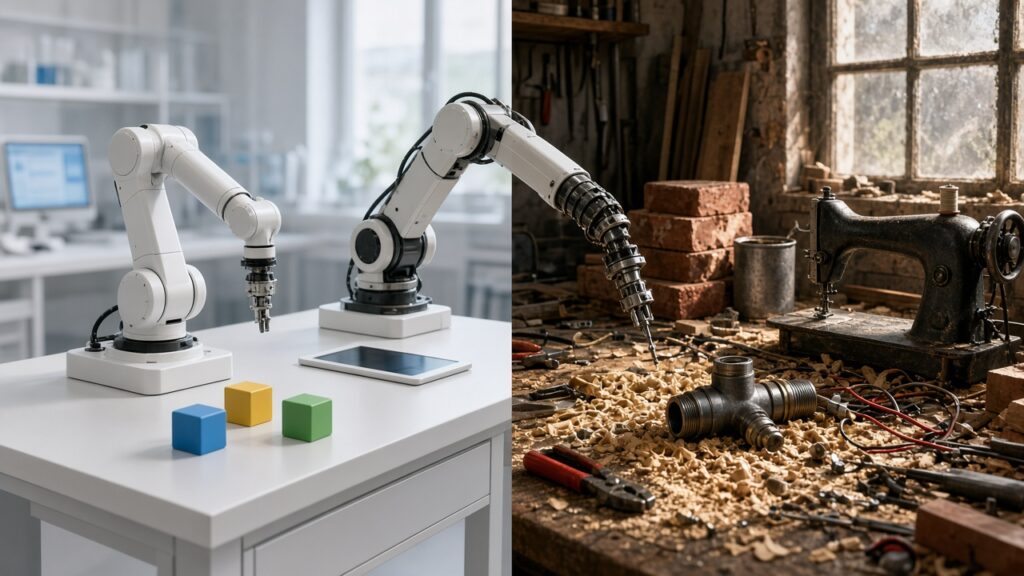
A robot that stacks blocks on a clean laboratory table can look almost ready for the factory. Move it to a real workshop — a bench covered in offcuts, a kitchen mid-service, a renovation site with cables on the floor — and the same skill often falls apart. The lighting is harsher, the tools are slightly different, and the object is never quite where the training set left it. That gap is not a curiosity for researchers alone. It is a problem for anyone hoping to put a general-purpose arm on a shop floor, in a warehouse, or beside a tradesperson.
On 16 November 2026, Hub Labs (Hub Data, Inc.) released the first public slice of a dataset built around that problem. The collection is called HubEgo-100K. The “100K” in the name is the program’s target: staged releases toward 100,000 hours of video. Version 1.0, the one available today, is much smaller and still large: Hub Labs reports 10,124 hours of first-person video of skilled manual work [1][2][3].
The company has not yet published results from a robot policy trained on this data. What it has published is the footage, the labels, a technical paper, and a clear bet: if robots fail because they have not seen enough real workplaces, then the missing ingredient is many people, filming their own work, in their own spaces.
What “first-person” video is, and why it matters
First-person, or egocentric, video is footage filmed from the wearer’s point of view, usually with a camera on the head, so you see the hands, the tools and the task as the person doing the work sees them.
That viewpoint is close to what a robot’s wrist or head cameras will see when it tries the same job. It is also cheaper to collect than a teleoperated robot demonstration: the worker already knows the craft, and no robot has to be in the room. Earlier projects have used the same idea in different ways — from open video models pretrained on web footage to handheld grippers that record a task without a robot present. HubEgo-100K is trying to fill a more specific hole: skilled work, filmed in the wild, at the scale of thousands of workplaces.
The closest well-known predecessor is Ego4D, a 2022 collection of first-person daily-life video. Its paper reports 3,670 hours recorded by 931 camera wearers in 74 locations across nine countries, covering households, leisure, commuting and some workplace scenes [4]. Hub Labs argues that this kind of everyday footage still contains relatively little of the trades a factory or construction robot would need to imitate — bricklaying, wiring, industrial sewing, watch repair, phone-board soldering, engine work [2]. Version 1.0 is aimed at that gap.
What Hub Labs says is in version 1.0
All of the figures in this section come from Hub Labs, in its dataset page, its Hugging Face card and its accompanying paper [1][2][3].
- 10,124 hours of 1080p video (about 1.09 billion frames), recorded at 30 frames per second with one head-mounted phone, plus motion-sensor readings 100 times a second that capture how the wearer’s head was moving.
- 72,754 episodes, typically a few minutes long (a median of 4.9 minutes, and no episode longer than 30 minutes).
- 12,227 contributors filming in 15,548 environments. An “environment” here means one person’s own setting of one type, such as their kitchen or their workshop.
- 83% of the hours filmed in workplace settings (the paper’s finer breakdown is 82.6%), including trades carried out in someone’s home, such as plumbing or electrical work; the rest is household work.
- Work spread across 11 setting types, 30 work categories, 56 task types and 35 families of hand actions. Hub Labs says 18 categories each hold more than 200 hours, and that no single category or action family dominates (the largest category is 13.1% of hours; no action family exceeds 10%).
- The license is CC BY 4.0: free to use, share and adapt, including for commercial use, with credit. Access on Hugging Face is through a short form with automatic approval. The data is packaged in two open formats used by robot-learning tools: LeRobot, a standard layout for robot datasets, and MCAP, a file format for time-stamped sensor recordings.
Contributors filmed a named but unscripted task during their own work, with their own tools, in their own workplace or home. There were no staged studio sessions. Hub Labs also reports, from automatic estimates, that at least one hand appears in 94.7% of sampled frames and both hands in 76.3%, and that about 96.9% of the kept time is spent actually doing the task [1][2].

What “annotation” means — and who wrote these ones
An annotation is a label added to a recording so a computer can find it and learn from it: a short description of the task, a difficulty rating, the type of action, where it was filmed.
Every episode in version 1.0 has such labels: a short task description, a one- or two-sentence instruction covering the goal, actions and objects, an action family, a skill group, a difficulty level (easy, medium or hard) and a setting type [1][2][3]. Hub Labs reports that 34% of the hours are labelled hard and 47% medium [1][3].
These labels are largely automatic. The paper is explicit: the release comes with “machine-generated action and language annotations” [2]. A vision-language model — a system that looks at video and writes text — cuts each recording down to the stretches where the wearer’s hands are doing the named task, then writes the descriptions and category labels. Human review, “where available”, can override the automatic cuts, but the descriptions themselves are produced by the model, not narrated by the worker [2]. That is useful at this scale, and it is also a reason to treat the labels as a starting point, not as a gold standard signed off by every tradesperson in the set.
Consent and privacy, as the sources describe them
The sources are not silent on this point. Hub Labs states that every contributor agreed that their recordings may be used to train and evaluate AI and robotics systems [1][2][3]. It says that before release it removed: stretches where a child, another person’s face, or private text (documents, screens, cards, license plates) was detected, cut with a five-second margin; recordings in which faces fill a large share of the footage; episodes in which the video annotation detected a minor; care tasks performed on another person; and audio, location, device identifiers and contributor identity. Identifiers in the public release are pseudonymous strings; phone make and model are kept as capture metadata [1][2][3]. The paper also notes that the dataset was collected by a company and not as an institutional human-subjects study [2].
A preprint, and no robot results yet
The accompanying paper, “HubEgo-100K: In-the-Wild Egocentric Video of Skilled Work for Robot Learning” (arXiv:2611.21938), is a preprint: a paper posted publicly before other researchers have formally reviewed it [2].
The authors measure how diverse the footage is and relate that to earlier studies on what helps a robot policy — the software that turns camera images into motor commands — succeed in new places. They do not, in this version, train or evaluate a robot on HubEgo-100K. They write that their next step is to train baselines, including visual encoders pretrained on the data and policies co-trained with robot data, and that “later versions of this paper will add these experiments and cover subsequent releases” toward 100,000 hours [2].
That absence matters. Earlier work has already shown that first-person human video can help, under specific conditions. EgoMimic, a 2025 paper by Kareer and colleagues, trained one policy on both robot demonstrations and first-person human video with hand tracking; the authors report that adding the human footage improved task scores by 34 to 228% over robot data alone, on their own tasks and robots [5]. That is evidence for the general approach, not a result for HubEgo-100K. Until someone publishes a policy trained on this new workplace footage, the 10,124 hours remain a resource, not a proof.
What this changes, and what it does not
If the program reaches its 100,000-hour target, first-person video of real work will sit beside robot demonstrations and synthetic or web video as one of the main raw materials for generalist robot models. For industrial teams, the practical hope is narrower: a policy that has watched thousands of real benches, kitchens and sites may fail less often when the next workshop does not look like the lab.
Several limits stay in view, all of them documented by Hub Labs or obvious from what is missing:
- Version 1.0 is 10,124 hours, not 100,000. The name describes the destination.
- The footage is human video, not robot video. Hands, timing and camera motion still have to be translated into a particular robot’s body, which is why collections recorded with handheld grippers on the tool itself remain complementary.
- The annotations are mostly model-written, with human overrides only where they were available.
- After rebalancing across task types, as the authors note, the mix of work in version 1.0 does not reflect how often each task occurs in the world, so models trained on it should be tested in the conditions where they will actually run [2].
- No robot-policy numbers have been published on this dataset yet.
Bottom line
Robots still fail outside the lab in part because they have practised in too few messy, real places. HubEgo-100K v1.0, released on 16 November 2026, is Hub Labs’ first open attempt to change that: 10,124 hours of first-person workplace video from 12,227 contributors in 15,548 environments, under a CC BY 4.0 license, with the 100,000-hour figure as a target for later releases. The labels are largely automatic, the supporting paper is an unreviewed preprint, and no robot has yet been shown to improve because of this footage. The value, for now, is the thing factories and trades have been short of: a large, open window onto skilled work as it actually looks from the person doing it.
References / Sources
- Hub Labs — HubEgo-100K dataset page (v1.0 released 16 November 2026). https://hub.xyz/datasets/hubego-100k
- Javad Amirian, Armin Kiani, Loïc Schaeffer, Tim Sprecher, Mohamed Taha, Karthik Yadati — “HubEgo-100K: In-the-Wild Egocentric Video of Skilled Work for Robot Learning”, arXiv:2611.21938 (preprint, not peer-reviewed). https://arxiv.org/abs/2611.21938
- Hub Labs — Hugging Face dataset card,
HubLabs/HubEgo-100K(CC BY 4.0; LeRobot and MCAP formats). https://huggingface.co/datasets/HubLabs/HubEgo-100K - Kristen Grauman et al. — “Ego4D: Around the World in 3,000 Hours of Egocentric Video”, CVPR 2022; project site. https://arxiv.org/abs/2110.07058 · https://ego4d-data.org/
- Simar Kareer, Dhruv Patel, Ryan Punamiya et al. — “EgoMimic: Scaling Imitation Learning via Egocentric Video”, arXiv:2410.24221; ICRA 2025. https://arxiv.org/abs/2410.24221 · https://egomimic.github.io/
- Related reading: AndBeyond.Tech — When Video Models Go Open: Runway’s Praxis-1; No Robot Required: AIRoA-0 and Handheld Grippers.
Images: original illustrations generated for AndBeyond.Tech; no logos or real people depicted.