No Robot Required: AIRoA-0 and Scaling Manipulation from Handheld Grippers
Most robot foundation models still scale with the number of robots you can staff, because someone has to teleoperate those robots to grow the dataset….
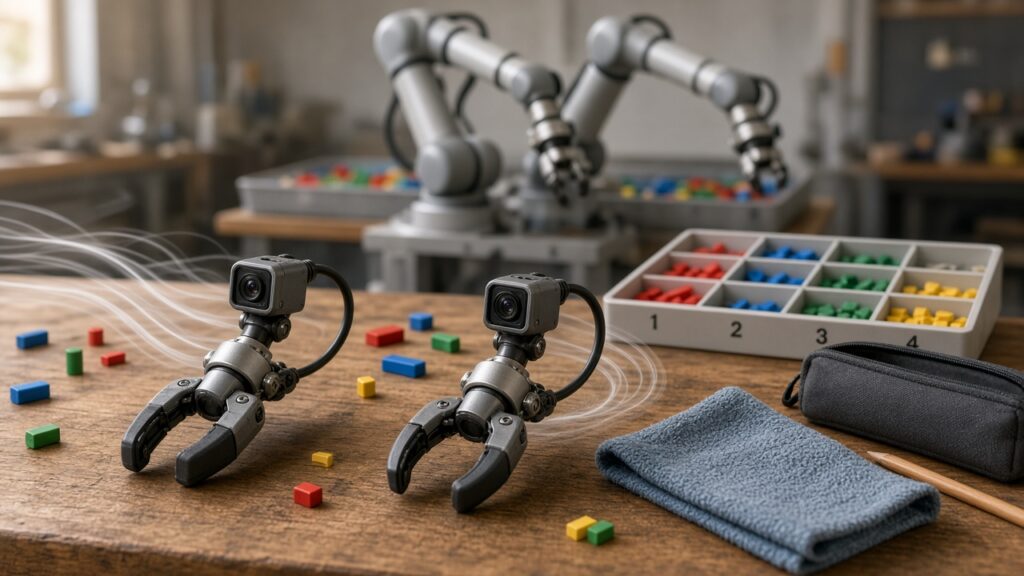
Most robot foundation models still scale with the number of robots you can staff, because someone has to teleoperate those robots to grow the dataset. A different bet says the bottleneck should be people, not arms: put a camera and a tracker on a handheld gripper, let anyone record a task at a kitchen table or a workbench, and only later mount the same gripper on a robot.
On 6 November 2026, Japan’s AI Robot Association (AIRoA) released AIRoA-0 (A-0), a bimanual vision-language-action model trained that way [1]. The accompanying technical report, “AIRoA-0: Long-Horizon, Precise, Cross-Embodiment Manipulation from Handheld Data” (arXiv:2611.03815), is an arXiv preprint and has not been peer-reviewed [2]. The headline result — 78% average success versus 27% for the strongest of four other VLAs post-trained on the same task data — comes from a specific protocol: ten tasks, fifteen trials each, on a bimanual Franka, at a site where none of the training data was recorded, with partial credit for partly completed tasks [1][2][3].
This article stays inside those conditions, and it states clearly what has and has not been released.
The idea: record with your hands, deploy on any arm that takes the gripper
The hardware is YUBI (Yielding Universal Bidigital Interface), an open-source handheld gripper. A person holds one gripper in each hand and does the task. Each gripper carries a wrist camera and is tracked in six degrees of freedom; the recording stores the two wrist views, the trajectory of each gripper, and how far each jaw is open [1][2]. The hardware design comes from Toyota Motor Corporation’s Frontier Research Center; the collection software comes from AIRoA; both, AIRoA says, are already publicly available [1]. The approach follows the earlier UMI line of handheld demonstration tools [2][3].
Because the same gripper later mounts on a robot as its end effector, the images and the actions stay in a shared frame: what the demonstrator saw at the wrist is close to what the robot will see, and the policy outputs gripper poses (position and orientation), not robot-specific joint angles. Each platform’s controller then turns those poses into arm motion [1][2]. In principle, any robot that can carry YUBI can run the same weights.
That is also a constraint. A-0 does not see a head or scene camera — only the two wrist views — and nothing in the training data shows a robot acting, failing or recovering [2][3]. Deployment at a site the recorders never visited is, the authors argue, the ordinary condition of this method, not a special stress test [2].
What was trained — and what is not yet public
AIRoA reports 16,151 hours of bimanual YUBI demonstrations, amounting to 10.65 million subtask segments (about 5.5 seconds on average) and 1.74 billion time steps at 30 Hz. Every segment carries a task instruction and a subtask instruction. The corpus covers well over a hundred tasks, including pick-and-place, sorting, assembly, insertion, cable routing, opening and closing, tool use and handovers [2][3]. Starting from the π0.5 base weights released by Physical Intelligence, AIRoA says it used this handheld data only: no teleoperation, no reinforcement learning, and no on-robot corrections [1][2].
The system has four parts designed together: data processing (filtering, outlier detection, retiming), pre-training on the full corpus, post-training that adds a prediction of the stage the task has reached and a memory of recent motion, and an inference harness that smooths the predicted stage and decodes actions as a stream [2][3]. AIRoA says a new task can be post-trained in under four hours on a single node of eight H200 GPUs [3].
The 16,151-hour dataset itself has only been announced, not released. The preprint and the project page say the authors “are releasing” the corpus [2][3]. AIRoA’s official 6 November update is more precise: the organisation “plans to release the dataset used for training”, and “details, including the release timing, scope, and instructions for use, will be announced on the AIRoA website once finalized” [1]. As of this writing, the training corpus does not appear as a published dataset alongside the weights. What is out, according to the official update, are pre-trained and post-trained model weights on Hugging Face, plus data-collection, post-training and inference code on GitHub, offered for research and development [1].
Until the dataset actually ships, outside groups can fine-tune A-0 on their own YUBI recordings, but they cannot independently re-run pre-training at the reported scale or audit the 16,151 hours.
The 78% versus 27% result, with its protocol
All of the comparison numbers below come from AIRoA’s evaluation, as reported in the official update, the project page and the preprint [1][2][3]. They are not an independent re-evaluation.
Protocol [1][2][3]:
- Embodiment for the main comparison: a bimanual Franka.
- Site: distinct from every recording site — none of the training data was collected there.
- Tasks: 10 bimanual tasks, each specified by a single instruction given once at the start.
- Trials: 15 per task.
- Scoring: success rate averaged over those trials, with partial credit when a task is only partly completed.
- A-0: one post-training recipe on every task.
- Baselines: four other VLAs — π0.5, Xiaomi-Robotics-1 (XR-1), GR00T N1.7 and MolmoAct2 — each starting from its public pretrained checkpoint, post-trained on the same task demonstrations, with the paper reporting each baseline’s best result over a search of action horizons, action frequencies and update counts [2].
| Task (post-training hours of handheld demos) | A-0 | π0.5 | XR-1 | GR00T N1.7 | MolmoAct2 |
|---|---|---|---|---|---|
| Towel folding (3.3 h) | 73 | 22 | 21 | 0 | 8 |
| Letter blocks (3.4 h) | 84 | 13 | 0 | 24 | 0 |
| Orange pyramid (3.4 h) | 90 | 2 | 52 | 13 | 28 |
| Parts kitting (4.0 h) | 83 | 30 | 13 | 7 | 12 |
| Colour sorting (4.1 h) | 97 | 45 | 39 | 20 | 19 |
| Robot vacuum (5.3 h) | 73 | 1 | 14 | 1 | 3 |
| Fuel bracket (6.3 h) | 93 | 34 | 33 | 47 | 11 |
| Pencil case (8.8 h) | 73 | 36 | 31 | 15 | 23 |
| Cup pyramid (17.9 h) | 80 | 71 | 11 | 23 | 36 |
| Earbuds (25.8 h) | 30 | 13 | 18 | 10 | 3 |
| Average | 78 | 27 | 23 | 16 | 14 |
Success rates in percent; each cell is an average over 15 trials with partial credit. Source: Table 1 of the AIRoA-0 preprint [2].
The 27% figure is therefore π0.5’s average under this protocol — the strongest of the four baselines — not a generic “other models” score. A-0 also has the highest reported success rate on every individual task in the table [2]. The spread inside the table matters: colour sorting reaches 97%, while earbuds sit at 30% even for A-0, so the average does not mean every long-horizon precise task is solved.
Several tasks last minutes. The preprint walks through a roughly two-minute autonomous vacuum-servicing run in which the policy removes two used mop pads, attaches two new ones and pulls out the brush, all from the single instruction given at the start [2]. Other evaluated skills include sorting more than a dozen small parts into numbered cells, unzipping a pencil case, filling it and zipping it shut, folding a towel, stacking cups or oranges, and replacing parts of a robot vacuum [1][2].
The same weights on other arms — and a mid-task disturbance
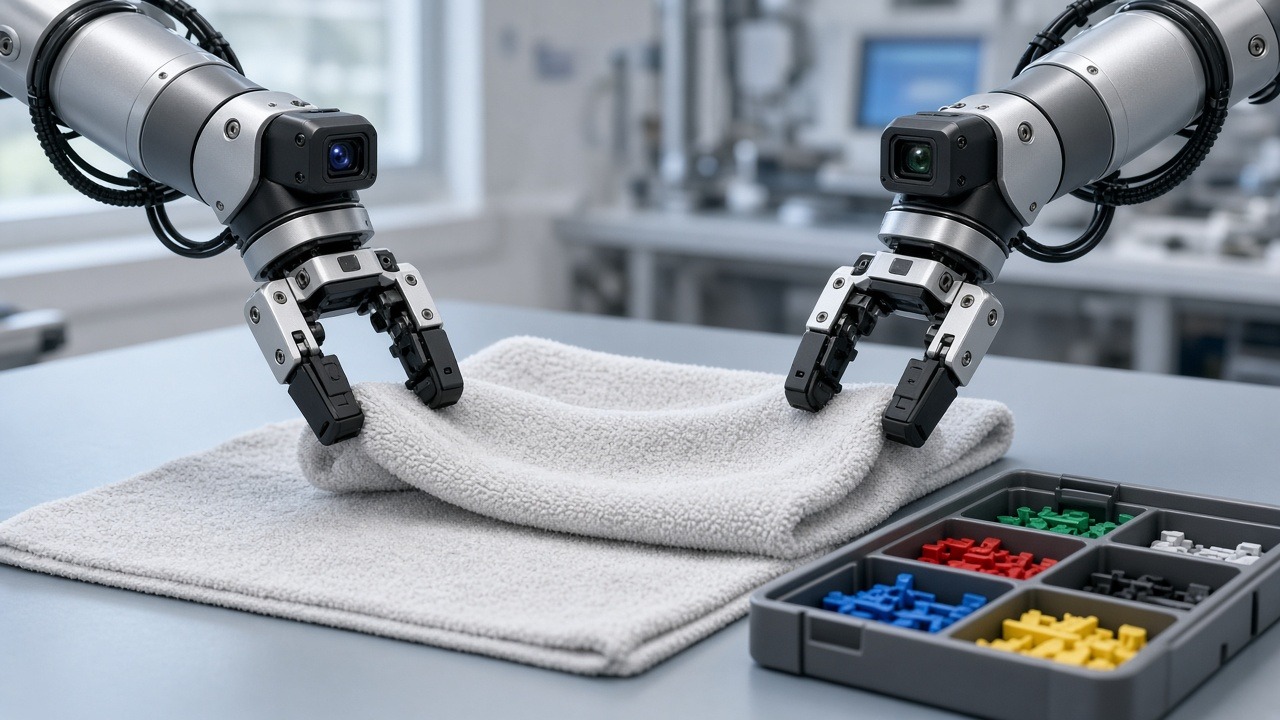
Because actions live in gripper pose space, AIRoA reports that the same weights also run, with nothing retrained for the body, on three other dual-arm platforms that mount YUBI: TX-G2 (described as a humanoid / semi-humanoid), OpenArm, and a pair of UR industrial arms [1][2][3]. The paper describes a subset of the ten tasks on those robots — for example, cup and orange pyramids, the pencil case and colour sorting on TX-G2 — and again notes that none of the training data was recorded on those platforms [2]. Those qualitative transfers support the “embodiment-agnostic” design claim; the 78% versus 27% table itself is the Franka, 10×15 protocol above.
The authors also report a disturbance test on colour-based sorting: a person moves the bins while the robot is placing a part, and the arms redirect to the correct bin in one continuous motion, even though no training episode showed a robot meeting that kind of interruption [1][2]. It is a useful existence proof that the policy is not replaying a memorised path, but it is one qualitative experiment, not a scored robustness benchmark.
What this does — and does not — change
Handheld collection attacks a real bottleneck in robot learning: teleoperation is slow, and robot fleets are expensive. If 16,151 hours can be gathered without a robot in the loop, the cost curve looks more like staffing demonstrators than like buying and maintaining arms. AIRoA’s scaling plots, on the project page and in the preprint, argue that more pretraining data still lowers action loss after post-training, following a power-law trend on held-out demonstrations [2][3].
The limits are just as structural:
- The robot still has to wear YUBI. This is not a general “drop-in” policy for arbitrary grippers and camera rigs.
- There is no robot in the data. Recovery behaviours, contact dynamics and failure modes that only appear on hardware are missing — which is why sim-to-real methods and residual or real-world RL remain complementary rather than obsolete.
- Evaluation is the authors’ own, on ten tasks at one unseen Franka site, with partial credit. It is stronger than a demo reel, and weaker than a multi-site, third-party benchmark such as RoboColosseum.
- The pretraining dataset is not out yet, so the scale claim cannot be independently retrained or audited [1].
- The technical report is a preprint, not a peer-reviewed paper [2].
AIRoA presented related work at CoRL 2026 in Austin (9–12 November) and has released the weights and recipes so others can post-train new tasks [1]. The next test is whether groups outside the project can record with YUBI, adapt A-0, and see similar gains under protocols they control — especially once the announced dataset actually appears.
Bottom line
AIRoA-0 is a serious attempt to scale bimanual manipulation without collecting robot data: 16,151 hours of handheld YUBI demonstrations, a model that outputs gripper poses, and a reported 78% versus 27% average on ten tasks and fifteen trials, on a Franka, at a site unused for recording, with partial credit, against the best of four VLAs post-trained on the same task demonstrations. Those figures belong to AIRoA and to that protocol. The training dataset is announced, not released, and the paper is an unreviewed preprint. Handheld data may well be the right way to grow coverage. It does not, by itself, retire the robot from evaluation, adaptation or the last few points of reliability.
Related reading
- Vision-Language-Action Models: The New Foundation Layer for Robots
- Sim-to-Real in 2026: Closing the Gap Without Endless Real-World Data
- After Imitation: Residual and Real-World RL as the Next Layer for Robot Policies
- RoboColosseum and the Race to Measure Physical Intelligence in the Wild
References / Sources
- AIRoA — “AIRoA Releases “AIRoA-0” Robot Foundation Model” (6 November 2026). https://airoa.org/updates/20261106/832/
- Yueh-Hua (Kris) Wu, Kei Ota, Hanlong Li et al. — “AIRoA-0: Long-Horizon, Precise, Cross-Embodiment Manipulation from Handheld Data”, arXiv:2611.03815, November 2026 (arXiv preprint, not peer-reviewed). https://arxiv.org/abs/2611.03815
- AIRoA — AIRoA-0 project page. https://a-0.airoa.io
- Related reading: AndBeyond.Tech — Vision-Language-Action Models: The New Foundation Layer for Robots; Sim-to-Real in 2026; After Imitation: Residual and Real-World RL; RoboColosseum and the Race to Measure Physical Intelligence.
Images: original illustrations generated for AndBeyond.Tech; no logos or real people depicted.