Vision-Language-Action Models: The New Foundation Layer for Robots
How vision-language-action (VLA) models went from RT-2 to Gemini Robotics 2, π0.7 and GR00T N1.6—and why world models are the next robot layer.
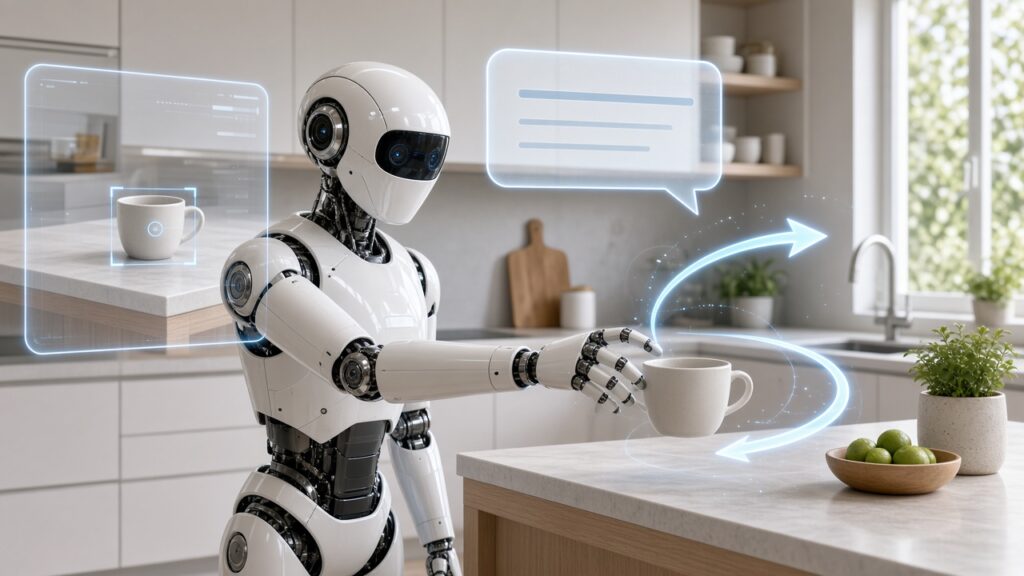
For most of their history, robots have been brilliant specialists and hopeless generalists. A welding arm can repeat the same seam millions of times, but ask it to tidy a kitchen it has never seen and it has nothing to offer. In the last three years, that has begun to change, and the reason has a name: the vision-language-action model, or VLA.
A VLA takes the same ingredients that power today’s multimodal chatbots — a model pretrained on internet-scale images and text — and teaches it to output something new: motor commands. In 2026 the idea has moved from a research curiosity to the default architecture of the industry’s most ambitious robot programmes, from Google DeepMind’s Gemini Robotics 2 to Physical Intelligence’s π0.7 and NVIDIA’s open GR00T N1.6. This article explains what VLA robotics is, how the field got here, where world models fit, and what still stands between a robot foundation model and a robot you would trust in your home.
What is a vision-language-action model?
The term was popularised by Google DeepMind in July 2023 with RT-2 (Robotic Transformer 2), which DeepMind described as a VLA model that “learns from both web and robotics data” and translates that knowledge into robot control [1]. The core trick was disarmingly simple. Vision-language models (VLMs) already take images and text in and produce text tokens out. RT-2 represented robot actions as tokens too — strings of numbers encoding whether to stop, how to move and rotate the end-effector, and how far to open the gripper — so a VLM could be fine-tuned to “speak” actions without changing its input or output spaces [1].
That framing has three consequences that still shape the field:
- Knowledge transfer. A model that has seen billions of web images already knows what a banana, a recycling bin or a celebrity photo looks like. RT-2 could carry out commands involving objects and concepts absent from its robot data, such as moving an object onto a number given as a sum (“two plus one”) [1].
- Reasoning in the loop. DeepMind showed that adding a short natural-language “plan” step before the actions — a form of chain-of-thought — let RT-2 handle multi-stage instructions, for instance picking a rock as an improvised hammer [1].
- Scale from the language-model world. Because a VLA is architecturally a VLM, it inherits the training infrastructure, scaling recipes and rapid progress of the broader foundation-model ecosystem [2].
The results were striking for the time. Across more than 6,000 robot trials, DeepMind reported that RT-2 roughly tripled generalisation performance on emergent-skill tests versus prior baselines, and raised success on previously unseen scenarios from 32% (RT-1) to 62% [1].
From closed giants to open models: OpenVLA
RT-2 and its multi-robot successor RT-2-X were closed. In June 2024 a coalition of researchers from Stanford, UC Berkeley, Toyota Research Institute, Google DeepMind, Physical Intelligence and MIT released OpenVLA, a 7-billion-parameter open-source VLA trained on 970,000 real robot demonstrations drawn from the Open X-Embodiment dataset [2].
OpenVLA is built on a Llama 2 language model with a vision encoder that fuses DINOv2 and SigLIP features — the DINOv2 half reportedly helps with the spatial reasoning that manipulation depends on [2]. Its headline result was that it outperformed the 55-billion-parameter RT-2-X by 16.5 percentage points of absolute task success across 29 tasks, with roughly seven times fewer parameters [2].
Just as important were the practical findings. The authors showed that OpenVLA could be fine-tuned with LoRA while training only about 1.4% of its parameters and still match full fine-tuning, and that 4-bit quantisation preserved task success while cutting GPU memory to around 7 GB [2]. The whole model ran at roughly 6 Hz on a single consumer RTX 4090 [2]. In other words, a capable robot foundation model was suddenly something a university lab or start-up could adapt on modest hardware.
OpenVLA’s paper was also candid about limits: single-image input only, inference too slow for 50 Hz dexterous control, and reliability typically below 90% on tested tasks [2]. Those limitations became the roadmap for the next generation.
Physical Intelligence and the π series: from tokens to flow
If OpenVLA democratised VLAs, the San Francisco start-up Physical Intelligence has arguably done the most to push their generalisation. Its π0 model, followed by π0.5 in April 2025, moved away from purely discrete action tokens. π0.5 combines autoregressive token decoding for high-level decisions with a continuous flow-matching “action expert” that outputs 50-step, one-second “action chunks” of joint commands [3]. In practice, the model first tells itself in words what to do next (“pick up the pillow”) and then generates smooth motor trajectories to do it — the same model handling both levels [3].
The central lesson of π0.5 was about data mixture rather than architecture. Physical Intelligence co-trained on web data, high-level subtask labels, verbal coaching from humans, and robot data from many different embodiments and environments [3]. Its ablations showed that removing web data hurt performance on out-of-distribution objects, while removing data from other robots hurt everywhere [3]. Strikingly, after roughly 100 distinct training environments, π0.5’s performance in entirely new homes approached that of a baseline trained directly on the test environment [3].
The company’s 2026 work extends that trajectory. In March it introduced Multi-Scale Embodied Memory (MEM) for tasks longer than ten minutes, and an “RL Token” approach for faster online reinforcement learning on precise tasks [4]. In April 2026 it released π0.7, described as a “steerable” generalist model. π0.7 has about 5 billion parameters: a vision-language backbone initialised from Google’s Gemma 3 4B model (with a 400-million-parameter vision encoder), a MEM-style video-history encoder and an 860-million-parameter flow-matching action expert. It is conditioned not only on a language command but on metadata and visual subgoal images that describe how to perform a task [5]. Physical Intelligence reports the first signs of compositional generalisation: with step-by-step language coaching, π0.7 operated kitchen appliances it had no demonstrations for, such as loading a sweet potato into an air fryer, and it folded laundry on a bimanual UR5e industrial-arm system for which no laundry-folding data had been collected [5]. The company says a single π0.7 model matched or exceeded its RL-trained π*0.6 specialist models on laundry folding, espresso making and box building [5]. On 13 October 2026 the company opened a Pi API beta, letting developers upload data, fine-tune its latest models on compute it manages and run cloud-hosted inference on their own robots; early-access partners range from autonomous heavy machinery to a dual-arm robot maker [6] — a sign that the robot foundation model is becoming a platform product, not just a paper.
Google DeepMind’s Gemini Robotics 2: whole-body control
Google DeepMind, which coined the VLA label, has since rebuilt its robotics stack on Gemini. On 30 July 2026 it introduced Gemini Robotics 2, a family of three models [7]:
- Gemini Robotics 2, its most advanced VLA, which converts vision and language input into motor control and can drive full humanoids “from feet to fingertips” as well as bi-arm robots [7].
- Gemini Robotics ER 2, an embodied-reasoning VLM that acts as the planner: it understands the scene, communicates with people, and plans multi-step tasks lasting several minutes and involving hundreds of decisions. It also coordinates several robots working as a team [7].
- Gemini Robotics On-Device 2, an efficient VLA designed to run locally on the robot; DeepMind says it can adapt to new bi-arm embodiments in a few hours, typically with fewer than 200 examples [7].
This split between a “thinking” reasoning model and an “acting” VLA mirrors the high-level/low-level structure seen in π0.5, but packaged as separate products. DeepMind showed a single checkpoint controlling three embodiments, Apptronik’s Apollo 2 humanoid fitted with SharpaWave hands, the same humanoid with Inspire hands, and a Franka Duo with Robotiq grippers [7]. DeepMind says the model can drive the five-fingered, 22-degree-of-freedom SharpaWave hand for tasks such as tying knots or sealing a ziplock bag [7]. It was also notably frank: the company says whole-body and gripper-based dexterous tasks reach medium-to-high success rates, while multi-finger dexterous manipulation “remains challenging” [7]. Availability is limited: ER 2 is available on Google AI Studio and in private preview on Gemini Enterprise Agent Platform, while the VLA and On-Device models are restricted to early-access partners [7][8].
NVIDIA GR00T N1.6: an open humanoid foundation model
NVIDIA’s approach is to supply the open “reference platform” for humanoid makers. Its Isaac GR00T programme bundles data pipelines, simulation, runtime libraries and the Jetson Thor computer around an open robot foundation model [9]. The current release, GR00T N1.6, is a 3-billion-parameter open VLA published on Hugging Face [10].
GR00T N1.6 pairs an NVIDIA Cosmos vision-language model (a Cosmos-Reason-2B variant) with a diffusion/flow-matching transformer head that is twice as deep as its predecessor’s — 32 layers versus 16 — and predicts state-relative action chunks rather than absolute joint angles [11][12]. Its pretraining mix added several thousand hours of teleoperated data from bimanual arms, AgiBot Genie-1, simulated robots and whole-body loco-manipulation on Unitree G1, and NVIDIA reports it outperforms N1.5 in simulation and on real robots [11]. The company’s own description of the data recipe is telling: internet-scale human video for world knowledge, real teleoperation for physical grounding, and synthetic data to scale safely [9].
Openness matters here. NVIDIA says GR00T models are available in Hugging Face’s LeRobot library for fine-tuning and evaluation, and that Hugging Face’s open-source Reachy 2 humanoid will run VLAs including GR00T N1.6 on Jetson Thor [13]. For humanoid start-ups that cannot train a frontier model from scratch, this is the equivalent of starting from an open-weight LLM.
Where world models fit in
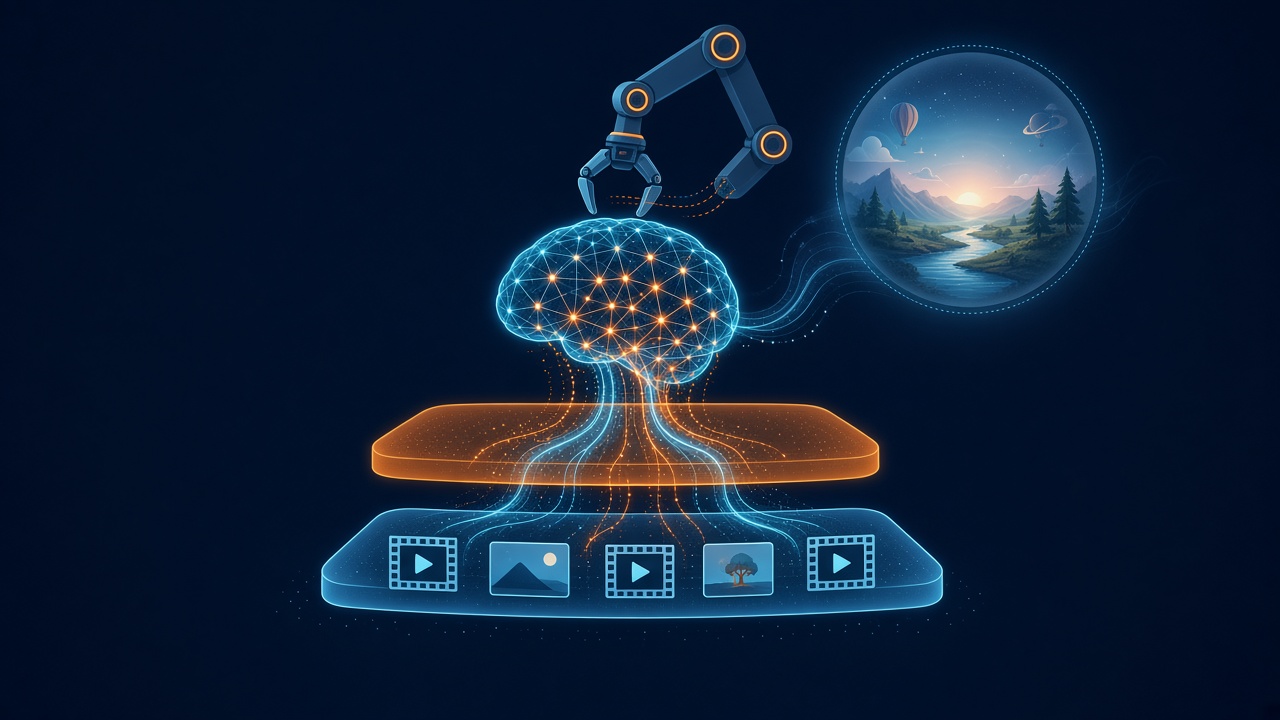
VLAs map observations directly to actions. World models take a complementary route: they learn to predict how the world will change, and let the robot plan by imagining consequences before acting.
Meta’s V-JEPA 2, released in 2025, is a clear example. It was pretrained self-supervised on more than one million hours of internet video, then post-trained into an action-conditioned model (V-JEPA 2-AC, a 300-million-parameter transformer) using less than 62 hours of unlabelled robot video from the DROID dataset [14]. Deployed zero-shot on Franka arms in two labs that did not appear in its training data, it planned grasping and pick-and-place from goal images — without task-specific training or rewards [14]. Meta reports 65–80% success on pick-and-place of new objects in unseen environments, using model-predictive control: the robot imagines candidate actions, scores them against the goal image, executes the best one and re-plans [15].
NVIDIA is pursuing world models from the simulation side. Its Cosmos Predict 2.5 and Cosmos Transfer 2.5 are open world models for physically based synthetic data generation and for evaluating robot policies in simulation, alongside the Cosmos Reason 2 VLM that also feeds GR00T [13]. In NVIDIA’s sim-to-real workflow for GR00T N1.6, whole-body reinforcement learning in Isaac Lab produces motion primitives that transfer zero-shot to physical humanoids, with the VLA coordinating them [12].
The emerging pattern is convergence rather than competition. World models supply cheap, scalable experience and a way to “think ahead”; VLAs supply fast, reactive control grounded in language. Expect the line between the two to blur further as VLAs gain memory and planning (as in π’s MEM work [4]) and world models gain action heads.
Why VLAs are becoming the foundation layer
Taken together, the 2026 landscape suggests why “foundation layer” is the right metaphor:
- One model, many bodies. Cross-embodiment training is now standard. Gemini Robotics 2 runs one checkpoint across humanoids and arms [7]; GR00T N1.6 covers Unitree G1, AgiBot Genie-1, Fourier GR-1 and bimanual setups [9]; π0.5 gained most from data collected on other robots [3].
- Adaptation instead of programming. OpenVLA showed LoRA fine-tuning on a single GPU [2]; Gemini Robotics On-Device 2 claims new bi-arm embodiment adaptation in a few hours with typically fewer than 200 examples [7]; the Pi API turns fine-tuning into a hosted service [6].
- Language as the interface. Every major model accepts natural-language instructions, from high-level goals (“clean the bedroom”) down to specific motions [3].
- Hierarchy. A reasoning layer that plans and a motor layer that acts — explicit in Gemini Robotics ER 2 plus the VLA [7], implicit in π0.5’s self-generated subtasks [3], and in GR00T’s use of Cosmos Reason for task decomposition [12].
What still holds VLA robotics back
The honest caveats come from the builders themselves:
- Reliability. OpenVLA typically stayed below 90% success [2]; Physical Intelligence says π0.5 “often makes mistakes” at both the semantic and motor level [3]; DeepMind calls multi-finger dexterity still challenging [7]. For homes, hospitals or factories, a 10% failure rate is not a rounding error.
- Data. Even large manipulation datasets hold roughly 100,000 to one million examples, orders of magnitude below web-scale text and images [2]. This is why synthetic data, world models and cross-embodiment pooling are so central.
- Speed and compute. High-frequency control (OpenVLA’s authors cite 50 Hz bimanual systems) demands faster inference than early VLAs offered [2], pushing the field toward action chunking, flow matching and on-device models.
- Access. The most capable proprietary models, such as Gemini Robotics 2, remain in private preview [8], while open models trail on some capabilities.
The bottom line
In just over three years, the vision-language-action model has gone from a clever reframing — “treat actions like words” — to the organising principle of modern robot learning. RT-2 proved web knowledge could reach the gripper; OpenVLA made the approach open and affordable; π0.5 and π0.7 showed that diverse data and steerable prompts unlock generalisation to new homes and tasks; Gemini Robotics 2 and GR00T N1.6 extended it to whole humanoid bodies. World models such as V-JEPA 2 and Cosmos are adding imagination and synthetic experience underneath.
None of these systems is yet a dependable household helper. But the architecture of the robot foundation model is now clear, the tooling is increasingly open, and the remaining problems — reliability, data and speed — are the kind that scale, engineering and time tend to erode. For anyone tracking autonomy, VLA robotics is no longer a niche to watch; it is the layer everything else will be built on.
Related reading
- Sim-to-Real in 2026: Closing the Gap Without Endless Real-World Data
- Embodied Edge: Offline AI for Robots and Vehicles
- Humanoids on the Factory Floor: From Demo Videos to Full Shifts
References / Sources
- Google DeepMind — “RT-2: New model translates vision and language into action” (28 July 2023). https://deepmind.google/discover/blog/rt-2-new-model-translates-vision-and-language-into-action/
- Kim, Pertsch, Karamcheti et al. — “OpenVLA: An Open-Source Vision-Language-Action Model”, arXiv:2406.09246. https://arxiv.org/abs/2406.09246
- Physical Intelligence — “π0.5: a VLA with Open-World Generalization” (22 April 2025). https://www.physicalintelligence.company/blog/pi05
- Physical Intelligence — homepage research updates (MEM, RL Token, 2026). https://www.pi.website/
- Physical Intelligence — “π0.7: a Steerable Model with Emergent Capabilities”, blog (16 April 2026), and technical paper arXiv:2604.15483. https://arxiv.org/html/2604.15483 · https://www.pi.website/blog/pi07
- Physical Intelligence — “Frontier Models for Every Robot: Announcing our API beta” (13 October 2026). https://www.pi.website/blog/api-beta
- Google DeepMind — “Gemini Robotics 2 brings whole body intelligence to robots” (30 July 2026). https://deepmind.google/blog/gemini-robotics-2-brings-whole-body-intelligence-to-robots/
- Google DeepMind — Gemini Robotics 2 model page. https://deepmind.google/models/gemini-robotics/vla/
- NVIDIA Developer — Isaac GR00T. https://developer.nvidia.com/isaac/GR00t
- Hugging Face — nvidia/GR00T-N1.6-3B model card. https://huggingface.co/nvidia/GR00T-N1.6-3B
- NVIDIA GEAR Lab — “GR00T N1.6: An Improved Open Foundation Model for Generalist Humanoid Robots” (15 December 2025). https://research.nvidia.com/labs/gear/gr00t-n1_6/index.html
- NVIDIA Technical Blog — “Building Generalist Humanoid Capabilities with NVIDIA Isaac GR00T N1.6 Using a Sim-to-Real Workflow” (8 January 2026). https://developer.nvidia.com/blog/building-generalist-humanoid-capabilities-with-nvidia-isaac-gr00t-n1-6-using-a-sim-to-real-workflow/
- NVIDIA — “NVIDIA Releases New Physical AI Models as Global Partners Unveil Next-Generation Robots” (press release). https://investor.nvidia.com/news/press-release-details/2026/NVIDIA-Releases-New-Physical-AI-Models-as-Global-Partners-Unveil-Next-Generation-Robots/
- Meta FAIR — “V-JEPA 2: Self-Supervised Video Models Enable Understanding, Prediction and Planning”, arXiv:2506.09985. https://arxiv.org/html/2506.09985
- Meta AI — “Introducing the V-JEPA 2 world model and new benchmarks for physical reasoning”. https://ai.fb.com/blog/v-jepa-2-world-model-benchmarks/
Image credits: Both illustrations (vla-hero.jpg, vla-stack.jpg) are AI-generated for AndBeyond.Tech, compliant with BP §5.2. Text is original; figures are paraphrased and attributed per §5.1.
Images: original illustrations generated for AndBeyond.Tech; no logos or real people depicted.