NVIDIA Took In $107.6 Billion From Data Centers in One Quarter. Here’s What It Says About the AI Chip Race
On 17 November 2026, NVIDIA reported revenue of $115.8 billion for the three months that ended on 25 October, more than double the same quarter…
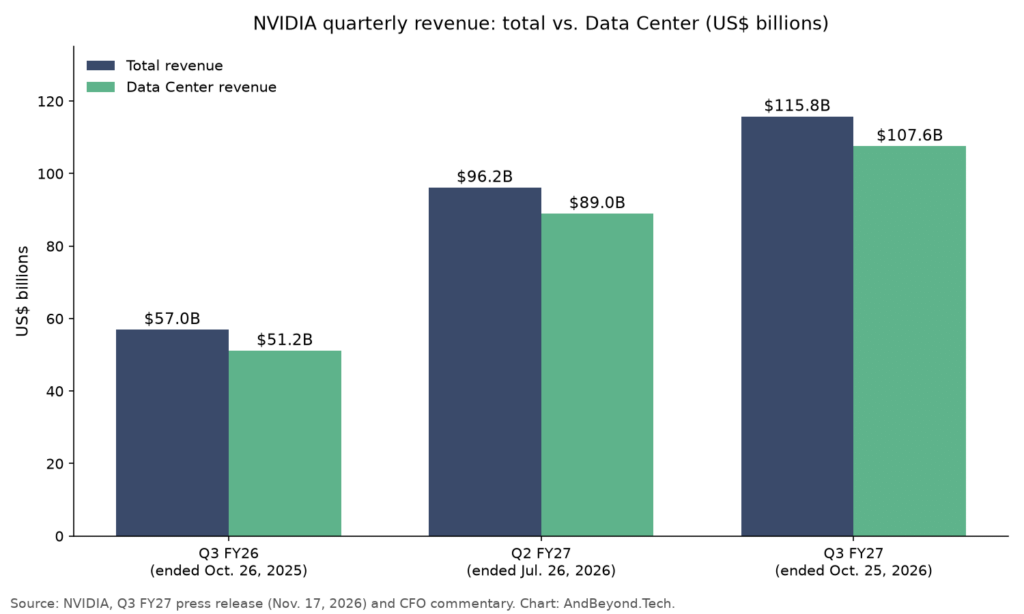
Chart: AndBeyond.Tech, data from NVIDIA.
On 17 November 2026, NVIDIA reported revenue of $115.8 billion for the three months that ended on 25 October, more than double the same quarter a year earlier. Almost all of it, $107.6 billion, came from data centers: the giant buildings where cloud companies and AI labs train and run their models. The same day, NVIDIA confirmed that its next-generation rack, Vera Rubin NVL72, has started shipping. The numbers say a lot about who is buying AI chips, how fast, and what NVIDIA expects next. For the wider market picture, see our overview of the AI accelerator market.
The quarter in five numbers
NVIDIA’s fiscal calendar runs ahead of the normal one, so the quarter that ended on 25 October 2026 is its third quarter of fiscal year 2027, or “Q3 FY27”. Here is what the company reported [1][2]:
- Revenue: $115.8 billion, up 20% from the previous quarter ($96.2 billion) and up 103% from a year earlier ($57.0 billion).
- Data Center revenue: $107.6 billion, up 21% in a quarter and up 110% in a year.
- Gross margin: 74.8% under standard accounting rules (GAAP). Gross margin is the share of each dollar of sales left after paying to make the product. In other words, NVIDIA kept roughly 75 cents of every dollar before research, salaries and other running costs.
- Net income: $65.3 billion (GAAP), compared with $31.9 billion a year earlier.
- Cash returned to shareholders: $28.1 billion through share buybacks and dividends during the quarter.
To put the growth in perspective, NVIDIA added $19.6 billion of revenue in a single quarter, from $96.2 billion to $115.8 billion. A year earlier, its entire quarterly revenue was $57.0 billion.
The results also came with a leadership detail. The press release quotes Colette Kress as NVIDIA’s “interim CEO and executive vice president and chief financial officer” [1]. “Vera Rubin is off to an explosive start, our roadmap is on track and our ambition has never been greater,” she said [1].
Two ways NVIDIA slices its sales
NVIDIA reports its revenue in two different ways, and the headline “Data Center” figure is only one of them. The difference matters when you read other coverage.
By market platform, NVIDIA groups sales by the kind of customer and use. Data Center covers what NVIDIA sells for data centers; the company describes its platforms as combining “processors, interconnects, software, algorithms, systems, and services” [2]. It came to $107.6 billion this quarter, split into two customer groups [2]:
- Hyperscale: $60.1 billion, up 71% in a year. Hyperscalers are the largest cloud and internet companies, the ones that run data centers across the world.
- AI Clouds, Industrial & Enterprise: $47.5 billion, up 195% in a year. This group includes smaller specialist AI clouds (often called “neoclouds”), factories and ordinary businesses building their own AI systems.
The remaining $8.2 billion came from NVIDIA’s other market platform, which covers PCs, gaming graphics cards, professional workstations, cars and robots [2].
By reportable segment, the lens used in NVIDIA’s official accounts, the split is different. Compute & Networking brought in $106.0 billion, and Graphics $9.8 billion [2]. Compute & Networking is defined by the type of product, not the customer: it bundles the processors that do the calculating with the networking gear that links them together, whoever buys them. That is why it is close to, but not the same as, the Data Center figure. NVIDIA’s Q3 press release and CFO commentary do not break Compute & Networking down further into compute on one side and networking on the other.
The practical takeaway: when a headline says NVIDIA “sold $107 billion of AI chips”, the more precise reading is that its Data Center platform, which includes systems, networking and software as well as chips, generated $107.6 billion of revenue.
Who is buying
NVIDIA does not name its biggest customers in its financial documents, but it does describe how concentrated its sales are. According to the supplemental financial information filed with the results, three direct customers accounted for 14%, 11% and 11% of total revenue in the quarter, all mainly in the Compute & Networking segment [3]. NVIDIA explains that its “direct customers” are the companies that buy from it directly, such as server manufacturers, distributors, cloud providers and frontier labs, while “indirect customers” buy through them [3].
The press release, however, names many of the organisations deploying NVIDIA’s newest hardware [1]:
- Cloud providers: Google Cloud, Microsoft Azure, Oracle Cloud Infrastructure and AWS.
- Neoclouds, the specialist rental clouds for AI: CoreWeave, Nebius, Nscale and Verda.
- AI labs and model builders: OpenAI, Meta, Anthropic and SpaceXSI.
Anthropic is an interesting case because it does not build on one supplier. NVIDIA says it “expanded Anthropic’s access to NVIDIA Grace Blackwell and Vera Rubin capacity through cloud providers” [1]. So even companies that use other chips are also renting NVIDIA systems through the clouds.
NVIDIA is also starting to help customers pay for and house that hardware. The CFO commentary describes guarantees for a data center campus in Ohio that “will exclusively host NVIDIA infrastructure under 20-year leases to OpenAI”, with a maximum exposure of $105 billion that builds up only as each building comes online [2]. It also lists up to $32 billion of commitments to neoclouds, which take effect only if those neoclouds secure financing and deploy the capacity [2]. In plain terms, NVIDIA is not just selling chips; in some cases it is underwriting the buildings and the financing that let customers buy them.
Vera Rubin NVL72: what is actually shipping
The biggest product news of the quarter is that Vera Rubin NVL72 has shipped. NVIDIA calls it “the fastest product ramp in the company’s history” [1].

A rack is a tall metal cabinet, about the height of a person, that holds many servers stacked on top of each other, along with the cables, power supplies and cooling that connect them. NVIDIA no longer sells only individual chips: it sells whole racks designed to work as a single, very large computer. Vera Rubin is the name of the platform, combining NVIDIA’s Rubin graphics processors (GPUs), the chips that do the heavy AI calculations, with its Vera central processor (CPU), which manages the work around them.
The press release says Vera Rubin NVL72 racks are “running at partners including CoreWeave, Google Cloud, Microsoft Azure, Oracle Cloud Infrastructure and Nebius, and coming online soon at SpaceXSI” [1]. It also mentions general availability of Vera Rubin systems on Oracle Cloud Infrastructure and of Google Cloud’s Vera Rubin-powered A5X instances [1].
What does that mean for the business? The CFO commentary links the growth in both data center customer groups to “the introduction of our Rubin infrastructure, our fastest architecture ramp ever, standalone Vera CPUs and the continued growth of Blackwell Ultra” [2]. Blackwell Ultra is the previous generation, still selling strongly. A new generation also has a cost: NVIDIA says gross margins “decreased slightly sequentially, reflecting the initial Rubin ramp” [2], from 75.0% to 74.8% [1]. Early production of a new product is usually less efficient than mature production, and that shows up in the margin.
The ramp also shows on the balance sheet. Inventory, the chips and parts NVIDIA holds before selling them, rose from $31.6 billion to $39.7 billion in a quarter “to support our Rubin product ramp” [2].
Why inference is now part of the pitch
Much of NVIDIA’s messaging this quarter is about inference: the moment an AI model is actually used, answering a question, writing code or running an agent, as opposed to training, when the model is built. Training happens once per model; inference happens every time someone uses it, which is why it is becoming the larger, longer-lasting market.
NVIDIA says Vera Rubin NVL72 “demonstrated leading inference performance in its MLPerf Inference preview debut” [1]. MLPerf is an industry benchmark suite in which vendors submit results for standard AI tasks; its “preview” category covers systems that are not yet generally available. NVIDIA also presents Vera CPUs and its BlueField-4 data processors (chips that handle networking and security tasks so the main processors don’t have to) as parts of a system for running AI agents [1].
Memory is a recurring thread. NVIDIA’s supply commitments rose from $279 billion to $390 billion in a single quarter, “primarily related to the multi-year procurement of memory supply” [2]. AI chips depend on very fast stacked memory called high-bandwidth memory (HBM), and NVIDIA is locking in years of it. Our article on the HBM4 supply race explains why memory has become one of the tightest parts of the AI supply chain. NVIDIA also announced plans with packaging and substrate suppliers including Amkor, IBIDEN and Siliconware Precision Industries to expand manufacturing capacity [1], a bottleneck we cover in our piece on advanced packaging.
SpaceXSI: a customer building at scale
SpaceXSI, which develops the Grok models, appears several times in NVIDIA’s release: as a site where Vera Rubin NVL72 racks are “coming online soon”, in “the continued buildout of SpaceXSI’s infrastructure”, and as a company already building with Vera CPUs [1]. Its scale is documented in SpaceX’s own filing. In its amended S-1 registration statement of June 2026, SpaceX states that it brought online about 100,000 H100 processors at its COLOSSUS site in Memphis, Tennessee, then about 110,000 GB200 processors and a second cluster of 110,000 GB300 processors at COLOSSUS II, and expects the next expansion phase there to add “at least 220,000 additional GB300 processors” once fully operational [4]. These are figures declared by the issuer, SpaceX, not independent counts. They show why a single AI developer can now buy at the scale of a cloud provider.
What NVIDIA expects next quarter
NVIDIA’s forecast for its fourth quarter of fiscal 2027 is the following [1][2]:
- Revenue is expected to be $130.0 billion, plus or minus 3%. NVIDIA notes that this quarter “includes an additional week”, so it is longer than Q3.
- Gross margins are expected between 71.0% and 72.0%, below Q3’s 74.8%, as Rubin production ramps up.
- Operating expenses are expected at about $11.0 billion (GAAP).
Two caveats come from NVIDIA itself. First, this is the company’s forecast, not a result. Second, NVIDIA says it is “not assuming any Data Center compute revenue from China in its outlook” [1]. In Q3, the CFO commentary reports $2.4 billion of shipments of Data Center Hopper products to China [2], so China sales, if any, would come on top of the forecast rather than inside it.
The rest of the field moved the same month
NVIDIA’s results landed a week after its rivals made their own moves. Between 9 and 12 November, Google, AMD and Intel each announced new chips aimed at inference, all built around the idea that memory capacity matters as much as raw computing power. We compared them in Three Inference Chips in One Week. NVIDIA, for its part, used the SC26 supercomputing conference on 16 November to introduce Rubin HPC, a new GPU for scientific simulation that it expects to be available in 2028 [5].
For readers following the bigger picture of how such chips are combined to train the largest models, our article on multi-trillion-parameter training silicon gives the background.
What the quarter tells us
Three things stand out from NVIDIA’s own documents.
Demand is broadening beyond the largest clouds. Hyperscale customers still bring in the most, $60.1 billion, but the “AI Clouds, Industrial & Enterprise” group grew faster, up 195% in a year to $47.5 billion [2]. Neoclouds, AI labs and businesses are becoming a second engine.
NVIDIA is now part supplier, part financier. Supply commitments of $390 billion, $102 billion of cloud service and data center lease commitments, and up to $118 billion of maximum guarantee exposure [2] show a company securing memory, factories and even data center sites years in advance, and in some cases backing its customers’ buildouts.
The new generation is arriving, at a cost. Vera Rubin is shipping and NVIDIA expects revenue of about $130 billion next quarter, but it also expects gross margins to dip to 71–72% during the ramp [1]. That is the trade-off of moving a very large business onto a new product line quickly.
Competitors are not standing still, and the customers themselves, from Google to Meta to SpaceXSI, are building at a scale that gives them bargaining power. But on the numbers NVIDIA published on 17 November, it remains the company the rest of the race is measured against.
Sources
- NVIDIA, “NVIDIA Announces Financial Results for Third Quarter Fiscal 2027”, press release (Nov. 17, 2026): https://investor.nvidia.com/news/press-release-details/2026/NVIDIA-Announces-Financial-Results-for-Third-Quarter-Fiscal-2027/default.aspx — also filed as Exhibit 99.1 to Form 8-K, SEC EDGAR: https://www.sec.gov/Archives/edgar/data/1045810/000104581026000088/q3fy27pr.htm
- NVIDIA, “CFO Commentary on Third Quarter Fiscal 2027 Results” (Nov. 17, 2026), Exhibit 99.2 to Form 8-K, SEC EDGAR: https://www.sec.gov/Archives/edgar/data/1045810/000104581026000088/q3fy27cfocommentary.htm
- NVIDIA, “Supplemental Financial Information for the Quarter Ended October 25, 2026” (Nov. 17, 2026), Exhibit 99.3 to Form 8-K, SEC EDGAR: https://www.sec.gov/Archives/edgar/data/1045810/000104581026000088/supplementalfinancialinfor.htm
- SpaceX, Form S-1/A registration statement (Amendment No. 2, June 3, 2026), SEC EDGAR: https://www.sec.gov/Archives/edgar/data/1181412/000162828026040364/spaceexplorationtechnologib.htm
- NVIDIA Blog, “NVIDIA Announces Rubin HPC — A New GPU to Accelerate Agents for Science, Engineering and Analytics” (Nov. 16, 2026): https://blogs.nvidia.com/blog/rubin-hpc/
Images: original illustrations generated for AndBeyond.Tech; no logos or real people depicted.