AI Cobots and Vision: Where Factories See ROI First
How AI cobots and factory vision AI deliver early industrial ROI in pick-and-place and inspection—and why integration failures still stall pilots.
Factories do not buy neural networks. They buy fewer collisions, fewer escapes, and cycle times that hold across shifts. That is why the earliest, most bankable returns from industrial AI robotics rarely come from a greenfield “lights-out” line. They come from two tightly scoped jobs where perception and motion already collide: vision-guided pick-and-place, and visual inspection—often delivered with AI cobots and factory vision AI running close to the cell.
The pattern is consistent across automotive body shops, appliance final control, and high-mix electronics handling. When part position, orientation, or cosmetic criteria vary more than fixtures can absorb, classical “blind” robots and rule-based vision stall. When teams treat AI as a bolt-on camera demo instead of a plant system—lighting, PLC handshakes, MES context, safety validation, model maintenance—pilots freeze after the slide deck. ROI appears first where the problem is already expensive, the cell already exists, and edge inference can close the loop fast enough for both throughput and collaborative safety.
This article maps those early-ROI use cases, what documented deployments actually report, and the integration failures that still kill otherwise sound projects.
Why pick-and-place and inspection win the ROI race
Three conditions tend to separate projects that pay back from those that linger as proofs of concept.
1. Variability that fixtures cannot economically fix.
Worn racks, forklift-placed containers, mixed SKUs, and reflective or textured surfaces break fixed tooling and brittle vision rules. Part variability—not camera price—is what tips many cells toward vision-guided robotics rather than more steel.
2. A measurable baseline cost already on the books.
Downtime minutes, scrap, rework, containment, inspection labor, and quality escapes can be counted before the first purchase order. Without that baseline, “AI accuracy” floats free of operations.
3. A path to production that includes integration, not only inference.
Hardware is usually the smaller line item. Lighting, EOAT, PLC/OT interfaces, validation, training, and ongoing model upkeep decide whether a pilot becomes a cell that runs on night shift.
Pick-and-place and inspection satisfy those conditions more often than open-ended “autonomous factory” programs. They also sit naturally on cobots: slower than hard-automation transfer lines when volume is extreme, but faster to retrofit, safer to commission beside people, and flexible enough for high-mix work.
Pick-and-place: where vision pays for itself in motion
The failure mode blind cells share
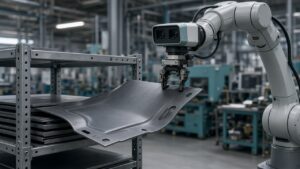
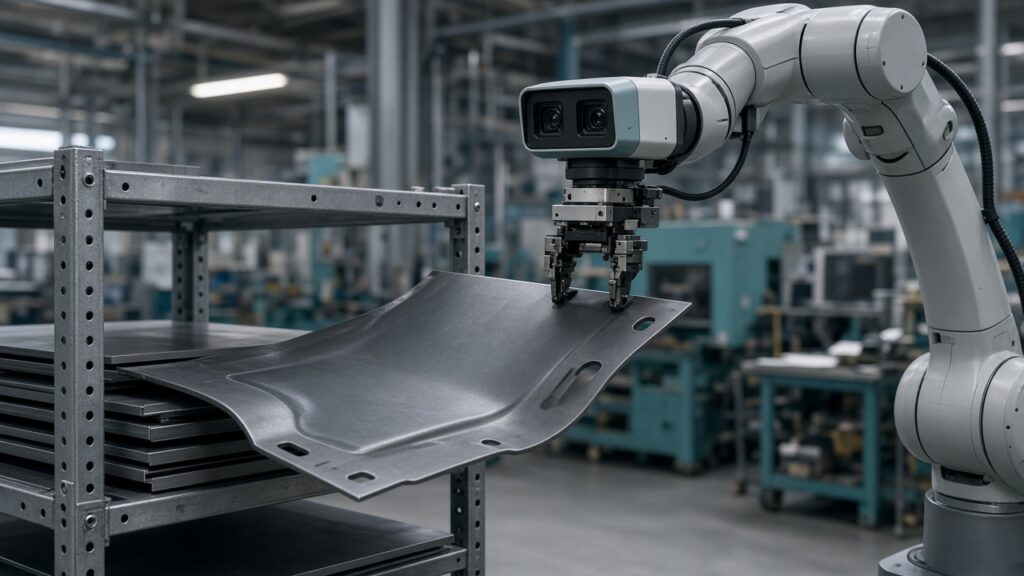
Material-handling cells that unload racks, de-stack panels, or bin-pick components fail for a shared reason: the part is never exactly where the program expects. Rack wear, manual loading, and imperfect indexing produce collisions, mispicks, and operator babysitting. Laser search routines can recover position, but they burn cycle time while the line waits.
What AI-guided trajectories change
Robot-mounted 3D vision plus AI localization updates the pick path from the live pose of each part. Instead of scanning slowly or relying on perfect fixturing, the cell recalculates trajectory on the cycle. Documented automotive body-shop work illustrates how large the operational swing can be when that loop is closed on an existing robot.
At Stellantis’ Detroit Assembly Complex – Jefferson, a body-side aperture de-racking cell suffered repeated breakdowns as a laser-based approach failed against rack and part displacement. Retrofitting the FANUC cell with robot-mounted AI vision guidance—without mechanical rework of the station—cut breakdown time dramatically: from about 184 minutes per day to roughly 4.9 minutes per day in the reported before/after window, a ~97% reduction, with payback cited at three months and no collisions after install in the follow-up period described by the vendor case study. A related pick-and-place station at the same complex reported roughly 30% faster cycles versus laser searching, with a projected ROI window of about three to six months for that retrofit class of work.
Those figures are plant-specific and vendor-reported; they are not industry averages. They do, however, show where early ROI concentrates: brownfield robots, high downtime cost, and pose variability that AI perception can absorb faster than mechanical redesign.
Elsewhere, AI bin-picking on a Universal Robots UR10 has been shown in integrator case material to reach six-second scan-to-place cycles on randomly oriented steel switchgear parts for a Siemens-related line, with collision-free deep-bin picks using a long gripper. Again, the lesson is not a universal cycle-time guarantee—it is that perception-led bin picking becomes economically interesting when orientation randomness would otherwise force trays, singulators, or operators.
Realistic payback expectations
Vendor retrofit stories that land in a few months usually exclude a different class of project: new vision-guided robotics cells scoped from scratch. Guidance published by Cognex on when vision-guided robotics actually drives ROI emphasizes that a well-scoped project often targets roughly 12–24 months of payback once integration, lighting, training, and MES/ERP connectivity are inside the business case—and that quotes promising about six months deserve scrutiny for omitted costs. The same guidance argues that integration cost, not the arm or camera, is where budgets overrun, and that part variability within a known family is the strongest fit signal for vision-guided robotics versus fixed automation.
For plant controllers, the practical synthesis is:
| Situation | What usually drives ROI first |
|---|---|
| Existing robot, high collision/downtime, pose variation | Retrofit AI vision; downtime recovery can dominate |
| High-mix, multi-shift manual pick | Labor differential + consistency across shifts |
| Stable geometry, single SKU, high volume | Fixed tooling may still win on cost and speed |
| New cell, full VGR stack | Plan ~12–24 months if the case is complete |
Treat aggressive payback claims as a prompt to list every line item—EOAT, lighting, safety validation, MES tags, spare cameras, model maintenance—not as a forecasting method.
Factory vision AI for inspection: quality economics, not demos
When AI beats classical vision—and when it does not
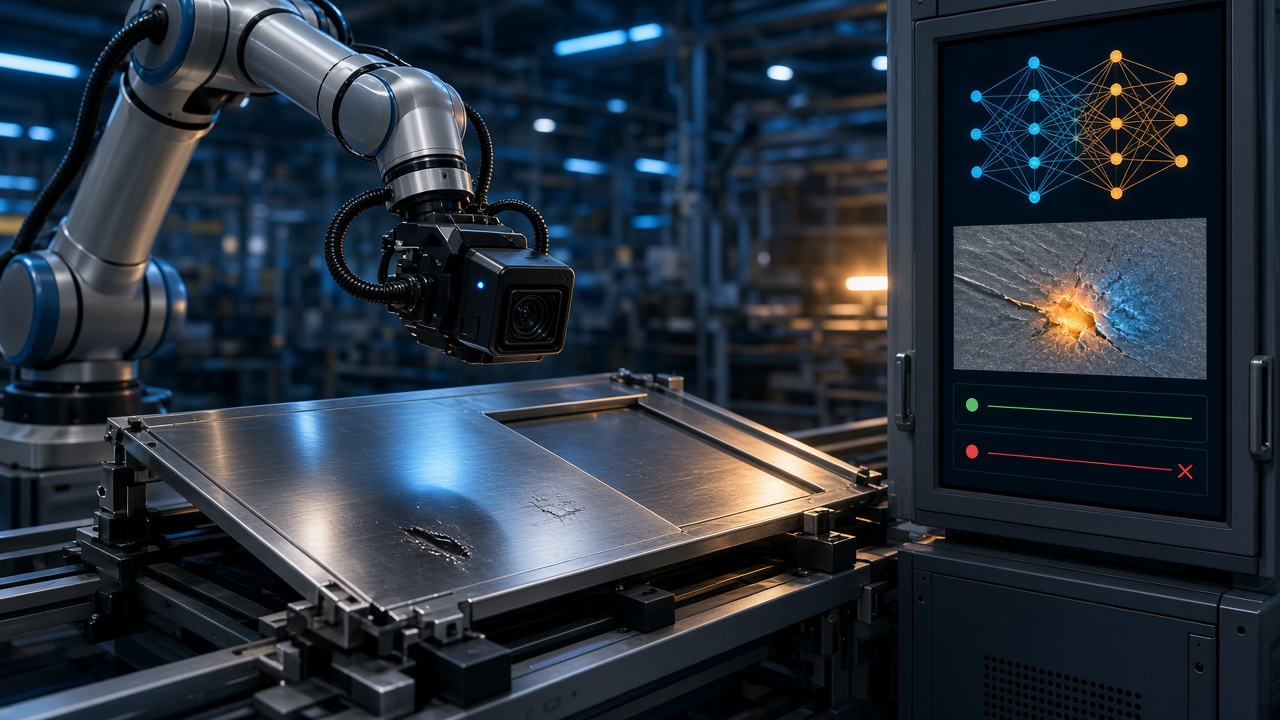
Not every inspection needs deep learning. Barcode reads, presence checks, and simple dimensional gauges remain better served by conventional machine vision or sensors. Factory vision AI earns its keep on irregular surfaces, complex textures, cosmetic variation, natural material scatter, and subtle defect patterns that resist clean rule sets.
Human inspection still leaves measurable gaps. Research summarized in industrial inspection economics writing notes missed-defect rates commonly cited in the 20–30% range across many manual visual inspection environments—context that motivates AI-assisted review rather than a claim that every site matches those figures. Deployments such as Sandia National Laboratories’ AI-assisted inspection of precision ceramic components aim to cut inspection time from roughly an hour per part toward minutes while targeting very high recall, with technicians still reviewing anomalies before final disposition. That hybrid pattern—AI surfaces candidates, humans decide high-consequence calls—is often where regulated or high-risk quality systems land first.
The ROI math that survives contact with the floor
A useful framing from Octave’s investment guidance is blunt: annual economic benefit equals current-state cost minus future-state cost; payback equals implementation investment divided by that annual benefit. Current-state cost is not only inspector headcount. It includes equipment utilization, containment, scrap, rework, warranty exposure, throughput limits at the inspection gate, and the cost of rare escapes. Future-state cost must include human-review labor, false-positive and false-negative impacts, cameras and lighting, compute, integration engineering, validation, training, software support, and ongoing model maintenance.
False positives are especially corrosive to ROI. A model with high recall that floods the line with nuisance flags creates review queues, delays, and operator distrust. False negatives create the opposite risk: escapes, recalls, and compliance exposure. Both belong in the spreadsheet before the camera SKU is chosen.
Field results show what “good” can look like when the system is engineered as a cell, not a notebook demo. An AI-assisted collaborative inspection cell at Silverline’s kitchen-appliance factory (AI-PRISM project), combining a UR10e vision path with a second cobot for functional tests under ROS 2, reported quality-check time falling from 82 s to 61 s per unit (~25%), final-control resource efficiency rising from 0.75 to 0.88, and a large reduction in operator visual-inspection viewing time, with lower measured mental demand on NASA-TLX. Those gains required solving glare, lighting, reach, and multi-robot software collisions—not only training a detector.
A broader review of machine-learning vision for robotic inspection across dozens of manufacturing studies reports detection/classification accuracy frequently above 95% in published work—and sometimes higher in controlled settings—yet finds that a large majority of implementations remain at prototype or pilot scale. The technology can work; industrialization is the scarce resource.
AI cobots, edge inference, and why latency is an ROI variable
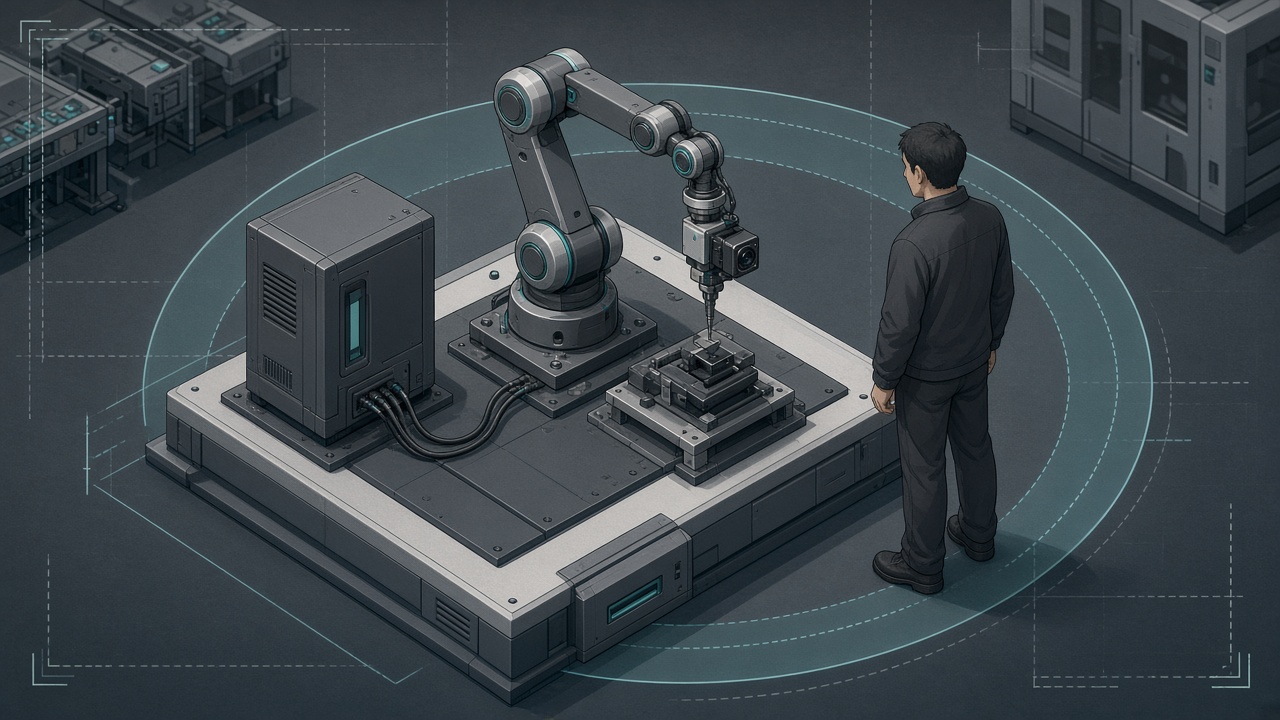
Collaborative applications only deliver ROI if the robot keeps moving productively beside people. Cloud-centric vision can support analytics; it struggles when the loop must protect operators and protect cycle time at once.
Industry analysis of physical AI for collaborative cells notes that round-trip cloud paths for high-fidelity depth sensing and skeletal tracking commonly land in the 100–200 ms range. At a moderate arm speed of about 2 m/s, that delay corresponds to roughly 200–400 mm of motion before a stop or slowdown command can act—enough to force oversized safety envelopes, conservative speeds, and stop-and-go behavior that destroys the business case. Deterministic end-to-end latency on the order of under ~30 ms for speed-and-separation-style monitoring is argued as the practical target, which pushes inference to the edge and, for dynamic kinematic updates, toward a direct path into the motion controller rather than waiting on every PLC scan.
That architecture aligns with the Edge & On-Device AI theme badge on this piece: cameras and models live with the cell; certified safety functions remain on the safety-rated path; the edge layer supplies fast perception for trajectory and speed setpoints. Research on 5D/5G edge offload for collaborative control similarly treats reaction time, image rate/resolution, QoS, and timeout-based safe stops as first-class design variables—not afterthoughts.
Safety standards reinforce the same systems view. ISO 10218-2:2025 addresses industrial robot applications and cells—design, integration, commissioning, operation, and maintenance—and incorporates collaborative-application requirements previously associated with ISO/TS 15066. Industry FAQs from A3 note the shift toward assessing the collaborative application (robot, tooling, workpiece, program, procedures), not a mythical “collaborative robot” label alone, and call out added cybersecurity requirements tied to industrial robot safety. Practically: AI perception does not replace risk assessment, force/speed limits, or a cybersecurity threat assessment for networked cells.
Robot Learning & Autonomy enters here as well. CAD-based or few-shot approaches that shorten training for new part families matter because changeover cost is part of ROI. Autonomy that cannot be validated, monitored for low-confidence predictions, and rolled back under out-of-distribution glare or novel defects is not autonomy plants will trust on B-shift.
Integration failures: why projects stall after the pilot
Most stalled industrial AI robotics programs do not fail because Softmax was wrong on a curated test set. They fail in the seams.
1. Underestimating OT/IT plumbing
Edge-inspection practitioners frequently report that integration—PLC handshakes, data pipelines, lighting, network, validation—consumes the majority of calendar time, while model training is a minority slice. When legacy machines cannot exchange the signals the cell needs, “the AI works in the lab” becomes “the line cannot talk to the model.” Budget and schedule for interfaces first.
2. Lighting, reflections, and uncontrolled scenes
Metallic and glass surfaces under harsh overhead fixtures create specular glare and shadows that quietly destroy precision. Documented cobot inspection deployments have had to add end-effector and cell LEDs, replan paths for reach, and expand training sets for out-of-distribution lighting. If the pilot only ran on a golden image set, production will rediscover physics.
3. Business cases that omit false positives and maintenance
A dashboard accuracy number that ignores review labor, scrap from over-reject, escape risk, software subscriptions, and periodic retraining will look brilliant in CapEx review and sour in OpEx. Model drift after a coating change or supplier shift is an operations problem with a name.
4. Safety and software coordination treated as paperwork
Multi-robot ROS 2 stacks colliding on default topic names, missing namespace isolation, or AI decisions without low-confidence aborts have already appeared in published deployment write-ups. Collaborative cells also need application-level risk assessment under the current ISO 10218 framework—and cybersecurity threat assessment as networked robots become the norm. Skipping either is not a shortcut; it is a stop-ship later.
5. Pilots without workflow ownership
Detection that does not answer “ship / hold / rework / contain / investigate” fails to create value. Inspection outputs must align with quality standards and connect to MES, genealogy, and disposition rules. Cross-functional ownership (quality, operations, controls, IT) at kickoff correlates with cells that survive audit and night shift.
A practical sequence for plants chasing early ROI
- Pick one expensive, well-measured pain. Collisions on de-rack, inspection bottleneck, or multi-shift pick labor—with numbers.
- Decide if AI is required. Prefer classical vision or fixtures when rules suffice.
- Baseline costs end-to-end. Labor, scrap, escapes, downtime, containment, capacity.
- Scope total installed cost. Robot or retrofit, cameras, lighting, EOAT, safety, integration, MES, training, spares, model ops.
- Design for edge latency and safety. Keep certified stops on the safety path; put perception where timing allows.
- Pilot under real lighting and SKU mix. Include rare defects and worst-case racks.
- Define human roles. Assistive review vs closed-loop reject—match risk.
- Instrument payback. Minutes of downtime, false-positive rate, escape rate, cycle time, and model update effort—reviewed monthly after go-live.
- Scale only what ran for a quarter. Copy the cell design, not the slide.
Bottom line
Factories see ROI first from AI cobots and factory vision AI where perception removes expensive uncertainty from motion and quality—pick-and-place under pose variation, and inspection under criteria that rules cannot hold. Documented retrofits show that downtime recovery and cycle-time gains can be large when AI vision rides existing robots; inspection cells show double-digit quality-check time cuts when lighting, multi-robot software, and human review are engineered together. Edge inference is not a buzzword in this context: it is how collaborative cells keep both people and takt time intact.
The projects that stall usually underfund integration, ignore false-positive economics, or treat standards and cybersecurity as afterthoughts. The projects that pay treat industrial AI robotics as plant engineering with models inside—not as a model with a plant attached.
Related reading
- Physical AI Data Factories: How Synthetic Data Accelerates Industrial Robots
- Humanoids on the Factory Floor: From Demo Videos to Full Shifts
- Sim-to-Real in 2026: Closing the Gap Without Endless Real-World Data
References / Sources
- Inbolt — Stellantis bodyshop de-racking case (97% breakdown reduction; ~3-month ROI): https://www.inbolt.com/resources/customer-stories/stellantis-enhances-bodyshop-efficiency-by-97-with-inbolts-vision-guided-de-racking-solution/
- Inbolt — Stellantis automotive pick-and-place (~30% cycle-time reduction; 3–6 month projected ROI): https://www.inbolt.com/resources/customer-stories/30-cycle-time-reduction-in-automotive-pick-place/
- Inbolt — Pick & place / de-racking use-case overview (retrofit framing, brand compatibility notes): https://www.inbolt.com/use-cases/placement-deracking/
- Cognex — “How Vision-Guided Robotics Helps to Drive ROI” (payback framing, part variability, integration cost emphasis; page content summarized via search index this turn; direct fetch rate-limited): https://www.cognex.com/en/tools-and-resources/resource-center/when-vision-guided-robotics-actually-drives-roi
- Octave — “Before investing in AI vision inspection, do the math” (cost framework, false positives/negatives, Sandia context): https://www.octave.com/learn/resources/blogs/before-investing-in-ai-vision-inspection-do-the-math
- The Robot Report — Madhu Gaganam, “Closing the latency gap: Why physical AI requires edge-first architectures” (3 May 2026; latency / SSM discussion): https://www.therobotreport.com/closing-latency-gap-why-physical-ai-requires-edge-first-architectures/
- arXiv HTML — “AI-Driven Collaborative Assembly Line Inspection: System Integration and Deployment Challenges” (Silverline / AI-PRISM cobot inspection cell metrics and integration issues): https://arxiv.org/html/2609.33522v1
- PMC / Sensors review — “Machine Learning-Powered Vision for Robotic Inspection in Manufacturing: A Review” (accuracy ranges; high share of pilot-scale work): https://pmc.ncbi.nlm.nih.gov/articles/PMC12899094/
- SOLOMON 3D — AccuPick bin-picking case (UR10; ~6 s cycle; Siemens-related line via Motion Technique): https://www.solomon-3d.com/case-studies/accupick/bin-picking-steel-parts-ai/
- ISO — ISO 10218-2:2025 Robotics — Safety requirements — Part 2: Industrial robot applications and robot cells: https://www.iso.org/standard/73934.html
- A3 Automate — Updated ISO 10218 FAQ (collaborative application framing; cybersecurity notes): https://www.automate.org/robotics/blogs/updated-iso-10218-faq
- TÜV Rheinland — ISO 10218 standard update overview (TS 15066 integration; cybersecurity requirements summary): https://www.tuv.com/landingpage/en/robotics/main/standard-update-alert/
- IEEE Access — “Distributed Control for Collaborative Robotic Systems Using 5G Edge Computing” (reaction-time factors; timeout safe-stop pattern): https://doi.org/10.1109/access.2024.3475584
- IFR — Cobots infographic (ISO 10218 / ISO TS 15066 collaborative guidance pointers): https://ifr.org/img/uploads/Cobots_Infografik.pdf
Images: original illustrations generated for AndBeyond.Tech; no logos or real people depicted.