Physical AI Data Factories: How Synthetic Data Is Accelerating Industrial Robots
What a physical AI data factory is, how NVIDIA Cosmos synthetic data speeds industrial robots, and where sim-to-real still fails on the factory floor.
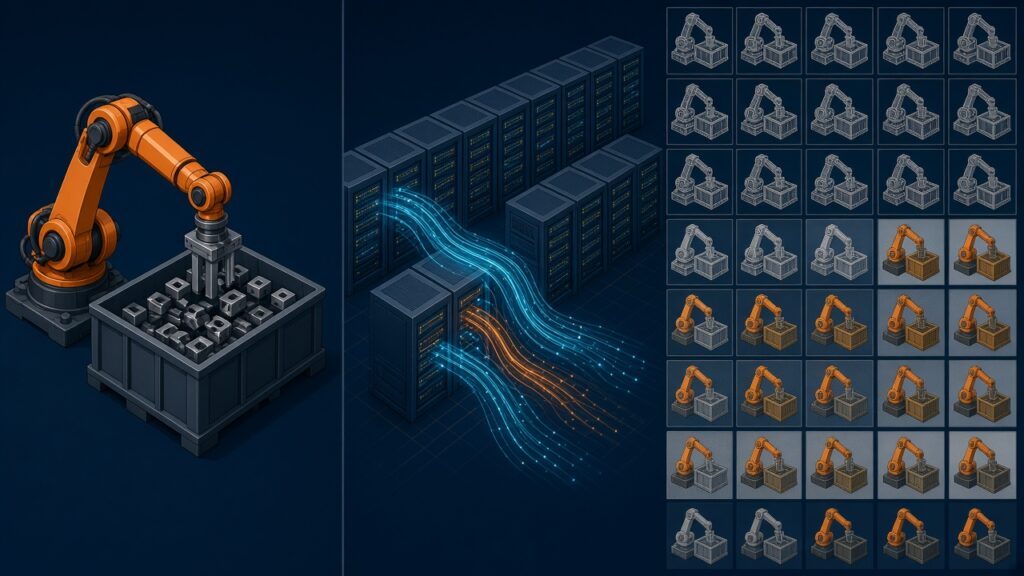
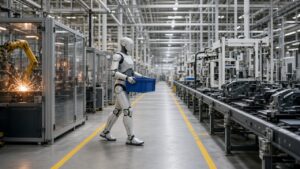
Industrial robots have never been short of compute. They have been short of examples. A vision-guided bin picker needs to see thousands of part poses under shifting light. An inspection model needs defects that, on a well-run line, almost never occur. A manipulation policy for a new assembly step needs hours of demonstrations that someone has to teleoperate, label and clean. For most manufacturers, that data bottleneck—not the price of a GPU or a robot arm—is what turns a promising pilot into a stalled one.
That is the problem the physical AI data factory is meant to address. The phrase, pushed hard by NVIDIA through 2026, describes an industrialised pipeline that takes limited real-world recordings and turns them into large, labelled, validated training sets for robots, vision agents and autonomous machines. NVIDIA’s own framing at its March GTC event was blunt: in the words of Rev Lebaredian, its vice president of Omniverse and simulation technologies, “compute is data.”
That slogan deserves scrutiny. This article looks at what a data factory actually contains, how synthetic data robotics workflows fit alongside older sim-to-real techniques such as domain randomization, what early adopters report, and where the approach still runs into the hard edges of physics, rare defects and safety certification.
What “data factory” means for robot learning
In software AI, training data was scraped from the web at enormous scale. Physical AI has no equivalent. Robot data is expensive to collect, specific to a given arm, gripper, sensor set and cell layout, and often unsafe to gather for the scenarios that matter most—collisions, spills, dropped parts, people stepping into a working envelope. A recent survey on embodied AI for industry in National Science Review describes industrial datasets as sparse, imbalanced and tightly coupled to specific equipment, with rare events and tight-tolerance conditions systematically under-represented.
A data factory treats that scarcity as a production problem. Rather than collecting everything physically, teams run a repeatable pipeline with distinct stages:
- Curate and search existing footage and sensor logs so that the right clips are found, deduplicated and annotated.
- Augment and multiply those clips—changing lighting, weather, textures, backgrounds or object appearance while preserving the underlying scene geometry.
- Generate new samples, either from physics-based simulation of a 3D scene or from generative world models conditioned on real inputs.
- Label automatically, since synthetic and augmented data can carry ground truth (bounding boxes, masks, poses, trajectories) that humans would otherwise have to draw.
- Evaluate and filter generated output, discarding samples that are physically implausible or off-target before they reach training.
The “factory” metaphor matters because each stage is meant to be orchestrated, scaled and monitored like a production line, with throughput limited mainly by available accelerator capacity. That is why this topic sits as much under AI accelerators and silicon as under robot learning: the economic argument is that GPU hours can substitute for some share of human demonstration hours and physical test time.
Inside NVIDIA’s blueprint: from PAIDF to Cosmos Data Factory
NVIDIA announced its Physical AI Data Factory Blueprint on 16 March 2026 as an open reference architecture for generating, augmenting and evaluating training data for robotics, vision AI agents and autonomous vehicles. According to the company’s press release, the blueprint organises work into three core workflows built on its NVIDIA Cosmos world foundation models:
- Cosmos Curator processes, refines and annotates large real and synthetic datasets.
- Cosmos Transfer expands curated data into more varied versions—different environments, lighting and conditions—to capture long-tail scenarios.
- Cosmos Evaluator, built on the Cosmos Reason model, scores and filters generated data for physical accuracy before it is used for training.
Orchestration initially ran through NVIDIA OSMO, an open-source workflow framework, which NVIDIA said would integrate with coding agents. Microsoft Azure and Nebius were named as the first cloud platforms offering the blueprint, and NVIDIA listed FieldAI, Hexagon Robotics, Linker Vision, Milestone Systems, RoboForce, Skild AI, Teradyne Robotics and Uber among early users.
The project has since been renamed. The public GitHub repository now calls it NVIDIA Cosmos Data Factory (CDF), and its migration guide explains two simultaneous changes: the name, and a shift to Apache Airflow as the single orchestration layer, with Kubernetes supported as the execution backend for every blueprint and OSMO retained as a backend for some. For engineering teams evaluating the stack, that detail is practical rather than cosmetic—Airflow and Kubernetes are tools many plant IT and data teams already operate.
The repository lists five reference blueprints:
| Blueprint | What it does (per NVIDIA’s repository) | Relevance to industrial robotics |
|---|---|---|
| Defect Image Generation | Turns PCB, metal and glass component references into simulated images, then adds generated defects | Inspection models when real defect samples are scarce |
| Event Video Generation | Converts one seed image into annotated videos of rare events such as fires or falls | Safety monitoring, anomaly detection in cells and warehouses |
| Video Data Augmentation | Re-renders existing footage across lighting, weather and environmental conditions while keeping scene structure | Robustness for mobile robots and outdoor or mixed-light sites |
| Image Attribute Augmentation | Varies appearance attributes of person crops | Person re-identification near robots |
| Autonomous Vehicle Dataset Generation | Retrieves similar driving clips and generates variants | Less directly industrial; relevant to yard and logistics autonomy |
Underneath sit reusable “skills”: anomaly generation from a handful of examples, augmentation, auto-labelling, curation and retrieval, orchestration, and a Simulation skill that renders labelled images from 3D scenes using Isaac Sim and Omniverse Replicator. That last component is a reminder that the data factory is not only about generative video; classic physics-based rendering of a digital twin remains part of the toolkit.
In an October 2026 update, NVIDIA said Cosmos Data Factory was available through GitHub, Microsoft Azure, Nebius and CoreWeave, and that Cosmos Curator had gained support for multimodal, multi-sensor inputs.
From pixels to motion: synthetic trajectories for manipulation
Perception data is the easier half. Teaching a robot how to move requires action data—joint trajectories or end-effector commands paired with observations. NVIDIA’s Isaac GR00T-Dreams blueprint, built on Cosmos, attacks that problem with a five-step process described in an NVIDIA technical blog:
- Collect a small set of teleoperated demonstrations of one task in one environment and use them to post-train a Cosmos Predict world model on the specific robot.
- Prompt the fine-tuned model with an initial image and new language instructions to generate many videos (“dreams”) of new tasks.
- Use Cosmos Reason to filter out failed or flawed dreams.
- Run an inverse dynamics model that infers the actions between pairs of frames, converting 2D video into “neural trajectories.”
- Train a visuomotor policy on those trajectories, alone or co-trained with real data.
The research behind this, published as DreamGen, reports that a humanoid robot learned 22 new behaviours in seen and unseen environments using teleoperation data from only a single pick-and-place task. The open-source repository supports embodiments including the Franka Panda arm, the Fourier GR1 humanoid and the low-cost SO-100 arm.
For industrial readers, the important qualifier is in NVIDIA’s own Cosmos Cookbook. Its GR00T-Dreams recipe notes that generated trajectories can be physically plausible yet still differ from real robot data; that the Cosmos Reason critic is “a proxy” for physical plausibility rather than a ground-truth oracle; and that results are strongest on setups resembling the manipulation data the model was trained on. Those caveats are not footnotes—they define where the technique currently fits.
Sim-to-real and domain randomization: the older foundation
Synthetic data in robotics did not begin with world models. The canonical reference is a 2017 paper by Josh Tobin and colleagues at OpenAI and UC Berkeley, which introduced domain randomization for sim-to-real transfer. Instead of trying to make a simulator perfectly realistic, the authors randomised textures, lighting, camera positions and distractors so heavily that “the real world may appear to the model as just another variation.” Their object detector, trained only on non-realistic simulated images, localised real objects to roughly 1.5 cm and was used to drive grasping in clutter.
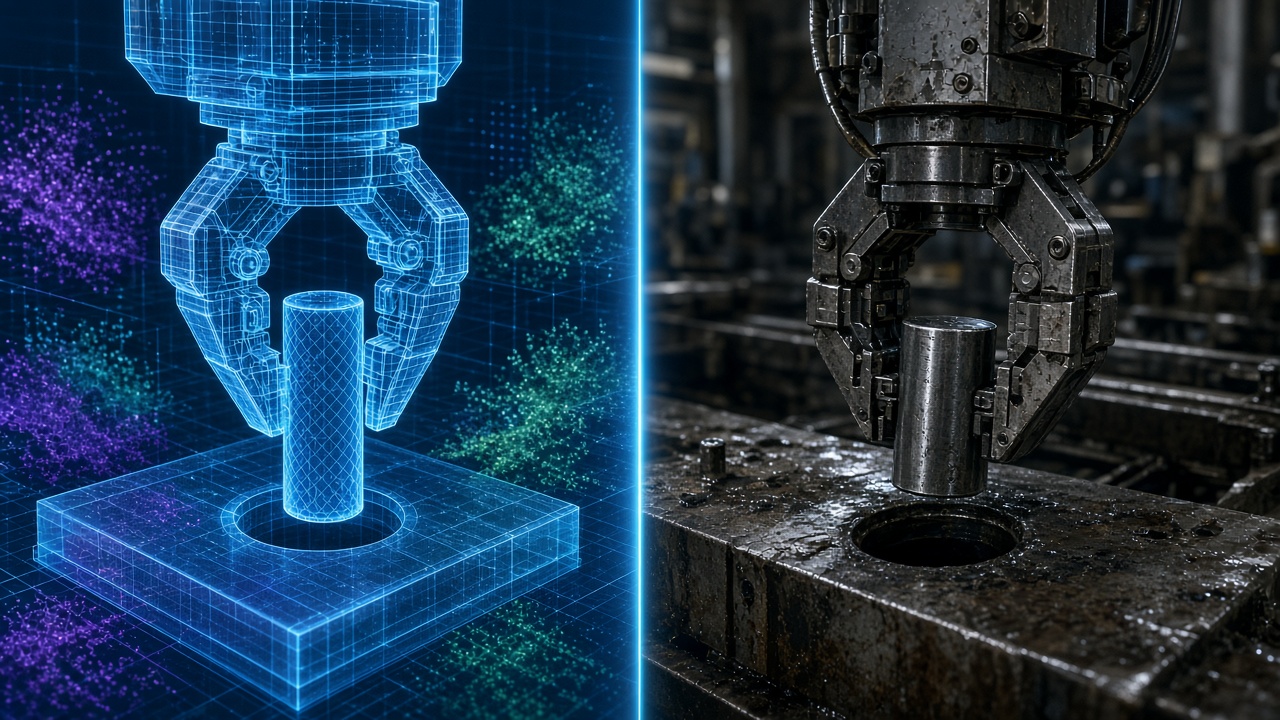
Modern data factories combine both philosophies. Physics-based tools such as Isaac Sim with Replicator provide exact labels and controllable randomisation. Generative models such as Cosmos Transfer add photorealistic variation anchored to real footage, which can narrow the appearance gap that pure randomisation leaves open. And evaluators try to catch generated samples that break physical rules.
A 2026 empirical study on sim-to-real generalisation for vision-language-action models frames the remaining question precisely: how much do multi-level randomisation, photorealistic rendering, physics realism and reinforcement-learning updates each contribute to real-world performance? The honest answer, across the literature, is that it depends heavily on the task. Appearance gaps are increasingly tractable. Dynamics gaps are not.
What early adopters report—and how to read it
NVIDIA’s October 2026 Cosmos update lists several deployments. All figures below are vendor-reported and have not been independently verified by AndBeyond.Tech:
- ANYbotics generated more than 1,500 synthetic video clips with Cosmos Data Factory blueprints, curating real data and validating outputs with Encord’s platform, to train its industrial inspection robots to spot liquid spills and other changes between facility rounds.
- Ultralytics retrained a YOLO detector on real images plus targeted synthetic defects and, according to NVIDIA, improved defect localisation and recall. No figures were published in the announcement.
- Fogsphere, working with ADNOC, uses the data factory to generate synthetic training data for rare safety hazards so they need not be physically staged.
- In automotive, Porsche is building a shared autonomous-driving data flywheel across Volkswagen Group brands; NVIDIA says this is expected to reduce repeated physical test drives by up to 90% and cut development cycles by up to 85%. These are projections, not measured outcomes.
The pattern is telling. The most concrete industrial cases are perception tasks—inspection, anomaly detection, hazard recognition—where synthetic images or clips augment a real baseline. That matches where synthetic data has the longest track record. Claims about generalist manipulation policies trained largely on generated data remain mostly in research and early pilots.
Industrial deployment realities
For a plant engineering team, adopting a data factory is less about models than about plumbing and governance.
Digital assets are the entry ticket. Physics-based generation needs accurate CAD, materials and cell layouts; generative augmentation needs representative real footage. Many brownfield sites have neither in clean form.
Compute is a budget line, not a free input. The “compute is data” argument assumes access to GPU clusters, whether on-premises or through clouds such as Azure, Nebius or CoreWeave. Best-of-N generation followed by critic filtering, as the Cosmos Cookbook notes, multiplies compute cost. Teams need to compare that against the cost of simply collecting more real data on a staged line.
Data lineage must be traceable. When a model fails on the floor, engineers need to know which synthetic batches, prompts and model versions shaped it. Pipeline tooling such as Airflow helps, but only if versioning is enforced.
Real data never disappears. Every credible workflow—from Tobin’s randomisation work to GR00T-Dreams co-training—keeps real data as anchor, test set or both. Research on linking real scenes to synthetic generation reaches the same conclusion: synthetic data works best as a supporting source alongside real capture.
The limits of synthetic data: a practical checklist
Before betting a line on synthetic data, check these failure modes.
Domain gap in contact and dynamics
Rendering has improved faster than physics. A 2020 position paper on contact simulation pointed out that common robotics simulators model contact as single points, while real contact is distributed, and that friction, deformable materials and soft bodies remain hard to capture. Industrial insertion research shows why that matters: tight assembly clearances can fall below 0.1 mm, where small modelling errors decide success or jamming. Generative video does not solve this—it learns what motion looks like, not the forces involved. Expect contact-rich tasks to need real-world fine-tuning, compliance control or system identification.
Rare defects and the “unknown unknowns”
Generators can multiply defect types that someone has already shown them. They cannot invent the failure mode nobody has seen, and they can introduce artefacts a model learns to exploit. Keep a held-out set of real defects for validation, measure escapes on that set, and treat synthetic-only gains with suspicion. Maintenance of the pipeline is also real work: the industrial-embodied-AI survey notes that high-fidelity contact and material models are costly to keep current as products, fixtures and wear states change.
Evaluators are filters, not certifiers
Automated critics such as Cosmos Evaluator and Cosmos Reason improve dataset quality, but NVIDIA’s own documentation calls the critic a proxy that can miss fine-grained physics. A plausible-looking clip is not a validated one.
Safety validation stays physical
Synthetic data can broaden training coverage and support scenario testing, but it does not change who is responsible for safety. ISO 10218-1:2025 and ISO 10218-2:2025, the revised industrial robot safety standards published in 2025, cover robot design and robot-cell integration, including functional safety and collaborative applications previously addressed in ISO/TS 15066. Risk assessment, verification of safety functions and commissioning still happen on real hardware. A learned perception or motion component needs its own validation evidence on real data, kept separate from any certified safety layer.
Outlook: a production discipline, not a shortcut
The physical AI data factory is best understood as a maturing production discipline for robot training data. NVIDIA has assembled a coherent, open toolchain—Cosmos Curator, Transfer, Reason and Evaluator, Isaac Sim and Replicator, GR00T-Dreams—and moved it onto orchestration tools that enterprise teams recognise. Early industrial uses in inspection and anomaly detection look sensible and low-risk.
What it does not do is remove the reality gap. For manufacturers, the pragmatic path in late 2026 is to start where synthetic data is proven—perception, rare-defect augmentation, lighting and environment robustness—keep a disciplined real-data validation set, and treat generated manipulation trajectories as a promising supplement to, not a replacement for, real demonstrations and physical safety testing. Compute can produce data. Only the factory floor can tell you whether that data was right.
Related reading
- Sim-to-Real in 2026: Closing the Gap Without Endless Real-World Data
- AI Cobots and Vision: Where Factories See ROI First
- Vision-Language-Action Models: The New Foundation Layer for Robots
References / Sources
- NVIDIA press release, “NVIDIA Announces Open Physical AI Data Factory Blueprint to Accelerate Robotics, Vision AI Agents and Autonomous Vehicle Development” (16 March 2026): https://investor.nvidia.com/news/press-release-details/2026/NVIDIA-Announces-Open-Physical-AI-Data-Factory-Blueprint-to-Accelerate-Robotics-Vision-AI-Agents-and-Autonomous-Vehicle-Development/default.aspx
- NVIDIA Blog, “NVIDIA GTC Showcases Virtual Worlds Powering the Physical AI Era”: https://blogs.nvidia.com/blog/gtc-2026-virtual-worlds-physical-ai/
- NVIDIA Blog, “NVIDIA Cosmos Opens New Tools to Train, Evaluate and Deploy World Models” (21 October 2026): https://blogs.nvidia.com/blog/cosmos-open-train-evaluate-deploy-world-models/
- NVIDIA Cosmos Data Factory repository (GitHub): https://github.com/NVIDIA/cosmos-data-factory
- Cosmos Data Factory migration guide (PAIDF → CDF, Airflow orchestration): https://github.com/NVIDIA/cosmos-data-factory/blob/main/MIGRATION.md
- NVIDIA Technical Blog, “Enhance Robot Learning with Synthetic Trajectory Data Generated by World Foundation Models”: https://developer.nvidia.com/blog/enhance-robot-learning-with-synthetic-trajectory-data-generated-by-world-foundation-models/
- NVIDIA GR00T-Dreams repository (GitHub): https://github.com/nvidia/GR00T-dreams
- Cosmos Cookbook, “Leveraging World Foundation Models for Synthetic Trajectory Generation in Robot Learning”: https://nvidia-cosmos.github.io/cosmos-cookbook/recipes/end2end/gr00t-dreams/post-training.html
- Jang et al., “DreamGen: Unlocking Generalization in Robot Learning through Video World Models” (arXiv 2505.12705): https://arxiv.org/html/2505.12705v2
- Tobin et al., “Domain Randomization for Transferring Deep Neural Networks from Simulation to the Real World” (arXiv 1703.06907, IROS 2017): https://arxiv.org/abs/1703.06907
- “Survey on embodied AI for industry: from the perspective of industrial robots,” National Science Review: https://academic.oup.com/nsr/advance-article/doi/10.1093/nsr/nwag505/8767815
- “Grounding Sim-to-Real Generalization in Robotic Manipulation: An Empirical Study with Vision-Language-Action Models” (arXiv 2603.22876): https://arxiv.org/html/2603.22876
- “Bridging the Sim-to-Real Gap with Dynamic Compliance Tuning for Industrial Insertion” (arXiv 2311.07499): https://arxiv.org/html/2311.07499v3
- Zhang, “Necessity for More Realistic Contact Simulation” (Sim2Real workshop, 2020): https://sim2real.github.io/assets/papers/2020/zhang2.pdf
- “Efficiently Linking Real Scenes with Synthetic Data Generation for AI-based Cognitive Robotics and Computer Vision Applications” (arXiv 2606.20272): https://arxiv.org/html/2606.20272
- ISO 10218-1:2025, Robotics — Safety requirements — Part 1: Industrial robots: https://www.iso.org/standard/73933.html
- A3, “Updated ISO 10218 — Answers to Frequently Asked Questions”: https://www.automate.org/robotics/blogs/updated-iso-10218-faq
Images: original illustrations generated for AndBeyond.Tech; no logos or real people depicted.