From Pilot to Every Plant: The Race to Make Robot Skills Portable
Schaeffler–Wandelbots, FMC³ Robotics and Aptiv show the new bottleneck: reusing robot applications across plants. What it takes to turn a PoC into production.

Most manufacturers no longer need convincing that a robot can do a new task. Proofs of concept (PoCs) with AI-based perception, learned grasping or mobile manipulation are now common. The harder question comes the morning after a successful pilot. Can the same application run in the next plant, on a different robot, beside different machines, without a second engineering project?
In most factories today, the answer is “not without rework”. An application that works in one cell is tied to that cell’s robot brand, controller, fixtures, lighting, conveyor heights, PLC signals and safety configuration. Moving it usually means re-teaching, re-validating and often re-programming. As a result, the cost of automation grows roughly with the number of sites, and the learning from the first deployment stays in the plant where it happened.
Three announcements from October and November 2026 show how vendors and manufacturers are trying to break that pattern. Schaeffler and Wandelbots are building a platform to test and transfer robot applications between plants. FMC³ Robotics is running two factory PoCs to check whether one embodied-AI approach can cover different tasks. Aptiv is bringing hundreds of partner robots onto its own production lines. None of these is yet proof that portable robot skills work at scale. Together, they show where the industry thinks the bottleneck now sits.
Why robot applications do not travel
It helps to be precise about what has to move when an application is “transferred”. A robot application is more than a motion program. It usually includes:
- The task logic: sequence, branching, error handling and recovery.
- Perception models: trained on images from one camera, at one angle, under one lighting condition.
- Hardware bindings: robot kinematics, controller language, gripper and tool I/O.
- Process integration: signals to and from PLCs, conveyors, machine tools and the plant’s manufacturing systems.
- Safety configuration: guarding, zones, speed and separation settings, validated for that specific cell.
- Process knowledge: tolerances, quality criteria and the corrections an experienced operator makes without thinking.
Traditional automation bundles all of these together. Each plant ends up with its own version, maintained by its own integrator. The emerging “portable skill” approach tries to separate them. The task logic and learned models live in a software layer above the hardware. Simulation checks them before they reach the shop floor. Only the plant-specific bindings are adapted locally. We looked at the data side of this in Physical AI Data Factories: How Synthetic Data Is Accelerating Industrial Robots. The validation side depends on closing the sim-to-real gap.
Case 1: Schaeffler and Wandelbots, a platform to move applications between plants
On 22 October 2026, motion-technology group Schaeffler and Dresden-based robotics software company Wandelbots announced a technology partnership. The announcement came in parallel press releases from Schaeffler and Wandelbots, and details were presented at NVIDIA GTC in Berlin.
What the companies say they are building
According to both releases, the partners will develop a physical AI platform for Schaeffler on top of Wandelbots’ NOVA software. Schaeffler describes the aim directly: the solution is meant to become available to all Schaeffler plants worldwide. It should support the development, testing and cross-location transfer of robotics applications, for both industrial and humanoid robots.
Wandelbots describes NOVA as a layer that separates application logic from hardware. It brings AI models, digital twins, machines and production data into one software environment, so that robots from different manufacturers, mobile systems and humanoids can be swapped underneath. Virtual testing uses NVIDIA Omniverse and NVIDIA Isaac Sim. Processes are simulated, validated and optimised digitally, then moved to the shop floor through the same software layer. Wandelbots says the logic validated in simulation goes into production unchanged.
The skill concept is central. Schaeffler says a skill store will bundle applications, models and technical knowledge. Skills developed in individual projects can then be captured systematically, used independently of the robot system and scaled to other plants. In the future they could also be offered to outside customers. Wandelbots calls the target metric “time-to-skill”.
The vendor-reported benefits
Both companies state a goal of cutting automation life-cycle costs by up to 40%, in new and existing production environments. This is a target set by the partners, not a measured result. The trade outlet Robot24 notes that the estimate has not been independently confirmed, and that no financial details or implementation timeline were disclosed.
Wandelbots also reports results from earlier joint projects. In a robot-assisted packaging cell, simulation cut development time by around two weeks per application (vendor-reported). Correction loops that previously took weeks to months were significantly shortened. According to Wandelbots, Schaeffler’s production network includes several thousand robotic systems, which gives a sense of the scale at which reuse could pay off.
Why it matters
The Schaeffler case is interesting because the manufacturer, not only the vendor, is framing the problem as one of transfer. A company with thousands of robots across many sites gets most of the value not from the first application but from the tenth copy of it. Whether “unchanged” logic really survives differences between plants is the claim to watch.
Case 2: FMC³ Robotics, one embodied-AI agent, two very different PoCs
FMC³ Robotics is an industrial embodied-AI company headquartered in Ingolstadt, Bavaria, with an office in Shanghai. On 3 November 2026 it published an exhibitor press release on the electronica 2026 portal describing two industrial PoCs. This is the company’s own primary text, in German. A longer English version appeared in ManufacturingTomorrow, which we cite as a secondary source for the extra detail.
The two PoCs
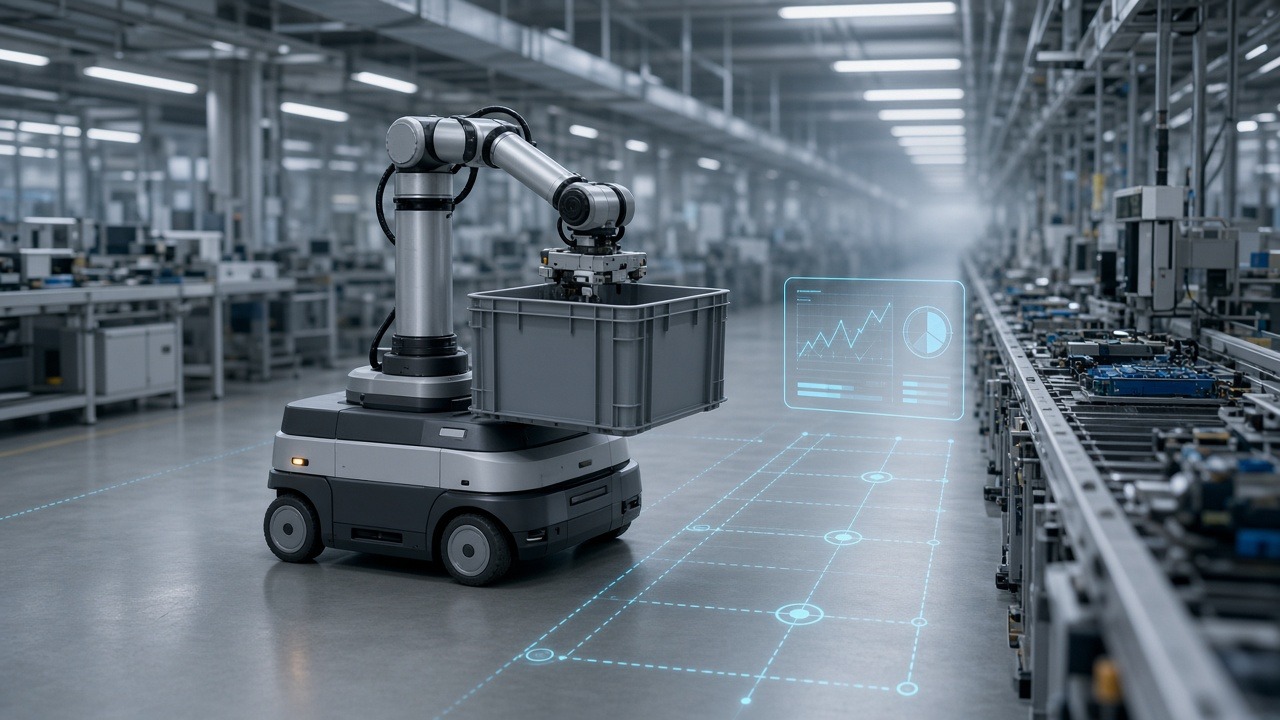
Mobile bin handling in consumer electronics. In the first PoC, which FMC³ describes as using a wheeled humanoid robot, the system runs a continuous chain of tasks under controlled test conditions. It picks up a bin, carries it through an existing facility, positions itself next to the target equipment and places the bin at a defined point on the line. According to ManufacturingTomorrow, the site handles several products and bin sizes, and neither aisles nor equipment were redesigned around the robot. The same report gives a delivery target of the end of October 2026.
Electrode-sheet handling in battery-cell production. The second PoC covers picking, transporting and precisely positioning battery electrode sheets in an existing process. Today a worker does this step. The robot has to coordinate grasp pose, placement position and work sequence with the surrounding equipment and tooling.
What FMC³ is actually testing
The company is explicit that both projects are still at PoC stage. In its words, the aim is to check whether the same industrial embodied-AI approach can handle different materials, task chains and robot configurations. It also wants to see whether data, models, robot hardware and manufacturing processes work together as a repeatable system. According to ManufacturingTomorrow, the metrics include cycle time, positioning deviation and continuous operating time.
The longer text also describes the data loop behind the approach. Task data is captured while workers do their normal jobs, using headsets, external cameras and, where needed, tactile gloves. That data then feeds simulation, training, validation, deployment and feedback. FMC³ emphasises traceability: which demonstration produced which capability, under which conditions it was trained and tested, and on which robot it was validated. The same report says FMC³, Vector Informatik and PEM Motion plan a German joint venture on data infrastructure for industrial embodied AI. As described, this JV is a plan, not an operating entity.
Why it matters
FMC³ tackles portability from the data end rather than the software-platform end. Its bet is that a skill can only be reused if the context it was learned in, including the mistakes and corrections, is captured and traceable. That is a sensible requirement. Two PoCs, however, cannot yet show that a capability learned in one plant transfers to another with less effort.
Case 3: Aptiv, its own factories as the validation ground
On 6 November 2026, Aptiv announced in a press release on its newsroom that it had signed separate strategic collaboration agreements with TARS and Shanghai Electric. The agreements were signed at the 9th China International Import Expo in Shanghai.
According to Aptiv, hundreds of robots from the two partners are being gradually deployed on Aptiv’s production lines, “moving from initial validation toward scaled deployment”. Aptiv says insights from production will feed back into developing the robotic systems so they adapt better to complex industrial environments. In the other direction, Aptiv’s high-performance computing platforms and power distribution products will be built into the partners’ robots, with initial production planned by the end of 2026. Aptiv says the computing architecture is meant to support several robot configurations and to improve “application portability”.
Aptiv’s release does not say which tasks the robots perform, which plants are involved, or what performance has been achieved. Those details should be treated as unknown until the company publishes them. What the announcement does show is a model where a large manufacturer uses its own lines as a proving ground. Reaching production volumes is treated as a gradual process, not a single switch-over.
A PoC is not production
All three cases are framed around scaling, and all three are early. Industrial buyers should keep in mind how much lies between a convincing demonstration and an application that runs every shift in every plant. Five areas matter most.
1. Validation evidence, not demonstrations
A PoC shows that a task can be done. Production needs evidence that it gets done reliably, across shifts, product variants and operators. That means agreed acceptance criteria, defined in advance, covering success rate, error modes and recovery behaviour, measured over a long enough run. Each transfer to another site should come with its own acceptance test. The fact that a skill was “validated in simulation” does not replace that test.
2. Safety under ISO 10218-2:2025
Safety does not transfer automatically. ISO 10218-2:2025 sets out safety requirements for industrial robot applications and robot cells. It covers their design, integration, commissioning, operation, maintenance and decommissioning, and it requires risk assessment of the complete application: robot, end effector, workpiece, program and related machinery. A skill moved into a new cell, with a different layout, different people nearby and different equipment, is in practice a new application. It needs its own risk assessment and safety validation. Learned behaviour adds a further question for safety engineers: how to show that the robot stays within its validated envelope when its actions come from a model rather than a fixed program.
3. Cycle time and uptime
The economic case rests on throughput. A mobile manipulator that completes the task in a PoC but runs slower than the line, or needs frequent operator help, will not pay off. Production readiness needs data on cycle time against takt, mean time between interventions, recovery time and continuous operating time. FMC³ lists these metrics for its PoCs, and the results should be checked once published.
4. Changeover
Portability between plants and flexibility within a plant are closely related. A skill platform proves its value when a new product variant, bin size or fixture can be added without a full re-engineering cycle. Buyers should ask how long a changeover takes, who can do it (integrator, plant engineer or operator), and how changes are re-validated.
5. Cybersecurity and software governance
A central skill library that pushes updates to robots in many plants is also a central point of attack and failure. Production deployments need version control, controlled rollout and rollback, access management, network segmentation between IT and OT, and clear accountability for models that change over time. Industrial cybersecurity frameworks such as the IEC 62443 series are the usual reference here. Data governance matters too, especially when operator demonstrations or production data leave the plant for training.
What buyers should ask
Taken together, the three cases suggest a short list of questions for any vendor promising portable robot skills:
- What exactly transfers? Task logic, perception models, motion, safety configuration, or only some of these?
- What has to be redone at the new site, and how many engineering hours did that take in real transfers so far?
- Which hardware is actually supported today, as opposed to on the roadmap?
- How is sim-to-real validated, and what happens when simulation and the real cell disagree?
- Who owns the skills and the data: the manufacturer, the platform vendor or the integrator?
- What independent or customer-verified results exist beyond vendor-reported targets?
Bottom line
The industry’s focus is shifting from “can a robot learn this task?” to “can we learn it once and use it everywhere?”. Schaeffler and Wandelbots are betting on a hardware-independent software layer with simulation and a skill store. FMC³ is betting on traceable data loops captured on the shop floor. Aptiv is using its own production lines to move partner robots from validation towards scale. Each answers part of the question. None has yet published evidence that a skill moved to a second plant at a fraction of the original engineering cost.
That evidence, measured transfer effort, safety validation per cell and long-run uptime, is what will separate platforms from pilots. Until it is published, the cost reductions in these announcements remain vendor-reported targets.
Related reading
- AI Cobots and Vision: Where Factories See ROI First
- Vision-Language-Action Models: The New Foundation Layer for Robots
- Five Million Factory Robots, Two Speeds: Why Asia Is Automating and Europe Is Stalling
References / Sources
- Schaeffler press release, “Physical AI: Schaeffler and Wandelbots enter into technology partnership”, 22 October 2026. https://www.schaeffler.com/en/media/press-releases/press-releases-detail.jsp?id=88223233
- Wandelbots news release, “Schaeffler Leverages Wandelbots NOVA as Its Physical AI Platform”, 22 October 2026. https://www.wandelbots.com/news/schaeffler-leverages-wandelbots-nova-as-its-physical-ai-platform
- Robot24, “Schaeffler, Wandelbots Partner on Factory Robot AI” (secondary source). https://robot24.com/schaeffler-wandelbots-partner-to-scale-physical-ai-in-factories
- FMC³ Robotics, exhibitor press release (German), “Zwei Fabrik-PoCs testen den industriellen Embodied-AI-Agent von FMC³”, electronica 2026 exhibitor portal, 3 November 2026 (primary). https://exhibitors.electronica.de/ausstellerportal/2026/presse/ausstellerpresseinformation/fmc-robotics/?elb=809.1180.12309.23.128231
- ManufacturingTomorrow, “FMC³ Robotics Tests Its Embodied AI Agent in Two Factory PoCs”, 2 November 2026 (secondary source). https://www.manufacturingtomorrow.com/news/2026/11/02/fmc%C2%B3-robotics-tests-its-embodied-ai-agent-in-two-factory-pocs/28511/
- FMC³ Robotics company website. https://www.fmc3-robotics.ai/
- Aptiv press release, “Aptiv Accelerates Robotics Expansion With Industry Partners”, 6 November 2026. https://www.aptiv.com/en/newsroom/article/aptiv-accelerates-robotics-expansion-with-industry-partners
- ISO, “ISO 10218-2:2025 Robotics — Safety requirements — Part 2: Industrial robot applications and robot cells”. https://www.iso.org/standard/73934.html
Images: original illustrations generated for AndBeyond.Tech; no logos or real people depicted.