The 181-Gigawatt Lock-In: Why On-Site Gas for AI May Not Stay Temporary
The gas plants being planned next to AI data centres are usually described as a bridge: a way to turn servers on while the transmission…
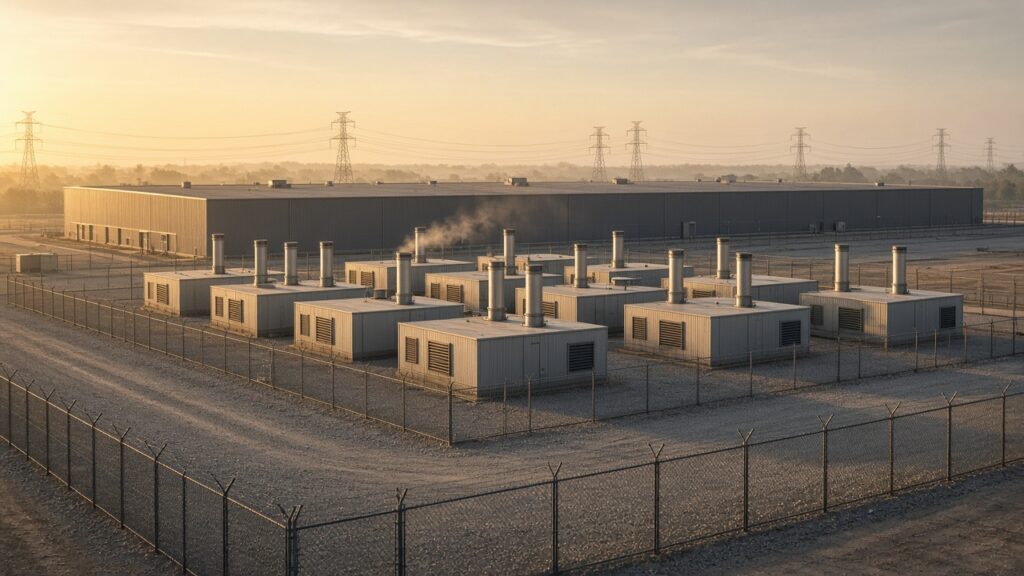
The gas plants being planned next to AI data centres are usually described as a bridge: a way to turn servers on while the transmission study is still in a queue. A report published on 11 November 2026 by BloombergNEF, commissioned by Bloomberg Philanthropies, puts a number on that bridge and then asks whether it will ever be taken down.
BNEF has tracked 181 GW of announced gas-fired generation proposed alongside data centres, more than 90% of it in the United States. The firm is careful, and the caution belongs in the lede. The pipeline “varies widely in maturity and timing,” BNEF says, and “should be viewed as an indication of potential scale rather than a forecast of what will ultimately be built.” Even as a ceiling, the figure is large enough to change the climate arithmetic of AI campus energy. If all announced on-site gas plants proposed for U.S. data centres were built and operated at the assumptions BNEF uses, they would emit about 345 million metric tons of carbon dioxide equivalent a year. That would be 152 MtCO2e more than if the associated data-centre capacity were served by average U.S. grid electricity — an amount BNEF equates to 10% of U.S. power-sector emissions in 2025.
The new finding is not that developers are ordering turbines. We mapped that supply chain, and the gap between announced and operating megawatts, in Skipping the Queue: Behind-the-Meter Gas and the AI Lab Arms Race for Turbines. The new finding is about what happens after the steel is in the ground. Many of these plants, BNEF notes, are intended to supply power only while a campus waits for a grid connection. Once they are online, “the economics could encourage them to continue generating energy, creating a longer-term fossil-fuel lock-in risk beyond the annual emissions.”
Temporary, in other words, is a planning assumption. It is not a thermodynamic law.
What the 181 GW figure is — and is not
Powering the Data Center Boom: How Grid Policy Can Deliver Clean Power Faster is a policy report, not a construction census. BNEF’s 11 November release is the public primary source for the figures used here; the full report sits behind a client paywall and is not quoted beyond what the firm has published.
Three numbers from that release frame the demand side. BNEF expects data-centre electricity demand almost to quadruple to 2,354 terawatt-hours by 2035, equivalent to 7% of global electricity consumption. In developed markets, grid constraints in the United States and Europe are delaying connections for large loads, while “the financial rewards for energizing quickly” are driving some developers to build on-site gas-fired power as they wait. Of the 181 GW announced alongside data centres, more than 90% is in the United States.
Mark Daly, BNEF’s head of data centres and emerging tech, put the policy conclusion in one sentence: “The extraordinary economics around AI are making speed to power one of the most important priorities for defining constraints on data center developers. The climate outcome will depend not only on how much electricity these facilities use, but on how quickly grids can connect them and whether power systems add cleaner generation alongside that demand.”
Two limits follow from the firm’s own wording. First, 181 GW is announced capacity, not a build-out forecast. Second, the 345 MtCO2e figure is a scenario: if all announced U.S. on-site plants were built and run at BNEF’s assumptions. It is not a measurement of plants already running, and it is not a prediction that they all will. Those caveats make the lock-in argument sharper, not weaker. The climate risk BNEF is flagging is not that 181 GW will definitely appear. It is that whatever subset does appear may have a commercial reason to keep running after the “bridge” years are over.
Why a bridge can become a fixture
A temporary generator is cheap to defend in a permit hearing and expensive to switch off once it is amortised. If the plant recovers its capital while the campus waits for a substation, the marginal economics of continuing to generate — especially when grid power is expensive, constrained, or interruptible — can favour keeping the turbines available. BNEF’s point is that this is a structural risk, not a moral accusation. In developed markets such as the United States and Europe, the firm argues, connecting data centres to the grid is “the more sustainable option,” which is why faster grid connections matter for limiting both near-term emissions and fossil-fuel lock-in. Continuing to decarbonise the power system in parallel “remains vital.”
The report reviews policies across 17 markets that aim to accelerate grid connections. BNEF’s own verdict is modest: the policy landscape is still emerging, many efforts should reduce waiting times, and “there is currently limited empirical evidence to demonstrate which will be most effective.” That is not a failure of the research. It is a warning against treating any single interconnection reform as a climate plan.
The geography of the problem also changes the answer. In some emerging markets, BNEF finds, a grid still heavily reliant on coal can make a grid-connected data centre worse than one powered by on-site gas. The four markets it highlights in the public release — Brazil, India, Indonesia and Malaysia — are not the focus of this article, but they are the reason a blanket “always connect to the grid” rule does not travel. The lock-in risk that matters for U.S. and European AI Hyperscale Infrastructure is the developed-market case: gas built to beat a queue, then left in place because it still pays.
The Guardian, in a 11 November report on the same research, placed the findings against the opening of the COP31 climate summit and reported additional United Kingdom colour that is not in the BNEF release: more than 100 inquiries in 2024–25 from planned UK data centres about connecting to gas, according to Future Energy Networks, and a government “datacentre covenant” under which the chancellor has backed temporary on-site fossil generation while sites wait for grid connections. Those UK particulars are Guardian reporting, not BNEF’s published figures, and are cited here as supporting context.
Mississippi, 10 November: a permanent permit survives appeal
The lock-in question is not only theoretical. On 10 November 2026, according to Mississippi Today, the Mississippi Environmental Quality Permit Board rejected an appeal of an air permit issued earlier in 2026 for a gas-turbine plant in Southaven, Mississippi, tied to SpaceXSI data-centre operations that cross the state line into Memphis, Tennessee. As of 16 November 2026, the board’s written minutes and order for that hearing had not yet been posted in MDEQ’s public minutes archive, which listed 2026 minutes only through August. The official record that is on MDEQ’s site is the meeting notice: the Permit Board convened on 9 November 2026 for an evidentiary hearing on a request regarding issuance of MZX Tech, LLC’s Prevention of Significant Deterioration Permit to Construct Air Emissions Equipment, Air Ref. No. 0680-00119, at 2875 Stanton Road, Southaven, MS 38671, continuing as needed after the regular board meeting at 9:00 a.m. on 10 November.
Mississippi Today, in a 12 November article, reported that the board issued its decision on Tuesday, the last day of the hearing, and rejected the appeal. The same article says that in March the board had approved air permits for 41 permanent gas turbines to power SpaceXSI’s data-centre operations in the area. The appellants, it reports, were the Safe and Sound Coalition, the NAACP, and Young, Gifted & Green, with the Southern Environmental Law Center arguing that MDEQ relied on limited modelling, did not require less-polluting turbines, and did not require emission offsets. Mississippi Today identifies the permittee, MZX Tech LLC, as a subsidiary of the company; this article uses the name SpaceXSI alone. The board’s lone dissenting vote, the newspaper reported, came from Agriculture Commissioner Andy Gipson. SELC, in an 11 November statement, described the ruling as the board doubling down on a permit that would allow 41 gas turbines to operate “for the foreseeable future.” That is an advocate’s characterization, presented as such.
What the official notice and the press account together establish, without a posted order to quote, is narrower and solid enough: a March permit for a permanent turbine plant at Stanton Road was tested in a two-day evidentiary hearing on 9–10 November, and the Permit Board, as reported on 10 November, left that permit in place. “Permanent” is the word that matters for lock-in. A bridge that needs 41 permitted permanent turbines is already designed to last longer than a construction delay.
A separate permitting fight around Starbase, in Texas, is covered in our Hyperscale Infrastructure report.
SpaceXSI’s position, in its own words
SpaceXSI’s public description of how it powers Colossus is set out on the company’s Memphis information page and deserves equal space. The company says Colossus, in South Memphis, “will draw power from Memphis Light, Gas and Water (MLGW) during standard operations via the substation(s) at our facility, which was built at no cost to MLGW,” and that it is working with MLGW to construct a second substation, also at no cost to the utility. “During emergency situations or when the grid is strained during times of deep cold or heat,” it says, “SpaceXSI will disconnect from the grid entirely.” For that contingency, the company says it has “installed more than 240 batteries onsite, and [is] keeping fifteen natural gas turbines with best-in-class emission controls technology on-hand for any prolonged outage,” so that “the community gets the power they need, when they need it.”
On temporary generation, the company is explicit. “In the early stages, we were concerned about how the electrical grid would react to the facility coming online. By temporarily generating our own power needs, SpaceXSI ensured the grid was not subjected to swings in demand. Now that we have finished constructing the first MLGW substation, we have begun removing the temporary natural gas turbines onsite and will continue to do so over the coming weeks and months.” It says it has applied to the Shelby County Health Department “to permanently house 15 natural gas generators at our facility — equipped with best-in-class emissions control technologies — which will only be used for back-up power generation during periods of prolonged outages.”
On emissions, SpaceXSI says Colossus was “constructed… to be the lowest emitting facility of its kind in the country,” that it “will primarily draw power directly from the MLGW grid,” that day-to-day operations “will generate very few emissions,” that drawing backup power from on-site batteries “will not generate emissions,” and that when the permanent backup generators are required, each will be equipped with SoLoNOx dry low-emissions technology and selective catalytic reduction systems “that lower nitrogen oxides (NOx) to 2 ppm, which is in line with the U.S. EPA’s Lowest Achievable Emission Rate.”
Those statements should be read carefully, and they should not be blended with the Southaven permit. The Memphis FAQ describes standard operations on the MLGW grid, a Shelby County application for 15 permanent generators characterized as backup, and the removal of temporary turbines at the Memphis site after the first substation came up. The Mississippi proceeding concerns a Prevention of Significant Deterioration construction permit for MZX Tech, LLC at Stanton Road in Southaven, which Mississippi Today reports covers 41 permanent turbines. They are related operations on either side of a state line. They are not the same permit, the same turbine count, or the same legal forum. This article does not invent operating hours, measured emissions, or a corporate organogram beyond what those sources state.
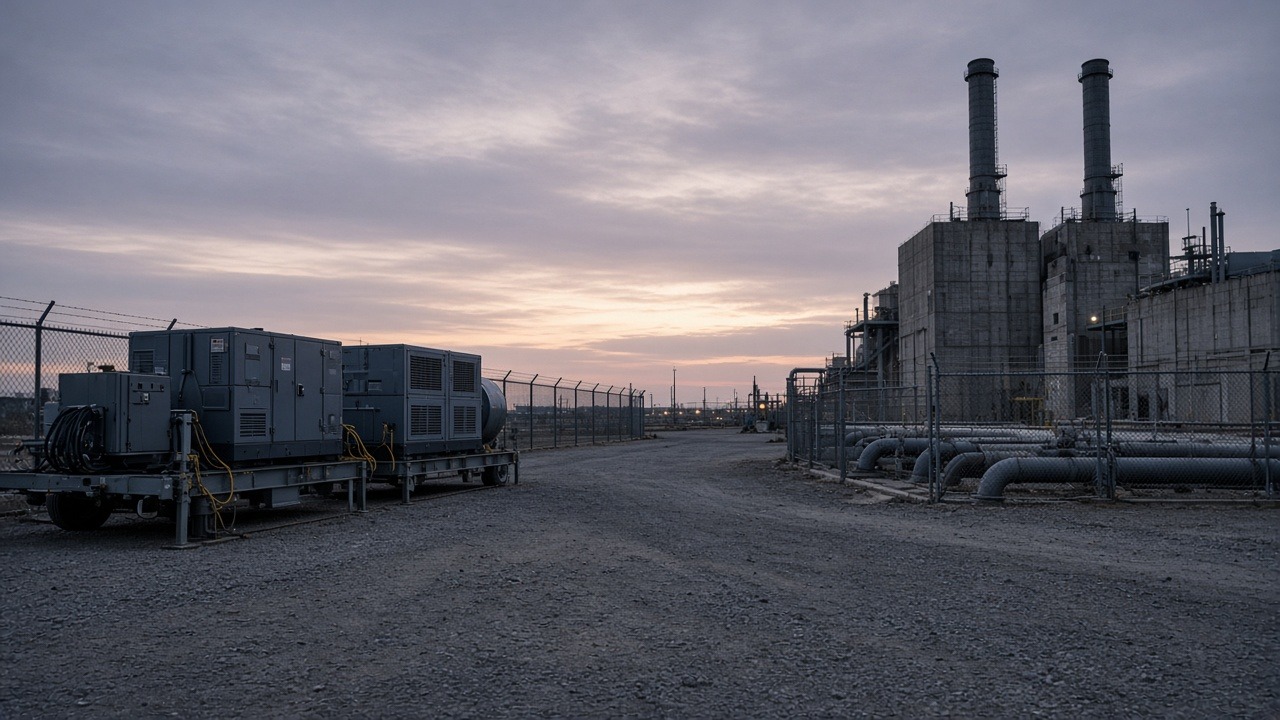
Set side by side, the two records are the lock-in debate in miniature. SpaceXSI’s Memphis page describes gas as a contingency and a bridge that is already being taken down, with the grid as the default and batteries as the first backup. The Southaven permit, as reported, is for a permanent plant. A company can be truthful about its intended operating protocol and still hold a permit that allows far more lasting generation than a “temporary” story suggests. A permit board can uphold a construction permit without settling how many hours the turbines will actually run. BNEF’s warning sits in the space between those facts: once permanent equipment is authorized and built, the option to keep generating does not expire when the interconnect is energised.
What the 181 GW implies for AI Power Players
For developers, the practical question is no longer only “how do we get megawatts this year?” It is “what residual generation stays on the site in year five?” A behind-the-meter plant that was justified as a queue-jumper can become, in effect, a merchant or captive generator with a data-centre offtaker already attached. That may be rational for the operator. It is the pathway BNEF says can add 152 MtCO2e a year above average U.S. grid power if the announced U.S. on-site fleet were built and run as modelled.
For grid operators and states, the implication is the inverse of the turbine-supply story. Speeding interconnection is not only an industrial-policy goal for AI Hyperscale Infrastructure. In BNEF’s developed-market framing, it is the main near-term climate control on a gas build-out that developers will otherwise self-supply. Flexible connections, financial commitments, special zones and clean-power procurement are among the tools the report reviews. The evidence on which of them actually shortens queues, BNEF itself says, is still thin. That is an argument for measuring outcomes, not for waiting.
For communities, Southaven is the reminder that “temporary” is tested in permit language. A March permit for 41 permanent turbines, left standing on 10 November after a contested hearing, is a lasting authorization whether or not the operator’s Memphis FAQ describes 15 backup units and a preference for grid power. Local opposition to that authorization is part of the same constraint set we described in Power, Water, and Local Pushback.
None of this requires inflating 181 GW into a prophecy. Most announced plants will slip, shrink or die, as announced plants do. The lock-in risk attaches to the ones that are built. If even a fraction of the U.S. pipeline is completed and then kept in the money after the grid arrives, the “bridge” will have done something more durable than its permit narrative claimed. BNEF has given a scale, a scenario and a mechanism. The Mississippi decision, as reported, has given a current example of how permanence gets written into an air permit. SpaceXSI has given its own account of a grid-first design with limited backup gas. Those three records, held in the same frame, are the story. The turbines that never ship will not lock anything in. The ones that do may.
Bottom line
BloombergNEF’s 11 November report does not prove that 181 GW of on-site gas will be built. It shows why the subset that is built may not remain temporary. Under the firm’s published assumptions, a completed U.S. announced on-site fleet would emit about 345 MtCO2e a year, 152 Mt above average grid power. The mechanism is economic: a plant installed to beat an interconnection queue can keep running once the capital is sunk. In developed markets, BNEF’s prescribed antidote is faster grid connection and continued power-system decarbonisation — with an honest admission that the policy evidence is still limited. In Southaven, a March permit for 41 permanent turbines at an MZX Tech site survived a 10 November appeal, as reported by Mississippi Today, while SpaceXSI’s own Memphis page describes standard operations on the MLGW grid, more than 240 batteries, the removal of temporary turbines, and 15 permanent generators intended only as backup. The tension between a permanent permit and a temporary narrative is the lock-in problem in one county. It will not be the last.
Related reading
- Skipping the Queue: Behind-the-Meter Gas and the AI Lab Arms Race for Turbines
- Power, Water, and Local Pushback: The Hidden Constraints on AI Campuses
- Nuclear You Can Buy Now: Constellation’s Peak+ and the Hybrid Alternative to New Gas for AI
- FERC’s Large-Load Showdown: Will Flexible AI Campuses Jump the Interconnection Line?
Sources
- BloombergNEF (primary) — “Data Center Power Demand Is Set to Surge, Raising New Climate Challenges: BloombergNEF” (11 November 2026): https://about.bnef.com/insights/data-centers/data-center-power-demand-is-set-to-surge-raising-new-climate-challenges-bloombergnef/
- The Guardian (supporting / secondary) — Sandra Laville, “AI datacentres plan on-site power stations on huge scale despite climate risks, research reveals” (11 November 2026): https://www.theguardian.com/world/2026/nov/11/ai-datacentres-on-site-gas-fired-power-stations
- Mississippi Department of Environmental Quality (primary; hearing notice, not a posted decision) — Permit Board page, November 9–10, 2026 meeting notice for MZX Tech, LLC, Air Ref. No. 0680-00119, 2875 Stanton Rd., Southaven: https://www.mdeq.ms.gov/permits/permit-board/
- MDEQ (primary; minutes archive checked 16 November 2026, November 2026 minutes not yet posted) — Permit Board Minutes 2026: https://www.mdeq.ms.gov/permits/permit-board/minutes/2026p/
- Mississippi Today (press; source for the 10 November decision) — Alex Rozier, “Permit board rejects appeal of SpaceXAI air permits in Southaven” (12 November 2026): https://mississippitoday.org/2026/11/12/spacexai-air-permits-data-center-southaven/
- Southern Environmental Law Center (advocate statement) — “MDEQ Permit Board doubles down on unlawfully flawed permit for xAI’s massive Colossus Gas Plant” (11 November 2026): https://www.selc.org/press-release/mdeq-permit-board-doubles-down-on-unlawfully-flawed-permit-for-xais-massive-colossus-gas-plant/
- SpaceXSI (primary) — Memphis Information Center / FAQs on power, temporary turbines, backup generation and emissions: https://x.ai/memphis/info
- AndBeyond.Tech — “Skipping the Queue: Behind-the-Meter Gas and the AI Lab Arms Race for Turbines.” /skipping-the-queue-behind-the-meter-gas-ai-turbines/
Images: original illustrations generated for AndBeyond.Tech; no logos or real people depicted.