Skipping the Queue: Behind-the-Meter Gas and the AI Lab Arms Race for Turbines
AI labs buy gas turbines to skip interconnection queues. Caterpillar’s backlog, Cleanview’s BTM tracker and announced-vs-online MW show the real power gap.
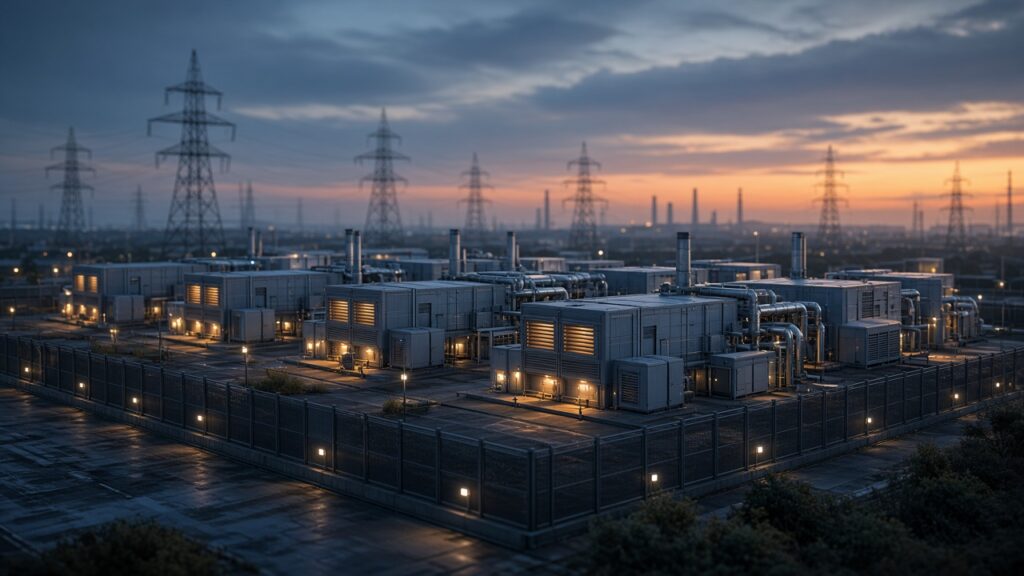
Behind-the-meter gas generation campus at dusk with modular generator halls and distant transmission towers.
For most of the cloud era, a data-center developer’s power strategy was simple: find land near a strong utility substation, file for interconnection, and wait. In 2026 that wait is often measured in years—sometimes half a decade—while AI training clusters and inference factories want megawatts on a product-roadmap clock. The industry’s answer is increasingly brutal and mechanical: skip the queue. Buy the turbines and reciprocating engines first. Build generation behind the meter. Energize the campus even if the transmission study is still in a filing cabinet.
This article is not a campus tour. For a site-by-site map of the new gigawatt campuses and the energy choices each one makes, see our Hyperscale Infrastructure piece Beyond Stargate: The New Gigawatt Map of AI Factories. For how water, local opposition and interconnection politics constrain those same campuses, see Power, Water, and Local Pushback. Here the lens stays on the gas turbine and generator supply chain—who can deliver steel, how long the backlog stretches, and the yawning gap between announced megawatts and megawatts actually spinning.
Why “behind the meter” became the default bridge
Behind-the-meter (BTM) generation means the power plant sits on the data-center side of the utility meter—or is contractually dedicated so tightly that the campus does not have to wait for a conventional network-upgrade path. It is not a new idea. Industrial campuses have co-located boilers and turbines for a century. What is new is the scale, speed and buyer set: frontier AI labs and hyperscalers treating generator order books as strategic inventory.
Several forces converge:
- Interconnection timelines in many U.S. regions now exceed the life of a GPU generation.
- Heavy-duty combined-cycle turbines—the efficient workhorses utilities prefer—have multi-year lead times and scarce open slots.
- AI revenue per megawatt is high enough that developers will accept less efficient aeroderivative turbines, mobile packages and reciprocating engines if they arrive sooner.
- Equipment OEMs are openly reporting that data centres, not oil and gas alone, now drive power-generation sales.
The result is a market that looks enormous in press releases and thin in satellite photos—exactly the mismatch Cleanview’s third-party tracker is designed to expose.
The Anthropic story: secondary reporting, primary silence
On 8 November 2026, the Financial Times reported—and CNBC summarised the same day—that Anthropic had struck a deal worth about $3.4 billion to secure 1.7 gigawatts of heavy-duty gas-fired generators for AI data centres. According to that secondary coverage, Anthropic took over equipment commitments from San Antonio-based OnePWR Solutions, including engineering and construction capability to install the machines; Anthropic did not acquire OnePWR itself, and no employees transferred. CNBC explicitly noted that Reuters could not immediately verify the report and that Anthropic and OnePWR did not respond to requests for comment.
As of this writing (9 November 2026), AndBeyond.Tech has not found a primary press release from Anthropic, OnePWR or Caterpillar that confirms the $3.4 billion / 1.7 GW transaction by name. Treat the FT/CNBC account as secondary journalism, not as a company filing.
What is primary, and useful context, is Anthropic’s own securities paperwork. An Amendment No. 1 to Form S-1 filed with the U.S. Securities and Exchange Commission on 2 November 2026 discusses electricity access as a constraint on data-centre expansion and describes very large aggregate infrastructure commitments. That filing does not, in the portions publicly summarised by secondary outlets, identify OnePWR or itemise a generator package matching the FT’s figures. In other words: the S-1 supports the thesis that power access is a binding constraint; it does not independently prove the OnePWR deal.
Why the story still matters even while unverified at the primary level: it fits a pattern already visible in OEM filings and third-party trackers—AI buyers are no longer content to sit in Caterpillar’s or GE Vernova’s ordinary queue. They buy someone else’s place in line.
Caterpillar’s primary signal: data centres are the demand
Unlike the FT-reported Anthropic deal, Caterpillar’s third-quarter 2026 results are a primary company disclosure. In its 29 October 2026 earnings release filed with the SEC, Caterpillar reported:
- Power Generation sales of $3.421 billion in Q3 2026, up 30% from $2.634 billion a year earlier.
- The increase came mainly in turbines and turbine-related services and in large reciprocating engines, primarily in data center applications.
- The broader Power & Energy segment posted $8.784 billion in sales (+18%) and a 24.4% segment profit margin.
- Enterprise sales and revenues of $20.7 billion (+17%) and a record backlog narrative reiterated on the earnings call.
Caterpillar’s retail-sales statistics for the same quarter show Power Generation sales to users up 75% year over year. On the call, management described taking some large reciprocating orders as far out as 2029 and turbine orders into 2030, and said it continues to expand production for data-centre demand.
Those are not AI-lab talking points. They are an industrial OEM telling investors that data-centre prime power has become a core growth engine. When an equipment maker’s backlog reaches into 2029–2030, “just order more turbines” is no longer a 2027 energisation plan—unless you can assume an existing order, as the FT claims Anthropic did via OnePWR.
Cleanview’s third-party map: ~90 GW announced, ~2 GW online
Third-party research firm Cleanview has become the most cited public census of U.S. behind-the-meter data-centre generation. Its report Bypassing the Grid: How Data Center Developers Are Building Their Own Power Plants (updated through mid-2026) is explicitly a third-party tracker, not a company filing. Its headline findings, as published on Cleanview’s site:
- 59 data centres with roughly ~90 GW of announced behind-the-meter generation capacity—more than 25% of planned U.S. data-centre capacity in Cleanview’s wider tracker.
- 92% of those projects (about 82 GW) were announced since the start of 2025.
- Only about 2 GW was actually operating as of mid-2026—roughly 2.2% of the announced total—with another ~1.2% under construction, ~36% permitted, and ~60% still announcement- or early-stage.
- Cleanview expects ~2.8–3.2 GW online by end-2026.
- A bullish 2027 path (all signed-tenant projects on schedule) could reach roughly 13 GW cumulative; a delay-heavy path could leave cumulative BTM capacity nearer 5 GW by end-2027.
- Among OEMs in Cleanview’s sample, Caterpillar held the highest market share (33%) of tracked projects, with more than 8.8 GW of permitted Caterpillar engines and Solar Turbines noted in the public summary.
- Equipment skews away from scarce heavy combined-cycle frames toward mobile generators, aeroderivative turbines, reciprocating engines, and refurbished industrial units—because speed beats efficiency when GPU racks are waiting.
Cleanview’s later newsletter update (live tracker covering 100+ gas plants serving data centres) describes roughly a doubling of operating BTM capacity and a quadrupling of capacity under construction since its June report—still a rounding error against the 90–100 GW announcement wall.
That announced-versus-online gap is the editorial point. A 1.7 GW package in a newspaper story, even if later confirmed, would be large relative to today’s operating BTM fleet—and still small relative to the roughly 90 GW announcement pipeline.
What AI buyers are actually ordering
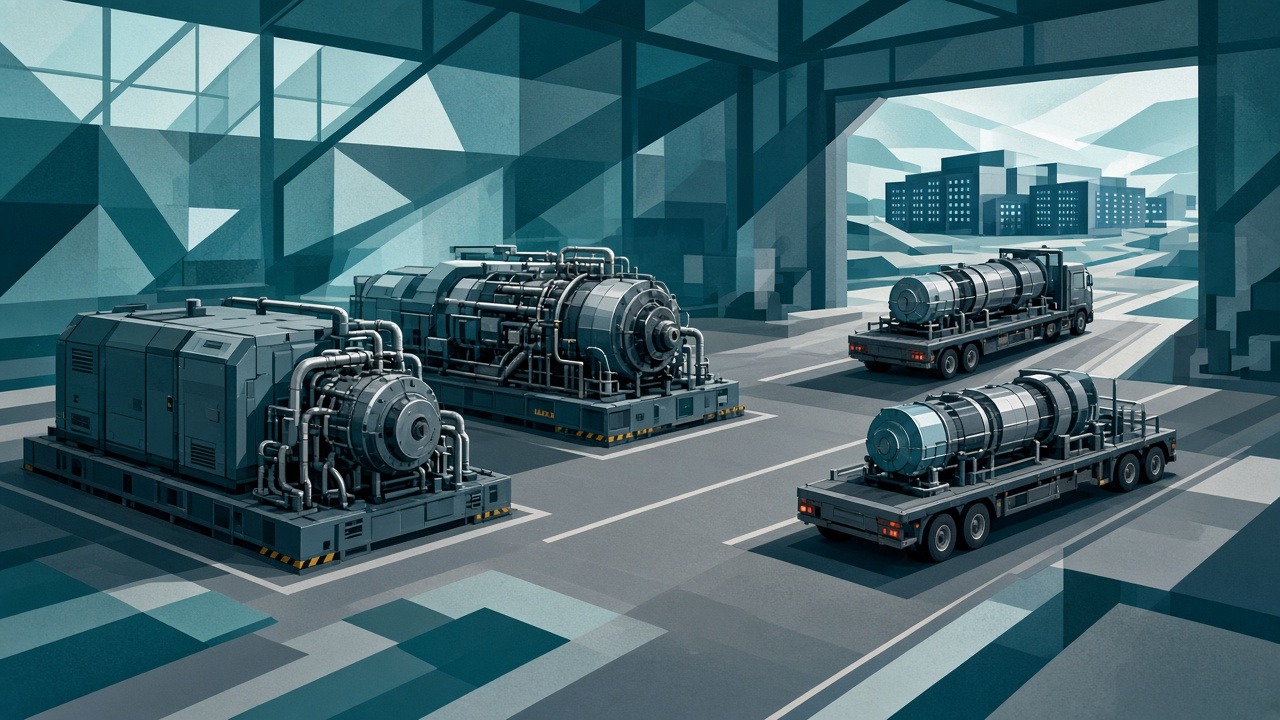
Public project descriptions and OEM disclosures point to a hierarchy of hardware, not a single “gas plant” archetype:
- Aeroderivative and mobile packages (for example LM2500-class and similar express units discussed in trade coverage of Stargate Abilene and other Texas campuses) can be delivered and installed faster than custom combined-cycle blocks.
- Large reciprocating engines from Caterpillar and peers show up repeatedly in air permits and OEM commentary; they ramp quickly and ship in modular blocks.
- Heavy-frame combined-cycle remains the efficiency prize—and the scarcest slot.
- Fuel cells and batteries increasingly appear as companions (smoothing AI load swings, bridging startup), but they do not replace the firm gas MW that many campuses still use as day-one firm power.
Trade reporting around Tallgrass and Mitsubishi Power’s allocation of M501JAC turbines to the Cheyenne Power Hub (~1,150 MW Phase 1 for Crusoe’s Project Jade campus) shows the other end of the spectrum: dedicated industrial parks pairing pipeline gas with behind-the-fence generation and a grid tie. Those projects are real capital programmes; they are also reminders that announced Phase 1 MW is not the same as energised IT load.
The economics that justify ugly efficiency
Cleanview’s public summary puts the opportunity cost plainly: AI data centres can generate on the order of $10–12 million per MW per year in revenue in its framing. Bringing a campus online years early can dwarf the fuel-cost penalty of a less efficient turbine. That arithmetic explains why developers accept reciprocating engines, refurbished units and mobile trailers that would look out of place in a traditional utility resource plan.
It also explains the secondary market for queue positions. If new Caterpillar or Solar Turbines slots stretch into 2029–2030, a two-year-old order sitting with a thinly capitalised intermediary becomes a strategic asset. The FT’s Anthropic narrative—if accurate—is less “Anthropic invents gas” than “Anthropic buys time.”
Permitting: the silent throttle on steel
Even after you own the turbines, air permits, pipeline rights-of-way and local zoning still decide whether they spin. Cleanview highlights delays including a New Mexico pipeline setback affecting a Stargate-related onsite plant and air-permit struggles for a Microsoft/Nebius New Jersey gas plant tied to a large compute contract. Those are not abstract ESG footnotes; they are why permitted megawatts in Cleanview’s stack sit so far above operating megawatts.
Local politics around noise, NOx, and water for any remaining evaporative cooling sit next door to the energy story we already covered in Power, Water, and Local Pushback. The supply-chain article’s job is simply to note that hardware lead time and permit lead time stack, they do not cancel.
How this differs from campus mapping
A campus map shows where the buildings go and who leases them (Beyond Stargate does that). The supply-chain question is which OEM units can arrive before the model launch. The practical checklist for readers tracking the turbine arms race:
- OEM backlog comments (Caterpillar, GE Vernova, Siemens Energy, Mitsubishi Power)—primary when filed.
- Air permits listing model counts and MW—often more honest than press releases.
- Satellite / construction status versus announcement status—Cleanview’s method.
- Secondary deal reports (FT, Reuters, trade press)—labelled as such until a 8-K, S-1 footnote, or OEM confirmation appears.
- Announced GW ÷ operating GW—the only ratio that matters for 2026–2027 reliability.
On that last ratio, Cleanview’s mid-2026 snapshot is stark: roughly ninety announced gigawatts, roughly two online. End-2026 guidance of ~3 GW still leaves the industry ~97% in the future tense.
What to watch next
- Primary confirmation (or denial) of the Anthropic–OnePWR package from any of the three named parties, or a clear line item in a future Anthropic filing.
- Caterpillar’s Q4 2026 and full-year commentary on whether data-centre power-generation growth is still accelerating after the Q3 surge.
- Cleanview tracker updates: operating MW, under-construction MW, and cancellations.
- Whether FERC’s large-load reforms (see our companion piece, FERC’s Large-Load Showdown) reduce the incentive to go fully BTM—or simply legalise more co-location hybrids.
Bottom line
The AI lab arms race for turbines is real, measurable in Caterpillar’s Power Generation line and visible in Cleanview’s permit-by-permit census. The newspaper-grade Anthropic story of early November 2026 may yet prove accurate—but until a primary source speaks, it remains secondary reporting layered on top of a primary industrial boom. What is not in dispute is the gap: announced behind-the-meter gas capacity is an order of magnitude larger than operating capacity. Skipping the interconnection queue only works if the generators exist, the permits clear, and the fuel shows up. Steel and air quality, not slide decks, will decide how much of the 90 GW storyboard becomes electrons before 2028.
Related reading
- Beyond Stargate: The New Gigawatt Map of AI Factories
- Power, Water, and Local Pushback: The Hidden Constraints on AI Campuses
- FERC’s Large-Load Showdown: Will Flexible AI Campuses Jump the Interconnection Line?
- The Texas AI Factory Race
Sources
- CNBC (citing the Financial Times; secondary) — “Anthropic secures $3.4 billion generator deal for AI data centers: FT” (8 November 2026). https://www.cnbc.com/2026/11/08/anthropic-generator-deal-ai-data-centers.html
- Data Center Dynamics (secondary, citing FT) — “Anthropic signs $3.4bn gas generator deal…” (9 November 2026). https://www.datacenterdynamics.com/en/news/anthropic-signs-34bn-gas-generator-deal-to-support-17gw-of-data-center-power/
- U.S. SEC / Anthropic, PBC — Amendment No. 1 to Form S-1 (filed 2 November 2026). https://www.sec.gov/Archives/edgar/data/2130357/000162828026068676/anthropicpbc-sx1ax1.htm
- Caterpillar Inc. (primary) — Third-quarter 2026 earnings release (29 October 2026). https://www.sec.gov/Archives/edgar/data/18230/000001823026000052/ex991toformcat3q2026earnin.htm
- Caterpillar Inc. (primary) — Quarterly retail sales statistics, Q3 2026. https://www.sec.gov/Archives/edgar/data/18230/000001823026000052/ex992toformcat3q2026retail.htm
- Cleanview (third-party) — “Bypassing the Grid: How Data Center Developers Are Building Their Own Power Plants.” https://cleanview.co/reports/behind-the-meter-data-centers
- Cleanview newsletter (third-party) — “Data Center Developers Have Announced More Than 100 GW of Their Own Power Plants.” https://newsletter.cleanview.co/p/data-center-developers-have-announced
- Microgrid Knowledge / MGrid (trade) — Tallgrass & Mitsubishi Power Cheyenne Power Hub ~1,150 MW (19 July 2026). https://mgrid.org/2026/07/19/tallgrass-and-mitsubishi-power-allocate-1150-mw-of-gas-turbines-to-the-cheyenne-power-hub-in-wyoming/
- AndBeyond.Tech — “Beyond Stargate: The New Gigawatt Map of AI Factories.” /beyond-stargate-gigawatt-map/
- AndBeyond.Tech — “Power, Water, and Local Pushback: The Hidden Constraints on AI Campuses.” /power-water-local-pushback-ai-campuses/
Images: original illustrations generated for AndBeyond.Tech; no logos or real people depicted.