FERC’s Large-Load Showdown: Will Flexible AI Campuses Jump the Interconnection Line?
FERC ordered six RTOs/ISOs to reform large-load tariffs for AI data centers. Responses due 16-20 Nov 2026: flexible loads, BESS and the interconnection line.

Abstract U.S. grid map and control-room panels representing large-load interconnection and flexible AI campus power.
AI campuses do not only need megawatts. They need a legal path onto the wires. In much of the United States that path runs through regional grid operators whose tariffs were written for factories and cities that grew slowly—not for 500 MW training halls that appear in a single capital cycle. On 18 June 2026, the Federal Energy Regulatory Commission (FERC) forced the issue: it ordered the six jurisdictional regional operators to justify or rewrite how they connect “large loads,” including data centres. Those operators’ responses are due in mid-to-late November 2026. This article explains the machinery in plain English, sticks to primary FERC materials, and does not anticipate what those filings will say.
For the parallel story of developers who simply build gas plants behind the meter to avoid the queue, see our companion piece Skipping the Queue. For local politics, water and community pushback, see Power, Water, and Local Pushback.
Plain English: what is an RTO or ISO?
An RTO (Regional Transmission Organization) or ISO (Independent System Operator) is a non-profit entity that runs the high-voltage grid and wholesale electricity markets across a multi-state (or large single-state) footprint. Think of them as air-traffic control for electrons: they do not usually own the power plants or the retail utility that bills your house, but they coordinate who can connect, how transmission is planned, and how energy is priced in the wholesale market.
The six operators under FERC’s June 2026 large-load orders are:
| Operator | Docket (show-cause) | Rough geography |
|---|---|---|
| PJM Interconnection | EL26-67-000 | Mid-Atlantic / parts of Midwest |
| SPP (Southwest Power Pool) | EL26-68-000 | Central Plains |
| NYISO | EL26-69-000 | New York |
| MISO | EL26-70-000 | Upper Midwest / South |
| CAISO | EL26-71-000 | California (plus limited neighbours) |
| ISO-NE | EL26-72-000 | New England |
Texas’s ERCOT is largely outside FERC’s interstate-transmission jurisdiction for these purposes; the June orders do not rewrite ERCOT rules. That matters for AI campuses in Texas, which follow a different playbook (see The Texas AI Factory Race).
Plain English: what is a “show-cause” order?
A show-cause order under section 206 of the Federal Power Act is FERC saying: we have preliminary reason to believe your tariff may be unjust and unreasonable; explain why it is fine, or fix it. It is not yet a final rewrite of rates. It puts a formal clock on the process.
On 18 June 2026, FERC issued tailored show-cause orders to each of the six RTOs/ISOs and their transmission owners. In its news release, the Commission directed them, within the original 60 days, either to:
- justify why existing tariffs remain just and reasonable without large-load-specific provisions, or
- file tariff changes addressing five reform categories.
FERC’s Office of Public Participation later summarised that the response deadline was extended to:
- 16 November 2026 for five RTO/ISOs, and
- 20 November 2026 for SPP.
Answers to those filings are generally due 30 days after each submission. Resource-adequacy informational reports were already due earlier (within 30 days of the June orders) and, per FERC OPP, were filed in July 2026.
The five reform buckets that matter for AI campuses
FERC’s June release and subsequent OPP explainer list five categories every region must address:
- Faster, clearer study processes for large-load transmission service, including consideration of alternative / grid-enhancing technologies.
- Cost transparency and anti-cost-shifting — who pays for network upgrades, and how the public can see those costs.
- Co-location and behind-the-meter generation rules — the legal twin of the turbine arms race.
- New transmission services for flexible large loads — the hinge for AI campuses that can curtail or shape demand.
- Joint study of generating facilities that serve electrically proximate large loads and co-located loads.
Read that list as a menu of ways an AI campus might jump the line without cheating: arrive with flexibility, arrive with its own generation, or pay transparently for upgrades—rather than silently shifting costs onto households.
How we got here: DOE ANOPR and docket RM26-4
The June show-cause orders did not appear from nowhere. On 23 October 2025, the U.S. Secretary of Energy, acting under section 403 of the Department of Energy Organization Act, directed FERC to consider an Advance Notice of Proposed Rulemaking (ANOPR) on interconnecting large loads to the interstate transmission system. FERC opened Docket No. RM26-4-000 to gather comment on principles that include, among other items:
- whether flexible large loads that agree to curtail could move through studies faster (DOE materials floated concepts such as studies within 60 days for qualifying flexible loads);
- whether large loads should pay the full cost of needed upgrades (with possible later credits);
- how to evaluate reliability when an existing plant partially redirects output to a co-located customer.
FERC’s June 2026 show-cause package is the region-by-region enforcement track running alongside that still-open national ANOPR. Chairman Laura V. Swett, in the Commission’s June release, framed the goal as speed-to-power for the innovation economy and consumer safeguards—protecting existing deals while unlocking new interconnection paths.
Why AI loads broke the old tariff assumptions
Traditional large industrial loads grew with multi-year construction schedules that roughly matched transmission planning. AI campuses compress that. A single hyperscale hall can request hundreds of megawatts with a commercial online date inside a chip-cycle. When many such requests stack in the same zone—northern Virginia, parts of PJM, pockets of MISO and SPP—study queues clog, upgrade costs balloon, and state regulators hear from ratepayers.
FERC’s OPP materials define large loads in the educational ANOPR context as demand generally greater than 20 MW, while recognising regional tariff definitions may differ (PJM, for example, has pursued its own Large Load registry concepts in separate filings). The precise MW threshold matters less for readers than the operational profile: high load factor, steep ramps from GPU synchronisation, and intense political visibility.
Flexibility as the golden ticket
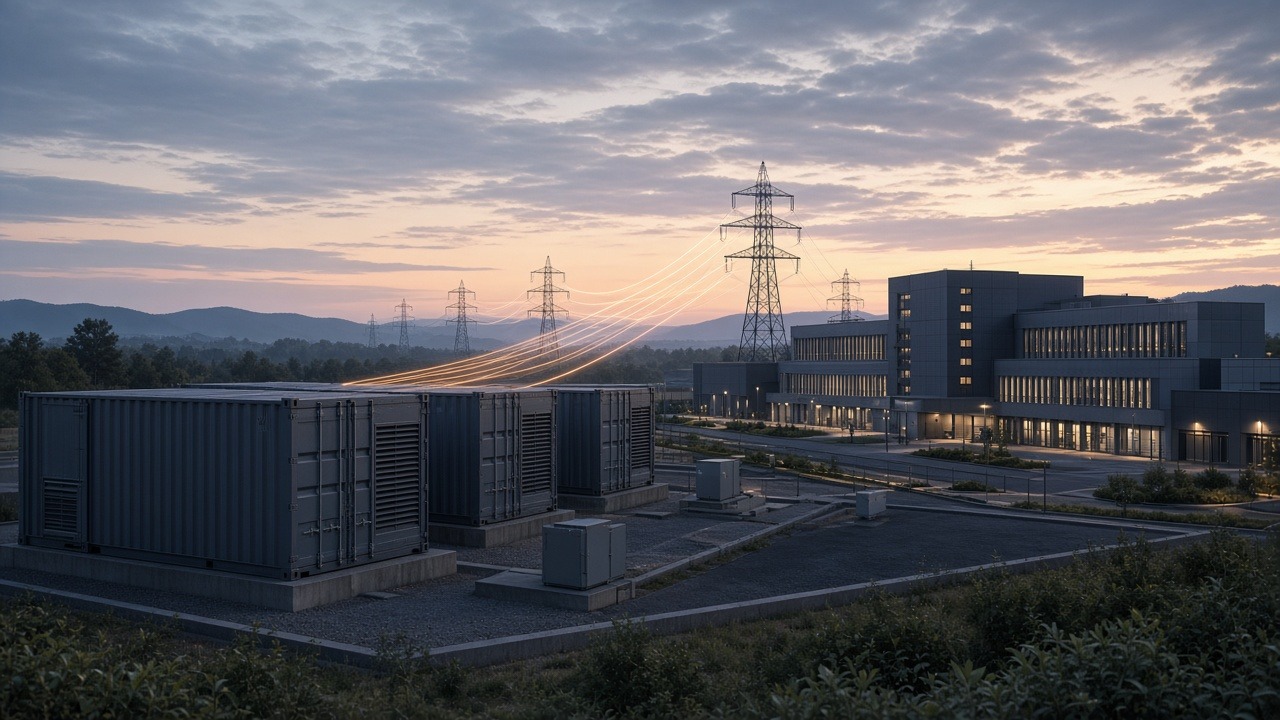
Category 4—services for flexible large loads—is where batteries, workload shifting and contractual curtailment meet tariff design. If a campus can reduce net draw on command, the grid operator may be able to interconnect it against existing headroom instead of waiting for a multi-year network upgrade.
Commercial examples already point that way (company / asset-manager primary pages, not FERC dockets):
- Macquarie Asset Management describes introducing portfolio companies Calibrant and Aligned Data Centers to a local utility to build a 31 MW / 62 MWh on-site battery energy storage system at Aligned’s Hillsboro campus—framed as a first-of-its-kind BESS designed specifically to accelerate interconnection, planned operational in the second half of 2026.
- Crusoe has published that it is deploying ON.energy medium-voltage “AI UPS” battery systems across hyperscale campuses (commissioning from 2026 into 2027), describing the BESS as both uninterruptible power and an active grid-stability asset that smooths AI training load swings.
These projects do not rewrite FERC tariffs by themselves. They are the physical behaviour FERC’s “flexible large load” service category is trying to recognise: a data centre that can look like a grid asset for minutes to hours, not only like a brick wall of demand.
Co-location: the legal twin of behind-the-meter gas
Category 3 forces RTOs/ISOs to clarify co-location and behind-the-meter generation. That is the paperwork twin of the turbine story. When a data centre sits next to an existing power plant and takes power “inside the fence,” who pays for the transmission system that the plant used to support? FERC has already wrestled with high-profile co-location disputes; the June orders push every region to put transparent rules in the tariff instead of improvising case by case.
For AI labs, the strategic fork is clear:
- Full BTM islanding (or near-islanding) with self-built gas — maximum schedule control, maximum permitting and emissions exposure.
- Co-location with legacy generation — faster electrons, heavier regulatory scrutiny.
- Flexible grid interconnection — depends on whether November’s filings create real, bankable curtailment products.
Cost shifting: why households are in the docket
FERC’s OPP explainer emphasises cost transparency and possible pro forma cost recovery agreements so that cancelled or delayed large loads do not leave upgrade costs on other customers. States still control retail rate design and most siting, but they need FERC-level transparency to allocate transmission costs fairly. That federal–state handoff is why consumer advocates are filing in the same dockets as hyperscalers.
AI companies that ignore this politics will rediscover it as local opposition—already covered in our Power, Water, and Local Pushback analysis. The FERC process is the interstate layer of the same fight.
Status as of 9 November 2026
Status as of 9 November 2026:
- Show-cause orders: issued 18 June 2026 (FERC news release; Items E-7 through E-12).
- Resource adequacy informational reports: filed July 2026 (per FERC OPP).
- Show-cause responses / answers to briefing questions: due 16 November 2026 (PJM, MISO, CAISO, ISO-NE, NYISO) and 20 November 2026 (SPP), following Commission letters that held proceedings in abeyance for 90 days.
- National ANOPR RM26-4-000: remains open.
- As of publication, the November response filings have not yet been posted; this article does not anticipate their contents.
What to watch after 16 and 20 November 2026
| Question | Where to look |
|---|---|
| Did each RTO/ISO justify the status quo or file reforms? | eLibrary dockets EL26-67 … EL26-72 |
| Do proposed tariffs create a named flexible large load product with study-time benefits? | Tariff redlines in each docket |
| Are co-location / BTM rates newly standardised? | Same |
| What cost recovery agreement language appears? | Same + OPP summary pages |
| Any region proposing sub-60-day studies for curtailable load? | Compare to RM26-4 principles |
| How do filings treat electrically proximate generation + load co-studies? | Category 5 responses |
Until those questions are answered in the filings, any claim that “FERC has fixed AI interconnection” is premature. The Commission has opened the gate; the RTOs still have to walk through it.
Practical implications for AI Power Players
- Schedule risk is now a regulatory workstream, not only an engineering one. Interconnection counsel belongs in the same war room as power-systems engineers.
- Flexibility is becoming collateral. Campuses that can document curtailment, BESS ride-through and load-shape control will have more tariff options if Category 4 reforms bite.
- BTM gas remains the hedge if filings disappoint—hence the parallel Caterpillar / Cleanview story.
- Transparency cuts both ways. Public upgrade-cost posting may intensify local political fights even as it protects ratepayers.
- ERCOT is a different game. Texas campuses should not assume FERC’s six-pack reforms apply one-for-one.
Bottom line
FERC’s large-load showdown is arguably the most consequential U.S. regulatory reset for AI energy since the first wave of nuclear PPAs. It asks a simple question with complex tariff answers: can a flexible AI campus earn a faster interconnection—or will the industry keep solving scarcity with behind-the-meter gas? The primary documents to watch are not tweets; they are EL26-67 through EL26-72, the companion ANOPR RM26-4-000, and the 16 / 20 November 2026 response filings. Once those filings are public, the industry will see whether flexibility is a slogan or a queue-jumping right.
Related reading
- Skipping the Queue: Behind-the-Meter Gas and the AI Lab Arms Race for Turbines
- Power, Water, and Local Pushback: The Hidden Constraints on AI Campuses
- The Texas AI Factory Race
- Beyond Stargate: The New Gigawatt Map of AI Factories
Sources
- FERC (primary) — “FERC Launches Aggressive Targeted Action to Speed Large Load Integration” (18 June 2026). https://ferc.gov/news-events/news/ferc-launches-aggressive-targeted-action-speed-large-load-integration
- FERC (primary) — Fact Sheet: “FERC Takes Action to Supercharge America’s Grid…” https://www.ferc.gov/news-events/news/fact-sheet-ferc-takes-action-supercharge-americas-grid-efficiency-reliability-and
- FERC OPP (primary educational summary) — “Cost Transparency and Customer Protection Initiatives in FERC’s June 2026 Show Cause Orders…” (includes 16 / 20 Nov 2026 deadlines). https://www.ferc.gov/cost-transparency-customer-protection
- FERC (primary) — Docket RM26-4-000, Interconnection of Large Loads to the Interstate Transmission System. https://ferc.gov/rm26-4
- Reuters (secondary wire on the June orders) — “Top US energy regulator pushes grids to overhaul data center power rules” (18 June 2026). https://www.reuters.com/business/energy/top-us-energy-regulator-pushes-grids-to-overhaul-data-center-power-rules-2026-06-18/
- Macquarie Asset Management (company) — “Accelerating data centre interconnection in power constrained, high-risk grid markets” (Aligned / Calibrant 31 MW/62 MWh BESS). https://www.macquarie.com/us/en/insights/accelerating-data-centre-interconnection-in-power-constrained-high-risk-grid-markets.html
- Crusoe (company) — “Why Crusoe chose ON.energy’s medium-voltage AI UPS solution.” https://www.crusoe.ai/resources/blog/why-crusoe-chose-on-energys-medium-voltage-ai-ups-solution
- AndBeyond.Tech — “The Texas AI Factory Race.” /texas-ai-factory-race/
- AndBeyond.Tech — “Power, Water, and Local Pushback: The Hidden Constraints on AI Campuses.” /power-water-local-pushback-ai-campuses/
- AndBeyond.Tech — “Skipping the Queue: Behind-the-Meter Gas and the AI Lab Arms Race for Turbines.” /skipping-the-queue-behind-the-meter-gas-ai-turbines/
Images: original illustrations generated for AndBeyond.Tech; no logos or real people depicted.