From Chatbots to Work OS: How AI Assistants Are Swallowing Enterprise SaaS
How AI assistants become a work OS that swallows enterprise SaaS: connectors, agents, seat pricing pressure and what buyers and vendors should do now.

Three years ago, the enterprise chatbot was a novelty tab. Employees opened it to draft an email or summarise a PDF, then went back to the real work inside their CRM, their ticketing tool, their HR portal, and their spreadsheets. In late 2026 that picture is changing. The chat window is quietly becoming the place where work starts, and more and more often where it ends. The enterprise AI assistant is no longer a feature bolted onto software; it is turning into the product itself.
That shift has a name that keeps coming up in strategy decks: the AI work OS. The idea is simple. If one assistant can read your files, query your business systems, run multi-step workflows on a schedule, and take actions with an approval trail, then it starts to behave like an operating system for knowledge work. Everything else, including many of the SaaS AI platforms companies have paid for over the past decade, risks becoming plumbing underneath it.
This article looks at how the major assistant platforms got here, what “work OS” means in practice, and what it does to the economics of enterprise software: seat pricing, systems of record, and the user interface layer that SaaS vendors have long treated as their moat.
From answer engine to action engine
Phase one: the chat box
The first generation of enterprise assistants was essentially a secure version of consumer chat. The selling points were data protection, admin controls, and the promise that company prompts would not be used to train models. Useful, but contained: the assistant knew only what you pasted into it.
Phase two: connectors and context
The second phase was about context. Assistants learned to reach into the places where company knowledge actually lives. OpenAI’s help pages now describe ChatGPT plugins that connect to tools such as Slack, SharePoint, Airtable and Google Drive. Crucially, the assistant sees only what the user can already see in the connected app. On Enterprise and Edu plans these integrations are off by default, and administrators decide which ones are available and to whom.
Google took the same route with Gemini Enterprise, launched on 9 October 2025. In its launch post, Google Cloud CEO Thomas Kurian said the platform connects to company data “wherever it lives”, naming Google Workspace and Microsoft 365 as well as business applications such as Salesforce and SAP, all under a central governance framework. Reuters described the product as a conversational platform where employees chat with their company’s data, documents and applications.
Phase three: agents that do the work
The third phase, the one now under way, is about action. OpenAI’s workspace agents, in research preview for ChatGPT Business, Enterprise, Edu and Teachers plans, let teams build an agent once, share it across a workspace, run it on a schedule, use it in Slack, or trigger it through an API. OpenAI’s own examples are telling: reviewing leads, summarising support requests, generating reports, updating tickets, editing documents and sending messages. That is a list of jobs people used to do by clicking through several SaaS interfaces.
Underneath sits the Model Context Protocol (MCP), an open standard for connecting AI models to tools. OpenAI’s documentation says full MCP support, including write and modify actions, is rolling out in beta to Business, Enterprise and Edu customers. Its stated examples include kicking off workflows, creating project-management tasks and updating your CRM, all from inside ChatGPT. Microsoft announced broad first-party MCP support at Build 2025 across GitHub, Copilot Studio, Dynamics 365, Azure AI Foundry and Windows 11, and joined the MCP steering committee. Google’s Gemini Enterprise launch named MCP alongside the Agent2Agent (A2A) protocol as standards for how agents communicate.
Once read and write access are standardised, the assistant stops being a viewer and becomes a controller.
The power players and their strategies
Four companies currently define the enterprise AI assistant market, and each comes at it from a different starting point.
OpenAI: the assistant as destination
OpenAI’s strategy is to make ChatGPT the front door. Its Enterprise page describes models and agents, including “ChatGPT Work” and the Codex coding agent, that use “your approved tools, files, and team processes”. The direction is clear: users should not need to leave ChatGPT to get work done. Apps, plugins, custom MCP apps and workspace agents all pull other software into the conversation, not the other way round.
Microsoft: the incumbent suite, re-centred on Copilot
Microsoft already owns the productivity suite, the identity layer and much of the enterprise developer stack. Its move is to make Microsoft 365 Copilot the orchestration layer on top of all of it. At Build 2025 the company introduced Copilot Tuning, which lets customers use their own data and processes to build domain-specific agents in a low-code way, and multi-agent orchestration in Copilot Studio. On the developer side, the open-source Microsoft Agent Framework merges AutoGen and Semantic Kernel and supports OpenAPI, A2A and MCP.
Microsoft is also notably model-agnostic. Anthropic announced that Claude Sonnet 4 and Claude Opus 4.1 became selectable models in Microsoft 365 Copilot’s Researcher agent and in Copilot Studio. For buyers, the message is that the platform matters more than any single model, which is exactly what you would expect from a company positioning itself as the work OS.
Google: Workspace plus an open agent platform
Google’s pitch with Gemini Enterprise combines deep integration with Workspace apps and an explicit promise of openness, including working with Microsoft 365 and SharePoint. Google has also folded its developer tooling into what it now calls the Gemini Enterprise Agent Platform, positioned as the place to build, scale, govern and optimise an “agentic workforce”. The bet is that the agent platform, not the document editor, becomes the long-term anchor.
Anthropic: the model inside everyone else’s OS, and its own
Anthropic plays on both sides. Claude is sold directly to enterprises, and it also shows up inside other vendors’ platforms, from Microsoft 365 Copilot to Salesforce. The Register reported that Salesforce’s AIforce, unveiled at Dreamforce, exposes the company’s data, workflows and business logic through interfaces including Slack and Claude. When a CRM giant ships a way for its logic to be consumed from a third-party assistant, the direction of travel is hard to miss.
What “AI work OS” actually means
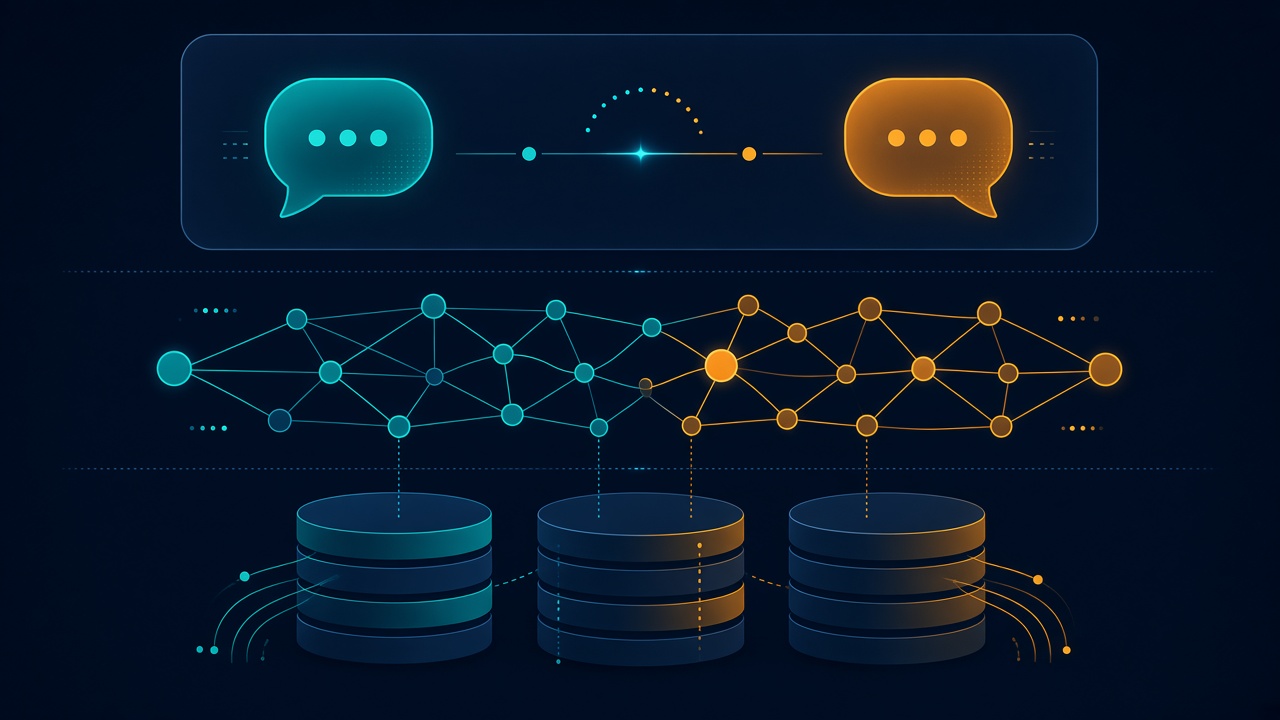
The phrase gets used loosely, so it helps to define it. An AI work OS has roughly five layers:
- A single conversational and agentic front end: the chat window, plus agents running in the background.
- A connector fabric: plugins, MCP servers and APIs that reach into documents, email, calendars and line-of-business systems.
- Identity and permissions: role-based access, end-user versus service-account authentication, and per-tool action controls. OpenAI’s workspace agents, for example, let each connection run either on the user’s own account or on an agent-owned account, and recommend service accounts with minimal access.
- Governance and audit: logs of tool calls and files accessed, and approval gates before sensitive actions such as sending messages or updating records.
- A model layer: increasingly swappable, as Microsoft’s adoption of Claude shows.
Look at that stack and notice what is missing: the application UI. In a work OS, the screens that SaaS vendors spent years designing are optional. The agent calls the API, the user reviews the result in chat, and the vendor’s carefully built dashboard may never load.
The impact on enterprise SaaS
1. Seat pricing under pressure
Per-seat licensing assumes a human sits in front of the software. Agents break that assumption. The Register put it bluntly: when AI agents and APIs do the work instead of named human users occupying seats, charging per user becomes a less natural fit.
Salesforce is the clearest case study because it is experimenting in public. Its Agentforce pricing page offers three models side by side: per-user licences, Flex Credits at $500 per 100,000 credits (with a standard action costing 20 credits and a voice action 30), and Conversations at $2 each. Salesforce Ben reported a further step: pay-per-resolution pricing for the new Agentforce Help Agent, announced for July 2026, where customers are charged only when the agent resolves an issue on its own. Salesforce’s own words: “If the customer asks for a human or walks away unhappy, there is no charge.”
Salesforce is not alone. Channel Insider notes that Intercom charges for its Fin agent based on defined outcomes such as resolved issues, and that Zendesk is expanding outcome-based pricing around verified resolutions. The same piece sorts the market into four models: traditional subscriptions, consumption, action-based and outcome-based pricing.
Yet the seat is not dead. TechTarget quoted Marc Benioff saying some customers “still want pure user pricing; it’s predictable”, while others want agent, usage, consumption or outcome pricing. “We’ve had to throw away our price book, basically,” he said. Outcome pricing also has a measurement problem: buyer and vendor have to agree on what counts as a billable result. Expect hybrid contracts, not a clean switch.
2. Systems of record: still essential, but less visible
If the assistant becomes the front end, what happens to the CRM, the ERP and the HR platform? The short answer: they become more important as data and logic, and less important as destinations.
Agents need a trustworthy source of truth to read from and write back to. Every serious enterprise AI assistant relies on connectors into exactly these systems, as Google’s list of Salesforce and SAP shows. Vendors that own clean, permissioned, well-modelled data are holding something an assistant cannot invent on its own.
The risk is commoditisation. If a vendor’s value is reached only through an API called by someone else’s agent, the customer relationship, the daily habit and much of the pricing power move up the stack. That is why systems-of-record vendors are rushing to ship their own agents (Agentforce being the obvious example) while also opening “headless” access for third-party assistants. They are hedging: own the agent where possible, be the indispensable back end where not.
3. The UI layer is the real battleground
For twenty years SaaS differentiation lived largely in the interface: better workflows, nicer dashboards, fewer clicks. An AI work OS flattens that advantage. When the instruction “update the opportunity, log the call and draft the follow-up” can be carried out across three tools from a single prompt, the elegance of each tool’s screens matters less.
This creates three likely winner profiles:
- Platform owners (Microsoft, Google, OpenAI, Anthropic) who control the front end, identity and agent governance.
- Data owners: systems of record with deep, proprietary, well-governed data that every agent must touch.
- Specialists in hard, regulated workflows, where domain logic, compliance and liability still justify a dedicated product.
The squeezed middle is the horizontal tool whose main value was a convenient interface over data that lives elsewhere.
What enterprise buyers should do now
For CIOs and procurement teams, the shift to SaaS AI platforms and assistant-led work raises practical questions:
- Pick a primary work OS deliberately. Most organisations will not run four assistants equally. Decide which one owns the front end, and treat the others as model or connector suppliers.
- Audit connector permissions. Write access through MCP is powerful. Use the admin controls these platforms provide: off-by-default plugins, role-based access, approval gates and audit logs.
- Prefer service accounts with least privilege for agents that run unattended, as OpenAI’s own guidance recommends.
- Renegotiate with agents in mind. If agents will do work that seats used to do, ask vendors for consumption, action or outcome options, and model the cost under each.
- Keep your system of record clean. An assistant is only as good as the data it can reach. Data quality is now AI strategy.
- Insist on open standards. MCP and A2A support reduce lock-in to any one assistant.
What SaaS vendors should do now
For vendors, the playbook is uncomfortable but clear:
- Be agent-ready first. Publish robust APIs and MCP servers, with fine-grained permissions and clear action semantics. If your product cannot be used from someone else’s assistant, it will be replaced by one that can.
- Ship your own agent where you have unique context. Domain data plus domain logic is the defensible combination.
- Rethink packaging. Offer hybrid pricing before customers demand it. Salesforce’s three-model approach shows both the opportunity and the complexity.
- Move value to outcomes and trust. Governance, auditability and measurable results are the new differentiators, more than screens.
The bottom line
The enterprise chatbot has grown up. Connectors gave it context, MCP gave it hands, and workspace agents gave it a schedule and a job description. The result is an emerging AI work OS in which the assistant is the product and many SaaS applications become services it calls.
That does not mean enterprise SaaS disappears. Systems of record, specialist workflows and trusted data are more valuable than ever. But the economics are shifting: from seats to actions and outcomes, from interfaces to APIs, and from owning the user’s attention to earning a place in the assistant’s toolset. The vendors that accept that early will be the ones agents keep calling.
Related reading
- Browser, IDE, and OS: The Three Battlegrounds for AI Interfaces
- Computer-Use Agents Enter Production: What Actually Works in the Enterprise
- Open-Weight Frontier Models vs Closed APIs: The Sovereignty Trade-Off
References / Sources
- OpenAI Help Center – ChatGPT Workspace Agents for Enterprise and Business: https://help.openai.com/en/articles/20001143-chatgpt-workspace-agents-for-enterprise-and-business
- OpenAI – Workspace agents feature page: https://chatgpt.com/features/workspace-agents/
- OpenAI Help Center – Developer mode and MCP apps in ChatGPT: https://help.openai.com/en/articles/12584461-developer-mode-and-full-mcp-connectors-in-chatgpt
- OpenAI – Plugins in ChatGPT: https://chatgpt.com/features/plugins/
- OpenAI – ChatGPT Enterprise: https://chatgpt.com/business/enterprise/
- Microsoft – Build 2025: The age of AI agents and building the open agentic web: https://blogs.microsoft.com/blog/2025/05/19/microsoft-build-2025-the-age-of-ai-agents-and-building-the-open-agentic-web/
- Microsoft Azure Blog – Introducing Microsoft Agent Framework: https://azure.microsoft.com/en-us/blog/introducing-microsoft-agent-framework/
- Google Cloud Blog – Introducing Gemini Enterprise: https://cloud.google.com/blog/products/ai-machine-learning/introducing-gemini-enterprise
- Reuters – Google launches Gemini Enterprise AI platform for business clients: https://www.reuters.com/business/google-launches-gemini-enterprise-ai-platform-business-clients-2025-10-09/
- Anthropic – Claude is now available in Microsoft 365 Copilot: https://claude.com/resources/articles/claude-now-available-in-microsoft-365-copilot
- Salesforce – Agentforce Pricing: https://www.salesforce.com/agentforce/pricing/
- Salesforce Ben – Salesforce introduces pay-per-resolution: https://www.salesforceben.com/huge-agentforce-pricing-shift-salesforce-introduces-pay-per-resolution/
- The Register – Salesforce wants to charge for AI outcomes: https://www.theregister.com/software/2026/09/21/salesforce-wants-to-charge-for-ai-outcomes-but-first-it-needs-to-figure-out-how/5297402
- TechTarget – Outcomes-based AI pricing works in theory, but in practice?: https://www.techtarget.com/news/Outcomes-based-AI-pricing-works-in-theory-but-in-practice/846370/
- Channel Insider – Agentic AI pushes SaaS toward outcome-based pricing: https://www.channelinsider.com/ai/agentic-ai-saas-outcome-based-pricing/
Images: original illustrations generated for AndBeyond.Tech; no logos or real people depicted.