Google Suncatcher In Orbit: The Power Duty Cycle Reality Behind the Haiku
Google Project Suncatcher’s orbital TPU prototype ran Gemma 4 — but power, heat, and radiation duty cycles define what data-center silicon can really do in LEO.
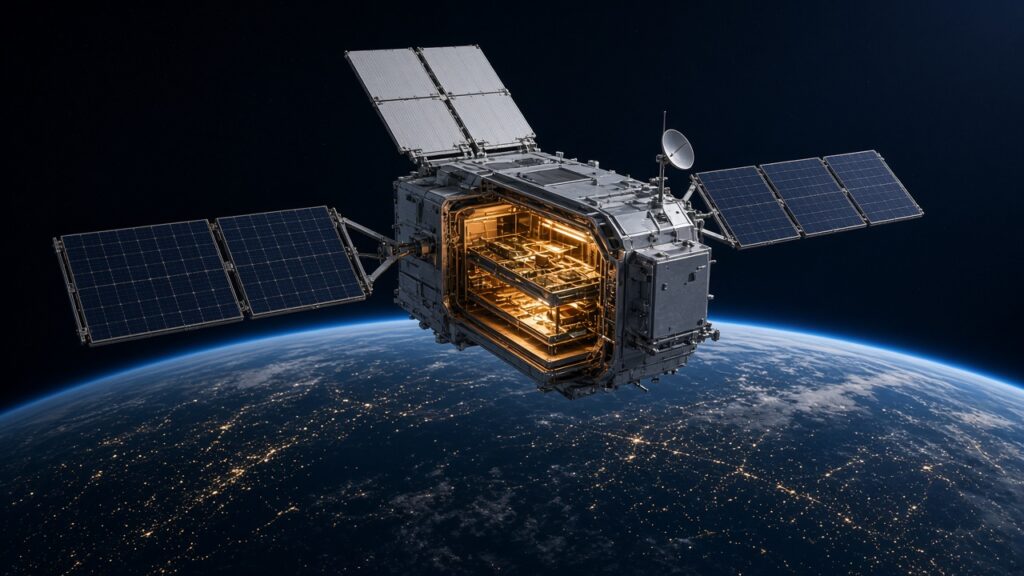
Modular research satellite with open compute bay glowing amber, solar wings extended, above Earth’s city-lit limb.
On 30 October 2026, Google published something that sounded like marketing poetry and engineering telemetry at once. After weeks of commissioning a Planet-built prototype for Project Suncatcher, engineers uplinked a prompt to an onboard Gemma 4 open model during a ground-station pass. The downlinked reply—a haiku about the blue marble below—was Google’s declared “Hello World” for a data-center-class TPU in orbit.
The poem is memorable. The physics lesson is the point. Suncatcher is not a cloud region that happened to leave the atmosphere. It is a measured experiment in whether AI accelerators & silicon built for terrestrial halls can survive launch loads, vacuum cooling, and radiation—and for how many minutes at a time those chips can usefully run before power and heat force a pause. That duty-cycle reality sits beside the broader debate we covered in Orbital Data Centers for AI and the workload triage in AI Workloads That Actually Make Sense in Orbit.
What Google actually flew and confirmed
Google’s primary posts are careful about what is proven versus planned.
- 1 October 2026: The Suncatcher prototype, built with Planet, launched on SpaceX’s Transporter-18 rideshare. Google confirmed contact and that the spacecraft was operating as expected, framing the flight as the first step of a research moonshot on scalable machine-learning infrastructure in space.
- Late October commissioning: Host and TPU trays were powered; early machine-learning tests ran.
- 30 October 2026 “Hello World”: First AI response from a data-center-class TPU in orbit—Gemma 4 generating a space haiku, then space-themed limericks and telemetry prompts about payload status—during a pass near Svalbard, Norway (Google blog).
- Next on the flight plan: Series of tests for TPU behavior under thermal stress and radiation exposure in orbit. Success here is framed as paving the way for twin interconnected satellites in 2027 to exercise optical links.
Google’s earlier research blog (4 November 2025) and peer-reviewed Joule paper sketch the long-term architecture: dawn–dusk sun-synchronous LEO for near-continuous solar; free-space optical links between tightly spaced satellites; Trillium (Cloud TPU v6e) radiation testing on the ground; and economic scenarios in which launch costs falling toward less than about $200/kg by the mid-2030s (Google research estimate) could make launch-plus-operate costs roughly comparable to reported terrestrial data-center energy costs on a per-kilowatt-year basis. Those are company/research estimates, not audited invoices.
Secondary reporting (TechCrunch, SpaceNews, NPR, Data Center Dynamics) has added hardware color that Google’s Hello World post does not itself quantify in the same way: a prototype often described as carrying four TPUs, on the order of ~1 kW of solar generation, and short run windows (on the order of ~15–20 minutes per active chip) constrained by power and heat. Treat those figures as secondary-reported engineering constraints, not as numbers restated in Google’s 30 October primary post. Where Google is unambiguous is the research agenda: prove the silicon in real LEO conditions, then move toward higher power and optical twins.
Why a “data-center-class” chip still lives on a duty cycle
Terrestrial hyperscale halls assume continuous wall power, chilled water or air, and operators who can swap boards. Orbit removes the wall and the air.
Power aperture versus chip appetite
Dawn–dusk SSO is attractive because panels can see near-constant sun and need fewer batteries—Google research cites up to about eight times the solar productivity per area versus Earth in the right orbit (company/research estimate). That advantage is real. It does not mean a smallsat suddenly owns megawatts. A pathfinder with kilowatt-class generation cannot keep multiple high-end accelerators in continuous thermal steady state the way a land hall can. Duty cycling—run, cool, wait for the next contact window—is the honest operating mode until spacecraft grow solar and radiator area by orders of magnitude.
Heat has nowhere to go but radiation
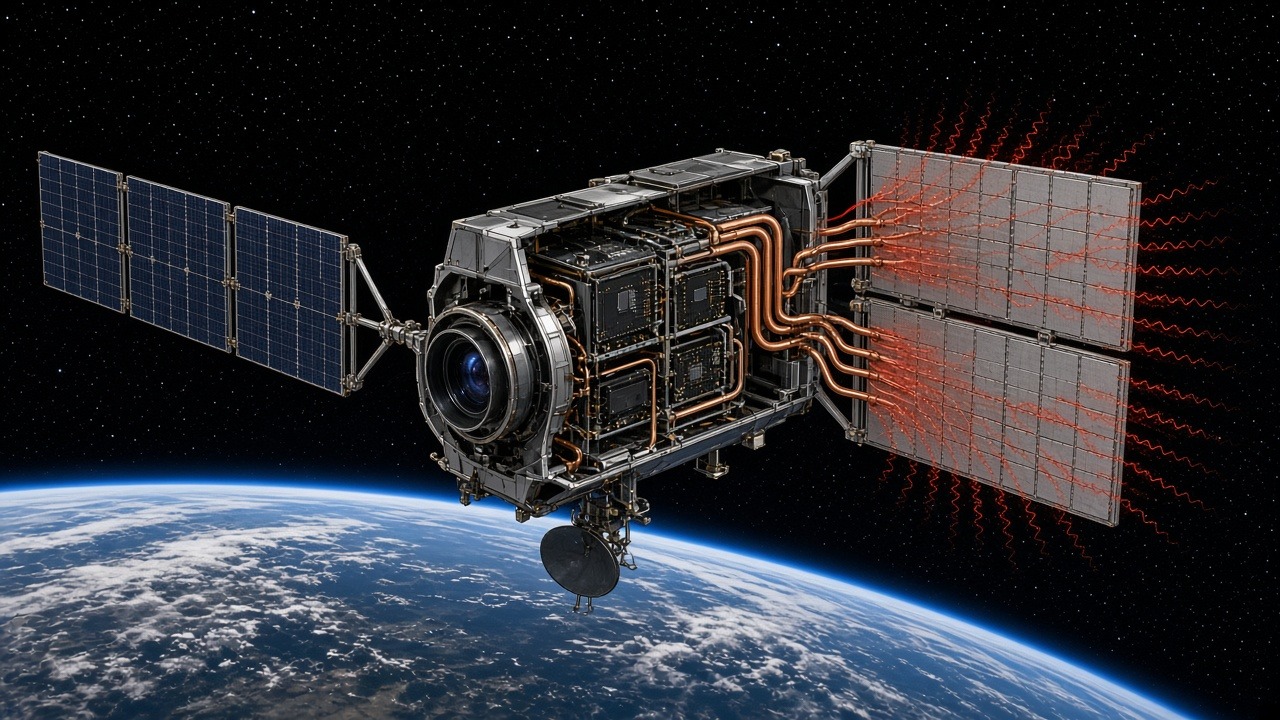
Google’s facts page is blunt: in vacuum there is no convective airflow; TPU heat must leave through heat pipes and radiators. Ground teams validated approaches in thermal-vacuum chambers; the flight campaign exists to see how that stack behaves with real orbital eclipse geometry, albedo loads, and pointing. The Stefan–Boltzmann constraint does not care about haikus: rejected power scales with radiator area and temperature to the fourth power. Short inference bursts are a systems answer when radiator mass and area are still pathfinder-sized.
Radiation: ground beams versus orbital truth
Before flight, Google reported proton-beam testing of Trillium TPUs at UC Davis’s Crocker Nuclear Laboratory while AI workloads ran. Public research notes that high-bandwidth memory was the most sensitive subsystem, with irregularities appearing only after cumulative doses several times a shielded five-year LEO estimate in their campaign, and no hard TID failures up to high test doses on a single chip (Google-reported lab results). The same materials stress that some effects can only be measured in space—especially soft errors, silent data corruption risk for long runs, and the interaction of thermal cycling with error rates. The post-Hello World campaign is therefore not a victory lap; it is the actual science program.
Launch survival was another pre-flight gate: Google describes vibration testing across axes to mimic rocket environments, noting components can see far higher local g-loads than the vehicle average. The prototype’s job is to turn those ground campaigns into flight telemetry.
What the optical twin milestone is really testing
Google’s research design for scalable space ML is formation flying plus free-space optics, not a single fridge with a celebrity chip. The 2025 analysis argues that data-center-class east-west bandwidth may need on the order of tens of terabits per second, which in turn pushes satellites into very close formations (kilometers or less) so optical link budgets close (Google research estimates). A bench demonstrator achieved 800 Gbps each way (1.6 Tbps aggregate) on a single transceiver pair—again a lab demonstration, not an on-orbit measurement.
The planned 2027 twin satellites are therefore the second act after “will the TPU boot and answer”: can two vehicles hold relative geometry tightly enough for high-rate lasers while still managing thermal and power envelopes? Without that, Suncatcher remains an impressive onboard demo, not a path to hyperscale AI infrastructure in orbit. Google’s own future-directions language still lists thermal management, high-bandwidth ground communications, and on-orbit reliability as open engineering challenges.
Inference bursts, contact windows, and why training stays on Earth
Google’s Hello World sequence—haiku, limericks, telemetry status—is pure inference: short prompts, bounded outputs, restartable if a soft error appears. That matches what ground radiation campaigns suggested qualitatively: inference can tolerate more disruption than long training runs, where silent corruption can poison gradients. The flight program will stress that distinction under real SEE rates and thermal derating.
Contact geometry adds a second clock. LEO passes over a given ground station last only minutes. If the accelerator can usefully run for a comparable window before thermal or power limits intervene, the mission design must co-schedule when the chip is allowed to wake, when the ground antenna has elevation, and when radiators are in a favorable attitude. Miss that co-scheduling and you either waste sunlight with the chip off or generate answers that cannot downlink until the next orbit. Optical inter-satellite links in 2027 are partly about escaping that single-station bottleneck—moving tokens between vehicles that still share a tight formation—rather than pretending RF passes suddenly last for hours.
None of this demotes the milestone. Running Gemma 4 on a data-center-class TPU above the atmosphere is a genuine first for Google’s stack. It does relocate the conversation from “will the chip boot?” to “what duty cycle, error budget, and link schedule make the next kilowatt of orbital silicon worth launching?” Those are hyperscale infrastructure questions asked at pathfinder scale—and they are the right questions.
How this differs from “orbital data centers” marketing
It is easy to flatten every LEO GPU story into one headline. Distinctions matter:
| Layer | What Suncatcher is testing now | What hyperscale ODC pitches often assume |
|---|---|---|
| Silicon | Data-center-class TPU survival + short inference | Continuous multi-rack FLOPS |
| Power | Pathfinder solar / duty cycle | Continuous multi-100 kW to MW nodes |
| Cooling | Heat pipes + radiators under flight loads | Tennis-court-scale radiator fields |
| Networking | 2027 optical twin as research gate | Instant Tbps east-west fabric |
| Economics | Mid-2030s launch $/kg scenarios (estimates) | Near-term cost parity claims |
Our orbital data centers economics piece argued that launch dollars per kilogram, radiator kilograms per kilowatt, and replace cycles set the floor. Suncatcher’s Hello World does not refute that; it supplies the missing empirical column: accelerator behavior under real LEO stress. Our workloads guide argued that space earns its keep on triage, alerts, and autonomy more than on training barns. A haiku from Gemma 4 is a communications and reliability milestone—not evidence that LEO is ready to absorb terrestrial training clusters.
What to watch next (without inventing outcomes)
- Published thermal and SEE telemetry from the ongoing campaign—does Google share duty-cycle statistics, error rates, or derating rules?
- 2027 optical twins—link closure rates, formation-keeping Δv budgets, and whether distributed inference across two vehicles is demonstrated or only single-node bursts continue.
- Model and software stack—how often weights are updated from the ground; how ECC and workload restart policies handle bit flips.
- Comparison with onboard-class orbital compute—Jetson-class and Myriad-class flights already showed small inference in space; Suncatcher’s bet is whether hyperscale silicon can join that lineage without becoming a one-shot stunt.
Bottom line
The haiku is a receipt: a data-center-class TPU answered from LEO. The duty cycle is the thesis. Until solar aperture, radiator area, and optical fabrics grow with the chip count, Project Suncatcher will teach the industry more about power, heat, and radiation envelopes than about relocating hyperscale regions. That is exactly what a serious moonshot should do first—measure the silicon’s space wings before promising a constellation of always-on racks.
Related reading
- Orbital Data Centers for AI: Promise, Physics, and the Cost Reality Check
- AI Workloads That Actually Make Sense in Orbit
- Who Flies the Orbital Data Center Fleet?
Sources
- Google — “We’ve received our first response from the Project Suncatcher prototype satellite” (30 Oct 2026). https://blog.google/innovation-and-ai/models-and-research/google-research/project-suncatcher-satellite-response/
- Google — “Our Project Suncatcher prototype satellite is in orbit” (1 Oct 2026). https://blog.google/innovation-and-ai/models-and-research/google-research/project-suncatcher-prototype/
- Google — “Behind Project Suncatcher…” facts / engineering challenges (24 Sep 2026). https://blog.google/innovation-and-ai/models-and-research/google-research/google-project-suncatcher-facts/
- Google Research — “Exploring a space-based, scalable AI infrastructure system design” (4 Nov 2025). https://research.google/blog/exploring-a-space-based-scalable-ai-infrastructure-system-design/
- Agüera y Arcas et al. — “Towards a future space-based, highly scalable AI infrastructure system design,” Joule (peer-reviewed Suncatcher paper; linked from Google prototype post).
- TechCrunch — secondary report on prototype operations / power framing (30 Oct 2026). https://techcrunch.com/2026/10/30/googles-first-data-center-satellite-is-online-and-writing-poetry/
- SpaceNews — secondary report on orbital TPU milestone (1 Nov 2026). https://spacenews.com/google-runs-ai-model-on-satellite-chip-advancing-orbital-data-center-ambitions/
- NPR — secondary report noting short run windows for heat management (1 Oct 2026). https://www.npr.org/2026/10/01/nx-s1-5983697/project-suncatcher-google-ai-data-center-space
Images: original illustrations generated for AndBeyond.Tech; no logos or real people depicted.