The HBM4 Supply Race: Samsung, SK hynix, and Micron Rewrite AI Memory Economics
How Samsung, SK hynix and Micron are reshaping AI memory economics with HBM4 capacity, long-term contracts and 2027 HBM volumes Samsung says are sold out.
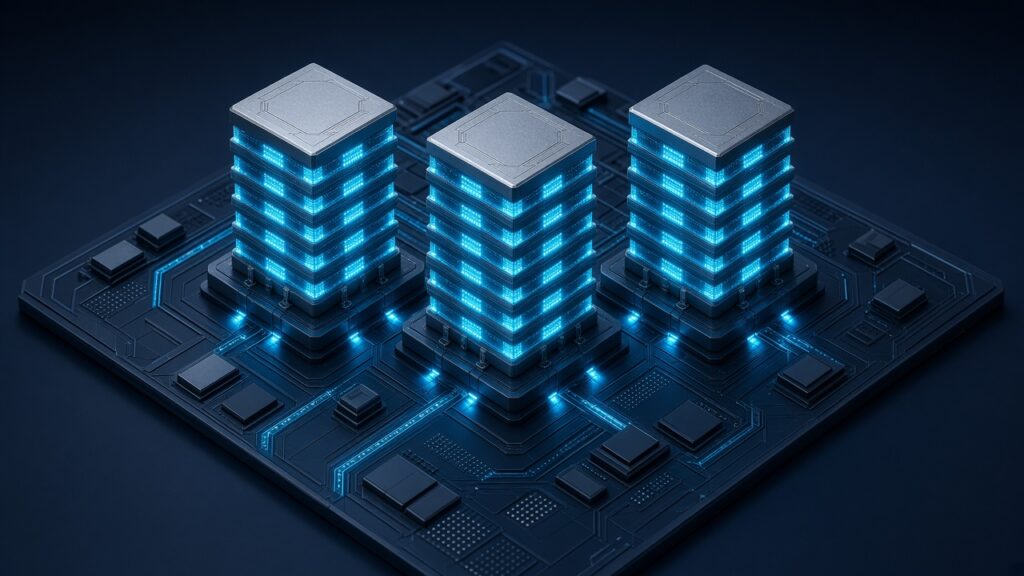
AI accelerators are useless without the memory stacked beside them. In late 2026 the three largest DRAM makers are not merely shipping a new HBM generation—they are locking multi-year HBM4 supply, posting operating margins near 80%, and treating memory capacity as a strategic choke point. This article maps that commercial race. For the technical requirements of training silicon, HBM bandwidth and scale-up fabrics, see our guide to multi-trillion-parameter training silicon.
Why HBM4 supply is now a market story
High Bandwidth Memory sits physically next to AI compute dies inside advanced packages. When HBM is short, finished accelerators are short—regardless of how many logic wafers a foundry can start. That is why the late-October 2026 earnings season for Samsung Electronics, SK hynix and Micron Technology read less like a cyclical DRAM update and more like a contest over who controls the scarce input to AI hyperscale infrastructure.
The product generation in question is defined by JEDEC. On April 16, 2025, JEDEC published JESD270-4 (HBM4), describing transfer speeds up to 8 Gb/s across a 2048-bit interface for up to 2 TB/s of bandwidth, 32 independent channels per stack (versus 16 in HBM3), optional lower VDDQ/VDDC levels for power efficiency, backward compatibility with HBM3 controllers, and stack heights including 12-high and 16-high configurations with cube densities up to 64 GB [1]. That standard is the common language of the HBM4 supply race. Vendors then compete on yields, base-die integration, customer qualifications and—above all—bits of capacity they can promise through 2027 and 2028.
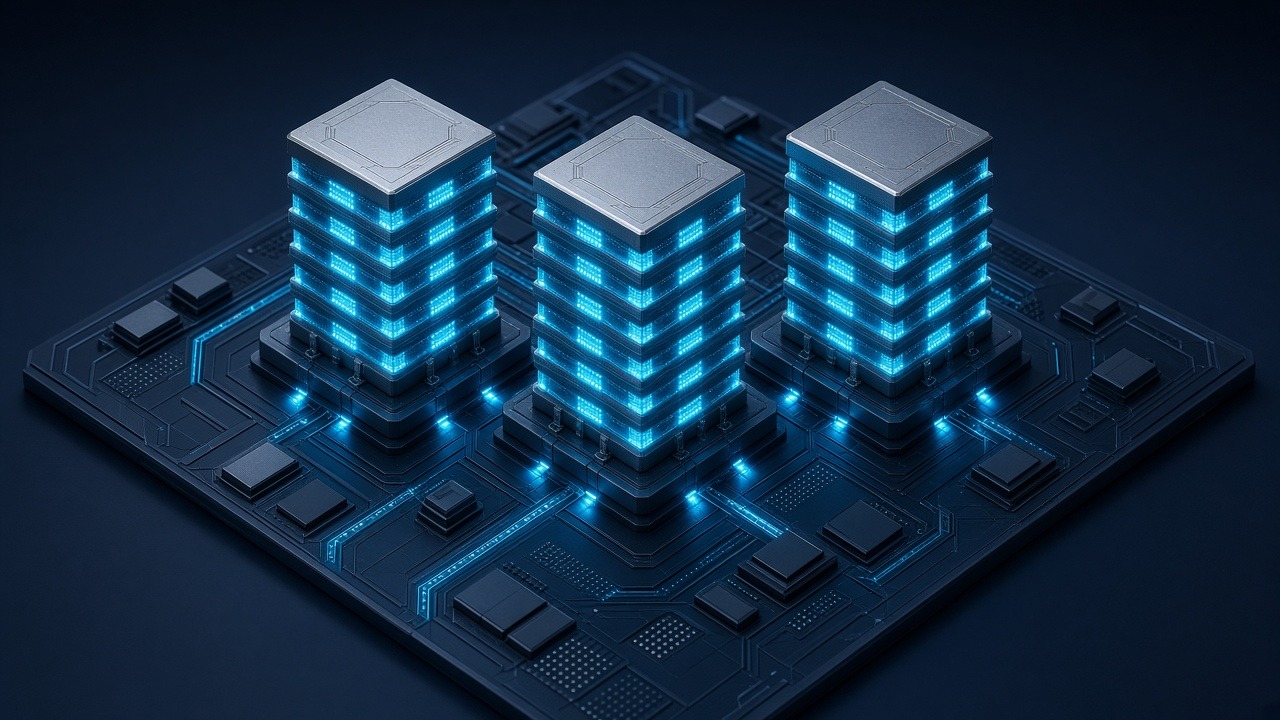
SK hynix: still the incumbent, locking the calendar
SK hynix entered the autumn of 2026 as the HBM share leader and reinforced that position with record results. In its October 28, 2026 newsroom release, the company reported third-quarter revenue of KRW 104.6155 trillion, operating profit of KRW 83.3338 trillion (about an 80% operating margin) and net profit of KRW 39.7756 trillion [2]. Revenue and operating profit rose 32% and 38% quarter on quarter, respectively, and quarterly sales surpassed KRW 100 trillion for the first time [2].
On the product mix, SK hynix said HBM4 shipments “began in earnest,” that it will ramp its M15X facility to maximum capacity by year-end to increase HBM4 output, and that it expects HBM4 to surpass HBM3E in both shipment volume and revenue in the fourth quarter [2]. Its investor presentation for the same quarter repeats that M15X ramp and the Q4 HBM4-over-HBM3E expectation, and states that 2027 HBM negotiations have been finalized [3].
The commercial structure matters as much as the bits. SK hynix said it has signed long-term agreements (LTAs) with 14 key customers, including major global cloud service providers, typically on five-year terms, with pricing inside customer-agreed ranges that can reflect market conditions, and with safeguards such as deposits [2][3]. Secured LTA volumes already cover more than 50% of total production capacity for 2027 and 2028 [2][3]. The company also said it expects demand to outpace supply through 2030, citing the difficulty of leading-edge processes and the long lead time to build new fabs [2].
That combination—HBM4 becoming the mainstream SK hynix HBM product, M15X at full tilt, and half of medium-term capacity pre-sold—is how an incumbent defends its lead against Samsung: not only with technology leadership, but with calendar control.
Samsung: the HBM4 comeback, sold out into 2027
Samsung’s official third-quarter release, dated October 29, 2026, reported consolidated revenue of KRW 195.3 trillion and operating profit of KRW 107.4 trillion—the first time, Samsung said, that any global tech company had exceeded KRW 100 trillion in quarterly operating profit [4]. Device Solutions posted KRW 147.1 trillion in revenue and KRW 106.5 trillion in operating profit; Memory set another record by focusing the mix on AI products amid capacity constraints, and “significantly scaled up sales of HBM4” [4]. Samsung’s IR conference materials show Memory sales of KRW 140.7 trillion in the quarter and full-year 2026 DS capital expenditure guided at about KRW 76.8 trillion within a company total near KRW 84.4 trillion [5].
The sharper HBM4 metrics came on the earnings call. According to the call transcript carried by Investing.com, Memory executive Jaejune Kim said HBM4 sales increased more than threefold quarter on quarter, that HBM4 accounted for about 60% of Samsung’s total HBM sales, that Samsung believed it had already brought HBM market share in line with its overall DRAM share ahead of its prior second-half target, that HBM4E samples shipped in May with positive early feedback, and that “2027 HBM supply volume is already sold out at an agreed target price,” even as key customers still ask for more [6]. Samsung’s newsroom does not print those exact percentages; they are attributed here to the earnings-call record.
Korean business press amplified the same call. Aju Press, on October 29, 2026, quoted Kim Jae-jun saying 2027 HBM volumes were sold out at target prices and summarized Samsung’s claim that HBM4 revenue more than tripled with roughly a 60% mix of HBM sales [7]. Aju Press also cited Counterpoint Research figures for second-quarter 2026 HBM revenue share—SK hynix about 50%, Samsung about 33%, Micron about 18%—which are secondary market-research estimates, not company disclosures [7].
Samsung’s foundry comments on the same call underline a structural card the company wants to play: integrating HBM base dies with advanced logic. Foundry executives said Q3 results improved on HBM base-die sales and advanced-node demand, and that joint development of an HBM4 base die on a 4 nm process had delivered strong performance and early yields [6]. Whether that integration closes the gap with SK hynix’s accelerator customers is the open competitive question; the financial evidence is that Samsung is no longer a distant HBM follower.

Micron: U.S. scale, HBM4 in volume, margins in the same league
Micron reports on a U.S. fiscal calendar. For the fiscal fourth quarter ended September 3, 2026, its September 30, 2026 press release reported revenue of USD 54.23 billion, GAAP operating income of USD 43.75 billion (80.7% of revenue) and GAAP net income of USD 37.70 billion [8]. Full-year fiscal 2026 revenue was USD 133.19 billion with GAAP operating income of USD 99.34 billion [8]. Capex investments net of incentives were USD 10.77 billion in the quarter and USD 27.37 billion for the year [8].
On the HBM4 product, Micron’s March 16, 2026 press release said it had begun volume shipment of HBM4 36 GB 12-high in the first quarter of calendar 2026, designed for Nvidia’s Vera Rubin platform, with pin speeds above 11 Gb/s and bandwidth greater than 2.8 TB/s—about 2.3× the bandwidth of its comparable HBM3E stack and more than 20% better power efficiency on Micron’s stated workload comparison [9]. Micron also said it had shipped samples of a 48 GB 16-high HBM4 stack, a 33% capacity increase per HBM placement versus the 36 GB 12-high part [9].
Micron’s fiscal Q4 earnings release itself does not break out HBM revenue or state that calendar-2027 HBM supply is sold out; those details, where reported in secondary transcripts, are not used here as primary facts. What the official materials do show is a memory vendor posting AI-era margins comparable to SK hynix’s ~80% operating margin while already shipping JEDEC-generation HBM4 into a leading accelerator platform [8][9].
The new economics: contracts, mix shift, and AI memory shortage
Three patterns rewrite AI memory economics across all three suppliers.
Long-term contracts replace spot DRAM habits. SK hynix’s LTAs with 14 customers covering more than half of 2027–2028 capacity are explicit [2][3]. Samsung’s call described multi-year contracts with 10 major accounts already signed and talks with about 10 more, with a goal that multi-year deals cover 60%–70% of mid- to long-term capacity [6]. That is how producers fund cleanrooms before equipment arrives—and how customers try to guarantee HBM4 supply.
HBM crowds out conventional bits. Building HBM consumes advanced DRAM capacity that could have made commodity DDR. SK hynix says the demand-over-supply structure should last through 2030 [2]. On Samsung’s call, Kim argued that 2027 CapEx will not quickly translate into 2028 bit growth because much spending goes to buildings, construction inflation and long equipment lead times, while larger HBM dies and more metal layers physically constrain output [6]. If that holds, the squeeze extends beyond HBM to conventional server DRAM supply—not only HBM pricing.
Margins near 80% are real—and fragile. SK hynix’s 80% operating margin and Micron’s 80.7% GAAP operating margin in their respective latest quarters are primary figures [2][8]. Samsung’s DS division margin is lower when foundry and logic are included (about 72% on KRW 106.5 trillion operating profit / KRW 147.1 trillion sales) [4][5]. Aju Press correctly notes that those comparisons are not perfectly like-for-like [7]. Extraordinary profitability also stresses Samsung’s Device eXperience businesses, which posted an operating loss of KRW 0.8 trillion in Q3 as component costs rose [4]—a reminder that the same AI memory shortage that enriches memory makers squeezes device makers and, eventually, AI infrastructure buyers.

What the race means for AI power players
For hyperscalers and AI labs, HBM procurement is now a multi-year negotiation, not a quarterly buy. The vendors with signed LTAs and qualified HBM4 stacks can plan racks; others face allocation risk. For accelerator vendors, packaging and HBM must be co-scheduled: a CoWoS slot without an HBM cube is as useless as an HBM cube without a package. For policymakers and infrastructure buyers, the concentration of HBM capability in three firms—and of advanced packaging largely in Taiwan—is a systemic dependency for AI hyperscale infrastructure.
None of this replaces the silicon engineering story. Bandwidth, stack height, base-die process and power efficiency still decide which HBM4 part wins a given GPU or ASIC socket—topics covered in our guide to multi-trillion-parameter training silicon. What changed in the October–November 2026 earnings window is the market structure around those parts: sold-out calendars, five-year contracts, and margins that look more like software than memory.
What to watch into 2027
- Whether HBM4 truly becomes SK hynix’s mainstream HBM in Q4 shipment and revenue share, as the company guided [2][3].
- Samsung’s delivery against “sold out” 2027 HBM volumes and the ramp of HBM4E mass production discussed on its call [6].
- Micron’s calendar-2027 HBM bit agreements and HBM4E / custom HBM roadmap, which require future official IR updates beyond the March 2026 product release [9].
- Independent verification of HBM revenue shares (Counterpoint and peers)—treat share tables as research estimates until confirmed [7].
The HBM4 supply race will not be decided by a single quarter. It will be decided by who can add known-good stacks, year after year, into the packages that turn wafers into AI accelerators.
Related reading
- Beyond the Die: Why Advanced Packaging Became the Real AI Silicon Bottleneck
- Multi-Trillion-Parameter Training: What the Next Silicon Generation Must Deliver
- The AI Accelerator Market: GPUs, ASICs and the Second-Source Race
- Equity for Silicon: How AMD Turned OpenAI and Meta Into Stakeholders
References / Sources
Primary / official
1. JEDEC, “JEDEC and Industry Leaders Collaborate to Release JESD270-4 HBM4 Standard…” (Apr. 16, 2025): https://www.jedec.org/news/pressreleases/jedec%C2%AE-and-industry-leaders-collaborate-release-jesd270-4-hbm4-standard-advancing
2. SK hynix Newsroom, “SK hynix Announces 3Q26 Financial Results” (Oct. 28, 2026): https://news.skhynix.com/en/q3-2026-business-results/
3. SK hynix, FY2026 Q3 Earnings Presentation (Oct. 28, 2026): https://mis-prod-koce-homepage-cdn-01-blob-ep.azureedge.net/web/attach/21435786328187801.pdf
4. Samsung Global Newsroom, “Samsung Electronics Announces Third Quarter 2026 Results” (Oct. 29, 2026): https://news.samsung.com/global/samsung-electronics-announces-third-quarter-2026-results
5. Samsung Electronics, 3Q 2026 Earnings Call Presentation (IR PDF): https://images.samsung.com/is/content/samsung/assets/global/ir/docs/2026_3Q_conference_eng.pdf
8. Micron Technology, “Reports Record Fiscal Fourth-Quarter and Full-Year 2026 Results” (Sept. 30, 2026): https://investors.micron.com/news/press-release/2026/Micron-Technology-Inc–Reports-Record-Fiscal-Fourth-Quarter-and-Full-Year-2026-Results/default.aspx
9. Micron Technology, “Micron in High-Volume Production of HBM4 Designed for NVIDIA Vera Rubin…” (Mar. 16, 2026): https://investors.micron.com/news/press-release/2026/Micron-in-High-Volume-Production-of-HBM4-Designed-for-NVIDIA-Vera-Rubin-PCIe-Gen6-SSD-and-SOCAMM2-03-16-2026/default.aspx
Secondary (clearly attributed)
6. Investing.com transcript of Samsung Electronics Q3 2026 earnings call (published Oct. 28, 2026) — third-party transcript of the official call Q&A (Jaejune Kim HBM remarks): https://www.investing.com/news/transcripts/earnings-call-transcript-samsung-electronics-posts-record-q3-2026-profit-93CH-4981365
7. Aju Press, Candice Kim, “Samsung’s HBM strides intensify AI memory race” (Oct. 29, 2026) — includes Counterpoint share estimates and call quotes: https://www.ajupress.com/view/20261029152541046
Images: original illustrations generated for AndBeyond.Tech; no logos or real people depicted.