Space-Based Data Centers: What the ICEF Caution Report Actually Warns
When a new roadmap on space-based data centers appeared in mid-November 2026, the temptation was to treat it as a verdict. It is not. The…
When a new roadmap on space-based data centers appeared in mid-November 2026, the temptation was to treat it as a verdict. It is not. The Innovation for Cool Earth Forum (ICEF) document Space-based Data Centers Roadmap: The Case for Caution, dated November 2026 and chaired by David Sandalow of Columbia University, is explicit about its status. In the preface, Sandalow writes that the text was prepared under a tight deadline, “has not been subjected to peer review,” and is therefore a “working paper.” That caveat should stay attached to every figure that follows.
What the paper does offer is a structured warning, and a useful sorting rule for a field that is moving faster than its paperwork. Programs already covered in AndBeyond’s reporting on orbital data centers have put small amounts of AI compute into orbit. Regulatory filings now describe constellations that, if built as proposed, would dwarf the satellite population now flying. Those two facts are not the same fact. The ICEF authors’ main contribution is to keep them apart, and to ask what night skies, launch cadence, debris, atmospheric chemistry, and international law would look like if the filings were taken at face value.
A working paper, not a refereed verdict
ICEF is a Tokyo-based forum supported by Japan’s New Energy and Industrial Technology Development Organization (NEDO). The 2026 roadmap sits in a long-running “Innovation Roadmap” series; the 2025 edition addressed sustainable data centers. Ten co-authors contributed. The analysis, the preface says, is “primarily based on documentary research conducted during the summer of 2026.” Comments are invited, and some or all of the text may be updated. Columbia’s Center on Global Energy Policy and the Columbia Climate School have posted accompanying explainers, but the primary document is the roadmap itself, published chapter by chapter on the official ICEF site.
That is the right way to read the six “main messages” that open the working paper. They are the authors’ initial conclusions, not a journal result:
- Space-based data centers are “coming soon,” including “proposals to launch more than one million data centers into orbit.”
- Neither technical challenges nor high costs will, in the authors’ view, block initial deployment; some space-based data centers are already operating, and leading companies “will be willing and able to incur high costs for many years.”
- Many rocket launches would be required to deploy comparatively small amounts of compute, including the paper’s estimate that more than 700 launches of large rockets every year—about two a day—would be needed “in perpetuity” to meet 10 percent of projected 2030 demand for AI data centers.
- Large constellations would create “very significant risks and impacts,” including “dramatic alterations of the night sky,” debris in low Earth orbit, harm from de-orbiting satellites, stratospheric ozone depletion, increased global warming, and interference with astronomy.
- Current governance regimes are “inadequate,” especially for lack of international coordination.
- Companies and policymakers “should proceed with great caution” and should not deploy large constellations “without more operational experience and until risks and impacts are better understood and well managed.”
None of those statements is, by itself, a forecast that one million orbital data centers will fly. Message 1 is about activity and proposals. The later chapters are largely about applications, institutional gaps, and scenarios. Keeping that distinction is the difference between covering a live risk debate and inflating a filing into a fleet.
Filings are not fleets already flying
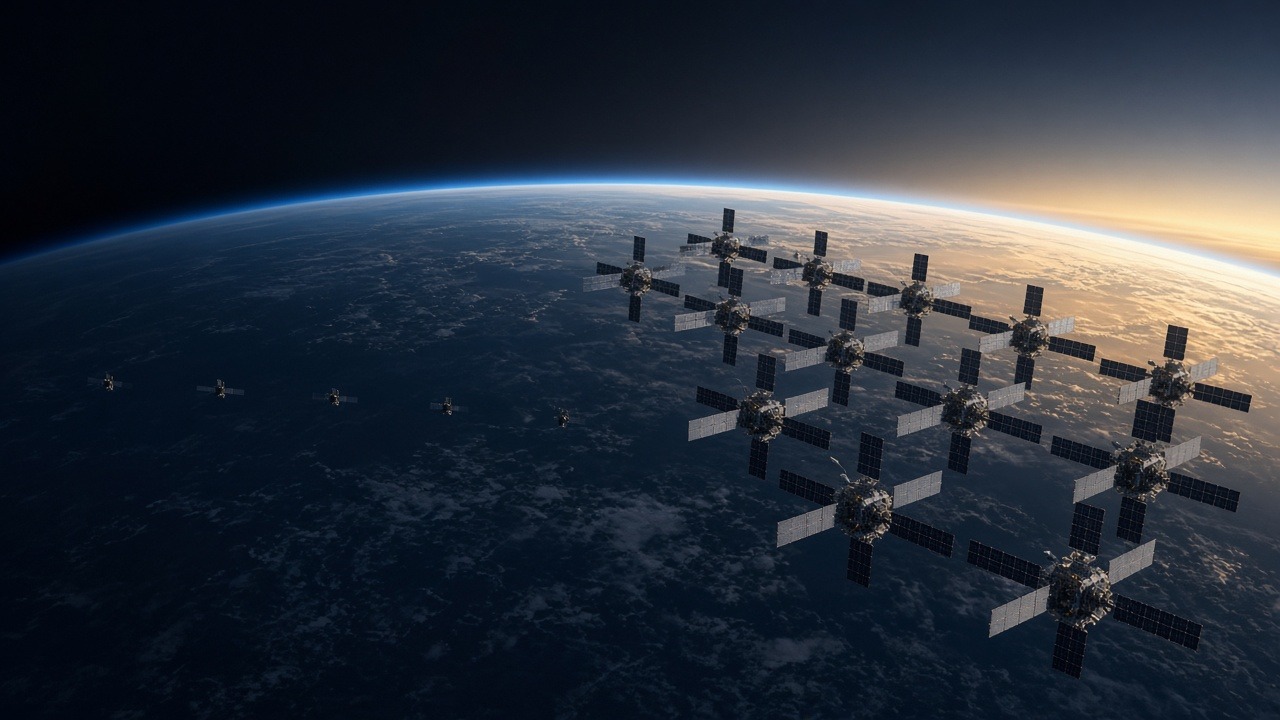
The findings section draws the line in numbers the authors themselves provide. “Roughly a dozen satellites have been launched primarily to demonstrate the feasibility of performing artificial intelligence (AI) model training and inference in space.” Meanwhile, “today there are roughly 19,000 satellites orbiting the Earth.” Against that baseline, “full implementation of proposed plans for space-based data centers would increase the number of satellites in low Earth orbit by more than 50x.” That multiplier is a working-paper estimate of announced and filed plans, not a count of hardware already in production or already catalogued.
The opening essay is more specific about the paperwork. “In January 2026, SpaceX sought permission from the US Federal Communications Commission (FCC) to operate one million space-based data centers (SBDCs).” Four other companies, the essay says, have followed with applications that “propose to put several hundred thousand more data centers in low Earth orbit.” The night-sky chapter, still as a working-paper account of proposals, says Starcloud “has proposed a constellation of 88,000 SBDCs” and that “Orbital has filed an application to launch and operate up to 100,000 satellites.” The congestion chapter adds that Blue Origin “has proposed a constellation of up to 51,600 satellites.” Those figures belong in the filing column.
SpaceX’s application should be cited the same way. On 4 February 2026, the FCC Space Bureau issued public notice DA-26-113, accepting for filing Space Exploration Holdings’ application SAT-LOA-20260108-00016 for a “SpaceX Orbital Data Center system” of up to one million satellites in the 500–2,000 km altitude range, with optical inter-satellite links described as routing via the Starlink mesh. Accepting an application for filing is a procedural step. It is not a grant of the license, and it is not a deployment. SpaceX’s Form S-1/A, filed with the U.S. Securities and Exchange Commission on 1 June 2026, describes orbital AI compute as a company thesis and states an expectation that deployment could begin “as early as 2028”—a company expectation, not a schedule of satellites already on the pad.
The working paper also notes activity outside the United States, including a Chinese proposal by ADA Space for a 2,800-satellite “Star Compute” constellation and the authors’ statement that ADA Space “launched the first 12 satellites in May 2025.” Even on that account, twelve spacecraft are a demonstration-scale start, not the proposed constellation. The European Commission’s ASCEND study remains a feasibility effort, not a flying fleet.
The practical test is simple. If a number comes from a license application, a company roadmap, or a memorandum of understanding, it is a plan. If it comes from a catalog of objects already on orbit, it is a fleet.
The launch-cadence warning is an estimate, with stated assumptions
The headline launch figure is easy to repeat and easy to misuse. The six main messages state that “more than 700 launches of large rockets every year (2 per day) would be required in perpetuity to meet 10% of projected global demand for artificial intelligence data centers in 2030.” The findings repeat the claim as “at least 700 launches of Starship-sized rockets per year.”
Those are working-paper estimates, and the launch chapter shows the arithmetic. The authors define a “Reference SBDC” of 100 kW of compute, 2.5 tonnes, and a five-year operational life, and they assume a super-heavy vehicle that can place about 100 tonnes in orbit—described as the current estimate for SpaceX’s Starship. On those assumptions, a 1-GW constellation of 10,000 reference spacecraft would require about one such launch a week for as long as the constellation is maintained, because replacements begin when the first satellites reach the end of their assumed life. Scaling that model to 10 percent of the 2030 demand the authors use produces the “more than 700 a year” figure. A further scenario in the same chapter, citing a McKinsey projection of 156 GW of AI data-center demand by 2030, says that meeting 25 percent of that demand with the same reference design would require on the order of 2,000 such launches a year. For comparison, the working paper says there were 329 rocket launches globally in 2025, across a range of vehicle types.
Change the mass per kilowatt, the vehicle performance, or the lifetime, and the cadence changes—the authors say so. If the spacecraft are heavier than the reference design, significantly more launches would be required. What does not change is the direction of the warning: under the paper’s reference design, a fleet large enough to matter for global AI capacity is a continuous launch campaign, not a one-time construction push. Pads, propellant, and range safety become governance issues as much as engineering ones. That is a risk argument, not a re-run of the economics in earlier coverage of orbital data centers.
Night skies and astronomy: measurements, then mitigations
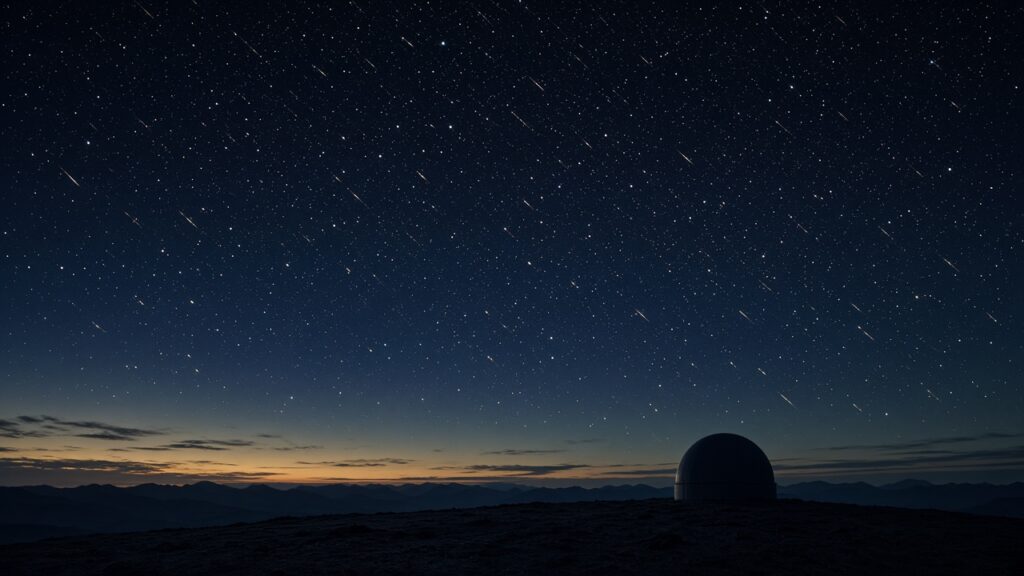
The night-sky chapter, by Alexis Abramson and David Sandalow, is the part of the roadmap most likely to travel. If announced plans were “fully implemented,” the authors write, “most visible points of light in the sky during much of the night in much of the world could be satellites, not stars,” and those points would drift. They also warn that large, hot radiator panels—necessary because an orbital facility can reject waste heat only by radiating it—would be sources of infrared emission that professional observatories are designed to avoid. Visible brightness, they note, can be reduced at a thermal or operational cost; the total infrared output of a radiatively cooled data center is fixed by the compute load. The American Astronomical Society, they add, has opposed SpaceX’s application as “an unprecedented threat to the visual integrity of the night sky.” Those are the working paper’s claims. They apply to proposed space-based data centers, which the authors say would be much larger than today’s communications satellites, not to the demonstration spacecraft already flown.
For a fair baseline, the relevant comparison is not a hypothetical million-satellite data-center constellation. It is the communications constellations already on orbit, and the brightness limits astronomers have already published.
The International Astronomical Union’s Centre for the Protection of the Dark and Quiet Sky (IAU CPS) has recommended a visual-magnitude limit of Vmag > 7.0 for satellites at or below 550 km, with a fainter (numerically higher) limit at higher altitudes given by Vmag > 7.0 + 2.5 × log10(altitude / 550 km). The intent, in the CPS’s own recommendation, is to keep low-Earth-orbit satellites invisible to the unaided eye from dark sites and to reduce, though not eliminate, interference with professional observations.
Peer-reviewed photometry of Starlink, the largest constellation now flying, is the right evidence to set next to that target. In Monthly Notices of the Royal Astronomical Society (MNRAS 516:1502, 2022), Halferty, Reddy, Campbell, Battle and Furfaro reported 353 observations of 61 Starlink satellites. They found an average Gaia G magnitude of 5.5 ± 0.13 overall; 5.1 ± 0.13 for the original V1.0 (pre-VisorSat) spacecraft; 7.3 ± 0.13 for the experimental dark-coated “DarkSat” (about 7.6 times fainter than V1.0 in that study); and 6.0 ± 0.13 for “VisorSat.” A later multi-year V-band campaign, published in MNRAS as article stag552 and normalized to a common 550 km altitude, found median magnitudes of about 5.37 (v1.0), 6.01 (Gen-2, a small sample of N=6), 6.11 (v1.5), 6.62 (VisorSat), and 8.43 (DarkSat, N=2). That study concludes that mitigation-era designs are typically fainter than the original v1.0, but that the medians for the well-sampled generations remain about 0.4–1.6 magnitudes brighter than the IAU CPS / SATCON goal of V ≥ 7 at roughly 550 km, with the main uncertainties arising from the very small DarkSat and Gen-2 samples. In MNRAS Letters 544:L15 (2025), Mallama and Cole compared brightness statistics for Starlink, BlueBird, Qianfan, Guowang and OneWeb with the CPS limits and reported that nearly all of those spacecraft exceed the magnitude-7 research limit, and that most also exceed a magnitude-6 “aesthetic” reference.
SpaceX has published its own account of the same design history, and it should be included. In an official “Brightness Mitigation Best Practices for Satellite Operators” paper, the company describes first-generation sun visors that were later dropped because the visor material blocked laser inter-satellite links and generated significant drag, requiring more propellant at the low altitudes Starlink uses. The replacement was a dielectric mirror film on the nadir face, designed to scatter sunlight away from Earth. For second-generation spacecraft, SpaceX says it is using an improved dielectric film, dark treatments on solar-array backsheets and small components, and a “terminator tracking” maneuver that points solar arrays so only their thin profile faces Earth when the satellite crosses the day–night line—a maneuver the company says costs about 25 percent of available power. The stated goal is to make second-generation satellites “invisible to the naked eye when they are on station serving users,” while acknowledging that they can be brighter during orbit raise, station-keeping and de-orbit. In January 2023, the U.S. National Science Foundation and SpaceX announced a coordination agreement, summarized by NSF and by the IAU CPS, under which the company would continue work to reduce optical brightness toward 7th visual magnitude or fainter, keep operational altitudes at about 700 km or lower, and provide public orbital information that observatories can use in scheduling.
Two things can be true at once. Official mitigations have been designed, flown, and iterated, and independent photometry shows later Starlink generations are fainter than the first. The same photometry, and the IAU CPS target, show that the communications constellation still often misses the research brightness limit. The ICEF authors’ further point is that none of those mitigations has been demonstrated on structures whose solar arrays and radiators would be many times larger than a Starlink satellite. That is a scale-and-design argument, not a claim that current Starlink operations already look like a million-unit data-center fleet.
Congestion, re-entry, and the atmosphere
The congestion chapter, by Kathleen Curlee, places proposed space-based data centers in an already crowded low Earth orbit. The U.S. government, the chapter says, has tracked more than 34,000 pieces of debris larger than 10 cm since 1958, while millions of smaller fragments cannot be tracked reliably and can still damage spacecraft. Large constellations, the authors argue, would increase collision-avoidance demand and could, through collisions, failures or attacks, add debris of their own. They note, correctly, that FCC applications “do not guarantee that the systems will be built at their proposed scale.” Earlier AndBeyond reporting on fleet autonomy and collision avoidance covers the operational problem; the ICEF text adds a governance emphasis: existing space-traffic-management arrangements are, in the authors’ view, not sized for hundreds of thousands of large spacecraft.
The roadmap also flags stratospheric ozone and climate effects as serious, and as incompletely quantified. Findings list ozone depletion “driven by rocket fuel emissions during launches and by vaporized satellite components during de-orbiting,” and “increased global warming, driven by rocket fuel emissions.” The same section lists “known unknowns,” including the technical potential for brightness mitigation at data-center scale, the ozone impact of de-orbiting large numbers of massive spacecraft, and the climate effect of stratospheric black carbon. Those are research agenda items, not measured outcomes of a fleet that has not been built. They belong in a caution report. They should not be rewritten as settled environmental accounting.
Governance: a patchwork asked to license a new class of infrastructure
The authors’ institutional conclusion is blunt. “Current governance regimes are inadequate for managing the risks and impacts of large constellations of space-based data centers. The lack of international coordination is a particularly challenging problem.” The findings describe a patchwork of international and domestic law, a space regime built before private operators dominated launch and before today’s satellite counts, and the possibility of regulatory arbitrage in how spacecraft are registered and how spectrum is filed at the International Telecommunication Union (ITU).
The recommendations that follow are about process, not a ban. Companies, the authors say, “should not launch large numbers of space-based data centers until a range of significant risks and impacts are addressed.” National regulators “should require phased deployment,” with licenses “subject to annual renewals granted on the basis of performance in brightness mitigation, deorbit impacts, emissions reduction and other factors.” Governments and companies should collect and share data; companies proposing large constellations should fund independent research. As a precedent for proceeding slowly, the findings quote SpaceX’s own FCC filing: “Initial operations under this license will be limited to a significantly smaller number of satellites and re-entries than the maximum authorized, providing time to monitor actual effects, validate models with real-world data, and implement any necessary adjustments before scaling.” Whatever one thinks of the million-satellite request, that sentence is a principle the ICEF authors want applied generally: do not treat the maximum number on an application as the number that should be authorized, or flown, in a single step.
None of this settles whether a much smaller, carefully flown set of orbital facilities could be operated responsibly. It does mean that a debate which starts from “the FCC has a million-satellite data-center filing” and ends at “a million data centers are about to launch” has skipped the only part of the record that is solid today.
What the caution report settles — and what it does not
Read as a working paper, the ICEF roadmap is a useful brief for regulators, astronomers, and operators. It states, with unusual directness, that early technical demonstrations and falling launch costs will not, by themselves, answer questions about night-sky brightness, debris, re-entry, atmospheric chemistry, or the adequacy of today’s licensing tools. It also reminds readers that some companies may proceed even if costs remain high—an observation about incentives, not a cost forecast, and not a reason to re-litigate the program economics already covered in who is building what, which workloads belong in orbit, or Google’s Suncatcher duty-cycle work.
The document does not inventory every program now in orbit, or replace the engineering detail in company and agency papers. The ICEF authors ask a different question: if the filings were built at the scale written on the forms, would the sky, the launch range, and the law be ready? Their answer, offered as a working paper and not as peer-reviewed proof, is that they would not, and that the burden of showing otherwise should sit with the companies and the governments that would authorize the scale-up.
The test for the next few years is therefore institutional as much as technical. Watch what is actually catalogued in orbit, not only what is accepted for filing. Watch whether brightness, de-orbit, and emissions performance are written into licenses as conditions that can be renewed or withheld. And keep the working-paper label on the 700-launch and 50-fold figures until a refereed literature, or an operational record, has had time to catch up.
Related reading
- Orbital Data Centers for AI: Promise, Physics, and the Cost Reality Check
- AI Workloads That Actually Make Sense in Orbit
- Google Suncatcher In Orbit: The Power Duty Cycle Reality Behind the Haiku
- Who Flies the Orbital Data Center Fleet? Autonomy, Collision Avoidance, and the Ground-Ops Bottleneck
Sources
- ICEF — Space-based Data Centers Roadmap: The Case for Caution (hub, November 2026). https://icef.go.jp/roadmap/
- ICEF — Preface (David Sandalow; working-paper status). https://icef.go.jp/wp-content/themes/icef_new/pdf/roadmap/2026/ICEF%20SBDC%20Roadmap%20Preface%20Nov%202026.pdf
- ICEF — Six Main Messages. https://icef.go.jp/wp-content/themes/icef_new/pdf/roadmap/2026/ICEF%20SBDC%20Roadmap%20Six%20Main%20Messages%20Nov%202026.pdf
- ICEF — Findings and Recommendations. https://icef.go.jp/wp-content/themes/icef_new/pdf/roadmap/2026/ICEF%20SBDC%20Roadmap%20Findings%20and%20Recommendations%20Nov%202026.pdf
- ICEF — Opening Essay: Growing Momentum Towards Space-Based Data Centers (David Sandalow). https://icef.go.jp/wp-content/themes/icef_new/pdf/roadmap/2026/ICEF%20SBDC%20Roadmap%20Opening%20Essay-Growing%20Momentum%20Nov%202026.pdf
- ICEF — Chapter 1.5, Launch Capacity. https://icef.go.jp/wp-content/themes/icef_new/pdf/roadmap/2026/ICEF%20SBDC%20Roadmap%20Ch1.5%20Launch%20Capacity%20Nov%202026.pdf
- ICEF — Chapter 2.1, Night Sky and Astronomy (Alexis Abramson and David Sandalow). https://icef.go.jp/wp-content/themes/icef_new/pdf/roadmap/2026/ICEF%20SBDC%20Roadmap%20Ch2.1%20Night%20Sky%20and%20Astronomy%20Nov%202026.pdf
- ICEF — Chapter 2.2, Orbital Congestion and Space Debris (Kathleen Curlee). https://icef.go.jp/wp-content/themes/icef_new/pdf/roadmap/2026/ICEF%20SBDC%20Roadmap%20Ch2.2%20Orbital%20Congestion%20and%20Space%20Debris%20Nov%202026.pdf
- ICEF — Chapter 2.3, Stratospheric Ozone Depletion. https://icef.go.jp/wp-content/themes/icef_new/pdf/roadmap/2026/ICEF%20SBDC%20Roadmap%20Ch2.3%20Strat%20Ozone%20Depletion%20Nov%202026.pdf
- ICEF — Chapter 2.4, Greenhouse Gases and Black Carbon. https://icef.go.jp/wp-content/themes/icef_new/pdf/roadmap/2026/ICEF%20SBDC%20Roadmap%20Ch2.4%20GHGs%20and%20Black%20Carbon%20Nov%202026.pdf
- ICEF — Chapter 3.2, Key Governance Issues and Recommendations. https://icef.go.jp/wp-content/themes/icef_new/pdf/roadmap/2026/ICEF%20SBDC%20Roadmap%20Ch3.2%20Key%20Governance%20Issues%20and%20Recs%20Nov%202026.pdf
- Columbia Center on Global Energy Policy — publication page for the ICEF roadmap. https://www.energypolicy.columbia.edu/publications/space-based-data-centers-roadmap-the-case-for-caution/
- Columbia Climate School, State of the Planet — “New Report Urges Caution in the Race for Space-Based Data Centers” (12 November 2026). https://news.climate.columbia.edu/2026/11/12/new-report-urges-caution-in-the-race-for-space-based-data-centers/
- FCC DA-26-113 — Space Bureau accepts for filing SpaceX’s application for orbital data centers, SAT-LOA-20260108-00016 (4 February 2026). https://docs.fcc.gov/public/attachments/DA-26-113A1.txt
- SpaceX S-1/A (1 June 2026) — orbital AI compute thesis; company expectation of deployment “as early as 2028.” https://www.sec.gov/Archives/edgar/data/1181412/000162828026039276/spaceexplorationtechnologi.htm
- IAU Centre for the Protection of the Dark and Quiet Sky — Call to Protect the Dark and Quiet Sky from Harmful Interference by Satellite Constellations (visual-magnitude limits, Box 1). https://cps.iau.org/documents/49/techdoc102.pdf
- Halferty, Reddy, Campbell, Battle and Furfaro — “Photometric characterization and trajectory accuracy of Starlink satellites,” MNRAS 516:1502–1508 (2022). https://doi.org/10.1093/mnras/stac2080 / https://arxiv.org/abs/2208.03226
- “Brightness evolution of LEO Starlink mega-constellation satellites from 2021 to 2023: a multiyear ground-based photometric study,” MNRAS 548, stag552. https://doi.org/10.1093/mnras/stag552 / https://academic.oup.com/mnras/article/548/2/stag552/8540255
- Mallama and Cole — “Satellite constellations exceed the limits of acceptable brightness established by the IAU,” MNRAS Letters 544:L15–L17 (2025). https://doi.org/10.1093/mnrasl/slaf094 / https://arxiv.org/abs/2507.00107
- SpaceX / Starlink — “Brightness Mitigation Best Practices for Satellite Operators” (official company paper: visors, dielectric mirror film, terminator tracking, black paint). https://starlink.com/public-files/BrightnessMitigationBestPracticesSatelliteOperators.pdf
- NSF — statement on the NSF–SpaceX astronomy coordination agreement. https://www.nsf.gov/news/statement-nsf-astronomy-coordination-agreement
- IAU CPS — “NSF and SpaceX Sign Agreement to Mitigate Impact of Starlink Satellites on Ground-Based Astronomy” (10 January 2023). https://cps.iau.org/news/nsf-and-spacex-sign-agreement-to-mitigate-impact-of-starlink-satellites-on-ground-based-astronomy/
- NSF’s NOIRLab — announcement of the same NSF–SpaceX agreement (ann23004). https://noirlab.edu/public/announcements/ann23004/
Images: original illustrations generated for AndBeyond.Tech; no logos or real people depicted.