From a Sentence to a PLC Program: Agentic AI Arrives in Automation Engineering
For decades, the path from a production idea to a running robot cell has gone through the same people: the integrator’s designer, the controls engineer…

For decades, the path from a production idea to a running robot cell has gone through the same people: the integrator’s designer, the controls engineer who writes the PLC code, the robot programmer and the commissioning team on site. In November 2026, two European suppliers announced software that tries to compress much of that path into a written request. An engineer describes the task, AI agents propose the cell and generate the program, the result is checked in simulation, and a human approves it.
The first is Bosch Rexroth’s Agent iXi, an AI agent built into the ctrlX AUTOMATION platform. One point matters before anything else: Agent iXi is in beta. Bosch Rexroth says it expects the product to be available in early 2027. It will be shown publicly at SPS in Nuremberg, 24–26 November 2026. The second is fruitcore robotics’ PLEXA OS, an AI-native operating system for the company’s industrial humanoid, PLEXA One. FANUC, working with Google, has been moving in the same direction since May.
This article first sets out what the vendors announced, from their own press material, then gives our reading of what it changes for integrators and what is still unproven. Unless stated otherwise, every capability described in the first part is vendor-reported and has not been independently tested.
What the vendors announced
Bosch Rexroth Agent iXi: an agent inside the engineering toolchain (beta)
Bosch Rexroth presented Agent iXi in a press story dated 4 November 2026. According to the company, the agent takes an objective set by a human, breaks it into individual steps, and then plans and carries them out. To do that, it draws on engineering tools, apps and documentation, as well as on the data and functions of the automation system itself. Bosch Rexroth says “curated skills” supply the automation knowledge and engineering rules the agent needs.
Bosch Rexroth says Agent iXi’s tasks cover:
- selecting components and system topologies;
- configuring motion, drives and I/Os;
- generating PLC programs;
- system monitoring and documentation.
The SPS demonstration uses a three-axis handling system. From a drawing and a task written in plain language, the agent is meant to create the axes and kinematics and then generate the PLC program for the motion. Bosch Rexroth stresses that people stay in charge: the agent acts within defined access rights, and its actions are logged and remain traceable.
Two other items in the same announcement matter for validation. The long-term-support release ctrlX OS 4.6 adds integrated Git version management, so configuration changes can be tracked on the device, and the platform is certified to the IEC 62443-4-2 cybersecurity standard at Security Level 2. On functional safety, Bosch Rexroth lists its ctrlX SAFETY range, including a software Safety PLC app. The announcement does not say that Agent iXi generates or changes safety logic, and we should not assume it does.
Again: Agent iXi is a beta, with no published pricing, language list or customer reference yet.
fruitcore robotics PLEXA OS: describe, simulate, approve, run
fruitcore robotics, based in Konstanz, Germany, announced PLEXA OS in a release dated 9 November 2026. It is the operating system of PLEXA One, which the company calls an industrial humanoid. According to fruitcore, users describe their automation task in natural language or supply a sketch, and specialised AI agents design the robot cell, generate the program and test it in simulation before it runs on the robot.
The company describes three layers:
- Intelligence. AI agents interpret instructions, sketches or CAD data, design the cell and generate the program. Users review and approve the proposed solution instead of defining each step by hand.
- Simulation. Movements and process sequences are tested and refined in a physics-based virtual environment, so errors can be caught before deployment.
- Execution. fruitcore’s existing robot operating system, already used on its HORST robots, provides deterministic robot control and coordinates connected equipment. fruitcore says integrated PLC functionality can control peripheral devices directly, so a separate PLC is not needed “in suitable applications”.
Three details in the fruitcore text are worth noting for engineers. First, the company states that functional safety remains with the robot’s embedded safety controls. In other words, the AI layer is not presented as part of the safety function. Second, it describes three modes that can be combined: an agent mode, where an agent pursues a goal using permitted capabilities and tools; a program mode, with defined logic that is created or taught and then tested for repeatable execution; and a streaming mode, where outside systems such as teleoperation or learned policies supply motion targets. Third, it exposes open interfaces, including APIs, Python and TypeScript SDKs and the Model Context Protocol (MCP). Through MCP, fruitcore says, agents can read robot status, preview motions and start approved tasks, with permissions set per deployment.
PLEXA OS is included with every PLEXA One, according to fruitcore. As with Bosch Rexroth, there is no independent performance data yet.
FANUC: natural language, drawings and Google, confirmed by FANUC itself
A trade-press article dated 1 November 2026 presented FANUC’s collaboration with Google as news. FANUC’s own record shows the announcement is older. FANUC Corporation published it on 13 May 2026, and FANUC America followed on 19 May 2026. FANUC says it has built a Physical AI system using Google’s Gemini Enterprise as an agent that understands instructions, recognises objects and operates FANUC robots. It also says all FANUC robots, including the CRX cobots, will be supported on the platform of Intrinsic, Google’s robotics software company, and its Flowstate development environment. FANUC adds that, since it showed its Physical AI system at the International Robot Exhibition in Tokyo in December 2025, it has shipped more than 1,000 robots for “Physical AI related applications” (vendor-reported; FANUC does not define the category).
The FANUC item closest to the subject of this article is the AI Welding Agent, announced on 11 September 2026. FANUC says the system, built with Google Cloud technology, reads a component drawing photographed with the camera of a CRX tablet teach pendant. It then generates the welding parameters, such as current and voltage, and the robot motion programs. Operators can run the output as it is or fine-tune it before welding. FANUC says shipments are scheduled to begin at the end of December 2026.
On the simulation side, FANUC Europe’s AMB 2026 announcement describes the integration of NVIDIA Isaac Sim and Omniverse libraries into its ROBOGUIDE simulation software. Robot programs can be taught, executed and verified virtually before commissioning. An earlier FANUC release frames it as a virtual commissioning environment.
Our analysis: what changes for integrators and automation engineers
Everything in this section is AndBeyond.Tech’s interpretation. It is not a vendor claim and has not been tested.
The unit of work moves from writing code to reviewing it
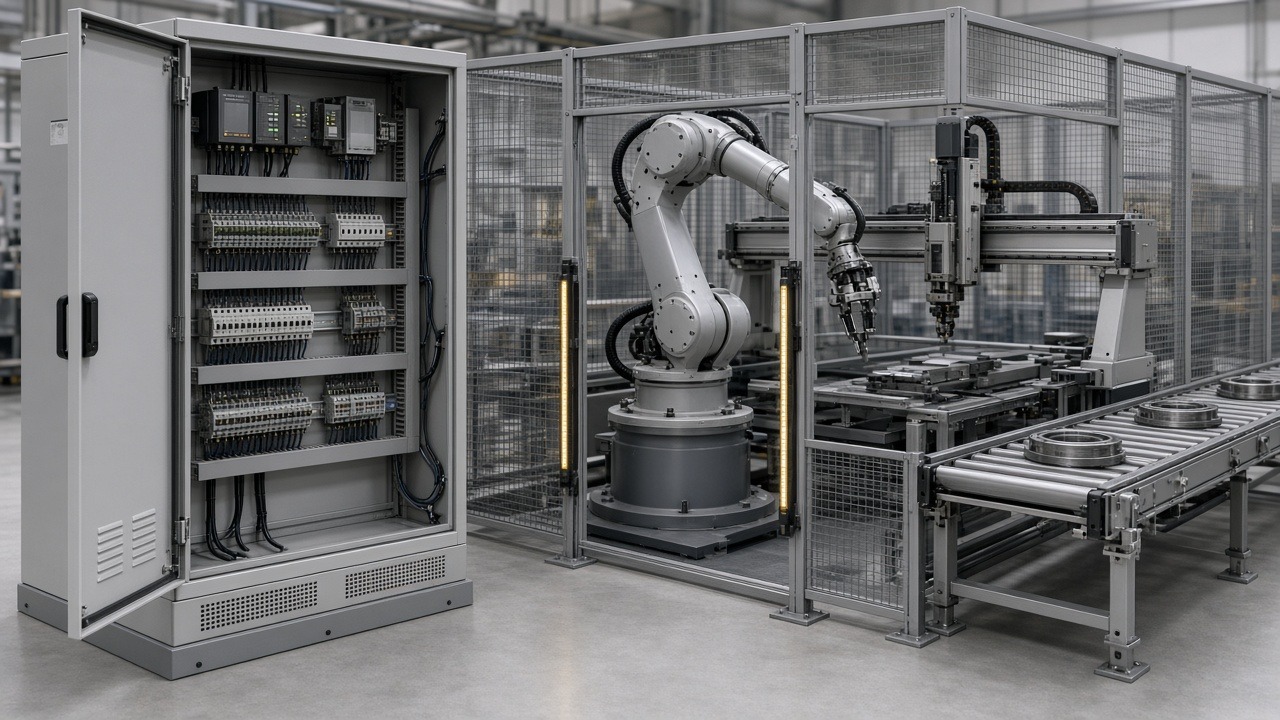
What is new is the target: drive parameters, I/O maps and PLC programs, the material that ends up in a controller cabinet. For a controls engineer, the job described by Bosch Rexroth and fruitcore is no longer “write the sequence”. It becomes “state the requirement precisely, then check what came back”.
In a typical integration project, much engineering time goes into work that is well understood but slow: setting up axes, mapping signals, writing standard state machines and documenting the result. If agents can do that reliably, the scarce people in an integrator’s team can spend more time on what goes wrong in real plants, such as process variation, interlocks with neighbouring machines, and recovery from faults. Bosch Rexroth’s inclusion of documentation stands out: it is the task every commissioning team leaves until last.
Simulation becomes the gate before the plant floor
All three vendors place simulation between the generated program and the physical machine. That is the right instinct: a generated program that has never run is a draft, and virtual commissioning turns it into something that can be judged. If cell layout and program are produced together and tested in a digital twin, more of the debugging moves from the customer’s site to the integrator’s office. Our earlier piece on physical AI data factories and synthetic data looked at the limits of that approach. A simulation is only as good as its models of friction, part tolerances, sensor noise and cycle time. The question for integrators is not whether a program passes in simulation. It is which failure modes the simulation cannot show.
Standard languages and reuse decide whether this scales
PLC programming in most factories follows IEC 61131-3, whose current edition was published in 2025. It defines structured text, ladder diagram, function block diagram and sequential function charts. For an integrator, the practical test of any generated program will be whether a maintenance technician on night shift can read it, modify it and trust it, years after the agent that wrote it has moved to a new version. Neither Bosch Rexroth nor fruitcore has yet published which languages their agents produce, how the output is structured, or how far it follows a customer’s own coding standards. That information matters more than any demo.
The same applies to reuse. Generated cells only pay off if they can be carried to the next line or plant without starting again, a theme we covered in the race to make robot skills portable. fruitcore says existing programs and configurations can be reused, and Bosch Rexroth leans on curated skills, but neither yet shows how this works across sites.
The integrator’s business model is under pressure, in both directions
If an end user can describe a three-axis handling task and get a working PLC program, part of the integrator’s billable hours disappears. Yet someone still has to own the risk assessment, the safety design, the acceptance test and the warranty, and that is rarely the robot vendor. Our expectation is that integrators who adopt these tools early will quote faster and win on lead time, while those who sell programming hours alone will feel the squeeze first.
What remains unproven
Functional safety is still outside the agent
The most important sentence in the fruitcore release may be the one that says functional safety stays with the robot’s embedded safety controls. None of the three vendors claims that an AI agent designs, generates or validates safety functions. That boundary matters. Industrial robot safety is governed by standards such as ISO 10218-1:2025 for the robot itself and ISO 10218-2:2025 for its integration into a system. The integrator remains responsible for the risk assessment of the complete cell, which covers guarding, safety-rated speeds and zones, emergency stops and safe states. An AI agent can suggest a layout, but it cannot sign off a risk assessment.
There is also a European regulatory dimension. The new EU Machinery Regulation 2023/1230 applies from 20 January 2027, around the time Agent iXi is expected to become available. According to the regulation’s text, safety components with fully or partially self-evolving behaviour based on machine learning must go through third-party conformity assessment. That rule does not cover conventional software that cannot learn. On our reading, a PLC program generated by an agent, then frozen and approved, is ordinary deterministic software, and the agent is an engineering tool. That distinction may become the central compliance argument for these products. It holds only if the program really is fixed and reviewed before it runs.
Validation: what exactly is a human approving?
“A human reviews and approves” is the line that makes these products acceptable. It is also the weakest point. A reviewer who sees a 3D simulation that looks right may approve a program whose rare fault branches have never been exercised. Conventional software review at least relies on the reviewer being able to read the code. Several questions remain open:
- What test coverage does the simulation step provide, and is it reported?
- Are generated programs checked against the customer’s own coding rules and naming conventions?
- Does the same request always produce the same program, or can two runs differ?
- When the agent changes an existing program, is the change shown as a clear difference that can be reviewed?
Traceability is promised, not yet shown
Bosch Rexroth says Agent iXi’s actions are logged and traceable, and ctrlX OS 4.6 adds Git version management. fruitcore describes roles, permissions and approvals. These are the right building blocks. What no vendor has yet shown is the full audit trail an acceptance test or a later incident investigation would need: which request, which model version, which skills or documents were used, which simulation results, and who approved what and when. For regulated industries such as pharmaceuticals, food or automotive safety parts, that record will matter more than speed.
Beta status and missing evidence
Agent iXi is a beta, with availability expected in early 2027. PLEXA OS ships with a new humanoid platform whose field record is still to be written. FANUC’s AI Welding Agent is due to start shipping only at the end of December 2026. None of the three has published independent benchmarks, error rates or case studies for generated programs. Trade-fair demos are chosen to work; a fair test would be a messy brownfield retrofit with undocumented wiring.
What to watch next
- SPS Nuremberg, 24–26 November 2026. How much of the Agent iXi demo is live, what it generates, and how the review step is presented (Hall 7, booth 450, according to Bosch Rexroth).
- fruitcore’s German-language webinar on 26 November. Whether it shows the agent mode on a real task and how approvals work.
- FANUC AI Welding Agent shipments from the end of December, and the first customer reports on how often operators had to correct the generated programs.
- The Machinery Regulation start date on 20 January 2027, and any guidance from notified bodies on AI-assisted engineering tools.
Bottom line
Agentic AI has reached the part of automation that has resisted most software trends: PLC and robot programming, cell design and commissioning. Bosch Rexroth, fruitcore and FANUC describe a common pattern: words, sketches or drawings go in, a cell and program come out, simulation checks them and a human approves. If that holds up in real projects, it could shorten lead times and ease the shortage of controls engineers. For now, the key products are in beta or about to ship, functional safety stays outside the agent, and the evidence integrators need has not been published: test coverage, repeatability, audit trails and field results. Treat these tools as a promising change to the engineering workflow, not yet as a replacement for the engineer who signs the acceptance report.
Related reading
- Physical AI Data Factories: How Synthetic Data Is Accelerating Industrial Robots
- From Pilot to Every Plant: The Race to Make Robot Skills Portable
References / Sources
- Bosch Rexroth, “Bosch Rexroth presents agentic AI and mobile humanoid robotics at SPS 2026”, 4 November 2026. https://apps.boschrexroth.com/microsites/ctrlx-automation/en/news-stories/story/agentic-ai-mobile-humanoid-robotics-sps-2026/
- fruitcore robotics, “PLEXA OS: fruitcore robotics brings AI-driven automation from task description to robot execution”, Konstanz, 9 November 2026. https://www.fruitcore-robotics.com/en/horstblog-news/plexa-os
- FANUC Corporation, “FANUC Accelerates the Physical AI Through Collaboration with Google – AI Agent Powered by Google Operates Robots”, 13 May 2026. https://www.fanuc.co.jp/en/profile/pr/newsrelease/2026/notice20260513.html
- FANUC America, “FANUC Accelerates Physical AI Through Collaboration with Google AI Agent Powered by Google Operates Robots”, 19 May 2026. https://www.fanucamerica.com/press-releases/fanuc-accelerates-physical-ai-through-collaboration-with-google-ai-agent-powered-by-google-operates-robots
- FANUC Corporation, “FANUC Accelerates Physical AI in Arc Welding with the New ‘AI Welding Agent'”, 11 September 2026. https://www.fanuc.co.jp/en/profile/pr/newsrelease/2026/notice20260911.html
- FANUC Europe, “FANUC at AMB 2026”, 23 July 2026. https://www.fanuc.eu/eu-en/news/fanuc-amb-2026
- FANUC Europe, “FANUC Strengthens Collaboration with NVIDIA”, 22 May 2026. https://www.fanuc.eu/eu-en/news/fanuc-strengthens-collaboration-nvidia
- IEC, “IEC 61131-3:2025 – Programmable controllers – Part 3: Programming languages”. https://webstore.iec.ch/en/publication/68533
- ISO, “ISO 10218-1:2025 – Robotics – Safety requirements – Part 1: Industrial robots”. https://www.iso.org/standard/73933.html
- Regulation (EU) 2023/1230 on machinery, EUR-Lex. https://eur-lex.europa.eu/eli/reg/2023/1230/oj/eng
- EU-OSHA, “Regulation 2023/1230/EU – machinery”. https://osha.europa.eu/en/legislation/directive/regulation-20231230eu-machinery
Images: original illustrations generated for AndBeyond.Tech; no logos or real people depicted.