Can Nuclear Power AI in Time? SMRs, Large Reactors, and the 2030 Gap
AI energy demand is surging toward 2030. We compare SMRs, large nuclear and renewables against hyperscale timelines—and where the 2030 gap remains.
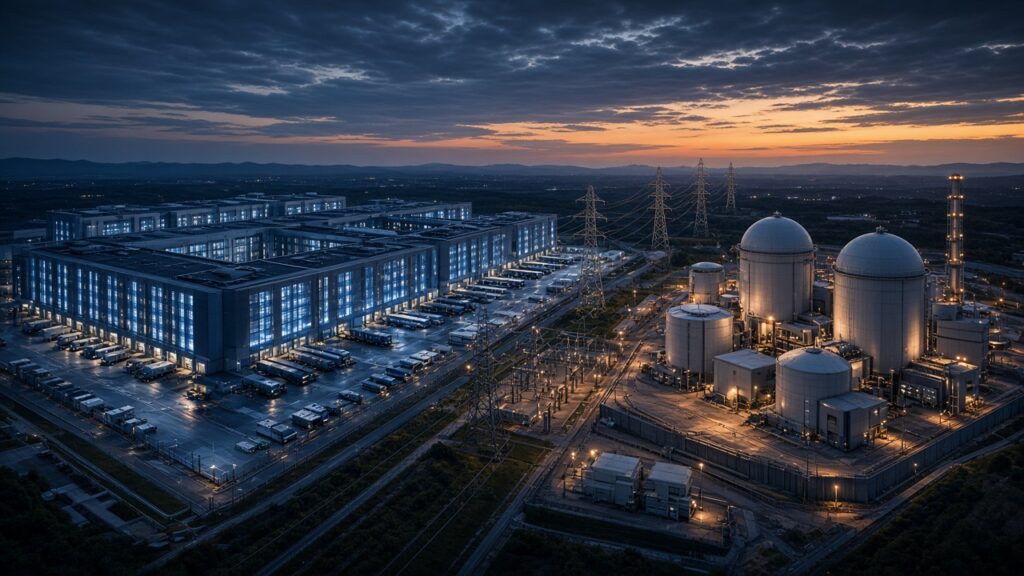
Hyperscale AI campuses are being planned in months. Large nuclear plants are built over decades. Between those two clocks sits the question that now dominates boardrooms at Microsoft, Google, Amazon, Meta, and every utility that serves them: can AI nuclear power arrive before the loads do—or will gas, delayed interconnects, and opportunistic renewables fill the gap instead?
The short answer from the latest energy-system data is uncomfortable. Nuclear—especially existing plants and carefully staged restarts—can cover some of the surge. First-of-a-kind small modular reactors (SMRs) targeted at SMR data centers are still, in commercial Western fleets, a late-decade story. Renewables grow fastest on paper. The mismatch between AI energy demand and firm, carbon-free megawatts through 2030 is real, measurable, and already reshaping PPAs, site selection, and grid politics.
The demand side: AI loads that look like factories
The International Energy Agency’s Energy and AI special report puts global data-centre electricity use at about 415 TWh in 2024—roughly 1.5% of world electricity consumption—with the United States accounting for about 45%, China 25%, and Europe 15%. In the IEA Base Case, that figure more than doubles to around 945 TWh by 2030, slightly above Japan’s total electricity use today. Beyond 2030, the Base Case rises toward about 1,200 TWh by 2035, while sensitivity cases span roughly 700–1,700 TWh.
Two details matter more than the global share. First, growth is concentrated. Nearly half of U.S. data-centre capacity sits in five regional clusters; locally, AI campuses can rival aluminium smelters in draw while stacking far denser capital. Second, the IEA notes that a typical AI-focused facility already consumes as much electricity as about 100,000 households, and the largest campuses under construction can approach twenty times that scale.
Earlier IEA Electricity 2024 work had already flagged a sharp near-term jump: data centres, AI, and cryptocurrency together consumed about 460 TWh in 2022, with a 2026 range of 620–1,050 TWh and a base case just over 800 TWh. The newer Energy and AI numbers extend that trajectory into the decade when most first Western SMRs hope to reach commercial operation.
For hyperscalers, the operational constraint is not average annual terawatt-hours alone. Training clusters and always-on inference want high capacity factors, predictable interconnection dates, and—increasingly—hourly matching of carbon-free attributes. That combination is why nuclear PPAs and co-location deals moved from niche ESG storytelling to core infrastructure strategy in 2024–2025.
What “in time” actually means for nuclear
“Nuclear for AI” is not one technology. It is at least four different clocks:
- Existing nuclear fleets — already online, can be contracted via PPAs or uprates.
- Restarts of shuttered reactors — faster than new builds if licensing and capital hold.
- Large new light-water reactors — multi-gigawatt, decade-plus construction in Western markets.
- SMRs and advanced reactors — modular promise, first commercial units mostly aimed at ~2030.
Only the first two can meaningfully change the AI power balance before the early 2030s. The third and fourth set the tone for the mid-2030s and beyond.
Restarts and PPAs: the near-term lever
In September 2024, Constellation Energy announced a 20-year power purchase agreement with Microsoft to restart Three Mile Island Unit 1—now the Christopher M. Crane Clean Energy Center—adding about 835 MW of carbon-free capacity. Constellation’s original public timeline pointed to operations around 2028; company updates reported in 2026 have described the restart as tracking toward 2027, subject to remaining U.S. Nuclear Regulatory Commission approvals. The deal is widely cited as the first major commercial restart of its kind, financed by AI-era data-centre demand rather than traditional utility rate base alone.
Amazon’s relationship with Talen Energy around the Susquehanna plant in Pennsylvania followed a similar logic: secure firm nuclear output next to cloud and AI campuses. In June 2025, Talen announced an expanded PPA under which, at full contract quantity, it would supply Amazon with up to 1,920 MW of carbon-free nuclear power through 2042, ramping toward full volume no later than 2032, while exploring SMRs and uprates on Talen’s Pennsylvania footprint.
Meta and Constellation announced a 20-year PPA for the full output of Illinois’s Clinton Clean Energy Center—on the order of 1.1 GW, with a planned uprate—supporting continued operation and relicensing of existing generation rather than a greenfield reactor.
These deals do not invent new physics. They reallocate and extend already-licensed megawatts. That is precisely why they can arrive “in time” for 2027–2032 AI ramps when greenfield nuclear cannot.
Large reactors: Vogtle as the cautionary baseline
The United States’ newest large reactors illustrate the opposite clock. At Plant Vogtle in Georgia, Units 3 and 4 entered commercial operation on 31 July 2023 and 29 April 2024 respectively, according to the U.S. Energy Information Administration. Construction began in 2009; original schedules targeted commercial operation in 2016 and 2017 at roughly $14 billion. EIA reporting notes Georgia Power later estimated total project cost at more than $30 billion.
Vogtle proves large Western reactors can be finished—and that the schedule risk is measured in years, not quarters. For AI campuses that need firm power in 2027–2030, waiting for the next AP1000-class project is not a credible primary plan. Large new nuclear remains relevant as 2035+ baseload, not as a near-term AI bridge.
SMRs: first steel, still late-decade power
SMRs are the technology most often paired in headlines with SMR data centers. The engineering pitch is clear: factory modules, smaller capital tranches, potential co-location with industrial loads, and designs that fit constrained sites. The commercial Western record is still thin.
GE Vernova Hitachi’s BWRX-300 is the farthest along among OECD land-based projects. According to GE Vernova Hitachi, construction of the first unit at Ontario Power Generation’s Darlington New Nuclear site began in May 2025, with construction of that unit estimated to finish by the end of 2029 and commercial operation by the end of 2030. OPG’s own project page frames the planning goal as completing construction of the first SMR by the end of the decade and connecting to the grid by the end of 2030, after the Canadian Nuclear Safety Commission issued a Licence to Construct in April 2025 (OPG later applied for a Licence to Operate in March 2026). The first unit is about 300 MW; up to four units are planned. In the United States, Tennessee Valley Authority has pursued the design at Clinch River, with GE Vernova citing a delivery target around 2032 for that U.S. path.
NuScale—whose design was the first SMR certified by the U.S. NRC—saw its earlier UAMPS project in Idaho cancelled in late 2023. Company commentary has kept a possible operating plant around 2030 on the table amid advanced customer discussions, while Romania’s RoPower proposal for six uprated modules has moved through investment decisions. None of that yet equals a fleet of operating Western commercial SMRs feeding AI campuses in 2027–2028.
Kairos Power and Google announced in October 2024 what Google described as the world’s first corporate agreement to purchase power from multiple SMRs—up to about 500 MW across multiple deployments, with a first plant targeted for 2030 and further deployments through 2035. In August 2025, Google’s public announcement with Kairos and TVA described the first deployment as the Hermes 2 plant in Oak Ridge, Tennessee (~50 MW), with TVA purchasing electricity from a plant scheduled to begin operations in 2030 and Google procuring clean-energy attributes for data centres in Tennessee and Alabama. The U.S. Nuclear Regulatory Commission issued construction permits for Hermes 2 on 21 November 2024 (NRC docket for Kairos’s advanced test/demonstration facility); Kairos still requires a separate NRC operating license before startup, per the agency’s and Kairos’s own licensing descriptions.
Amazon and X-energy have framed multi-gigawatt ambitions for Xe-100 deployments into the late 2030s, alongside utility partnerships. Those volumes, if realized, matter enormously for AI Hyperscale Infrastructure—but they sit mostly beyond the immediate 2030 crunch.
The IEA’s Energy and AI Base Case itself places the first SMRs coming online around 2030, while assigning nuclear and natural gas roughly comparable roles in meeting incremental data-centre generation needs—and giving renewables the largest share of growth through 2035 when storage and grids cooperate.
Renewables: fastest to build, hardest to firm
If the question is only “which carbon-free electrons arrive first,” renewables win on construction lead times. The IEA projects renewables generation growing by more than 450 TWh to help meet data-centre demand through 2035—about half of global data-centre demand growth in its framing—supported by storage and the wider grid. Tech-company procurement strategies already lean heavily on wind and solar PPAs.
The catch for AI campuses is firmness. Training clusters dislike multi-hour renewable lulls unless batteries, gas peakers, or nuclear fill the gaps. Hourly matching goals push hyperscalers toward nuclear attributes even when annual renewable MWh are plentiful. Gas remains the flexible bridge in many U.S. markets: the IEA expects natural gas generation serving data-centre demand to expand by about 175 TWh, with turbine delivery lead times themselves stretching into multi-year waits that can push projects past 2030.
In other words, renewables shrink the energy gap fastest; nuclear and gas shrink the capacity-and-reliability gap—on very different schedules.
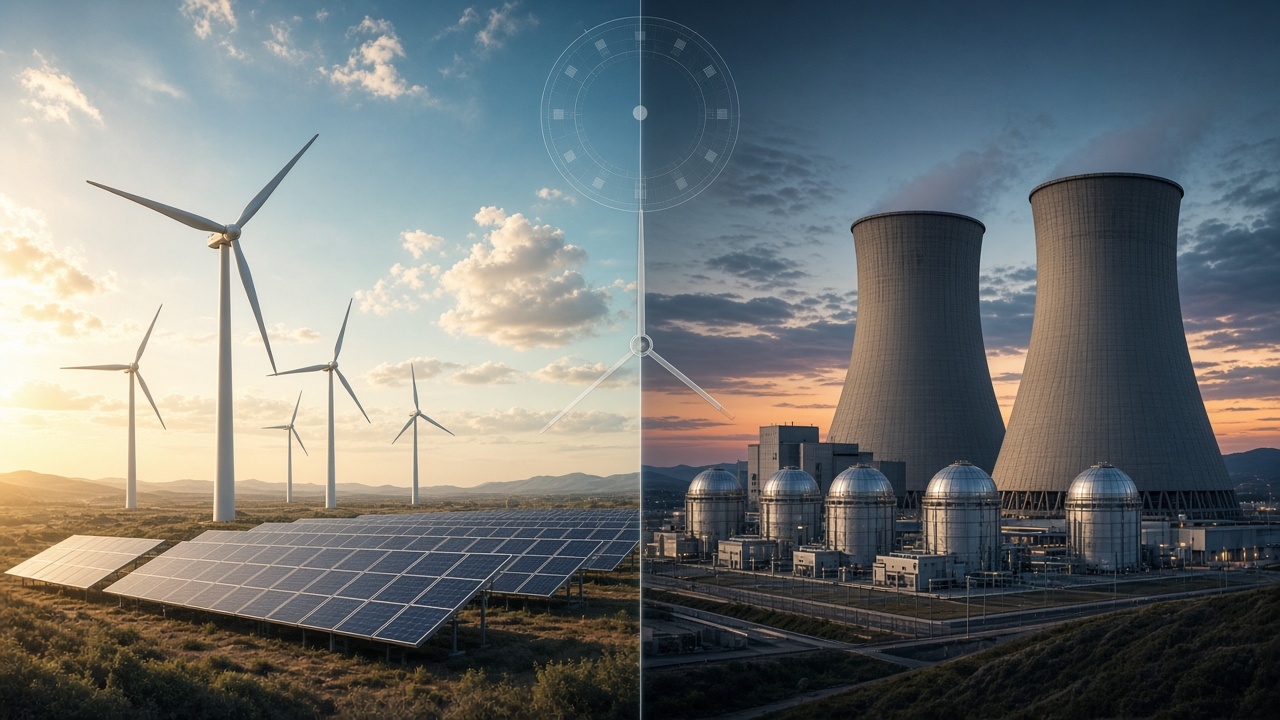
The 2030 gap, stated plainly
Put the clocks side by side:
| Pathway | Realistic new firm MW for AI before ~2030 | Notes |
|---|---|---|
| Existing nuclear PPAs / uprates | High | Fastest; reallocates fleet output |
| Reactor restarts (e.g., Crane / TMI-1) | Medium–high | Hundreds of MW per project if licensing holds |
| Large new reactors | Very low | Vogtle-class timelines measured in ~15 years |
| First Western SMRs | Low–medium at end of decade | Darlington grid connection end-2030 (OPG/GE Vernova); Hermes 2 ops ~2030 (Google/Kairos); many others later |
| Renewables + storage | High (energy), variable (firmness) | Fastest build; needs firming |
| New gas | Medium–high | Flexible but emissions and turbine lead times |
The 2030 gap is therefore not a shortage of announcements. It is a shortage of new nuclear electrons before 2030. Hyperscalers have responded rationally: buy what already exists (Susquehanna, Clinton, Crane restart), sign options on SMRs for the 2030s, and keep building renewables and gas as hedges.
Grid constraints amplify the gap. The IEA estimates that without mitigation, around 20% of planned data-centre projects could face delay risk; transmission builds in advanced economies often take four to eight years, and wait times for transformers and cables have roughly doubled in three years. Even when a generator is ready, the wire may not be.
What hyperscalers are optimizing for
From an AI Power Players perspective, the nuclear wave of 2024–2026 is less about ideology than about three practical requirements:
- Schedule certainty relative to GPU cluster deliveries.
- Carbon accounting that survives hourly matching and Scope 2 scrutiny.
- Locational strategy that pairs campuses with generation or with constrained but nuclear-rich grids (PJM, parts of the Midwest, Ontario, Tennessee Valley).
That is why co-location and “behind / front of the meter” structures keep evolving—as in the Talen–Amazon shift toward front-of-the-meter arrangements after transmission reconfigurations—and why utilities suddenly find hyperscalers willing to underwrite decade-plus nuclear offtake that ratepayers alone would not.
Policy and industrial reality checks
Several non-technical factors will decide whether nuclear narrows the post-2030 gap:
- Licensing throughput at the NRC, CNSC, and peers for both restarts and FOAK SMRs.
- Supply chain for large forgings, qualified workforce, and fuel (including HALEU for some advanced designs).
- Cost learning after first units; SMR economics remain uncertain until several identical modules operate.
- Public acceptance and local siting, especially where cooling water and transmission corridors collide with communities already wary of hyperscale campuses.
None of these resolve before 2030. They determine whether the mid-2030s look like a genuine nuclear renaissance for AI—or a continued patchwork of gas, renewables, and a handful of FOAK reactors.
Bottom line
Can nuclear power AI in time? Partly.
- Yes, for a material share of near-term hyperscale loads, if “nuclear” means existing plants, uprates, and successful restarts underwritten by Big Tech PPAs.
- Not at fleet scale, if “nuclear” means new large reactors finished before 2030 in Western markets.
- Only at the margin by 2030, if “nuclear” means commercial SMRs—with Darlington, Hermes 2, and early Kairos/Google units as the test cases, not a panacea.
- Always as a portfolio, because renewables will supply the bulk of incremental clean energy, while nuclear and gas compete to supply firm capacity.
The 2030 gap is therefore less a failure of nuclear physics than a collision of industrial clocks. AI campuses are sprinting. Nuclear new-build is a marathon. The winners of the next five years will be the operators who buy the marathoners already on the track—and the policymakers who clear the lanes for the next cohort of SMRs before the 2030s demand curve turns into a wall.
Related reading
- Power, Water, and Local Pushback: The Hidden Constraints on AI Campuses
- The Texas AI Factory Race: Why Hyperscalers Are Betting Tens of Billions on One State
- Microsoft Fairwater and the Rise of the Distributed AI Superfactory
References / sources
- International Energy Agency — Energy and AI, Executive summary: https://www.iea.org/reports/energy-and-ai/executive-summary
- International Energy Agency — Energy and AI, Energy demand from AI: https://www.iea.org/reports/energy-and-ai/energy-demand-from-ai
- International Energy Agency — Electricity 2024, Executive summary: https://www.iea.org/reports/electricity-2024/executive-summary
- International Energy Agency — Electricity 2024 – Analysis and forecast to 2026 (PDF): https://iea.blob.core.windows.net/assets/6b2fd954-2017-408e-bf08-952fdd62118a/Electricity2024-Analysisandforecastto2026.pdf
- Constellation Energy — Crane Clean Energy Center / Microsoft PPA announcement (20 Sept 2024): https://www.constellationenergy.com/news/2024/Constellation-to-Launch-Crane-Clean-Energy-Center-Restoring-Jobs-and-Carbon-Free-Power-to-The-Grid.html
- Reuters — Microsoft–Constellation Three Mile Island deal: https://www.reuters.com/markets/deals/constellation-inks-power-supply-deal-with-microsoft-2024-09-20/
- U.S. Nuclear Regulatory Commission — Christopher M. Crane Clean Energy Center (formerly TMI-1): https://www.nrc.gov/info-finder/reactors/tmi1.html
- Talen Energy — Expanded nuclear PPA with Amazon (11 June 2025): https://ir.talenenergy.com/news-releases/news-release-details/talen-energy-expands-nuclear-energy-relationship-amazon/
- Reuters — Talen–Amazon nuclear deal: https://www.reuters.com/business/energy/talen-energy-amazon-sign-nuclear-power-deal-fuel-data-centers-2025-06-11/
- Constellation Energy — Meta / Clinton Clean Energy Center PPA: https://www.constellationenergy.com/news/2025/constellation-meta-sign-20-year-deal-for-clean-reliable-nuclear-energy-in-illinois.html
- U.S. Energy Information Administration — Plant Vogtle Unit 4 commercial operation: https://www.eia.gov/todayinenergy/detail.php?id=61963
- GE Vernova Hitachi — BWRX-300 (construction May 2025; commercial operation end 2030): https://www.gevernova.com/nuclear/carbon-free-power/bwrx-300-small-modular-reactor
- Ontario Power Generation — Darlington SMR (grid connection end 2030; Licence to Construct April 2025): https://www.opg.com/projects-services/projects/nuclear/smr/darlington-smr/
- Google The Keyword — Kairos Power / TVA Hermes 2 (18 Aug 2025; operations 2030, ~50 MW): https://blog.google/company-news/outreach-and-initiatives/sustainability/google-first-advanced-nuclear-reactor-project-with-kairos-power-and-tennessee-valley-authority/
- Reuters — Google–Kairos SMR agreement (14 Oct 2024; up to ~500 MW through 2035): https://www.reuters.com/technology/artificial-intelligence/google-buy-power-small-modular-nuclear-reactor-company-kairos-ai-needs-2024-10-14/
- U.S. Nuclear Regulatory Commission — Hermes 2 / Kairos construction permits (issued 21 Nov 2024): https://www.nrc.gov/reactors/non-power/new-facility-licensing/hermes2-kairos
- Kairos Power — NRC approves Hermes 2 construction permits (20 Nov 2024): https://www.kairospower.com/updates/nuclear-regulatory-commission-approves-construction-permits-for-hermes-2-demonstration-plant
- Canada Energy Regulator — Market Snapshot: Canada’s role in SMR technology: https://www.cer-rec.gc.ca/en/data-analysis/energy-markets/market-snapshots/2025/market-snapshot-canadas-role-in-small-modular-reactor-smr-technology.html
Images: original illustrations generated for AndBeyond.Tech; no logos or real people depicted.