Vertical Integration or Cosplay? Why AI Labs Want Dirt-to-Model Stacks
Why AI labs chase dirt-to-model stacks: power scarcity, custom silicon and campus deals—and when vertical integration is strategy versus cosplay.
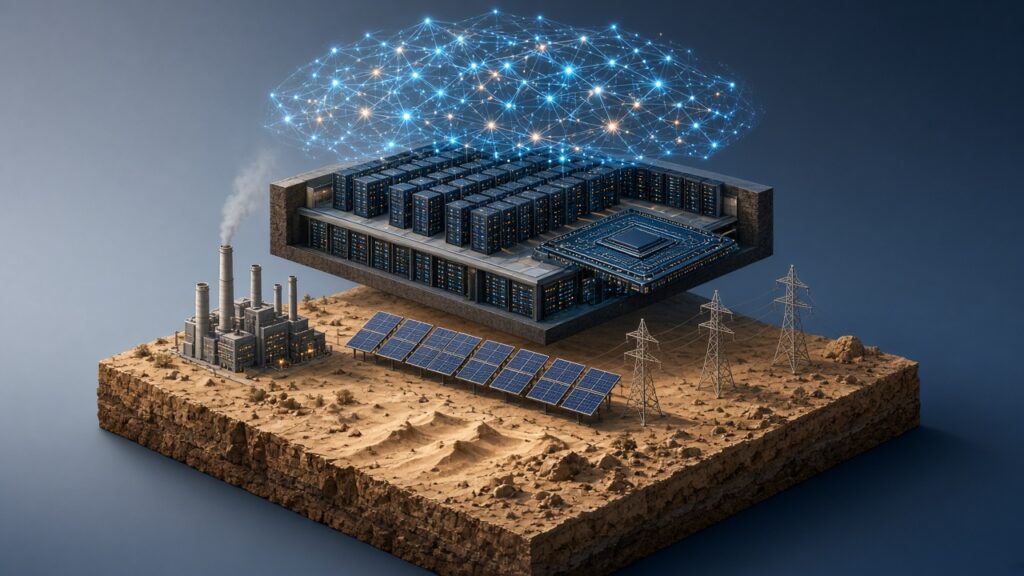
A few years ago, an AI lab’s supply chain fit on one invoice: rent GPUs from a cloud provider, train a model, ship an API. In 2026 the most ambitious players talk about something much heavier — a stack that starts with land and runs through power, buildings, chips and finally the model. Call it “dirt-to-model.”
The pitch is seductive: control every layer and you control cost, speed and destiny. But owning a stack and orchestrating one are very different things. This piece looks at who is actually building what, where the control really sits, and when AI vertical integration is strategy versus cosplay.
The five layers of the stack
Think of a frontier AI compute campus as five layers, each with its own bottleneck:
- Land — large, flat, zoned parcels near transmission and water, with local permits and community acceptance.
- Power — grid interconnection, substations and, increasingly, on-site or dedicated generation.
- Shell and cooling — the buildings, electrical rooms and liquid-cooling plants that host dense accelerator racks.
- Silicon — GPUs and custom accelerators, plus memory, networking and the servers they sit in.
- Model — the training runs, inference fleets and products that turn compute into revenue.
Classic cloud strategy integrated layers 3 to 5 at most, and rented the rest. The 2026 race is about pulling layers 1 and 2 inside the perimeter, or at least inside a contract the lab controls.
Why labs want the whole stack
Power is the new scarcity
Throughout 2026 the binding constraint on AI growth has shifted from chips to energized capacity. On its October 2026 earnings call, Microsoft said some third-party capacity deliveries expected in its September quarter were delayed, lowering its quarterly capex below plan. When a company with Microsoft’s balance sheet cannot simply buy its way to on-time megawatts, owning — or tightly contracting — the power layer stops looking like a luxury.
Speed is a competitive weapon
Frontier labs compete on how quickly they can bring the next cluster online. Every month a campus waits for a transformer, a permit or a grid upgrade is a month of training time lost. Integrating land and power lets a lab run construction, energization and chip delivery as one schedule rather than three negotiations.
Margin capture
Each layer adds a margin: the landlord, the utility, the developer, the cloud provider, the chip vendor. A lab that rents everything pays all of them. Owning or co-owning layers is a way to claw back some of that margin — at the cost of putting much more capital at risk.
Custom silicon needs custom buildings
As accelerators become more specialized, the rack, the cooling loop and the network fabric get designed around them. Alphabet’s results show where this leads: its Q3 2026 release says sales of TPU systems were a meaningful contributor to Google Cloud’s growth, and its CFO said cash flow was affected by an inventory build for those TPU system sales. Google is now not only using its own chips but selling them as systems — the clearest case of a company that integrates from silicon to model.
Case studies: who actually owns what
OpenAI and Stargate: integration by contract
OpenAI is the archetype of the dirt-to-model ambition — and of its limits. When Stargate was announced in January 2025, OpenAI committed to securing 10 GW of AI infrastructure in the United States by 2029. In an undated 2026 update on its website (accessed 5 Nov 2026), the company said it had already surpassed that milestone, adding more than 3 GW in 90 days alone.
But “securing” is the key word. In September 2025, OpenAI, Oracle and SoftBank announced five new sites that brought Stargate to nearly 7 GW of planned capacity and over $400 billion of investment over three years, and described a separate agreement with Oracle to develop up to 4.5 GW of additional capacity in a partnership exceeding $300 billion over five years. The new sites were split between Oracle-developed campuses (Shackelford County, Texas; Doña Ana County, New Mexico; a Midwest site) and SoftBank-led sites in Lordstown, Ohio and Milam County, Texas, the latter with SB Energy supplying powered infrastructure.
The flagship Abilene, Texas campus shows how the layers are distributed. The capacity runs on Oracle Cloud Infrastructure; on Oracle’s fiscal Q1 2027 call (September 2026), management said six of eight buildings — 618 MW and 75% of total capacity — had been delivered to the customer, and that Oracle delivered 131,000 GPUs at Abilene in the quarter, 1.9 times the prior quarter’s volume. Public reporting describes the land and electrical infrastructure as belonging to Lancium, with Crusoe building the data center buildings.
In other words, OpenAI sits on top of a stack owned by others: a landowner, a developer, a cloud operator, chip vendors and financiers. That is not a weakness in itself — it let OpenAI move fast without owning concrete — but it means its “vertical integration” is a web of long-term contracts. The fragility showed in 2026: a planned 600 MW Abilene expansion was dropped, and OpenAI’s head of compute infrastructure, Sachin Katti, said the company chose to put that capacity in other locations. Crusoe subsequently announced it would build new buildings and an on-site power plant in Abilene for Microsoft.
Meta and Hyperion: integration by utility deal
Meta’s approach in Richland Parish, Louisiana is closer to genuine dirt-to-model ownership — with financial partners. On 21 October 2025, Meta announced a joint venture with funds managed by Blue Owl Capital to develop and own the Hyperion campus: Blue Owl funds hold 80%, Meta 20%, and the partners committed to fund approximately $27 billion of total development costs. Meta leases the facilities under four-year initial terms with extension options. In July 2026, Meta said Hyperion would become a 5 GW facility costing more than $50 billion; a spokesperson told CNBC it should reach 2 GW by 2030 and full build-out around 2032.
The power layer is where Meta went furthest. In March 2026, Entergy and Meta announced an agreement under which Meta will finance seven new gas-fired plants, on top of three previously approved, according to Fortune — a total of about 7.5 GW — plus help fund up to 2.5 GW of renewables and storage. Meta does not run the plants; a regulated utility does, and the new units still required state regulatory approval. But by paying for dedicated generation, Meta effectively buys priority on the most constrained layer of the stack.
Meta also owns the model layer outright — its own foundation models and agents — making Hyperion one of the purest examples of a company that pays for the power, owns the campus and trains its own models on it. What it does not own is the silicon design at the leading edge, where it still relies heavily on merchant GPUs.
Google: the most complete stack
If any company has a true dirt-to-model stack, it is Alphabet. It owns data centers, designs its own TPUs, builds the networking, trains Gemini and sells both models and compute through Google Cloud. In Q3 2026 Google Cloud revenue rose 103% to $30.7 billion, and around 65% of Alphabet’s technical-infrastructure investment went to servers and networking equipment versus 35% for data centers. Google’s weak spot is the same as everyone else’s: power and third-party capacity, with its CFO noting that outside capacity “came online only at the very end of Q3,” as reported by CNBC.
Microsoft and Amazon: integrated clouds, partnered labs
Microsoft and Amazon own enormous parts of the stack — campuses, power contracts, custom chips (Maia and Cobalt at Microsoft, Trainium and Graviton at Amazon) — but their most visible frontier-model relationships have historically been partnerships: Microsoft with OpenAI, Amazon with Anthropic. Amazon disclosed a $9.5 billion pre-tax gain from its Anthropic investments in Q3 2025, a reminder that it participates in the model layer partly as an investor. These companies integrate everything except, in part, the lab.
xAI: speed through on-site power
xAI, now part of SpaceX, represents the “build it yourself, fast” school. SpaceX’s Form S-1 registration statement (amended June 2026) says the first cluster of COLOSSUS II — data centers in Memphis, Tennessee and Southaven, Mississippi — came online in 91 days, and that COLOSSUS and COLOSSUS II together provide approximately 1.0 gigawatt of compute power. The filing describes its construction approach as “vertically integrated.” That first cluster held about 110,000 Nvidia GB200 processors and is powered in part by state-approved gas turbines in Southaven, as reported by Inside Deep Tech. Nameplate figures disclosed by the company count installed GPUs rather than actual draw, and independent analyses have suggested real consumption is lower — a useful caution against reading megawatt headlines as running compute.
When it is cosplay
Vertical integration becomes cosplay when the press release outruns the balance sheet or the org chart. Warning signs:
- Gigawatts “secured” versus gigawatts energized. A signed lease or letter of intent is not a running cluster. The gap between planned capacity and delivered capacity — 618 MW delivered at Abilene versus a 10 GW-plus programme — is the single most important number to watch.
- Owning the logo, not the asset. If the land belongs to one firm, the buildings to another, the power to a utility and the servers to a cloud provider, the lab is an anchor tenant, not an integrated operator.
- Financing that depends on the tenant. When developers, lenders and equity partners underwrite a campus against one customer’s contract, the risk loops back to that customer. Oracle’s fiscal Q1 2027 cash flow statement shows $11.363 billion of deferred revenue from customer prepayments with a significant financing component — customers effectively pre-funding their own capacity.
- Cancelled phases. Dropped expansions, paused sites and force majeure notices are normal in infrastructure, but they reveal how much of a “stack” was optionality rather than commitment.
When it is real strategy
Integration pays off when a company controls the bottleneck rather than every layer:
- Power priority. Funding dedicated generation, as Meta has done with Entergy, buys schedule certainty that no amount of GPU purchasing can.
- Silicon-to-system design. Google’s TPU systems, and other custom accelerators, let the owner co-design chip, rack, cooling and network — and capture margin the merchant-GPU buyer pays to Nvidia.
- Demand certainty. Integration is safest for companies with captive demand: an ad business (Meta), a search and cloud franchise (Google), or an enterprise cloud backlog (Microsoft and Oracle both report remaining performance obligations in the hundreds of billions of dollars).
The AI supply chain is a negotiation, not a ladder
The deeper lesson of 2026 is that the AI supply chain is not a ladder any single firm climbs alone. Even the most integrated players depend on utilities, turbine makers, transformer suppliers, memory makers and chip foundries they do not control. “Dirt-to-model” is best read as a spectrum:
| Approach | Typical player | Owns | Rents or contracts |
|---|---|---|---|
| Full stack | Alphabet | Campuses, TPUs, network, models, cloud | Grid power, some third-party capacity |
| Power-anchored | Meta (Hyperion) | Campus (via JV), models | Generation (utility-built, Meta-funded), GPUs |
| Contracted stack | OpenAI (Stargate) | Models, product | Land, buildings, power, cloud, chips |
| Speed-first self-build | xAI | Campus, models, on-site turbines | GPUs, grid |
| Integrated cloud, partnered lab | Microsoft, Amazon | Campuses, custom chips, cloud | Part of the frontier-model layer |
Bottom line
Labs want dirt-to-model stacks because power and delivery speed, not algorithms alone, now decide who trains the next frontier model first. But most “vertical integration” in AI is still integration by contract: long-term leases, utility agreements, prepayments and joint ventures that look like ownership in a slide and behave like dependencies in a downturn. The players to watch are not the ones announcing the most gigawatts, but the ones whose megawatts are energized, whose chips are installed and whose models are earning money on them.
Related reading
- Capex Arms Race: Mapping Hyperscaler AI Spend and What It Buys
- The Texas AI Factory Race: Why Hyperscalers Are Betting Tens of Billions on One State
- Inside the AI Accelerator Market: GPUs, Custom ASICs, and Who Wins Inference
Sources
- OpenAI — “Building the compute infrastructure for the Intelligence Age” (2026; page undated, accessed 5 Nov 2026). https://openai.com/index/building-the-compute-infrastructure-for-the-intelligence-age/
- OpenAI — “OpenAI, Oracle, and SoftBank expand Stargate with five new AI data center sites” (September 2025). https://openai.com/index/five-new-stargate-sites/
- Oracle Corp. — Fiscal Q1 2027 results release, 10 September 2026 (cash flow statement). https://investor.oracle.com/investor-news/news-details/2026/Oracle-Announces-Q1-Results-Driven-by-Triple-Digit-Growth-in-Cloud-Infrastructure-Revenues/default.aspx
- Oracle Corp. — Q1 FY2027 earnings call transcript (Abilene: 618 MW, 131,000 GPUs) — third-party transcript, The Motley Fool. https://www.fool.com/earnings/call-transcripts/2026/09/11/oracle-orcl-q1-2027-earnings-call-transcript/
- Alphabet Inc. — Exhibit 99.1, Q3 2026 results (SEC). https://www.sec.gov/Archives/edgar/data/1652044/000165204426000080/googexhibit991q32026.htm
- Alphabet Inc. — 2026 Q3 earnings call. https://abc.xyz/investor/events/event-details/2026/2026-Q3-Earnings-Call-2026-Ujou16CTw9/default.aspx
- Microsoft Corp. — FY27 Q1 earnings call, 28 October 2026. https://www.microsoft.com/en-us/investor/events/fy-2027/earnings-fy-2027-q1
- Amazon.com, Inc. — Q3 2026 results release (Anthropic gain in Q3 2025). https://ir.aboutamazon.com/news-release/news-release-details/2026/Amazon-com-Announces-Third-Quarter-Results/
- Meta Platforms — “Meta Announces Joint Venture with Funds Managed by Blue Owl Capital to Develop Hyperion Data Center,” 21 October 2025. https://investor.atmeta.com/investor-news/press-release-details/2025/Meta-Announces-Joint-Venture-with-Funds-Managed-by-Blue-Owl-Capital-to-Develop-Hyperion-Data-Center/
- CNBC — “Meta Louisiana data center investment reaches $50 billion amid AI push,” 13 July 2026. https://www.cnbc.com/2026/07/13/meta-louisiana-data-center-investment-reaches-50-billion-amid-ai-push.html
- Fortune — “Meta orders 10 gas power plants for Hyperion AI campus in Louisiana,” 27 March 2026. https://fortune.com/2026/03/27/meta-hyperion-10-gas-power-plants-louisiana-entergy/
- CNBC — “AI buildout hits snag as Google and Microsoft hold capex forecasts,” 29 October 2026. https://www.cnbc.com/2026/10/29/microsoft-google-ai-capex-estimates.html
- AP News — “Microsoft takes over a Texas AI data center expansion after OpenAI backs away” (2026). https://apnews.com/article/ai-stargate-microsoft-openai-crusoe-oracle-f4f74c3a4617d8cfab5b933fc31ccc6e
- Tom’s Hardware — “Oracle and OpenAI scrap planned 600MW Abilene expansion” (2026). https://www.tomshardware.com/tech-industry/oracle-and-openai-scrap-planned-600mw-abilene-expansion
- Space Exploration Technologies Corp. — Form S-1/A (Amendment No. 2), SEC EDGAR, 3 June 2026. https://www.sec.gov/Archives/edgar/data/1181412/000162828026040364/spaceexplorationtechnologib.htm
- Inside Deep Tech — “xAI Colossus 2: Full Guide to the Memphis Gigawatt Supercomputer” (secondary, citing SpaceX S-1). https://www.insidedeeptech.com/xai-colossus-2-memphis-gigawatt-ai-supercomputer-full-guide/
Images: original illustrations generated for AndBeyond.Tech; no logos or real people depicted.