Who Flies the Orbital Data Center Fleet? Autonomy, Collision Avoidance, and the Ground-Ops Bottleneck
Orbital Compute × Orca Aerospace put onboard autonomy and collision avoidance at the center of ODC scaling—as LEO congestion makes ground ops the bottleneck.
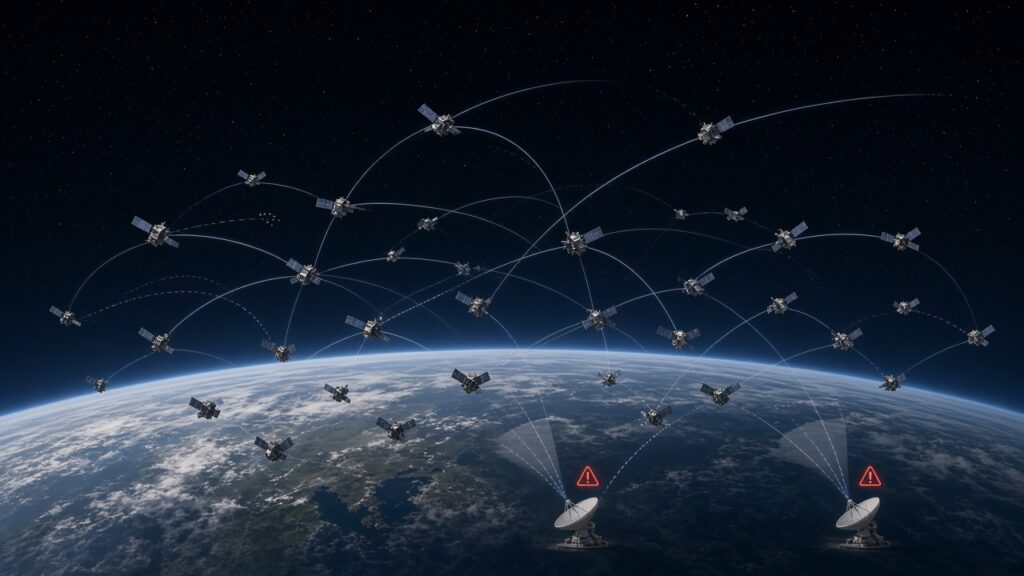
Crowded low-Earth-orbit satellite mesh with trajectory arcs above Earth; ground dishes below marked with alert indicators for exception-only ops.
Orbital data center pitches usually start with sunlight and radiators. The harder question arrives after the first hundred vehicles: who flies the fleet when every satellite needs conjunction assessments, station-keeping, fault responses, and safe disposal—and ground passes cannot keep up?
In early November 2026, that ops question moved to the center of the ODC story. Trade press reported that Los Angeles–based Orbital Compute, Inc. selected autonomy startup Orca Aerospace to put onboard guidance, navigation, and control (GNC) software—and collision-avoidance decision support—on Orbital’s planned compute constellation. The arrangement is described as a letter of intent worth up to about $20 million (company claim, reported by Payload and Data Center Dynamics; no dedicated press release was found on Orbital’s or Orca’s public sites at the time of writing). The deal’s substance matters more than the headline number: treat autonomy as a first-class layer of orbital compute, not an afterthought once the GPUs are warm.
This article is not a rehash of orbital data center economics or of which AI workloads belong in orbit. It is about robot learning & autonomy at constellation scale—and why AI power players betting on space compute inherit a space-traffic problem the moment they leave the slide deck.
The congestion backdrop (official counts, not folklore)
Any autonomy pitch for mega-constellations has to sit inside the real orbital environment.
ESA’s Space Debris Office publishes annual Space Environment Reports and live statistics via the Space Debris User Portal. As of ESA DISCOS statistics last updated 2 November 2026:
- About 15,800 satellites still functioning
- About 19,610 satellites still in space (of ~28,570 ever placed in Earth orbit)
- About 47,360 objects regularly tracked and catalogued by space surveillance networks
- MASTER-8 model (reference population February 2026): about 68,450 objects larger than 10 cm (including roughly 11,300 active payloads), plus about 1.5 million objects from 1 cm to 10 cm
ESA’s 2025 report overview (data through end-2024) already stressed that about 40,000 objects were tracked, of which about 11,000 were active payloads, and that in preferred LEO bands the density of threatening debris can reach the same order of magnitude as active satellites. The 2026 report overview adds that 2025 saw more than 300 launches and over 4,000 new payloads, with constellation traffic continuing to rise and mitigation still not stopping net debris growth.
Those are official ESA figures. They are not the same as informal press tallies that mix Starlink-only counts with unverified debris estimates. For ODC planners targeting dawn–dusk sun-synchronous orbits—where many solar-powered compute concepts want to live—polar crowding and conjunction rates are structural, not hypothetical.
What Orbital says it is building
Orbital’s own 30 June 2026 press release describes an FCC filing for a constellation of up to 100,000 satellites and a company ambition of about 10 GW of orbital compute at full scale (company claims). The same release sketches each satellite as a high-density rack analogue—on the order of eight of “today’s servers,” about 100 kW of solar generation, roughly 100 meters span and two tons mass (company estimates)—with a demo GPU payload targeted for 2027 and purpose-built Orbital-1 in 2028.
A 10 September 2026 Reflex Aerospace press release confirms Reflex as exclusive satellite platform partner for Orbital-1 and the follow-on constellation, citing planned peak power levels approaching 250 kW for Orbital-1 (partner/company framing). FCC application identifiers reported in industry databases (e.g., SAT-LOA-20260624-00251) align with a mid-2026 licensing push; licensing status should be checked on FCC systems rather than assumed approved.
Even if only a fraction of the filed maximum ever flies, the ops math is unforgiving. Orbital’s CEO told Payload that scaling safely requires autonomy onboard because there is “no central kind of governing or mapping function,” so each unit must handle its own navigation. Payload also relays company rollout waypoints of 10 satellites in 2029, 100 in 2030, and 1,000 in 2031 (company plans reported in trade press)—already enough daily decisions to overwhelm a classic console-centric ops room.
What the Orca stack claims to do
Orca Aerospace’s public site markets an “AI spacecraft operator that flies with the vehicle”: onboard decision-making between passes, with the ground setting mission intent. In the Payload exclusive (5 November 2026 reporting), CEO Jacob Ososke describes a layered architecture:
- A small onboard AI model suggests next steps (maneuvers, plan changes).
- A rules-based program turns choices into commands.
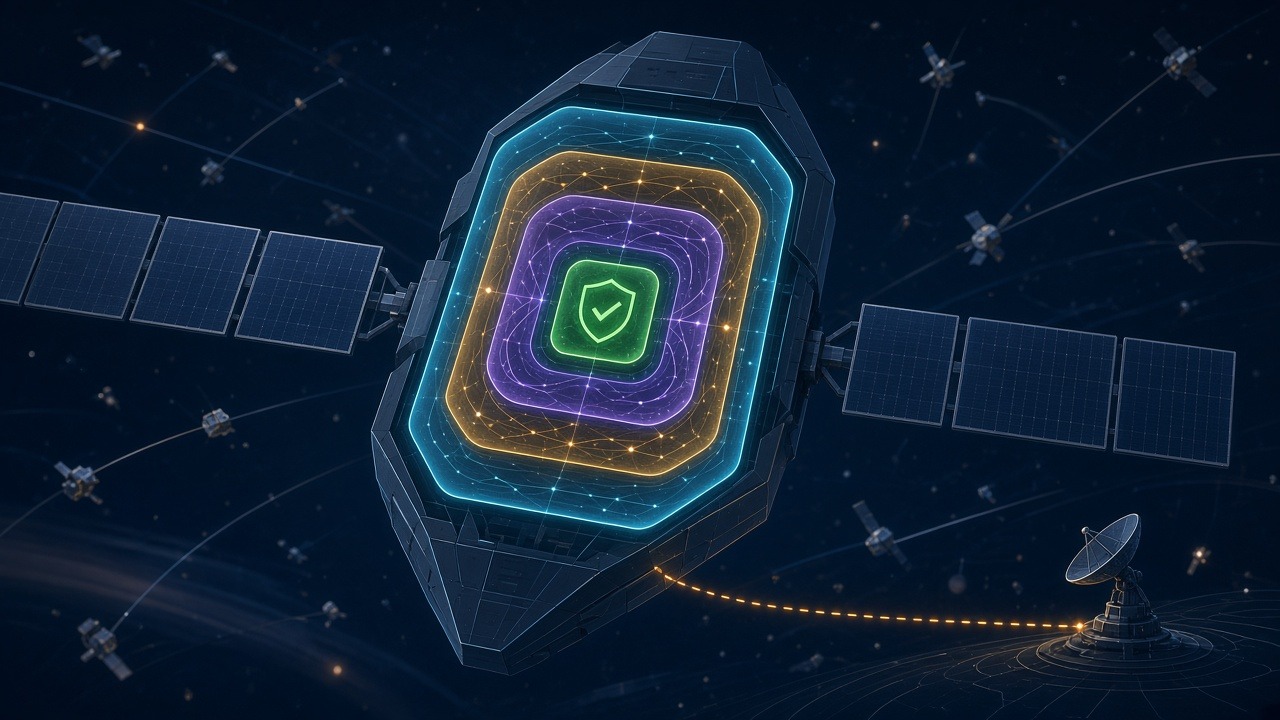
- A safety kernel checks each command against mission rules and vehicle limits before execution.
Operations start in shadow mode (telemetry for human review) and gain autonomy in layers. Integration is described as once per flight-software stack—with Reflex’s bus software as the target—and possible early exercise on a July 2027 Pathfinder, with operational flight on Orbital-1 in 2028 (timelines as reported; company plans). Commercial terms: integration fee plus per-satellite license; LOI framed as up to ~$20M (company claim).
Data Center Dynamics (9 November 2026) adds company-attributed claims that even a 1,000-satellite fleet creates thousands of decisions per day, that ground teams become the largest recurring cost, and that Orca’s approach could cut that burden “by about 10×” (company estimate—not independently audited). DCD also notes two overriding ground systems remaining under Orca management—autonomy is supervised, not a total human delete key.
Why ground ops becomes the bottleneck
Classical satellite operations assume:
- Scheduled contacts
- Humans in the loop for anomalies
- Conjunction screening supported by catalogs and operator playbooks
- Maneuver planning that can wait for the next pass
That model strains when:
- Constellation size multiplies conjunction alerts
- Dawn–dusk SSO geometries pack traffic near polar crossings
- Vehicles are large (100 m-class structures in company sketches) with higher collision consequences
- Compute payloads raise the cost of a lost bird
The largest existing constellation operators already treat automated conjunction handling and data sharing as first-order operational problems. ODC newcomers inherit the same physics with less operational heritage.
Autonomy does not remove liability. A safety kernel that blocks illegal commands is necessary; it is not sufficient without:
- Independent monitoring and kill switches
- Shared space-situational-awareness data of sufficient quality
- Clear rules for maneuver priority when two operators disagree
- Cyber hardening so an onboard “operator” cannot be spoofed into unsafe burns
Those governance pieces are why space-sustainability advocates watch aggressive automation carefully—DCD explicitly flags the optics of systems “too remote to be manually turned off.” The engineering answer is layered assurance; the policy answer is still being written.
Autonomy as an AI workload that does belong in orbit
Ironically, fleet GNC is one of the clearest fits for the taxonomy in our workloads article: the data (IMU, GNSS, thruster state, conjunction alerts) is born on the vehicle; the value decays in minutes; outputs are compact commands; waiting for Earth can be unsafe. It is robot learning & autonomy in the literal sense—closed-loop control under uncertainty—not a haiku demo and not a training cluster.
What stays on the ground:
- Model training and policy updates for the onboard suggester
- Catalog fusion and high-fidelity SSA products
- Human approval for high-risk regimes (early on-orbit, disposal, anomaly safing)
- Customer workload orchestration for the actual AI inference business
What must increasingly fly:
- Local collision-avoidance execution inside rule envelopes
- Fault detection and isolation between passes
- Formation-keeping for large structures and, eventually, optical compute clusters
Google’s Suncatcher roadmap toward tight optical formations (duty-cycle analysis) only raises the bar: relative navigation at hundreds of meters is an autonomy problem before it is a laser problem.
How to read the $20M claim and the 100,000-sat vision
Readers should separate the layers:
| Claim | Status |
|---|---|
| LOI “up to ~$20M” with Orca | Company claim via trade press; primary company PR not located |
| Per-sat license + integration fee | Reported commercial structure (Payload) |
| Up to 100,000 sats / ~10 GW | Company claims in Orbital’s June 2026 release + FCC filing narrative |
| 250 kW-class Orbital-1 peak power | Reflex/Orbital partnership framing (Sept 2026) |
| 10× ops-cost reduction | Company estimate (DCD) |
| ESA tracked/functioning object counts | Official ESA statistics |
Megaconstellation filings are permission structures, not population forecasts. Autonomy software is a scaling prerequisite whether the fleet stops at hundreds or ever approaches the filed maximum.
Related reading inside AndBeyond.Tech
For the physics and launch-cost floor behind ODC ambitions, see Orbital Data Centers for AI: Promise, Physics, and the Cost Reality Check. For which inference jobs belong beside the sensor versus on the ground, see AI Workloads That Actually Make Sense in Orbit. For how power duty cycles constrain even hyperscaler pathfinders, see Google Suncatcher In Orbit: The Power Duty Cycle Reality Behind the Haiku. Autonomy sits across all three: without it, neither economics nor workloads nor silicon demos scale into a fleet.
Bottom line
Who flies the orbital data center fleet? If the answer is “a ground army watching every pass,” the business model dies of opex before radiators and launch prices decide the CAPEX story. The Orbital–Orca pairing—company-claimed economics, layered AI + planner + safety kernel, Reflex bus integration—puts onboard autonomy and collision avoidance where they belong: on the critical path of Space Computing. Congestion figures from ESA show why. The remaining work is assurance, data sharing, and regulatory clarity so that scaling compute in LEO does not export risk onto everyone else sharing the sky.
Related reading
- Orbital Data Centers for AI: Promise, Physics, and the Cost Reality Check
- AI Workloads That Actually Make Sense in Orbit
- Google Suncatcher In Orbit: The Power Duty Cycle Reality Behind the Haiku
Sources
- Payload — “Exclusive: Orbital Taps Orca Aerospace for Onboard Autonomy Software” (5 Nov 2026). https://payloadspace.com/exclusive-orbital-taps-orca-aerospace-for-onboard-autonomy-software/
- Data Center Dynamics — “Orbital and Orca Aerospace sign deal…” (9 Nov 2026). https://www.datacenterdynamics.com/en/news/orbital-and-orca-aerospace-sign-deal-for-onboard-satellite-gnc-and-collision-avoidance-ai/
- Orbital — “Orbital Unveils Plans for a 100,000-Satellite Constellation…” (30 June 2026). https://orbital.inc/press/orbital-100000-constellation.html
- Reflex Aerospace — “Orbital Selects Reflex as Exclusive Satellite Platform Partner…” (10 Sept 2026). https://www.reflexaerospace.com/press-releases/orbital-selects-reflex-as-exclusive-satellite-platform-partner-space-data-center-constellation
- Orca Aerospace — product positioning (“Mission Control, Onboard”). https://orcaaerospace.com/
- ESA Space Debris User Portal — Space Environment Statistics (update 2 Nov 2026). https://sdup.esoc.esa.int/discosweb/statistics/
- ESA — Space Environment Report 2025 overview. https://www.esa.int/Space_Safety/Space_Debris/ESA_Space_Environment_Report_2025
- ESA — Space Environment Report 2026 overview. https://www.esa.int/ga/articles/esa-space-environment-report-2026
- ESA — Annual Space Environment Report PDF (latest issue referenced by ESA SDO). https://www.sdo.esoc.esa.int/environment_report/Space_Environment_Report_latest.pdf
- FCC.report mirror — SAT-LOA-20260624-00251 (Orbital Compute Inc. filing index; verify on FCC). https://fcc.report/IBFS/SAT-LOA-20260624-00251
Note on sources: No Orbital.inc or Orca Aerospace press-release page specifically announcing the Orca autonomy LOI was found; coverage relies on Payload’s exclusive interview reporting and DCD. Reflex and Orbital constellation PRs are primary for bus partnership and filed scale claims.
Images: original illustrations generated for AndBeyond.Tech; no logos or real people depicted.