Humanoids on the Grid: Why Utilities Are Betting on Physical AI for Substations
NEURA, E.ON and enviaM partner on Physical AI for grid inspections and substations: training at TUM RoboGym, pilots planned for 2027 — not a deployment yet.
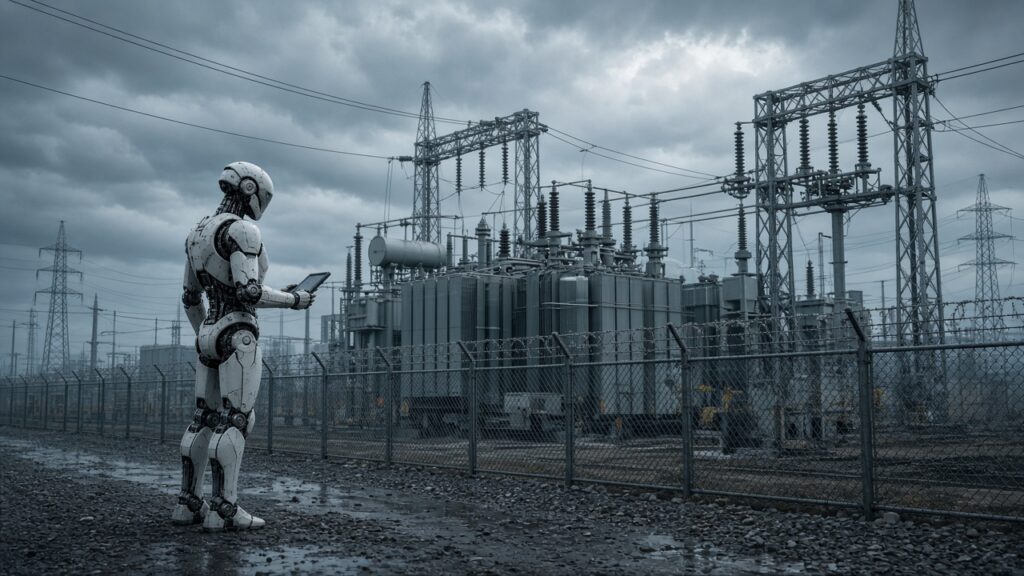
Factories and warehouses have dominated the humanoid conversation in 2026: tote moves, sheet-metal loads, cycle times. Utilities are now joining the queue — not with a robot already walking a live high-voltage yard every shift, but with a structured bet that Physical AI can help inspect and monitor grid assets built for people. On 5 November 2026, NEURA Robotics, E.ON and the enviaM Group announced a partnership to develop Physical AI for critical energy infrastructure, with skills trained first in a robotics gym and initial practical experience on the grid expected during 2027 (NEURA Robotics, 5 Nov 2026; E.ON press release).
Read that carefully. This is a partnership and a training programme, not a commercial deployment of substation robots already in day-to-day service. No robot count, no site list and no performance thresholds for live operation were disclosed. The useful story is why utility robotics and humanoid robots energy use-cases look attractive to grid operators — and what still has to be proven before a biped earns a place beside a transformer.
Why grids are a natural (and hard) humanoid pitch
Distribution grids are full of places designed around human bodies: stairs, doors, switchgear rooms, control cabinets, gravel yards and inspection routes that change with the season. Conventional industrial robots excel when the world is fixture-heavy and repetitive. Much of grid work is the opposite — infrequent visits, awkward access, weather, and procedures that skilled technicians carry in their heads.
E.ON describes itself as operating a distribution network of 1.6 million kilometres and serving around 47 million customers, with roughly 78,000 employees. The enviaM Group says it supplies about 1.1 million customers in eastern Germany and employs about 4,500 people; its grid subsidiary MITNETZ STROM manages a distribution network of approximately 71,000 kilometres across parts of Brandenburg, Saxony, Saxony-Anhalt and Thuringia (NEURA Robotics, 5 Nov 2026). Those are company-stated scales. They explain the incentive: even a narrow set of inspection and monitoring tasks, if made safer or more frequent, multiplies across a very large asset base.
enviaM Group CEO Stephan Lowis, quoted in the partnership materials, framed humanoids as support for physically demanding or safety-sensitive tasks, so specialists can focus on work that needs their judgment, with initial practical experience expected during 2027 (NEURA Robotics, 5 Nov 2026). That timeline is the partners’ own. It is not a promise that substations will be robot-staffed next quarter.
What the partners say they will — and will not — do yet
According to the joint announcement:
- Goal: develop Physical AI applications for grid operations — inspecting and monitoring technical assets, supporting potentially hazardous, physically demanding or repetitive tasks, and assessing site-security support.
- Platform: NEURA’s Neuraverse, described as an open Physical AI platform linking robots, models, developers and industry partners.
- Training venue: TUM RoboGym powered by NEURA, opened by NEURA Robotics and the Technical University of Munich at LabCampus at Munich Airport in October 2026, covering more than 2,300 square metres. Companies from more than ten industries were already training workflows there; E.ON brings the energy sector into that mix.
- Pilot partner: MITNETZ STROM, which is to test initial applications in real-world grid operations after skills are developed under controlled conditions.
- Data control: E.ON and enviaM retain control of their own data and trained skills and decide whether and with whom to share them (NEURA Robotics, 5 Nov 2026).
What the announcement does not claim: that a named humanoid model is already certified for live substation duty; that autonomous inspections are running unattended; or that financial terms, robot volumes or success metrics have been set. Stefan Padberg, Senior Vice President Innovation at E.ON, spoke of translating innovation into practical grid operations and improving safety and efficiency — language consistent with an R&D partnership, not a completed rollout (NEURA Robotics, 5 Nov 2026).
From RoboGym to yard: how skills are supposed to transfer
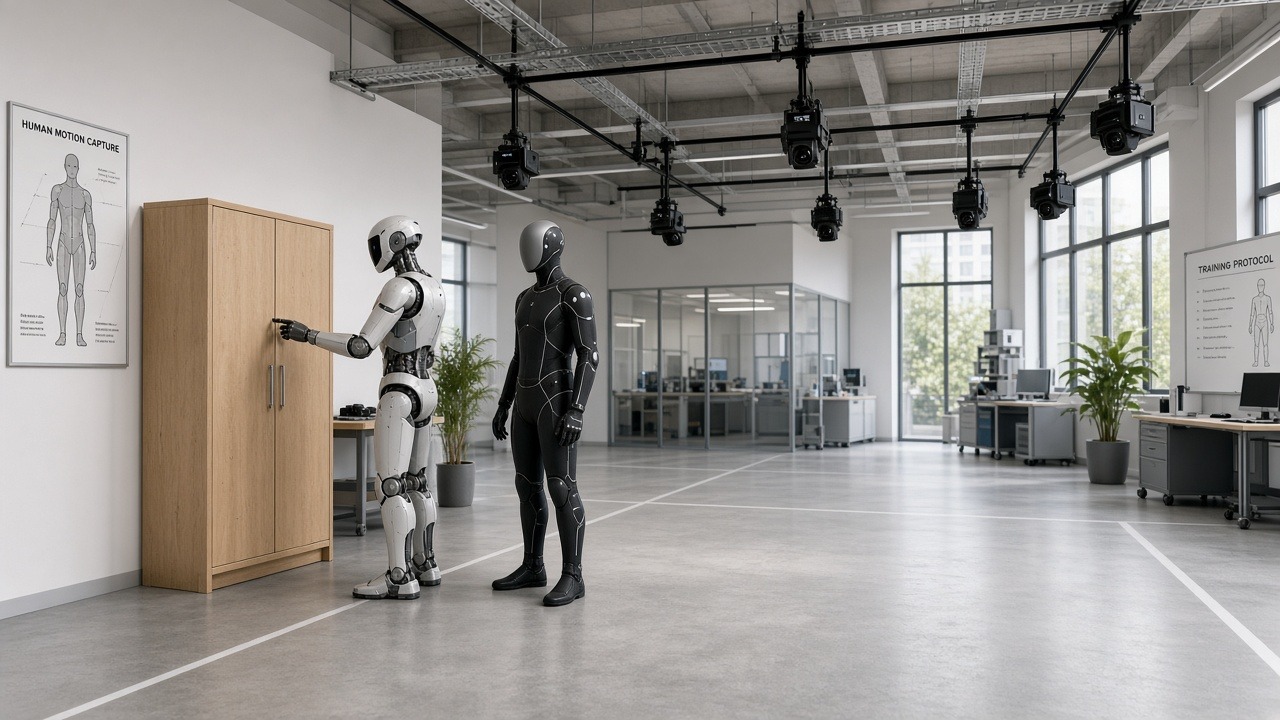
NEURA’s write-up is unusually explicit about the learning stack, which is why this story sits as much under Robot Learning & Autonomy as under energy.
The NEURA Gym, the partners say, combines three ways of gathering physical experience:
- Human demonstrations — grid specialists show workflows; sensor-equipped suits, motion capture and teleoperation capture that expertise for training.
- Real-world robot data — robots attempt the tasks while sensors record motion, contact and outcomes.
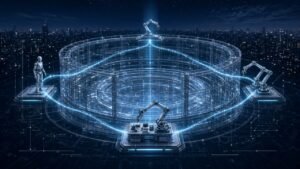
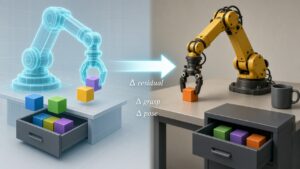
- Simulation and a “Data Amplifier” — virtual environments add variation before skills are validated again on real robots.
Training runs on Neuron AI, NEURA’s multimodal foundation model for Physical AI, described as combining 3D vision, touch, audio, robot state, language and memory. The pitch for inspection is that a robot can register what it sees, hears and feels — useful language for substations, where acoustic and thermal cues often matter as much as camera frames. NEURA also notes that humanoid platforms such as its 4NE1 are intended, in future, to navigate human-centric facilities without rebuilding them for machines (NEURA Robotics, 5 Nov 2026; TUM RoboGym / NEURA Gym page).
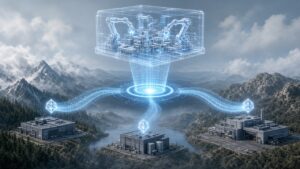
Neuraverse is positioned as the bridge from gym skill to later deployment: manage, deploy and refine reusable skills across compatible robots and sites. That architecture claim is central to NEURA’s business story. For utilities, the test is narrower and later: whether a skill trained in Munich survives contact with a real MITNETZ STROM asset in 2027 weather, access rules and safety procedures.
Substations specifically: attractive targets, strict constraints
The partnership materials call out inspections, monitoring of critical assets including substations, and site-security support as early focus areas, with hazardous environments to be assessed as possible applications (NEURA Robotics, 5 Nov 2026).
Why substations show up first in almost every utility robotics briefing:
- They concentrate expensive assets in fenced compounds that still require human-compatible access.
- Many inspection rounds are repetitive but consequential: visual checks, readings, looking for oil leaks, damaged insulators, animal nests, missing locks.
- Some tasks put people near energised equipment or into awkward postures; a robot that can take the dull or exposed pass — if it can do so safely — is an easy narrative sell.
Why substations are also unforgiving:
- Electromagnetic interference, uneven ground, rain, snow and low light punish naive autonomy.
- A false negative on a critical defect is worse than a missed tote in a warehouse.
- Safety cases for dynamically stable robots near high voltage are not the same as collaborative-robot rules on a factory aisle. For how industrial humanoid safety standards are still being written in manufacturing contexts, see our related explainer Humanoids on the Factory Floor. Grid sites will need their own procedures, permits and likely new assurance evidence.
Until MITNETZ STROM publishes what a 2027 trial actually measured — intervention rate, inspection coverage, weather limits, keep-out rules — substation robots remain a programme milestone, not an operating category.
Humanoid form factor versus other utility robots
Utilities already use drones for line corridors, fixed cameras for substations and, in some fleets, ground robots for confined or hazardous spaces. The NEURA–E.ON–enviaM materials do not argue that humanoids replace those tools. They argue that a biped can reuse human-scaled access — stairs, doors, cabinets — without rebuilding the facility, and that multimodal sensing (vision, touch, audio, state, language) can support inspection skills trained from worker demonstrations (NEURA Robotics, 5 Nov 2026).
That is a design hypothesis. Drones still win for long aerial corridors; fixed sensors still win for continuous telemetry. A humanoid earns its keep only where the work looks like a technician’s walkthrough: opening an enclosure path that a wheeled platform cannot take, pausing at a human-height panel, or entering a room whose clearances were never meant for a cart. Until the 2027 MITNETZ STROM tests publish where that hypothesis holds, the safer reading is complementary robotics, not a single-form-factor takeover of utility robotics.
How this differs from factory humanoid news
Automotive and logistics pilots ask whether a humanoid can hold takt time and cost per hour on a known station. Grid partnerships ask whether a humanoid can extend scarce technician attention across geographically dispersed assets without lowering reliability. The metrics will differ: circuit-kilometres inspected, defects found and confirmed, time-to-safe-state, hours of exposure avoided — not parts per hour.
NEURA founder and CEO David Reger, quoted in the release, cast the ambition as building a scalable European foundation for Physical AI in critical infrastructure, not merely parking individual robots on sites (NEURA Robotics, 5 Nov 2026). That is strategy language. The empirical bar stays with the 2027 practical tests.
What to watch through 2027
Readers tracking humanoid robots energy applications can use a short checklist derived only from what the partners have already put on the record:
- Use-case freeze. Which inspection or monitoring tasks survive the interdisciplinary triage among E.ON, MITNETZ STROM and NEURA?
- Gym-to-grid gap. Which skills validated at TUM RoboGym transfer without constant teleoperation once they leave LabCampus?
- Disclosure of trial design. Robot model(s) used, number of sites, supervised vs. semi-autonomous modes, and how failures are logged.
- Safety and regulatory path. How distribution-system rules treat a biped inside a substation fence.
- Data governance in practice. The promise that utilities keep control of data and skills will be tested if skills are later reused across regions or vendors.
Absent those details, treat November 2026 as the starting gun for a utility Physical AI programme — not as proof that the grid is already being walked by humanoids.
Bottom line
NEURA Robotics, E.ON and enviaM launched a partnership on 5 November 2026 to train and then trial Physical AI for grid inspections, asset monitoring and related support tasks, with MITNETZ STROM as pilot partner and first practical experience targeted in 2027. Training is anchored at TUM RoboGym powered by NEURA (opened October 2026, more than 2,300 m²). This is not a live deployment announcement, and it does not publish robot volumes or field KPIs (NEURA Robotics, 5 Nov 2026; E.ON press release). For AndBeyond.Tech readers, the signal is strategic: utility robotics is moving humanoids beyond the factory aisle into critical energy infrastructure — on a measured, partnership-first timetable that still has to clear the hardest environment those robots will face.
Related reading
- Humanoids on the Factory Floor: From Demo Videos to Full Shifts
- Agility Goes Public: What the First Pure-Play Humanoid Listing Means for Physical AI
- Power, Water, and Local Pushback: The Hidden Constraints on AI Campuses
- Vision-Language-Action Models: The Foundation Layer for Robots
References / Sources
- NEURA Robotics — “NEURA Robotics, E.ON and enviaM-Gruppe launch partnership to bring Physical AI to critical energy infrastructure” (5 November 2026): https://neura-robotics.com/physical-ai-energy-infrastructure-eon-enviam/
- E.ON — “E.ON, enviaM-Gruppe und NEURA Robotics starten Partnerschaft für Physical AI in der kritischen Energieinfrastruktur” (press release): https://www.eon.com/de/ueber-uns/presse/pressemitteilungen/2026/eon-enviam-group-und-neura-robotics-starten-partnerschaft.html
- NEURA Robotics — TUM RoboGym / NEURA Gym information: https://neura-robotics.com/neuragym/
- AndBeyond.Tech (internal) — “Humanoids on the Factory Floor: From Demo Videos to Full Shifts”: /humanoids-factory-floor/
Images: original illustrations generated for AndBeyond.Tech; no logos or real people depicted.