Nuclear You Can Buy Now: Constellation’s Peak+ and the Hybrid Alternative to New Gas for AI
The most useful nuclear product for an AI campus in 2026 may not be a reactor that has yet to be built. On 9 November…
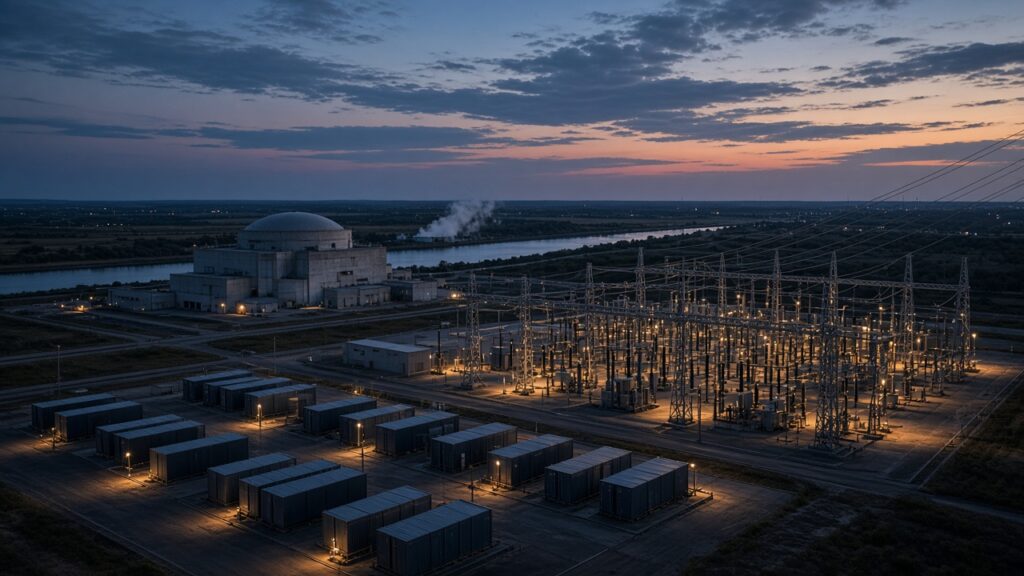
The most useful nuclear product for an AI campus in 2026 may not be a reactor that has yet to be built. On 9 November 2026, Constellation Energy reported its first Peak+ transaction: a 20-year agreement for 270 MW of unit-contingent energy, capacity and attributes from its existing nuclear fleet, scheduled to begin in 2028. The company did not name the customer, and this article does not guess who it is.
That single disclosure, in a third-quarter earnings release, is more than a product launch. It is a claim about clocks. New combined-cycle gas plants and first-of-a-kind small modular reactors are both for sale on paper. What Constellation is selling is something closer to inventory: megawatts that already exist, paired with what it calls “new capacity” — including new generation and demand response — to help large customers meet peak demand without waiting for a greenfield plant. In the same investor presentation, the company set that offer next to its own estimate of what new gas would cost. The comparison is Constellation’s, not an independent benchmark, and it should be read that way.
This is a different story from the one we told in Can Nuclear Power AI in Time? SMRs, Large Reactors, and the 2030 Gap. That article tracks whether new reactors and restarts can arrive before hyperscale loads do. This one asks what a large buyer can contract, today, from plants that are already running — and why that path is being pitched as an alternative to building new gas.
What Peak+ is — and what the first contract actually covers
Constellation’s 9 November release describes Peak+ as “an integrated customer solution that combines new capacity to support peak demand growth with energy products tailored to customer needs.” The first deal is more specific than the product slogan. The 270 MW is “unit-contingent energy, capacity, and attributes from our existing nuclear fleet,” beginning in 2028, under a 20-year agreement. “Unit-contingent” is a term of art: delivery is tied to the actual output of designated units, not to a firm promise that another plant will make up any shortfall.
The product wrapper around that block is broader. In the same release, chairman, president and CEO Joe Dominguez said Peak+ “brings together new capacity, including new generation and demand response, with energy products to help large customers meet their evolving needs.” The company’s third-quarter earnings presentation, dated 9 November 2026, repeats that definition and places Peak+ among “new capacity solutions” on a slide arguing that clean, firm, existing nuclear megawatt-hours “offer lower cost and less risk than new build CCGTs.”
What the first contract does not disclose is just as important. Constellation has not said who the buyer is. It has not said which nuclear units will supply the 270 MW. It has not itemised, for this transaction, how much battery storage, demand response or new generation — if any — sits alongside the existing-fleet block. Treating the 270 MW as a fully specified hybrid plant would be an invention. The honest reading is narrower: a long-term offtake from running nuclear units, sold under a product that Constellation says can also include incremental capacity.
On the 9 November earnings call, as reported by Utility Dive, Dominguez described Peak+ as “bringing capacity solutions plus existing clean and reliable generation,” and said the company “could add batteries and generation supply at our plants given the vast amount of land that we own around the plants.” Those remarks are oral commentary on a product still being rolled out. They are not a bill of materials for the unnamed 270 MW deal.
Constellation’s own price comparison with new gas
The economic pitch is on the company’s slides, and it should be attributed to Constellation. In the Q3 2026 presentation, a chart labelled “Clean, Firm, Existing Nuclear MWhs Offer Lower Cost and Less Risk than New Build CCGTs” shows \$20–\$50/MWh of “premium nuclear pricing to PTC floor,” set against a \$110–\$130/MWh “New build CCGT LCOE.” A footnote on that slide states the gas range assumes “a ~\$3,000/kW CCGT adjusted for eastern PJM.” The same deck’s 2032 generation estimates sit on the same page as the Peak+ product call-out.
That is a company comparison, built on company assumptions. The production-tax-credit “floor” is the federal nuclear PTC framework that Constellation also walks through in the appendix of the same presentation: in 2026, the company says, the credit can provide support of up to \$15/MWh when revenues fall between \$26/MWh and \$44.75/MWh, and phases out above that threshold. A Peak+ price “\$20–\$50/MWh” above that floor is therefore a premium to a regulated support level, not a published tariff the first customer is confirmed to be paying. Constellation has not released the 270 MW contract price.
The gas side of the slide is likewise an LCOE illustration, not a quoted offer from a turbine vendor. Eastern PJM is where much of Constellation’s nuclear fleet sits, and \$3,000/kW is the capital-cost assumption the company chose. If those inputs move — fuel, capacity payments, interconnection, carbon policy — the \$110–\$130/MWh band moves with them. The useful fact for readers is not that new gas “costs” \$120/MWh in some absolute sense. It is that Constellation is telling investors its existing nuclear, sold at a premium to the PTC floor, undercuts the company’s own 2032 LCOE for a new combined-cycle plant in eastern PJM.
That framing matters for AI energy demand. A hyperscale campus that needs firm power in 2028 does not have to wait for a first-of-a-kind reactor, and it does not have to place a turbine order into a multi-year backlog, if a running nuclear fleet can sell it a 20-year block. Whether that is cheaper for that campus, after transmission, congestion and residual risk, is a site-specific question the slides do not answer.
Why this is not the SMR story — and why the same week matters
The temptation is to fold Peak+ into the broader “tech goes nuclear” narrative. Resist it. Uprates, restarts and small modular reactors are additions to the fleet. Peak+’s first contract is, on the company’s wording, a sale of output from units that already operate. It reallocates existing clean firm power; it does not, by itself, create a new reactor.
The distinction is sharpened by news in the same week. On 9 November 2026, the U.S. Nuclear Regulatory Commission issued Construction Permit CPAR-3 to Long Mott Energy, a Dow subsidiary, for four Xe-100 reactors at the Long Mott Generating Station in Calhoun County, Texas — an industrial steam and power project at Dow’s Seadrift site, not an AI campus, and still requiring a separate operating license. On 10 November 2026, Ontario Power Generation said Unit 1 of the Darlington New Nuclear Project is no longer expected to meet its previously disclosed October 2030 commercial-operation target. Those developments belong in the 2030-gap ledger we keep in Can Nuclear Power AI in Time?. They are the backdrop, not the plot, of Peak+: the new-build clock is still slipping, which is precisely why a 2028 start from an existing fleet is commercially interesting.
Constellation is not abandoning new nuclear megawatts. The same 9 November release recaps two earlier agreements. In September 2026 it announced a 20-year, 690 MW PPA with Amazon, plus a related retail supply agreement, supporting more than \$3 billion of investment at Calvert Cliffs, including a 190 MW uprate expected between 2030 and 2032. In October 2026 it announced a 20-year PPA with Google that it says will enable more than \$4.3 billion of investment across 11 nuclear units in Illinois, Pennsylvania and New Jersey to add about 890 MW of incremental capacity to PJM, with the first uprate expected in 2028, plus a separate 15-year financial energy agreement for 2,700 MW. The Q3 presentation says long-term agreements now enable 1,165 MW of uprates at a project cost of about \$4.3 billion.
Peak+ sits beside those uprate deals, not on top of them. The first 270 MW is existing output, not the 890 MW or 190 MW of incremental capacity. For AI Power Players, the stack is becoming a menu: buy what already runs; pay to uprate what already stands; option what has not yet been built. Peak+ is the first of those, dressed as a product.
A product for large loads — not a named hyperscaler
Constellation’s public materials aim Peak+ at “large customers” in the context of connecting new large loads quickly without raising costs for other consumers. The 9 November presentation says regulators remain focused on that problem, that “rules are not final,” and that “deals can, and will, continue to get done.” It also cites, as a system benefit, the historical combined-cycle capacity factor of about 60% on average in PJM and ERCOT over the last five years, and a Brattle Group estimate (The Untapped Grid, March 2026) that fuller use of available system capacity could save U.S. households \$110–\$170 billion over ten years. Those are advocacy numbers on a company slide. They explain the pitch. They do not prove that the unnamed Peak+ buyer is an AI campus.
It would be easy, and wrong, to fill in the blank. AI and data-centre demand is the obvious commercial backdrop for any 2026 product that promises speed to power. Constellation is the largest nuclear energy company in the United States and, in its own description, holds 55 GW of capacity across nuclear, natural gas, oil, geothermal, hydro, wind and solar. It already sells nuclear output and attributes to technology companies. None of that identifies the 270 MW counterparty. Until Constellation or the buyer says so, the customer remains unnamed.
The other path: on-site gas, and a Colossus counterpoint
Not every large compute operator is buying existing nuclear. A parallel market, documented in Skipping the Queue: Behind-the-Meter Gas and the AI Lab Arms Race for Turbines, has labs and developers ordering gas turbines and generators to energise campuses while interconnection queues crawl. That is a supply-chain story: order books, lead times, and the gap between announced megawatts and megawatts actually online. Peak+ is the contractual opposite — firm energy from a plant that already runs, delivered across the grid under a long-term offtake.

SpaceXSI’s Colossus facility in South Memphis is a documented example of the other path, and only the facts on the company’s own information page are used here. SpaceXSI says that during standard operations Colossus will draw power from Memphis Light, Gas and Water through a substation the company built at no cost to the utility, and that it is working with MLGW on a second substation, also at no cost to MLGW. It says that in emergencies, or when the grid is strained by deep cold or heat, it will disconnect from the grid entirely. For that contingency, the company says it has installed more than 240 batteries on site and is “keeping fifteen natural gas turbines with best-in-class emission controls technology on-hand for any prolonged outage.”
On temporary generation, SpaceXSI says that after finishing the first MLGW substation it “has begun removing the temporary natural gas turbines onsite and will continue to do so over the coming weeks and months,” and that it has applied to the Shelby County Health Department for a permit to house 15 natural gas generators permanently “which will only be used for back-up power generation during periods of prolonged outages.” The company also states that Colossus will “primarily draw power directly from the MLGW grid,” and that day-to-day operations will generate “very few emissions,” with backup turbines described as using SoLoNOx dry low-emissions technology and selective catalytic reduction.
Those are SpaceXSI’s claims about how it intends to run Colossus. They are not an audit of actual operating hours, and they are not a statement about Constellation or Peak+. There is no public evidence that SpaceXSI is the unnamed Peak+ customer, and none is suggested here. The contrast is structural: one large AI operator is describing a grid-plus-batteries-plus-backup-gas design; Constellation is selling a 20-year block of existing nuclear to a buyer it will not name. Both are answers to the same shortage of timely, firm megawatts. They are not the same answer.
Local permitting around the wider Memphis–Southaven operations, including a 10 November 2026 Mississippi Permit Board decision on a Southaven air permit, is a separate story and is taken up in The 181-Gigawatt Lock-In: Why On-Site Gas for AI May Not Stay Temporary and in Power, Water, and Local Pushback.
What to watch
Three facts will decide whether Peak+ is a product or a one-off.
First, disclosure of the customer — or at least of the customer class. A utility, a manufacturer and a training campus use a 270 MW block very differently. Until a name appears, claims about “AI nuclear” attached to this contract are speculation.
Second, what “new capacity” means in practice. If later Peak+ deals attach storage or demand response in quantities that can be independently verified, the hybrid label will have substance beyond a marketing wrap around existing megawatt-hours. The first contract, as written, does not yet provide that inventory.
Third, delivery in 2028. Unit-contingent nuclear is only as firm as the units and the transmission path. Outage schedules, congestion and residual deliverability will show up in operations, not on the slide that compares Peak+ to a \$3,000/kW combined-cycle plant.
For AI Hyperscale Infrastructure planners, the menu is now clearer than it was a year ago. You can order turbines and try to skip the interconnection queue. You can underwrite an uprate or a restart and wait. You can option an SMR whose first Western commercial dates are still moving. Or, if Constellation’s product finds more buyers, you can purchase nuclear that is already on the grid, starting in 2028, at a premium the seller itself places \$20–\$50/MWh above the PTC floor — and still cheaper, in that seller’s telling, than new gas in eastern PJM. The comparison is Constellation’s. The test will be whether unnamed customers keep signing it.
Bottom line
Peak+ is a commercial answer to a calendar problem. Constellation has sold 270 MW of existing nuclear output, for 20 years, starting in 2028, under a product that also promises new capacity and demand response. The company, in its 9 November 2026 presentation, prices a nuclear premium of \$20–\$50/MWh above the PTC floor against its own \$110–\$130/MWh LCOE for a new eastern-PJM combined-cycle plant at about \$3,000/kW. That is a seller’s benchmark, not a market index. The customer is unnamed; the hybrid equipment attached to this first deal is unspecified. What the announcement does establish is a path that does not depend on an SMR arriving in 2030, and that is being sold, by the nation’s largest nuclear generator, as a cheaper and less risky alternative to building new gas.
Related reading
- Can Nuclear Power AI in Time? SMRs, Large Reactors, and the 2030 Gap
- Skipping the Queue: Behind-the-Meter Gas and the AI Lab Arms Race for Turbines
- The 181-Gigawatt Lock-In: Why On-Site Gas for AI May Not Stay Temporary
- Power, Water, and Local Pushback: The Hidden Constraints on AI Campuses
- FERC’s Large-Load Showdown: Will Flexible AI Campuses Jump the Interconnection Line?
Sources
- Constellation Energy (primary) — “Constellation Reports Third Quarter 2026 Results” (9 November 2026): https://www.constellationenergy.com/news/2026/11/constellation-reports-third-quarter-2026-results.html
- Constellation Energy (primary) — Q3 2026 earnings conference-call presentation (9 November 2026): https://constellationenergy.gcs-web.com/static-files/86dbe5b6-2ec4-485a-8024-c6ba0981fd3f
- Utility Dive (secondary; earnings-call quotations) — Brian Martucci, “Constellation pursues hybrid capacity contracts alongside nuclear uprates” (11 November 2026): https://www.utilitydive.com/news/constellation-pursues-hybrid-nuclearcapacity-contracts-alongside-uprates/874408/
- SpaceXSI (primary) — Memphis Information Center / FAQs, “How will SpaceXSI power Colossus?” and related energy questions: https://x.ai/memphis/info
- U.S. Nuclear Regulatory Commission (primary) — “NRC Issues First Construction Permit in Nearly 60 Years for High-Temperature Gas-Cooled Reactor,” No. 26-083 (9 November 2026): https://content.govdelivery.com/accounts/USNRC/bulletins/4323d99
- Ontario Power Generation (primary) — “OPG reports 2026 third quarter financial results” (10 November 2026): https://www.opg.com/documents/2026-third-quarter-financial-results-pdf/
- AndBeyond.Tech — “Can Nuclear Power AI in Time? SMRs, Large Reactors, and the 2030 Gap.” /can-nuclear-power-ai-in-time-smrs-2030-gap/
- AndBeyond.Tech — “Skipping the Queue: Behind-the-Meter Gas and the AI Lab Arms Race for Turbines.” /skipping-the-queue-behind-the-meter-gas-ai-turbines/
Images: original illustrations generated for AndBeyond.Tech; no logos or real people depicted.