AI Vision Tools for Integrators: ABB, KUKA and Yaskawa Take Three Different Routes
Robot vision has always had a staffing problem. The arm, the gripper and the fencing are catalogue items; the vision part is not. Someone has…
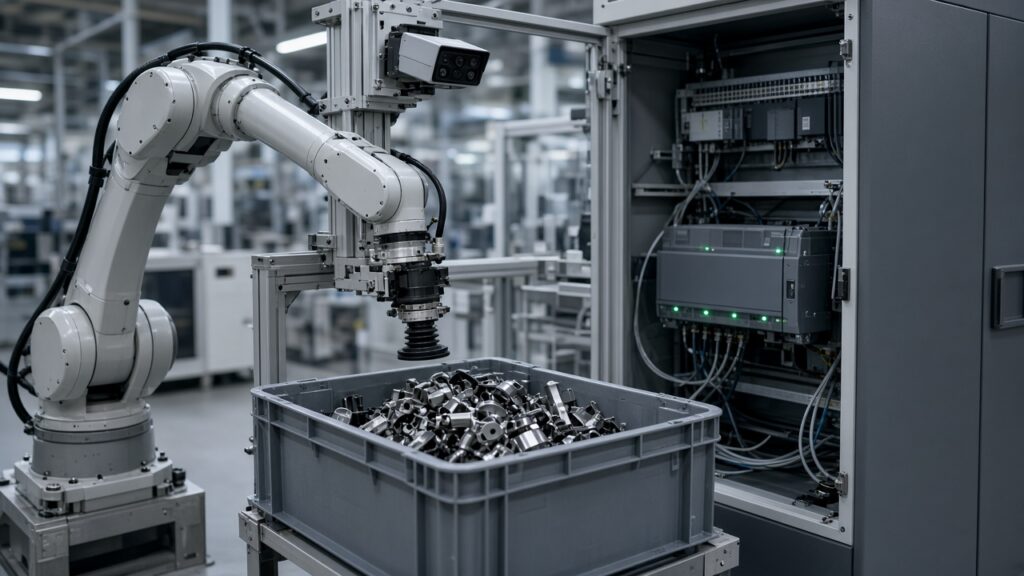
Robot vision has always had a staffing problem. The arm, the gripper and the fencing are catalogue items; the vision part is not. Someone has to collect images, train or tune a recognition model, calibrate it to the robot and keep it working when parts, packaging or light change. For many system integrators, that someone is a scarce specialist, or an outside vision supplier with its own computer and its own interface to the robot.
This autumn, three of the largest robot makers have each pitched a way around that bottleneck. ABB has added a training tool, AI Robot Trainer, to its OmniCore EyeMotion vision software and its Fashion Inductor sorting module. KUKA has launched iiQKA.AI Vision, which runs on a compute unit inside its controller. Yaskawa keeps building out MOTOMAN NEXT, whose controller carries a second, AI-capable computer.
All three tell integrators they no longer need an AI team to deploy robot vision. They mean different things by it, and they put the AI in different places. This article compares what each company says in its own releases and product pages, then gives our reading of what is still unproven.
A note on dates. Trade outlets covered these launches between 9 and 15 November 2026, which made them look like one week of news. The companies’ own newsrooms show earlier dates: 8 October 2026 for KUKA, and 12 and 15 October 2026 for ABB’s two releases. We found no November release from Yaskawa on vision tools or its MOTOMAN NEXT partner programme on either of its newsrooms. This is an autumn wave of announcements, not a single week.
What the companies say (sourced facts)
This section reports only what ABB, KUKA and Yaskawa state in their own releases and product documentation. All performance figures are vendor-reported and have not been independently verified.
ABB: AI Robot Trainer for OmniCore EyeMotion
OmniCore EyeMotion, ABB’s vision software for its OmniCore-controlled robots, launched in September 2025. The October 2026 release adds AI Robot Trainer. ABB says the pair lets customers train, deploy and continuously improve AI vision applications “without needing experts to build AI models from scratch”, and is designed for system integrators and automation partners.
ABB describes one workflow from shop-floor image capture to model training, deployment and improvement, with results fed to its automatic collision-free path planning. It also claims:
- a guided workflow and an AI chatbot to help users handle changing products (SKUs), lighting, layouts and object variations;
- training data mixing synthetic and real images;
- compatibility with any brand of camera or sensor;
- applications from 2D pick-and-place to 3D bin picking, inspection, sorting and assembly.
Vendor-reported figures: commissioning time cut by up to 90%, and cycle time by up to 50% when combined with path planning. The 2026 release gives no baseline. ABB’s September 2025 EyeMotion release already claimed up to 90% “compared to custom solutions”.
ABB’s Physical AI page says AI Robot Trainer fine-tunes pre-trained models in the cloud on the customer’s images. The resulting model file is uploaded to the robot cell, and no permanent cloud connection is needed in production.
ABB: Fashion Inductor with AI Robot Trainer
Three days later, ABB applied the tool to Fashion Inductor, its module for picking and sorting apparel in logistics centres. ABB calls the upgrade its “first end-to-end vision-based industrial-grade physical AI solution”.
- Vendor-reported performance: throughput of up to 1,300 items per hour per cell, with picking accuracy targets above 99.5%. ABB presents these as existing Fashion Inductor capabilities, not as gains from the AI upgrade.
- Vendor-reported effort saving: AI Robot Trainer reduces engineering and commissioning effort by up to 75%, through pre-trained fashion-specific vision models, application tools and fast retraining.
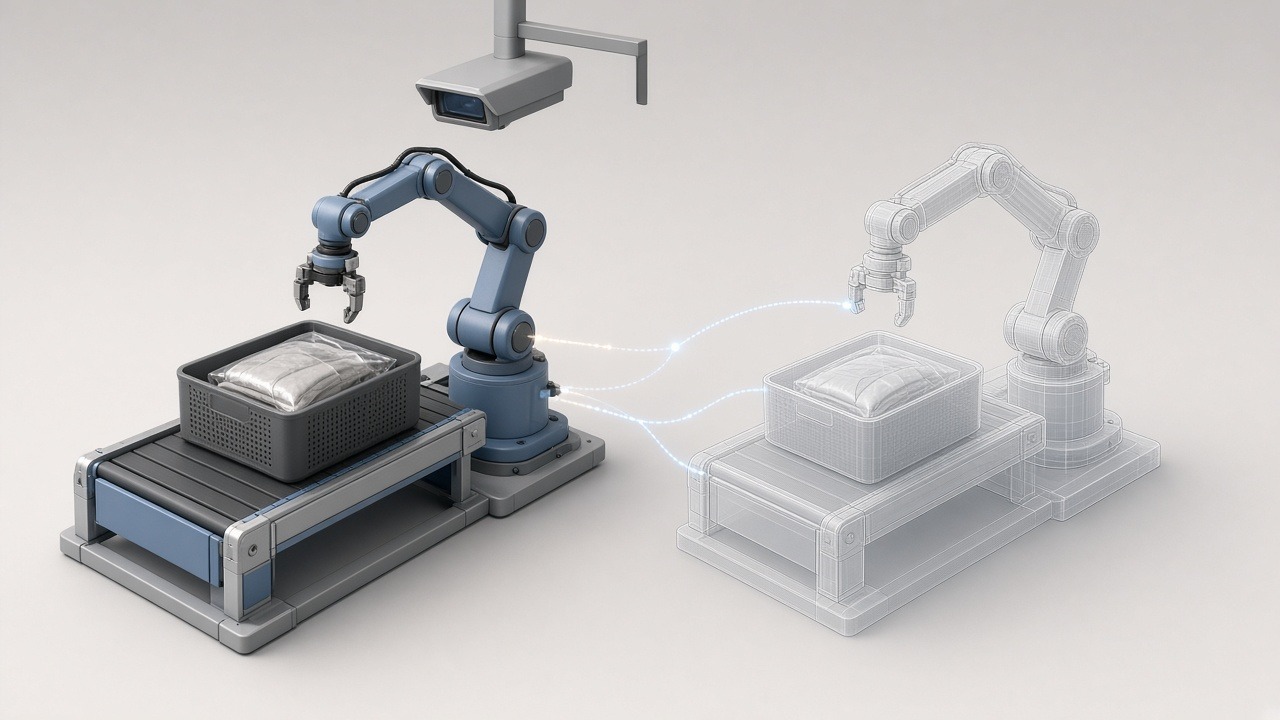
- Digital twin: a software replica of the module linking ABB’s Application Controller Platform, Automatic Path Planning, AI Robot Trainer and RobotStudio, which ABB says speeds commissioning and eases adding third-party grippers.
- Closed-loop retraining: the system monitors robot performance, flags anomalies, generates new training data and sends improved models back to the physical robot.
- Roadmap: ABB says the same AI Robot Trainer approach will spread to more of its vision-based applications through Q1 2027.
ABB’s Physical AI page adds two vendor claims: around 50 customer images can be enough for production quality, thanks to garment-specific pre-training, and a retrained model can go into production “in minutes”.
KUKA: iiQKA.AI Vision
KUKA’s release of 8 October 2026 aims iiQKA.AI Vision at integrators and users with limited vision experience who want vision without complex extra systems or high upfront costs. KUKA states:
- Applications: 2D and 3D vision for bin picking, assembly, quality control and depalletizing.
- Where it runs: image processing runs directly in the controller, on the KUKA AI Extension Platform, which KUKA describes as an integrated computing unit based on the NVIDIA Jetson Orin module. KUKA says no cloud connection, external PC or extra infrastructure is needed, and that images are processed and stored on board.
- Engineering: configuration happens in KUKA’s iiQWorks engineering software, through drag-and-drop tools, ready-made templates and guided workflows from setup to commissioning.
- Functions: 2D and 3D object recognition, position detection and gripping-point calculation, sent directly to the robot, and reliable, KUKA says, with varying parts and light.
- Hardware: cameras and compatible components come from KUKA; only the processing moves into the controller.
KUKA gives no percentage savings, only qualitative claims of lower integration effort and total cost of ownership. Unlike ABB, it does not describe a customer-run retraining loop.
Yaskawa: MOTOMAN NEXT and its autonomous control unit
Yaskawa did not announce a new vision tool this autumn. Its relevant product is MOTOMAN NEXT, on sale in Japan since December 2023 and introduced in Europe in June 2025.
According to Yaskawa, the YNX1000 controller contains two computers: the classic robot control unit (RCU) for motion, and an autonomous control unit (ACU) based on an NVIDIA Jetson Orin module. The ACU runs Linux and hosts Docker-packaged applications. Yaskawa pre-installs services for collision-free path planning, motion control, I/O, force sensing and 2D, 3D and AI-based image processing (HALCON library), and says this removes the need for an external PC.
Yaskawa’s pitch to integrators is openness rather than a no-code trainer: an ACU software development kit, the YNX Robot Simulator as a digital twin, and no annual licence or per-instance runtime fees for the platform services. Its Japanese case page lists more than two dozen co-creation partners.
Two 2026 releases show the direction. In July, Yaskawa linked MOTOMAN NEXT with Google DeepMind’s Gemini Robotics ER 1.6 model in an “Agentic Robot System”: the AI model decides what to do, the robot’s own vision, path-planning and force-sensing services decide how to move. Availability is still to be announced. On 28 October, Yaskawa and Toyota’s GAZOO Racing described a MOTOMAN NEXT welding cell that recognises pipe-frame conditions, welds, then inspects and corrects its own work, now in practical use in GR KART frame production.
Side by side
| ABB (EyeMotion + AI Robot Trainer) | KUKA (iiQKA.AI Vision) | Yaskawa (MOTOMAN NEXT) | |
|---|---|---|---|
| Release date (primary source) | 12 Oct 2026; Fashion Inductor 15 Oct 2026 | 8 Oct 2026 | Platform on sale since Dec 2023 (Japan); no new vision release this autumn |
| Who it targets | Integrators, automation partners, non-experts | Integrators and users with limited vision experience | Integrators, software developers, technology partners |
| Where models are trained | Cloud (AI Robot Trainer) | Not specified in release | Not specified in the sources used; SDK and simulator provided |
| Where vision runs in production | Separate industrial PC connected to the OmniCore controller (EyeMotion datasheet) | AI Extension Platform inside the KUKA controller (Jetson Orin) | Autonomous control unit inside the YNX1000 controller (Jetson Orin) |
| Retraining loop | Yes, closed-loop, described in detail | Not described | Not described as a packaged feature |
| Vendor-reported figures | Up to 90% faster commissioning; up to 50% shorter cycle time; up to 75% less engineering effort (Fashion Inductor) | None | None in the sources used |
| Camera choice | Any brand | KUKA-supplied cameras and compatible components | Not specified in the sources used |
Does the AI really move “into the robot controller”?
Our working title said all three makers move AI vision into the robot controller. The primary sources only support that for two of them.
KUKA: yes. KUKA’s own release says the processing runs “directly in the controller” on the AI Extension Platform with an NVIDIA Jetson Orin module, with no external PC.
Yaskawa: yes. Yaskawa’s own documentation places the Jetson-based autonomous control unit inside the YNX1000 controller, alongside the motion control unit, and says it removes the external PC.
ABB: no, as far as ABB’s documents show. The EyeMotion datasheet specifies a separate industrial PC (IPC) running Ubuntu Linux, with an external NVIDIA GPU for 3D and AI options, connected to the OmniCore controller over Ethernet. Training happens in the cloud. The Fashion Inductor release calls OmniCore “the execution layer in production”, but no ABB document we reviewed says the AI vision model runs on the controller itself. When ABB’s Physical AI page says EyeMotion runs the model “on the robot”, we read that as the robot cell.
That is why this article’s title talks about AI vision tools for integrators rather than AI “in the controller”. The common ground between the three is the audience and the promise, not the hardware location.
Our analysis
Everything in this section is AndBeyond.Tech’s interpretation. It is not a claim made by ABB, KUKA or Yaskawa.
Three routes to the same bottleneck
The three approaches line up neatly along one axis: how much of the vision job the robot maker wants to own.
ABB is selling a managed lifecycle: capture images, train in the cloud, deploy a model file, watch performance, retrain. It is also the only one to package this as a ready-made application with pre-trained models for a defined domain. Garments in polybags are a classic case where hand-written vision rules break down, so the bet is sensible.
KUKA is selling integration: no separate vision PC, no communication layer between vision system and robot, one engineering tool. Anyone who has debugged that handshake will see the appeal. KUKA says little about how models improve over time.
Yaskawa is selling a platform: a GPU-equipped Linux computer in the controller plus robot services, with partners building the applications. That is closer to a developer environment than to a guided tool for an integrator with no AI staff.
So “no AI team required” needs a qualifier for each. The AI expertise moves into ABB’s pre-trained models and cloud service, into KUKA’s templates and integrated software, and to the software partners building on Yaskawa’s platform.
How to read the vendor numbers
ABB’s figures are the only hard numbers in this round, and they need care.
- “Up to” is a ceiling, not an average. No release says how many projects were measured.
- The 90% figure is not new. ABB used the same “up to 90%” commissioning claim for EyeMotion in September 2025, before AI Robot Trainer existed, against “custom solutions” or “comparable solutions on the market”. The 2026 release does not separate how much of the saving comes from the new AI training tool.
- The 50% cycle-time figure is linked in ABB’s own wording to automatic collision-free path planning. It says little about vision quality.
- The 99.5% accuracy figure is a target, in ABB’s words. A target is not a measured result, and the release does not say under what conditions it applies.
- The 75% saving for Fashion Inductor has no stated baseline: a Fashion Inductor without AI Robot Trainer, or a custom-built cell?
KUKA and Yaskawa publish no comparable figures, which leaves buyers nothing yet to test them against.
What remains unproven
Field results. All evidence so far comes from the vendors. No release names an integrator using these tools across several sites, the use case ABB explicitly targets. Yaskawa’s GR KART cell is a named production deployment, but it was developed jointly with Yaskawa.
Retraining in practice. ABB’s closed loop is the boldest promise. Who approves a new model before it reaches production? How is it validated against quality and safety requirements? Can it be rolled back? ABB says improvement is “controlled and deliberate”; how that works on a busy sorting line remains to be seen.
Cloud and data. ABB trains in the cloud. Plants with strict data policies may not allow production images to leave the site. KUKA’s and Yaskawa’s local processing avoids that for inference, but neither explains how models are updated.
Compute headroom. A Jetson Orin module in a controller is capable but finite. Neither KUKA nor Yaskawa says how many cameras, how much 3D data or how large a model it handles at production cycle times. ABB’s separate IPC trades cabinet simplicity for scalable compute.
Lock-in. ABB stresses any-brand cameras; KUKA sells its own. All three tie the vision workflow to their own robots and software, which is a switching cost for integrators who work with several brands. We looked at this tension in From Pilot to Every Plant: The Race to Make Robot Skills Portable.
The skills question. “Without AI specialists” does not mean without skills. Lighting, camera placement, gripper design and calibration still decide whether a vision cell works. As we argued in AI Cobots and Vision: Where Factories See ROI First, the returns from vision usually come from well-scoped, repeatable tasks first.
Questions integrators should ask
Before betting a project on any of these tools, an integrator should ask:
- What baseline is behind each “up to” figure, and how many deployments was it measured on?
- Where does training happen, where does inference run, and what data leaves the site?
- How are retrained models validated, approved and rolled back?
- What are the compute limits per controller or per IPC, in cameras, frame rates and model size?
- What does licensing cost over the cell’s lifetime, including cameras and any cloud training service?
Bottom line
ABB, KUKA and Yaskawa all want to make AI vision something an integrator can deploy without hiring data scientists. Their own documents show three different designs. KUKA and Yaskawa run vision on a Jetson-based compute unit inside the robot controller. ABB keeps vision on a separate industrial PC and trains models in the cloud, but offers the most complete retraining loop and the only packaged application with pre-trained models.
The only hard numbers come from ABB and are vendor-reported ceilings, one of which predates the new AI tool. Until integrators publish results from real multi-site projects, the fair summary is that the robot makers have lowered the barrier to entry for AI vision. They have not yet shown how far.
Related reading
- AI Cobots and Vision: Where Factories See ROI First
- From Pilot to Every Plant: The Race to Make Robot Skills Portable
References / Sources
Primary sources (company press releases and documentation)
- ABB, press release, “ABB Robotics enables anyone to train, deploy and optimize AI-powered robotics applications” (page publication date 12 October 2026). https://www.abb.com/global/en/news/139391/prsrl-abb-robotics-enables-anyone-to-train-deploy-and-optimize-ai-powered-robotics-applications
- ABB, press release, “ABB Robotics brings industrial-grade physical AI to fashion logistics” (page publication date 15 October 2026). https://www.abb.com/global/en/news/139480/prsrl-abb-robotics-brings-industrial-grade-physical-ai-to-fashion-logistics
- ABB, German version of the Fashion Inductor release, Friedberg, 15 October 2026. https://new.abb.com/news/de/detail/139480/abb-robotics-bringt-physische-ki-in-die-fashion-logistik
- ABB, press release, “ABB Robotics launches OmniCore EyeMotion for vision-powered autonomy”, Zurich, 23 September 2025. https://new.abb.com/news/detail/129110/prsrl-abb-robotics-launches-omnicore-eyemotion
- ABB, OmniCore EyeMotion datasheet (IPC requirements). https://library.e.abb.com/public/9c44a50bf23040f48557774d245f409b/9AKK108471A7842_en_A_Datasheet%20EyeMotion%20datasheet.pdf
- ABB, OmniCore EyeMotion product page. https://www.abb.com/global/en/areas/robotics/products/controllers/omnicore/omnicore-eyemotion
- ABB, Physical AI page (AI Robot Trainer cloud training, model deployment). https://www.abb.com/global/en/areas/robotics/innovation/physical-ai
- ABB, Fashion Inductor product page. https://www.abb.com/global/en/areas/robotics/solutions/functional-modules/item-picking-family/fashion-inductor
- KUKA, press release, “iiQKA.AI Vision simplifies industrial image processing”, 8 October 2026. https://www.kuka.com/en-us/company/press/news/2026/09/iiqka-ai-vision-product-launch
- KUKA, iiQKA.AI Vision product page. https://www.kuka.com/en-us/products/robotics-systems/software/application-software/iiqka-ai-vision-industrial-image-processing
- Yaskawa Electric, news release (Japanese), launch of the MOTOMAN NEXT series (sales from December 2023). https://www.yaskawa.co.jp/newsrelease/product/1154379
- Yaskawa Europe, “MOTOMAN NEXT – A new platform from Yaskawa for intelligent adaptive robotic automation and AI”, 12 June 2025. https://www.yaskawa.eu.com/header-meta/news-events/article/motoman-next—a-new-platform-from-yaskawa-for-intelligent-adaptive-robotic-automation-and-ai_n22113
- Yaskawa Motoman, MOTOMAN NEXT page (YNX1000 controller, ACU). https://www.motoman.com/en-us/campaign/next
- Yaskawa Motoman Developer Portal, “Introduction to NEXT”. https://developer.motoman.com/en/NEXT/get-started/introduction
- Yaskawa Electric, news release, “MOTOMAN NEXT AI Robot’s Agentic Robot System Powered by Gemini Robotics”, 15 July 2026. https://www.yaskawa-global.com/newsrelease/news/179679
- Yaskawa Electric, news release, “Yaskawa Electric and GAZOO Racing Advance Welding Technology Proven in Motorsports”, 28 October 2026. https://www.yaskawa-global.com/newsrelease/267239
- Yaskawa Electric, MOTOMAN NEXT use cases and co-creation partners (Japanese). https://www.yaskawa.co.jp/motoman-next/case
- Yaskawa Electric, global newsroom (checked 16 November 2026; no November release on MOTOMAN NEXT partners). https://www.yaskawa-global.com/newsrelease
Secondary sources (trade press; cited only for facts also in the primary sources above)
- Robotics & Automation News, “ABB Robotics launches AI Robot Trainer to simplify robot vision programming”, 9 November 2026. https://roboticsandautomationnews.com/2026/11/09/abb-robotics-launches-ai-robot-trainer-to-simplify-robot-vision-programming/106808/
- Robotics & Automation News, “ABB Robotics brings industrial-grade physical AI to fashion logistics”, 14 November 2026. https://roboticsandautomationnews.com/2026/11/14/abb-robotics-brings-industrial-grade-physical-ai-to-fashion-logistics/107087/
- Control.com, “KUKA, ABB, and Kawasaki Unveil New Robotic Solutions”, 11 November 2026. https://control.com/news/kuka-abb-and-kawasaki-unveil-new-robotic-solutions/
Images: original illustrations generated for AndBeyond.Tech; no logos or real people depicted.