Beyond Stargate: The New Gigawatt Map of AI Factories
Wyoming fuel cells, Arizona batteries, Mississippi turbines, Inner Mongolia wind and a Yorkshire power station: how new AI campuses choose their energy.
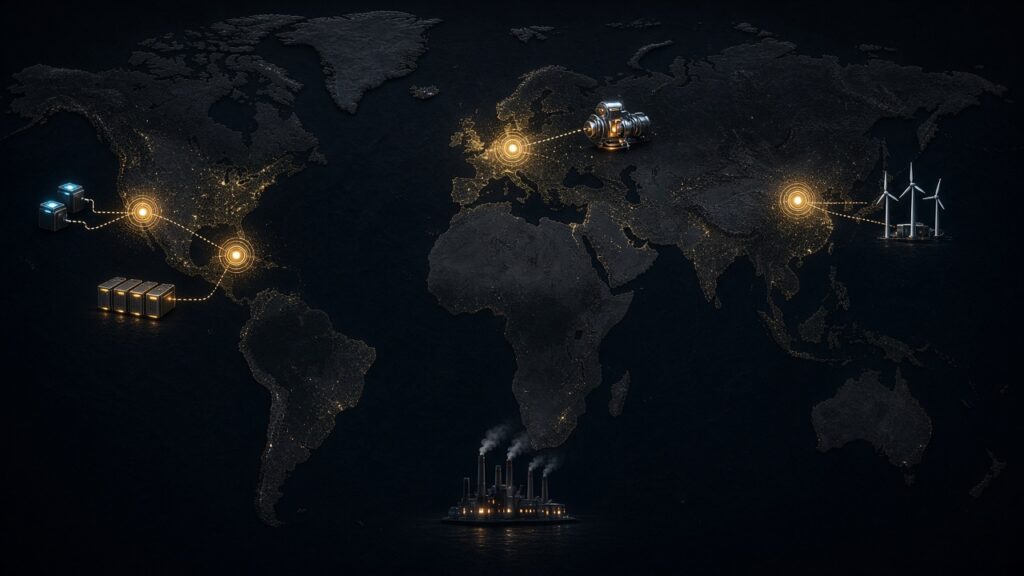
Stylized dark world map with glowing AI campus nodes, each linked to an energy-source icon such as fuel cells, batteries, wind turbines or a power station. (Conceptual illustration.)
For most of 2025 and 2026, the shorthand for an AI megaproject was “Stargate”: a flagship campus in Abilene, Texas, and a race to replicate it. We covered that race in The Texas AI Factory Race and the multi-site alternative in Microsoft Fairwater and the Rise of the Distributed AI Superfactory. Between 30 October and 9 November 2026, however, five announcements, filings and reports sketched a much wider map, from the high plains of Wyoming to the Arizona desert, a Mississippi state line, Inner Mongolia and North Yorkshire.
This article maps those campuses through one lens: where each one gets its electricity. It deliberately leaves aside two adjacent questions that our sister desks already cover. How much the hyperscalers are spending, and what that money buys, is the subject of Capex Arms Race: Mapping Hyperscaler AI Spend and What It Buys. Community opposition, water and the politics of permitting are covered in Power, Water, and Local Pushback: The Hidden Constraints on AI Campuses. Here, investment figures appear only to identify a project, and local disputes only where they directly affect the power supply.
The short version: “bring your own power” has stopped being one strategy. It is now at least five.
Why the energy choice now defines the campus
At gigawatt scale, a data center is no longer a customer that a utility simply connects. It is a load comparable to a city, arriving on a construction timeline measured in months, while new transmission and generation take years. Every developer therefore has to answer the same question before choosing land: where will the first few hundred megawatts come from, and how will the rest follow?
The answers below differ by geography, fuel, regulation and appetite for risk. Read together, they show the design space that AI factories are now exploring.
1. Cheyenne, Wyoming: contracted fuel cells with carbon capture
Developer: Google, with Tallgrass Energy, Black Hills Energy, American Electric Power (AEP) and Related Digital
Status: announced 5 November 2026; generation targeted for full operation by end-2028
Google’s first Wyoming data center, near Cheyenne in Laramie County, is the clearest example of a hyperscaler designing a dedicated power plant around a campus without building it itself. On its company blog, Google says the project is contracted with AEP to feature a “first-of-its-kind, commercial-scale, 702 MW fuel cell development with carbon capture and storage”, which it calls the largest planned development of its kind to date.
The pieces fit together as follows, according to Google and AEP:
- Fuel cells. Bloom Energy will supply fuel cells that convert natural gas into electricity electrochemically rather than by combustion. AEP says it plans to invest about $4 billion in the 702 MW Cheyenne Fuel Cell project, which it will own at roughly 92%, under a 20-year power purchase agreement with Google. Construction is planned to start in 2026, with full operation expected by the end of 2028.
- Carbon capture. Google says the large majority of the plant’s carbon emissions will be captured and permanently stored at Tallgrass’s nearby Eastern Wyoming Sequestration Hub. With this project, Google says its contracted carbon-capture capacity reaches nearly 1 GW.
- Gas backstop. Google is also sourcing power from gas generators operated by Tallgrass and Black Hills Energy, and is running a front-end engineering and design (FEED) study on fitting Tallgrass’s combined-cycle turbines with carbon capture.
- Cooling. The data center will be air-cooled to limit local water use.
The energy choice: natural gas, but routed through fuel cells and carbon capture, under a long-term contract with a regulated utility. It is a “bring your own power” model in which the hyperscaler brings the contract and the technology choice, while a utility builds, owns and runs the plant.
2. Cochise County, Arizona: the grid plus a giant battery
Applicant: Tombstone Resources L.L.C., reported by Data Center Dynamics to be an affiliate of SpaceXSI (formerly SpaceXAI)
Status: targeted; special-use application SU26-22 filed 30 October 2026, pending the Cochise County Planning and Zoning Commission hearing on 9 December 2026
The largest proposal on this map is still a proposal. In its application to Cochise County, Tombstone Resources describes a campus on about 747 acres of rural land along U.S. Highway 191, on two properties next to the Arizona Electric Power Cooperative’s (AEPCO) Apache Generating Station. The application, dated 30 October 2026, sets out the energy design in some detail:
- Size. Up to nine computing buildings in four phases, with a total electric demand of “approximately 6 gigawatts (6,000 megawatts)” at full build-out. Phase 1 covers the first computing buildings, at about 1,500 MW.
- Supply. Power is to be “delivered from the grid” through the Sulphur Springs Valley Electric Cooperative (SSVEC) and AEPCO, via a utility-owned on-site substation. The filing describes applicant-funded transmission and substation improvements, and targets initial electric service for construction in April 2027, with Phase 1 computing load following as transmission is completed.
- Backup. Natural-gas standby generators of about 10 MW per building serve critical loads only.
- Storage. Battery energy storage yards provide ride-through if utility power is lost.
- Cooling. The campus is dry-cooled with no cooling towers, and the applicant estimates operating water use at about 7 to 10 acre-feet a year at full build-out.
Data Center Dynamics, citing the application, reported that the plan includes a 24 GWh battery energy storage system intended to keep the campus’s draw steady so that its demand swings do not affect Arizona’s grid, four stages of 1.5 GW, and construction starting in March 2027 if zoning is approved. We could not find the 24 GWh figure in the 54-page application package we reviewed, so it should be read as reported rather than filed. SpaceXSI had not published its own release on the project at the time of writing.
Cochise County’s official public hearing notice confirms the request (Docket SU26-22, about 747 acres, up to nine computing buildings in four phases, with battery storage) and states that the full docket is on file with the County Development Services Department. The project details above come from the applicant’s filing and have not been independently verified. The commission may approve, approve with conditions, or deny the application on 9 December; its decision is final unless appealed to the Board of Supervisors.
The energy choice: a grid-served design, unusual in this list, that uses very large on-site storage rather than on-site generation to make a multi-gigawatt load acceptable to a regional cooperative grid. Whether it happens depends first on the zoning decision and then on transmission.
3. Southaven, Mississippi: Colossus 2 and on-site turbines
Developer: SpaceXSI (formerly SpaceXAI, and before that xAI)
Status: operating and expanding; new sites claimed operational by end-2026
SpaceXSI’s Colossus 2 cluster straddles the Tennessee–Mississippi line near Memphis, with most new capacity in Southaven, Mississippi. On 2 November, Data Center Dynamics reported that Elon Musk announced two more Southaven sites, called Gun Range and Spam. According to Musk’s statements as relayed by DCD, the two sites will host about 420,000 NVIDIA GB300 GPUs, with Gun Range “tracking to be operational by end of November and Spam in December”, and Colossus 2 will reach around 1.2 million Blackwell GPUs by the end of 2026. These are company claims; DCD also notes that an earlier claim of 1 GW at Colossus 2’s launch was reportedly contradicted by satellite imagery suggesting cooling equipment for about 350 MW.
The energy model here is on-site gas generation. Mississippi Today reports that the state permit board approved, in March 2026, the company’s application to build 41 permanent gas turbines in Southaven, and that a residents’ appeal hearing was scheduled for 9 November. In a separate case, a federal judge ruled at the end of October that the company’s temporary turbines are not “mobile sources” and need air permits; the lawsuit continues. We note these proceedings only because they bear directly on how the campus is powered; the wider local debate is covered by our energy desk.
The energy choice: speed first. Gas turbines on or next to the site let compute come online before grid capacity catches up, at the cost of air-permitting exposure that now shapes the power plan itself.
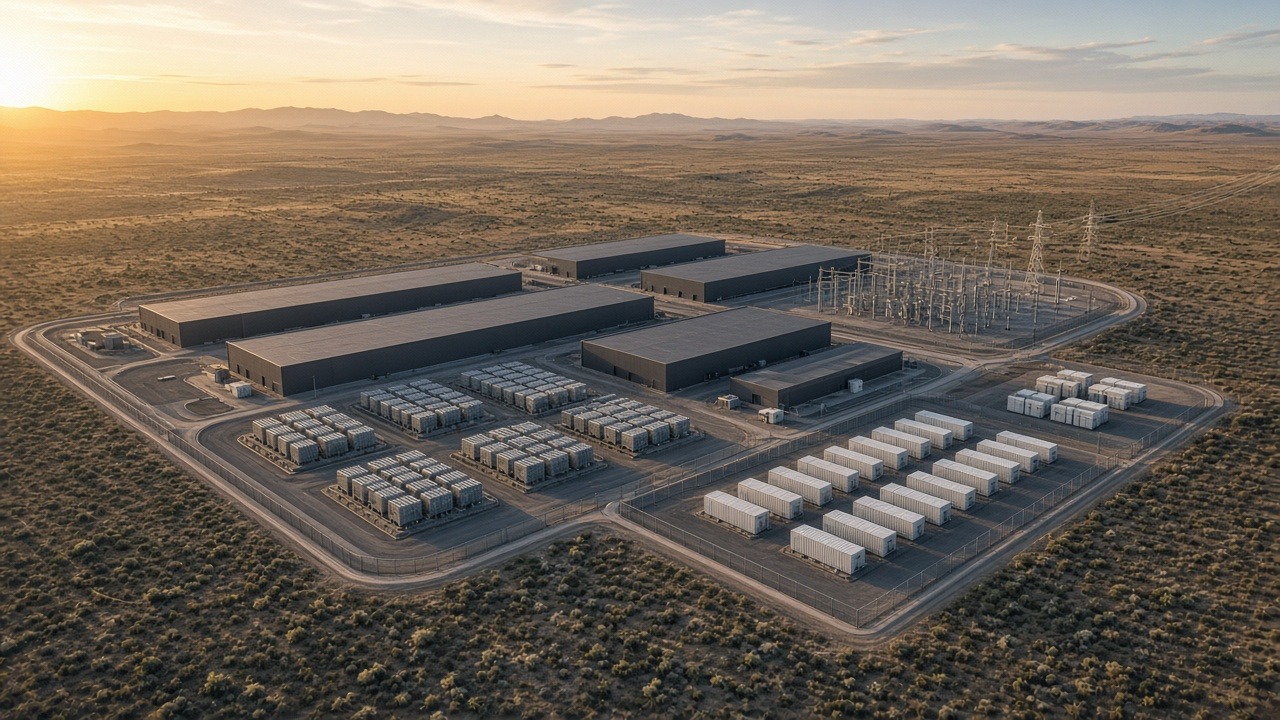
4. Ulanqab, Inner Mongolia: wind, storage and 800 V DC
Developer: Envision, for unnamed tenants
Status: operating since August 2026; build-out continuing
China’s entry on this map comes from an energy company rather than a cloud provider. Envision says its Galaxy AI data center campus in Ulanqab began operations in August 2026, has a planned capacity of 3 GW, is designed to support up to one million AI accelerators at full build-out, and plans for more than 80% of its power to come from direct renewable electricity connections. On 2 November, Envision also announced that an integrated 800 V DC power system, using solid-state transformers fed at 10 kV and coupled with batteries, is powering live workloads on the campus.
The research firm SemiAnalysis, which visited the site in September, gave a different measure of scale. As relayed by Tom’s Hardware on 9 November, it reported Galaxy as planned for up to 800 MW of IT capacity across four phases built for two internet companies, with the first 120 MW delivered in under a year and completion expected by the end of 2027. The 3 GW and 800 MW figures are not necessarily contradictory, since one may describe total planned capacity and the other IT load, but neither source reconciles them, and readers should treat both as stated by their respective sources.
The energy choice: co-location with wind generation and battery storage, built by a company that makes wind turbines and batteries. It is the most vertically integrated energy model on this list, and it is also where the in-hall 800 V DC architecture we examine in The 1 MW Rack is already running at pilot scale, as reported.
5. North Yorkshire, UK: a power station becomes a campus
Developers: Drax, Brookfield and Radiant, backed by the Brookfield–Qai joint venture
Status: announced 3 November 2026; subject to planning, regulatory and network approvals and to securing a tenant
The UK entry reuses an asset rather than building a new one. Drax Power Station in North Yorkshire is to host what the partners call “GW-scale” data center capacity. The release sets out what makes the site attractive for power: an estate of 1,000 acres, 4 GW of grid access, and 2.6 GW of active dispatchable generation with existing cooling systems.
The plan is phased:
- Phase 1: up to 100 MW, targeted to operate from Q1 2028.
- Phase 2: an ambition to ramp up to 500 MW between 2028 and 2031.
- Phase 3: additional capacity after 2031.
Drax describes the power station as the UK’s largest single source of renewable electricity by output, based on biomass, and says it is “one of the few UK sites that can provide large-scale reliable power directly to data centre customers by utilising existing and underutilised generation capacity”. The companies also say they believe the project fits the criteria of the UK government’s new Data Centre Covenant, which aims to speed up access to power and planning for strategically important data centers. A community consultation and the formal planning process are still ahead.
The energy choice: brownfield power. Instead of waiting for a new grid connection, the campus borrows one of the largest existing connections in the country, together with dispatchable generation already on site.
The map at a glance
| Campus | Status (9 Nov 2026) | Stated scale | Primary energy model |
|---|---|---|---|
| Cheyenne, Wyoming (Google) | Announced; fuel-cell plant targeted for end-2028 | 702 MW fuel-cell plant | Utility-owned gas fuel cells with carbon capture, plus gas generators |
| Cochise County, Arizona (Tombstone Resources / SpaceXSI, as reported) | Targeted; pending 9 Dec zoning hearing | ~6 GW at full build-out (filing) | Grid supply via cooperatives, battery ride-through; 24 GWh BESS reported |
| Southaven, Mississippi (SpaceXSI Colossus 2) | Operating and expanding | ~1.2M Blackwell GPUs by end-2026 (company claim) | On-site gas turbines |
| Ulanqab, Inner Mongolia (Envision Galaxy) | Operating since Aug 2026 | 3 GW planned (Envision); up to 800 MW IT (reported) | Direct renewables (>80% planned), storage, 800 V DC |
| North Yorkshire, UK (Drax / Brookfield / Radiant) | Announced; pre-planning | Up to 100 MW, then 500 MW, then more | Existing power station grid access and dispatchable generation |
Five patterns in “bring your own power”
1. The utility becomes a contractor. In Wyoming, Google does not own the power plant, but the plant exists because of Google. Long-term PPAs that underwrite dedicated generation let a hyperscaler choose the technology, in this case fuel cells and carbon capture, while a regulated utility carries construction and operation.
2. Storage as a grid passport. The Arizona filing proposes no large on-site generation. Instead it relies on grid supply and batteries, and the reported 24 GWh figure would make storage the device that makes a multi-gigawatt load tolerable to the grid. The same logic is moving inside the building, where batteries and capacitors smooth AI load spikes at the rack and row level.
3. Turbines as a bridge. Southaven shows the fastest path to power and its constraint: on-site gas generation gets compute online quickly, but air permits then become part of the critical path.
4. Renewables at the source. Galaxy follows the logic of moving the computer to the wind farm rather than moving the electricity to the city. Inner Mongolia’s wind resource, and an energy company acting as developer, make that possible at scale.
5. Recycled grid connections. Drax reflects a European reality: grid connections are scarcer than land. Repurposing a large thermal station’s connection is becoming a recognizable way to get ahead of the queue.
None of these models is free of trade-offs. Gas-based approaches carry emissions and fuel-price risk, even with carbon capture; grid-plus-storage depends on transmission that does not yet exist; on-site turbines carry permitting risk; remote renewables push compute far from users and networks; and brownfield sites have finite headroom. That last point links to a broader architectural shift. As single campuses hit their power limits, operators are also learning to spread one training job across several sites, a topic our networking desk explores in How Distributed AI Superfactories Stretch the Network Between Campuses.
What to watch
- 9 December 2026: the Cochise County Planning and Zoning Commission hearing on SU26-22, which decides whether the Arizona campus can proceed to the utility and transmission stage.
- Southaven permits: the outcome of the residents’ appeal on the 41-turbine permit and of the federal air-permit case.
- Cheyenne construction: whether the 702 MW fuel-cell plant and its carbon-capture link stay on track for full operation by end-2028.
- Galaxy disclosures: any primary figures from Envision on IT capacity, the size of its 800 V DC deployment and the share of renewable supply achieved.
- Drax planning: the start of community consultation and of the formal planning process, and the naming of a tenant.
Bottom line
The next generation of AI factories will not be defined by one flagship in one state. It will be defined by a growing menu of energy strategies: contracted fuel cells, grid-plus-battery megaprojects, on-site turbines, renewable co-location and recycled power stations. Each reflects a local mix of fuel, policy and grid headroom. For anyone tracking hyperscale AI infrastructure, the question to ask about a new campus is no longer only “how big?” but “powered by what, and on whose timeline?”
Related reading
- The Texas AI Factory Race: Why Hyperscalers Are Betting Tens of Billions on One State
- Microsoft Fairwater and the Rise of the Distributed AI Superfactory
- Capex Arms Race: Mapping Hyperscaler AI Spend and What It Buys
- Power, Water, and Local Pushback: The Hidden Constraints on AI Campuses
- How Distributed AI Superfactories Stretch the Network Between Campuses
- The 1 MW Rack: How 800V DC and Warm-Water Cooling Are Rewiring the AI Factory
References / Sources
Primary sources
- Google: “Investing in Wyoming’s infrastructure, energy and workforce” (5 Nov 2026)
- AEP: “AEP Advances Innovative Energy Solution for Google with 702MW of Bloom Fuel Cells” (14 Oct 2026)
- Tombstone Resources L.L.C. (applicant): Special Use Authorization Application to Cochise County, SU26-22 (30 Oct 2026). This is the applicant’s own filing; the copy is hosted on a third-party website opposing the project, and the county does not publish the full application online
- Cochise County (official): Legal Notice of Public Hearing, Docket SU26-22 (US Hwy 191 Data Center Campus), hearing 9 Dec 2026; listed on the county’s Public & Legal Notices page
- Envision (PR Newswire): “Envision Achieves World’s First Commercial Deployment of Integrated 800V DC SST-Based Power System in Large-Scale AI Data Center” (2 Nov 2026)
- Drax: “Drax, Brookfield, Radiant and Qai announce £20bn partnership to deliver GW-scale data centre capacity at Drax Power Station” (3 Nov 2026)
Secondary sources
- Data Center Dynamics: “SpaceXAI plans data center in Arizona, Musk’s firm claims it will have 6GW capacity” (6 Nov 2026)
- Data Center Feed: “SpaceXAI’s 6-GW Cochise Supercomputer Campus: Cochise County Sets Dec. 9 Planning Commission Hearing” (7 Nov 2026)
- Data Center Dynamics: “SpaceXAI launching two additional data center campuses in Mississippi to further expand Colossus 2” (2 Nov 2026)
- Mississippi Today: “Federal judge: Southaven data center gas turbines must have air permits” (2 Nov 2026)
- SemiAnalysis: “We Visited China’s Stargate in Inner Mongolia” (7 Nov 2026, paywalled)
- Tom’s Hardware: “China builds massive 800-megawatt AI data center campus to rival US Stargate project” (9 Nov 2026)
Images: original illustrations generated for AndBeyond.Tech; no logos or real people depicted.