The 1 MW Rack: How 800V DC and Warm-Water Cooling Are Rewiring the AI Factory
Why AI racks heading to 1 MW need a new power chain: NVIDIA 800 VDC vs OCP Mt Diablo, power sidecars, solid-state transformers, storage and 45C cooling.

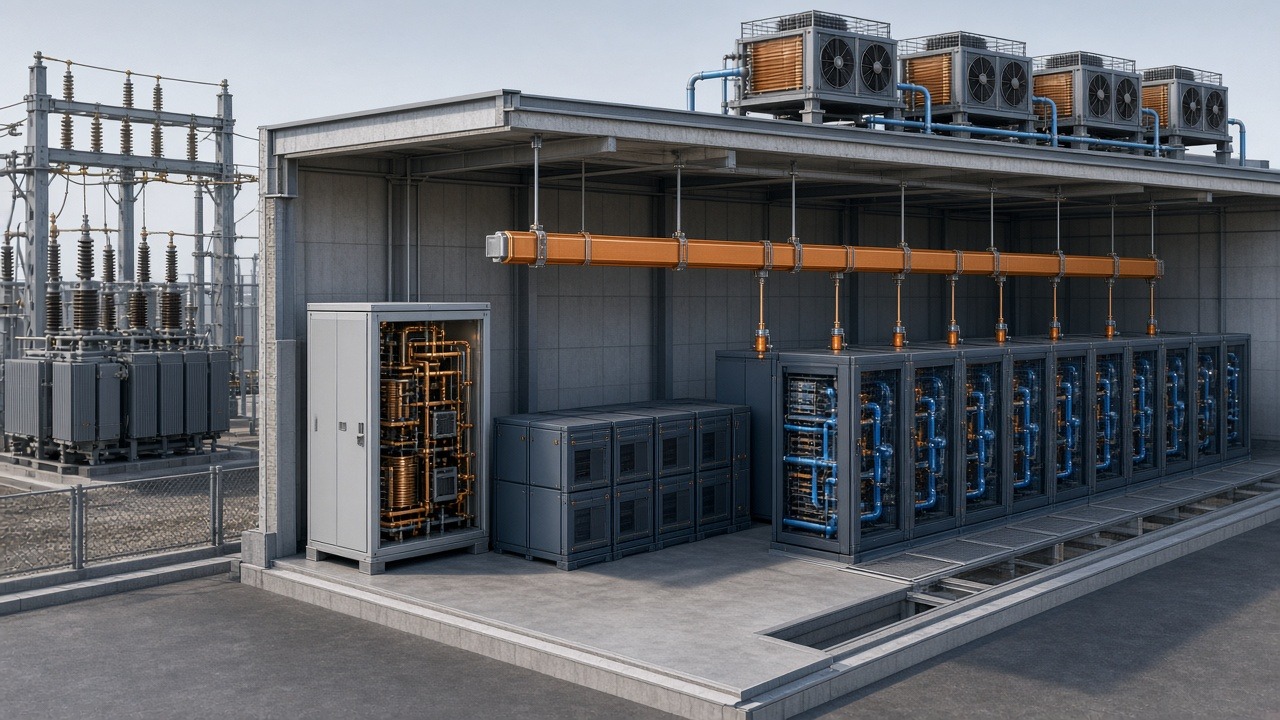
Dense liquid-cooled AI server rack next to a separate power sidecar cabinet, with orange DC busbars overhead and blue coolant pipes in a dark data hall. (Conceptual illustration.)
Most coverage of AI infrastructure looks at the campus from the outside: how many gigawatts, which utility, which state. This piece stays inside the building. The fight over power at the grid edge has a twin inside the data hall, where the power drawn by a single rack of accelerators is heading from about a hundred kilowatts toward a megawatt. That shift is forcing the industry to rethink two things it has not seriously changed in decades: the voltage that feeds a server rack, and the temperature of the water that cools it.
The headline number is 1 megawatt per rack. NVIDIA says it is leading a move to 800-volt direct current (800 VDC) power to support “1 MW IT racks and beyond, starting in 2027”. Microsoft, Meta and Google, working through the Open Compute Project (OCP), have just finalized a specification for a “sidecar” power rack scalable from 800 kW to more than 1 MW. Schneider Electric is building an 800 VDC sidecar for racks of up to 1.2 MW. These are not marketing round numbers; they are design targets written into specifications and product plans.
This article explains why the old power chain breaks at these densities, how the two main architectures differ, where solid-state transformers and on-rack energy storage fit, and why 45°C cooling water matters as much as 800 volts.
From 130 kW to a megawatt: why the old chain breaks
A useful baseline is the current generation of rack-scale systems. Vertiv’s reference architecture for NVIDIA’s GB200 NVL72, co-developed with NVIDIA, supports up to 132 kW per rack. That is already roughly an order of magnitude above a conventional enterprise rack, and it is the reason liquid cooling has become standard for frontier AI clusters.
Inside today’s racks, power typically arrives as three-phase AC (415 or 480 V), is converted to DC by power shelves mounted in the rack, and is distributed to compute trays at about 54 VDC over copper busbars. NVIDIA’s own engineers set out the limits of that design in a May 2025 technical blog:
- Space. GB200 and GB300 NVL72 racks already carry up to eight power shelves. Scaling the same 54 V approach to a megawatt-class Kyber rack would mean power shelves consuming up to 64 rack units, “leaving no room for compute”.
- Copper. At 54 VDC, a single 1 MW rack would need up to 200 kg of copper busbar. Multiply that across a gigawatt campus and the material bill becomes absurd.
- Conversions. Every AC/DC and DC/DC stage loses energy and adds a failure point, from the facility UPS down to the rack power supplies.
The physics is simple: power equals voltage times current. Holding voltage at 54 V while multiplying power by seven or eight means multiplying current by the same factor, and resistive losses grow with the square of the current. The only sustainable lever is to raise the voltage.
The next generations show why this is urgent. NVIDIA says its Kyber rack architecture, the successor to today’s Oberon racks, will house 576 Rubin Ultra GPUs by 2027, with compute blades rotated vertically “like books on a shelf” and up to 18 compute blades per chassis. SemiAnalysis has reported Kyber at around 600 kW per rack; NVIDIA itself frames the architecture around racks from 100 kW to “over 1 MW” on the same infrastructure. Even NVIDIA’s Vera Rubin NVL72, the nearer-term rack, is specified for a 45°C coolant inlet temperature, a detail we return to below.
Two roads to high-voltage DC
NVIDIA’s 800 VDC: move conversion to the edge of the building
NVIDIA’s proposal is the more radical end state. In its 2025 description, 13.8 kV AC from the grid is converted directly to 800 VDC at the data center perimeter using industrial-grade rectifiers, and then distributed through the hall on 800 V busways. Racks accept a two-conductor 800 V feed and convert it down inside the rack to the low voltages GPUs need.
The company’s quantified claims are worth stating precisely, because they are often rounded up in secondary coverage:
- Switching from 415 VAC to 800 VDC distribution lets 85% more power pass through the same conductor size, and cuts copper requirements by 45%.
- End-to-end efficiency improves by up to 5% compared with current 54 V systems.
- Maintenance costs fall by up to 70%, mainly through fewer power supply unit failures.
- Total cost of ownership could drop by up to 30%, through efficiency, reliability and architecture gains.
These are vendor targets, not measured fleet results. In an October 2025 follow-up, NVIDIA added a key detail on the rack side: Kyber uses a single-stage, high-ratio 64:1 LLC converter to step 800 VDC down to 12 VDC right next to the GPU, which NVIDIA says is more efficient and takes 26% less board area than multi-stage approaches.
By August 2026 the roadmap had become staged rather than all-or-nothing. NVIDIA now describes three building blocks:
- An MGX-compatible 800 VDC power rack, arriving in the second half of 2026, that slots into existing AC facilities and delivers 800 VDC to compute racks within the row “with no changes to the building’s electrical system”.
- A row power center that feeds multiple rack rows over an overhead 800 VDC busway, supporting up to 2 MW per row, with availability expected in 2027.
- A DC power block for new facilities, converting grid power to 800 VDC in a single step at facility scale.
OCP Mt Diablo: a ±400 V sidecar built on EV parts
The hyperscalers took a more incremental route. At the 2025 OCP EMEA Summit, Google described moving rack power delivery from 48 VDC to ±400 VDC, enabling IT racks to scale from 100 kW up to 1 MW. Its reasoning was supply-chain driven: 400 V is the voltage class of the electric-vehicle industry, so connectors, contactors and power electronics can ride EV volumes. Google said the first embodiment, an AC-to-DC sidecar that takes power components out of the IT rack, improves end-to-end efficiency by about 3% while freeing the entire IT rack for accelerators.
That work became Mt Diablo, a joint Microsoft, Meta and Google project at OCP. The Mt Diablo Disaggregated Power Rack Specification v1.0.0, effective 8 October 2026, describes a separate power rack that delivers ±400 VDC, which the latest revision now calls “differential 800 VDC”, to a neighboring IT rack. Its scope is explicit: rack power has grown “from 33kW to 100’s of kW”, and the power rack “can be scalable and updated to meet various power requirements from 800kW to 1MW+”, with the option to parallel power racks while keeping the IT rack unchanged. The document’s power table lists options up to about 1.1 MW depending on the AC input voltage, and the three authors’ rack dimensions are tabulated side by side.
Microsoft’s own infrastructure blog describes Mt Diablo as operating “at ±400VDC and 800VDC”. In practice the two camps differ less in total voltage than in topology: Mt Diablo is a bipolar system with a common midpoint, so each conductor sits at 400 V relative to that midpoint, while NVIDIA’s design is a two-conductor 800 V feed. That choice shapes protection schemes, connector standards and how easily each design borrows from the EV supply chain.
Convergence, not a standards war
The interesting development of 2026 is that the two roads are merging. NVIDIA’s August 2026 post states that NVIDIA, Google and Microsoft “have been developing the 800 VDC architecture together through the Open Compute Project”, publishing a joint white paper in March 2026 and an LVDC Solid-State Transformer Specification v0.3 in July 2026, and that more than 80 equipment makers are building to the specification. The disaggregated sidecar is now common ground: NVIDIA exhibited an 800 V sidecar for a Kyber rack at GTC 2025, Mt Diablo standardizes one, and Schneider Electric is developing an 800 VDC sidecar with NVIDIA rated for racks of up to 1.2 MW.
For operators, the practical question is no longer “which voltage wins” but “how far upstream do I move the conversion, and when”.
Power sidecars: the bridge architecture
The sidecar is the near-term workhorse because it requires no rebuilt building. A sidecar is a full-height rack placed next to one or more compute racks. It takes AC from the existing distribution, converts it to high-voltage DC, and feeds the neighbor over a short busbar or cable. The compute rack loses its power shelves and regains that space for accelerators.
The product specifications show what goes inside:
- Schneider Electric (October 2025): modular power conversion shelves, modular energy storage for short-term backup and load smoothing, and “Live Swap” capability for safer maintenance.
- Vertiv (October 2025): an 800 VDC portfolio built around centralized rectifiers, high-efficiency DC busways and rack-level DC-DC converters, then planned for release in the second half of 2026 to align with the 2027 Rubin Ultra rollout.
- OCP Mt Diablo: modular AC/DC power supply units in a rack following the Open Rack mechanical base, with a goal of standardizing high-voltage connectors and mating interfaces.
Timelines are slipping in the details even as the direction holds. On Vertiv’s third-quarter 2026 earnings call on 28 October, chief executive Giordano Albertazzi described a staged market: initial “800 volt to the rack” configurations fed from existing AC infrastructure would start generating revenue during 2027, while fully native 800 VDC would go through customer validation in 2027, with deployment “into the market in 2028” (as transcribed by The Motley Fool).
Solid-state transformers: replacing the substation transformer
A conventional data center substation steps medium voltage down through large oil- or dry-type transformers operating at 50 or 60 Hz, then rectifies to DC much further down the chain. A solid-state transformer (SST) replaces that with power electronics: it converts medium-voltage AC to high-frequency AC, steps it down through a much smaller transformer, and outputs DC directly. The appeal is fewer stages, a smaller footprint and native DC output for an 800 V hall.
NVIDIA said in 2025 that it and its partners were “actively studying” the cost and safety implications of both transformer-based and SST approaches, and the OCP’s July 2026 LVDC SST specification shows that the US ecosystem is now writing interfaces for them. Commercially, though, the first live deployment at scale has been announced in China.
On 2 November 2026, Envision said it had put an integrated 800 V DC power system into commercial service at its Galaxy AI data center campus in Ulanqab, Inner Mongolia. According to the company’s release, SSTs convert 10 kV medium-voltage AC directly to an 800 V DC bus; batteries provide “second-scale power support and minute-scale backup”; and a controller coordinates the SSTs and storage at the millisecond level to absorb GPU load swings locally. The release does not state the size of the deployment or measured efficiency. SemiAnalysis, which visited the site in September, reported that the SST system runs in a single 5 MW hall, with the SSTs removing the low-voltage transformers, UPS and rectifier stages in between; Tom’s Hardware relayed that account on 9 November. Both are secondary sources, and the “world’s first” label is Envision’s own claim.
The takeaway is not that China has “won” 800 V. It is that a medium-voltage-to-800 V DC path is now operating under live AI load somewhere, which gives US and European operators a reference point as they evaluate SSTs from their own suppliers.
Storage moves into the rack row
The second reason to rebuild the power chain is less obvious: AI training load is spiky. Thousands of GPUs computing and then synchronizing in lockstep can swing a site’s demand by large fractions of its capacity within milliseconds. NVIDIA’s October 2025 blog cites joint research by NVIDIA, Microsoft and OpenAI showing that synchronized LLM training can create grid-scale oscillations, making grid interconnection a primary bottleneck for AI scaling.
NVIDIA’s answer is multi-timescale energy storage, treated as an active part of the power architecture rather than a backup system:
- Milliseconds to seconds: high-power capacitors and supercapacitors placed close to compute racks absorb high-frequency spikes and fill brief valleys.
- Seconds to minutes: facility-level battery energy storage systems at the utility interconnection manage slower ramps and provide ride-through during transfers to backup generators.
The company argues that 800 VDC makes this easier, because storage no longer has to sit inline with an AC chain; it can be attached to the DC bus where it is most useful. The same logic shows up across the specifications. Schneider’s sidecar integrates storage for “load smoothing”. Mt Diablo’s specification requires power supplies to ride through short peak loads without triggering the battery backup units. Envision’s Galaxy system couples SSTs and batteries under one controller.
This matters beyond the hall. Utilities increasingly want large AI loads to behave predictably, and storage at the row or rack level is one of the few tools that can flatten demand on the inside before it reaches the grid. For the grid side of that story, see our energy desk’s analysis of Power, Water, and Local Pushback: The Hidden Constraints on AI Campuses.
45°C water: cooling without chillers
Every watt that enters a rack leaves it as heat. At 1 MW per rack, air cooling is not a serious option, and the question becomes how warm the liquid can be.
ASHRAE’s Technical Committee 9.9 defines liquid-cooling classes by the maximum facility water supply temperature. Since the fifth edition of its Thermal Guidelines (2021), the classes are named after that limit: W17, W27, W32, W40, W45 and W+, all with a 2°C lower bound. ASHRAE also tightened what compliance means: equipment rated for a class must deliver full performance across that class’s whole temperature range. In ASHRAE’s reference table, the colder classes rely on chillers with economizers as supplementary, while W45 is served primarily by cooling towers, with district heating as a supplemental option. In plain terms, at 45°C supply water, a facility can reject heat to outside air for most or all of the year without mechanical refrigeration.
That is why NVIDIA’s 45°C inlet temperature for Vera Rubin NVL72 matters. If the silicon tolerates 45°C coolant, operators can run dry coolers or cooling towers instead of chillers, cut the energy spent on cooling, and in cold climates export useful heat. Google has also contributed its fifth-generation coolant distribution unit, Project Deschutes, to OCP to speed liquid-cooling adoption.
Two caveats keep this honest. First, chiller-free does not automatically mean water-free: evaporative cooling towers consume water, while dry coolers use little water but more fan energy and land. Second, ASHRAE itself has warned that some high-power components, especially memory-heavy packages, may push requirements toward colder water. The warm-water trend is real, but it is a design negotiation between chip makers and facility engineers, not a free lunch. For how this played out in a real hyperscale design, see our look at Microsoft Fairwater and the Rise of the Distributed AI Superfactory, whose closed-loop liquid cooling is part of the same shift.
What changes for builders and operators
Taken together, the 1 MW rack rewires the AI factory in five ways:
- The electrical room moves. Conversion migrates from inside the server to a sidecar, then to the row, and eventually to the building perimeter or an SST block.
- Copper and floor space become design variables. Higher voltage cuts conductor size; removing power shelves gives rack space back to compute.
- Storage becomes part of the power path. Capacitors, rack batteries and site BESS act as a buffer between volatile AI load and the grid.
- Safety and skills change. High-voltage DC needs new protection devices, arc-flash practices and trained technicians. Schneider’s emphasis on Live Swap and Vertiv’s on its field-service workforce both point to this.
- Cooling targets rise. Racks designed for 40–45°C water let new sites drop or downsize chillers, which changes both cost and siting.
The calendar is the main uncertainty. NVIDIA ties full-scale 800 VDC production to Kyber in 2027; Vertiv’s latest comments push fully native 800 VDC deployment to 2028; and the first SST-based hall is live in China at a 5 MW scale, as reported. Brownfield sites will most likely run hybrid AC-plus-sidecar designs for years.
Bottom line
The race to gigawatt campuses gets the headlines, but the rack is where the engineering limits show first. Moving from roughly 130 kW to 1 MW per rack cannot be done with 54-volt busbars and cold water. The industry’s answer, high-voltage DC in either NVIDIA’s 800 V or the hyperscalers’ ±400 V form, power sidecars, solid-state transformers, distributed storage and 45°C liquid cooling, now has specifications, products and a first live reference site. The next 18 months will show whether that answer arrives on schedule with the silicon that needs it.
Related reading
- Microsoft Fairwater and the Rise of the Distributed AI Superfactory
- Power, Water, and Local Pushback: The Hidden Constraints on AI Campuses
- The Texas AI Factory Race: Why Hyperscalers Are Betting Tens of Billions on One State
- Multi-Trillion-Parameter Training: What the Next Silicon Generation Must Deliver
- Beyond Stargate: The New Gigawatt Map of AI Factories
- Inside the AI Switch: Co-Packaged Optics Moves From Lab Demo to Liquid-Cooled Fabric
References / Sources
Primary sources
- NVIDIA Technical Blog: “NVIDIA 800 VDC Architecture Will Power the Next Generation of AI Factories” (20 May 2025, updated 31 July 2025)
- NVIDIA Technical Blog: “Building the 800 VDC Ecosystem for Efficient, Scalable AI Factories” (13 Oct 2025)
- NVIDIA Blog: “NVIDIA, Partners Drive Next-Gen Efficient Gigawatt AI Factories in Buildup for Vera Rubin” (OCP Global Summit 2025)
- NVIDIA Blog: “Why Scaling AI Compute Performance Requires a New Power Architecture” (11 Aug 2026)
- NVIDIA: Vera Rubin NVL72 product page (45°C inlet temperature)
- Open Compute Project: Mt. Diablo Disaggregated Power Rack Specification v1.0.0 (effective 8 Oct 2026)
- Google Cloud Blog: “Enabling 1 MW IT racks and liquid cooling at OCP EMEA Summit”
- Microsoft Tech Community: “Rethinking Power Conversion and Distribution for the AI Era”
- Schneider Electric: “Schneider Electric Highlights Innovation in 800 VDC Power Systems in support of NVIDIA’s next generation GPUs” (13 Oct 2025)
- Vertiv: “From vision to readiness: Vertiv collaborates with NVIDIA to advance 800 VDC platform designs” (13 Oct 2025)
- Vertiv: GB200 NVL72 power and cooling reference architecture, up to 132 kW per rack (15 Oct 2024)
- ASHRAE TC 9.9: “Emergence and Expansion of Liquid Cooling in Mainstream Data Centers” (white paper; W-class renaming)
- Envision (PR Newswire): “Envision Achieves World’s First Commercial Deployment of Integrated 800V DC SST-Based Power System in Large-Scale AI Data Center” (2 Nov 2026)
Secondary sources
- SemiAnalysis: “We Visited China’s Stargate in Inner Mongolia” (7 Nov 2026, paywalled; 5 MW SST hall, Kyber ~600 kW)
- Tom’s Hardware: “China builds massive 800-megawatt AI data center campus to rival US Stargate project” (9 Nov 2026)
- The Motley Fool: Vertiv (VRT) Q3 2026 Earnings Call Transcript (28 Oct 2026)
- Upsite Technologies: “Major Changes to ASHRAE’s Fifth Edition of Thermal Guidelines – Part 3: Liquid Cooling Chapter Updates”
- Data Center Feed: “OCP Publishes Final Mt. Diablo Sidecar Power Rack Spec From Microsoft, Meta and Google as Racks Near 1 MW” (Oct 2026)
Images: original illustrations generated for AndBeyond.Tech; no logos or real people depicted.