When Video Models Go Open: Runway’s Praxis-1 and Web Video as Robot Pretraining
Robot vision-language-action models have mostly been trained on demonstrations collected with robots: teleoperation, handheld tools, or simulation. Video companies have long argued that the public…

Robot vision-language-action models have mostly been trained on demonstrations collected with robots: teleoperation, handheld tools, or simulation. Video companies have long argued that the public internet already contains a richer record of how objects move and how tasks unfold. On 11 November 2026, Runway put a test of that idea into the open. Praxis-1, the company’s “world action model”, is now available with open weights, and Runway licenses the weights plus the inference and fine-tuning code under Apache 2.0, including for commercial use [1][2][3].
This article describes what was actually released, attributes every headline score to Runway and to the benchmarks it cites, and treats the claim that web video can stand in for teleoperated robot video as an open question — not a settled result.
What Praxis-1 is
Runway first introduced Praxis-1 in September 2026 as its first world action model, built on the same large-scale video pretraining as its general world models [1]. In the November release it describes the model as a 27-billion-parameter mixture-of-experts diffusion transformer that predicts video and actions together [1]. The Hugging Face card for the base checkpoint is slightly more specific: a 27.2-billion-parameter mixture-of-experts video-diffusion policy with a chunk-causal trunk and a 0.3-billion-parameter action expert, running at 15 Hz with 24-step action chunks [3]. That card also states that the base checkpoint has no per-embodiment action heads and “does not run as a policy as is”; it is the starting point for fine-tuning on a new robot rig [3].
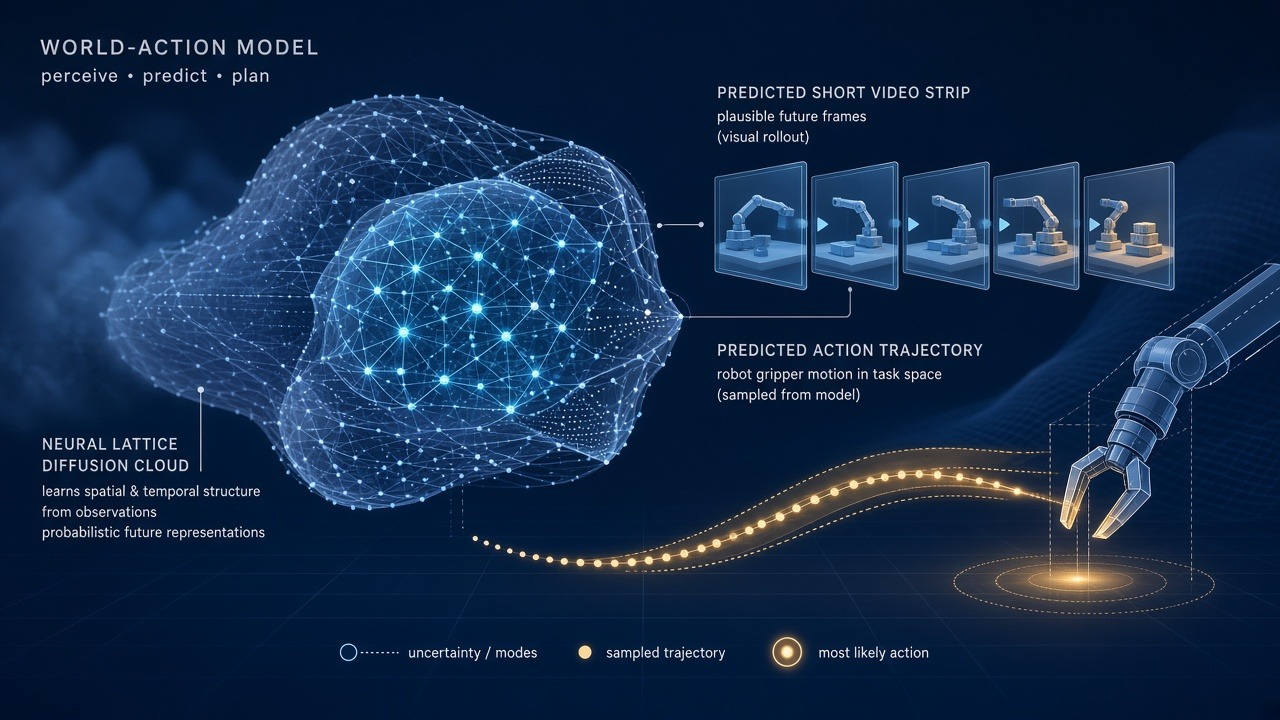
The practical idea is simple to state and hard to get right. Given camera observations, robot state and a language instruction, the model predicts a short video of what happens next and the actions that would produce it. The robot then executes the action chunk [2]. Runway calls this a world action model rather than a classic VLA, because the video prediction is part of the policy, not just a separate world model sitting beside it.
Ready-to-run checkpoints cover several common rigs: a single-arm DROID setup, a bimanual YAM setup, and SO-100 / SO-101 arms, including NVFP4 quantized variants and LeRobot-compatible layouts [2][3]. Runway also lists availability in vLLM-Omni, hosted inference on its Reactor service, and post-training tutorials with NVIDIA NeMo Automodel [1]. It says the model runs on NVIDIA data-centre GPUs (H100, B200), workstation GPUs (RTX 5090, RTX PRO 6000) and Jetson Thor on the robot itself [1].
Launch partners named in the announcement — Noble Machines, Standard Bots and Ultra — have, according to Runway, already run the model on a legged humanoid, a six-axis industrial arm and a dual-arm warehouse robot [1]. Those deployments are Runway’s account of partner use; this article does not independently verify their factory-floor performance. For a comparable vendor-reported factory result on humanoids, see our analysis of Gemini Robotics 2.5 in the factory.
The license, checked on the actual repo
Runway’s announcement says everything needed to run and adapt Praxis-1 is released under Apache 2.0, including for commercial use, covering weights and the inference and fine-tuning code, with support for both full fine-tuning and LoRA [1].
We checked the primary repositories rather than relying on the blog alone:
- The official code repository, github.com/runwayml/praxis-1-oss, is registered on GitHub as Apache License 2.0 (
spdx_id: Apache-2.0). TheLICENSEfile on themainbranch is the standard Apache License, Version 2.0, January 2004 text [2]. - The Hugging Face model cards for
runwayml/praxis-1-base,runwayml/praxis-1-droid,runwayml/praxis-1-yamandrunwayml/praxis-1-so101all list apache-2.0 [3].
One caveat is written on the base-model card and is worth keeping: the frozen dependencies packaged separately — the Wan2.2 variational autoencoder and the Qwen/Qwen3.5-2B text encoder — “are distributed separately under their own licenses” [3]. Apache 2.0 applies to Runway’s Praxis weights and to the praxis-1-oss code; it does not automatically cover those upstream components.
Scores, with their source and conditions
All of the following figures are Runway’s, reported in its 11 November 2026 announcement, and come from benchmarks Runway itself cites. They are not independent replications [1].
NVIDIA RoboLab-120, described by Runway as a leaderboard of world action models, with success measured across 1,200 episodes and figures “as of November 2026” [1]:
| Model (as listed by Runway) | RoboLab-120 success |
|---|---|
| Praxis-1 | 46.2% |
| FLUX 3 Action | 42.9% |
| Cosmos3 Nano | 36.8% |
| π0.5 | 28.0% |
Runway says Praxis-1 is the top-performing world action model on that leaderboard and that it outperforms every open-weight VLA on the same board [1]. Those rankings should be read as Runway’s reading of RoboLab-120 at that date, under whatever official protocol the benchmark uses — not as a general ranking of every robot policy in every setting. For a sense of how brittle single-number robot rankings can be once embodiments and tasks change, see our earlier look at RoboColosseum.
SimplerEnv, after fine-tuning on Google’s RT-1 robot. Runway reports that the RT-1 embodiment “never appeared in its training data”, and that a fine-tuned Praxis-1 reaches 80.0% success on SimplerEnv, compared with 52.4% for the original RT-1 policy [1]. Again, these are Runway’s reported numbers on that simulated evaluation suite, after a fine-tune, not a zero-shot real-robot score and not a third-party audit.
None of these results, on their own, tell you how a checkpoint will behave on a new industrial cell. They are useful as the company’s own yardstick, clearly labelled.
Can web video replace teleoperation? An open question
The more interesting claim sits one layer below the leaderboard. Runway writes that Praxis-1 “learns how objects behave and how tasks unfold from large-scale video”, giving it “a head start on a new embodiment before fine-tuning on any hardware or domain-specific data”. It then states that its research “has shown that web video matches teleoperated robot video as pretraining data for policy performance, which shifts the bottleneck on a capable policy to how much general video a model can learn from” [1].
That is a strong statement. It is also, for now, a claim to examine, not a result the field has settled.
A few reasons to keep it open:
- The open base checkpoint is not “web video only”. The Hugging Face card for
praxis-1-basedescribes the mid-training checkpoint as “trained on a mix of robot and human video across 18 embodiments” [3]. If robot video is still in the mix, “web video matches teleoperation” is a research finding Runway attributes to its own studies — not a description of a purely internet-pretrained policy that anyone can download and run. - The published scores are not a controlled swap test. RoboLab-120 and the RT-1 SimplerEnv number compare Praxis-1 with other models, or with the original RT-1 policy after fine-tuning. They do not, in the announcement, show a head-to-head ablation in which the same architecture is pretrained only on web video versus only on teleoperation and then evaluated under identical real-robot protocols [1].
- Adaptation is still in the loop. Runway’s own story of partner robots and of the RT-1 result is a story of a pretrained model plus light fine-tuning or LoRA on the target hardware [1]. Pretraining can lower the amount of robot data you need. That is not the same as removing robot data from the pipeline.
- Physical contact remains the hard part. As we have argued in our pieces on sim-to-real transfer and on residual and real-world reinforcement learning, internet video is rich in semantics and poor in the force, backlash and recovery behaviour that make insertion, folding and tool use fail on a real arm. A model can “know” what a mug is and still miss the last centimetre.
None of that makes the hypothesis uninteresting. If large-scale video pretraining really does match teleoperated pretraining for downstream policy performance, data collection strategy for foundation robot models would change: collect less routine teleoperation up front, and spend scarcer robot time on fine-tuning, evaluation and the long tail. The honest position in November 2026 is that Runway has opened a strong model and made a testable claim. Independent labs can now try to reproduce the match — or show where it breaks.
Why opening the weights matters
Closed robotics models are difficult to inspect, adapt or run under a factory’s own security rules. Apache 2.0 weights and training code lower that barrier, which is why Runway frames the release as a bid for “interoperability and openness” in physical AI and notes its role as a founding member of NVIDIA’s Cosmos Coalition [1]. For industrial teams, the useful test is narrower: can you take praxis-1-base, add heads for your cameras and action space, LoRA-adapt on a modest demonstration set, and get a policy that is safe and reliable enough to evaluate on a real cell?
The release makes that experiment cheaper to run. It does not finish it. Teams will still need sim-to-real discipline, careful on-robot evaluation, and, for many contact-rich skills, a post-imitation improvement loop [4]. Open weights are infrastructure, not a substitute for that stack.
Limits to keep in view
- Benchmark figures in this article are Runway’s, from RoboLab-120 (1,200 episodes, November 2026 snapshot) and from SimplerEnv after an RT-1 fine-tune [1].
- Partner hardware mentions are Runway’s; we have not audited those deployments.
- Apache 2.0 is confirmed for the official GitHub repository and the listed Hugging Face Praxis-1 checkpoints; separately distributed encoders and VAEs keep their own licenses [2][3].
- “Web video matches teleoperation” remains Runway’s research claim, and the public base model is documented as a mix of robot and human video [1][3].
Bottom line
Praxis-1 is a genuine opening of a large video-and-action policy: a 27-billion-parameter mixture-of-experts model, Apache 2.0 code and weights, and a public fine-tuning path. Runway reports 46.2% success on RoboLab-120 and 80.0% versus 52.4% on SimplerEnv after an RT-1 fine-tune; those numbers belong to Runway and to the benchmarks it cites. The deeper idea — that web video can replace teleoperation as pretraining — is now easier to test because the weights are out. It is not, on the evidence published with this release, a closed case.
Related reading
- Vision-Language-Action Models: The New Foundation Layer for Robots
- Sim-to-Real in 2026: Closing the Gap Without Endless Real-World Data
- After Imitation: Residual and Real-World RL as the Next Layer for Robot Policies
- RoboColosseum and the Race to Measure Physical Intelligence in the Wild
- Gemini Robotics 2.5 in the Factory
References / Sources
- Runway — “Praxis-1 Is Now Available” (11 November 2026). https://runway.com/news/company-news/praxis-1-is-now-available
- Runway — official code repository
runwayml/praxis-1-oss, Apache License 2.0 (LICENSE file onmain; GitHub SPDX Apache-2.0). https://github.com/runwayml/praxis-1-oss - Runway — Hugging Face model card,
runwayml/praxis-1-base(Apache 2.0; notes separate licenses for Wan2.2 VAE and Qwen3.5-2B). Related checkpoints:praxis-1-droid,praxis-1-yam,praxis-1-so101. https://huggingface.co/runwayml/praxis-1-base · https://huggingface.co/collections/runwayml/praxis-1 - Related reading: AndBeyond.Tech — Vision-Language-Action Models: The New Foundation Layer for Robots; Sim-to-Real in 2026; After Imitation: Residual and Real-World RL; RoboColosseum and the Race to Measure Physical Intelligence; Gemini Robotics 2.5 in the Factory.
Images: original illustrations generated for AndBeyond.Tech; no logos or real people depicted.