Gemini Robotics 2.5 in the Factory: What DeepMind’s 96% Kitting Score Does — and Doesn’t — Prove
On 10 November 2026, Google DeepMind introduced Gemini Robotics 2.5, which it calls its most capable vision-language-action model to date, and put a factory number…
On 10 November 2026, Google DeepMind introduced Gemini Robotics 2.5, which it calls its most capable vision-language-action model to date, and put a factory number at the centre of the reliability claim. During a “real-world proof-of-concept,” DeepMind says, the model helped Apptronik’s Apollo 2 humanoid “pick and pack automotive parts with a 96% success rate” (Google DeepMind, 10 Nov 2026).
That 96% figure is a DeepMind-reported result. It is not accompanied, in the same post, by a trial count, a definition of “success,” a cycle time, a shift length or an intervention rate. DeepMind itself describes the work as a proof of concept, not as a completed commercial deployment. This article stays on the factory question: what the announcement actually says about factory humanoid kitting, what it leaves open, and how far a single percentage can go toward proving that a humanoid robot AI model is ready to hold a station on a live line.
What DeepMind says happened on the line
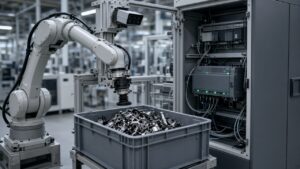
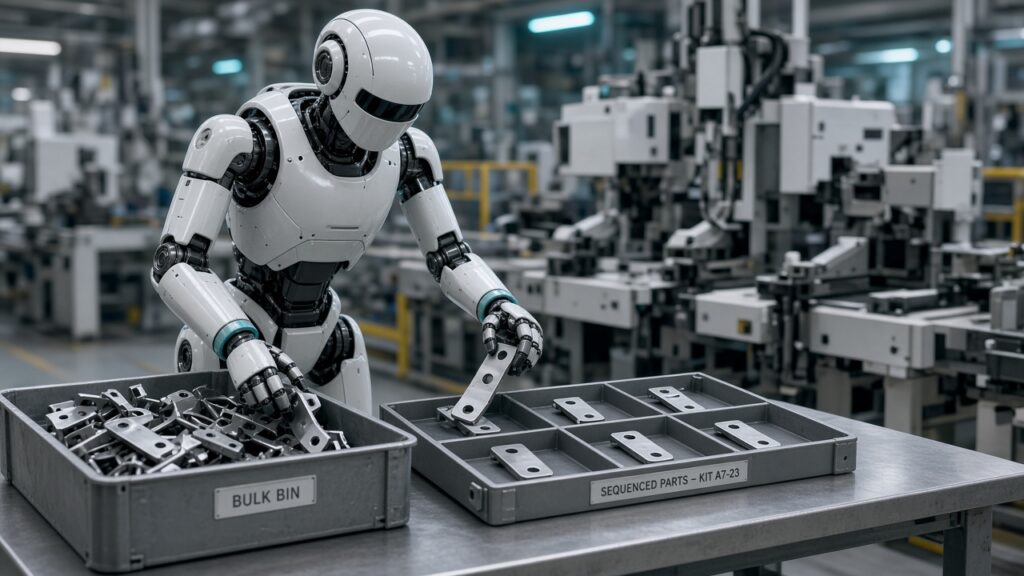
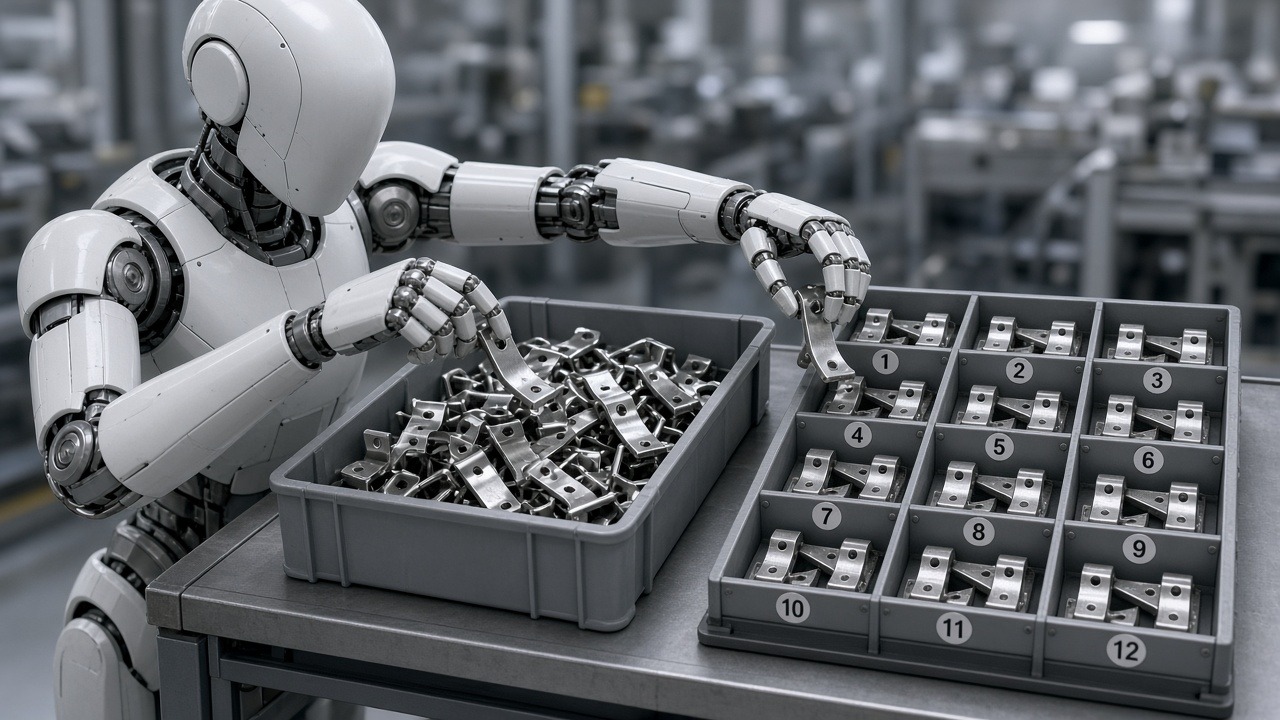
In a section headed “Testing real-world reliability with Apptronik’s Apollo and Mercedes-Benz,” DeepMind writes that it “partnered with Apptronik and Mercedes-Benz to use Apollo 2 humanoid robots on active automotive production lines in Kecskemét, Hungary, and Sindelfingen, Germany.” The task, as DeepMind describes it, is automotive kitting: sorting individual parts from bulk bins into organized trays “in the exact order needed for each vehicle on the line.” The robot, DeepMind says, reaches into supply bins, picks up metal automotive brackets and places them into sequencing containers, “correcting for any gaps,” and achieves a 96% success rate (Google DeepMind, 10 Nov 2026).
Those plant names and the Mercedes-Benz identification come from DeepMind’s wording. As of 16 November 2026, AndBeyond.Tech has not found a standalone Mercedes-Benz press release, or a standalone Apptronik news-room release, that restates the 96% figure or confirms the Kecskemét and Sindelfingen details independently. A quotation from Apptronik CEO and co-founder Jeff Cardenas does appear in DeepMind’s post. He says the companies “saw the models improve dramatically in just a few weeks of post-training and carry over to Mercedes-Benz production with very little drop-off” (Google DeepMind, 10 Nov 2026). That is Apptronik’s CEO, published by DeepMind, not a separate Apptronik or Mercedes-Benz communiqué.
The 2024 commercial agreement in which Apptronik and Mercedes-Benz said they would pilot Apollo in Mercedes-Benz manufacturing facilities, including kit delivery to the line, is a matter of public record from Apptronik (Apptronik, 15 March 2024). It establishes that a partnership existed. It does not, by itself, verify DeepMind’s 2026 success rate.
Until Mercedes-Benz or Apptronik publishes its own account of this proof of concept, the responsible reading is: DeepMind reports a 96% kitting result on Apollo 2 at plants it names as Mercedes-Benz sites in Hungary and Germany.
Why kitting is a revealing factory test
Kitting — sometimes called sequencing when parts must arrive in vehicle order — is not a random dexterity demo. A missed, swapped or empty slot in a tray can stop a line or force a person to catch the error before the kit reaches assembly. DeepMind’s own framing is that offloading this “monotonous prep work helps keep the assembly line moving, while freeing up technicians to focus on complex build tasks” (Google DeepMind, 10 Nov 2026).
That is exactly why the missing denominator matters. A 96% success rate sounds precise. Without knowing whether DeepMind counted individual picks, completed trays, or some other unit, and without knowing how many attempts sit behind the percentage, a plant engineer cannot tell whether 96% is a large-sample yield or a small-sample score. The post also does not say how a failure was handled: did the robot retry, did it flag the gap, or did a person step in? DeepMind says the robot corrects for gaps; it does not publish how often that correction was needed, or how long it took.
None of that makes 96% meaningless. A proof-of-concept that puts a biped on an active line and returns a high, if underspecified, success rate is still more informative than a laboratory highlight. It is not yet the same evidence standard as a multi-month, station-level shift record. For that broader test of demo versus shift, see Humanoids on the Factory Floor.
What the announcement does not publish
Readers who want to judge factory humanoid kitting as an operating job will notice what is absent from DeepMind’s post:
- Trial count and duration. There is no figure for how many kits, how many hours, or how many shifts the 96% covers, and no split between the two plants DeepMind names.
- Definition of success. It is not stated whether a “success” is a correctly placed part, a correctly completed tray, or a task episode under a time limit.
- Intervention rate. The write-up does not say how often a technician paused, reset or rescued the robot.
- Cycle time and throughput. There is no comparison with the station’s takt, and no parts-per-hour figure.
- Autonomy bounds. “Autonomously performs automotive kitting” is DeepMind’s phrase; the post does not describe supervision, network dependence, or what happens when a novel bracket or a blocked bin appears.
- Cost. No cost per hour, lease rate or comparison with a human kitter is offered.
DeepMind calls the result “promising progress toward widespread real-world industrial applications.” That is a fair description of a proof of concept. It is not a claim, and should not be rewritten as a claim, that Apollo 2 is now holding a full production shift at those plants.
How the model is described — only as far as the factory needs
Gemini Robotics 2.5 is presented as a vision-language-action (VLA) model: it takes in what the robot sees and a task instruction, and it outputs actions. On the kitting cell, DeepMind says two pieces worked together: Gemini Robotics ER, an “embodied reasoning” model, “to keep track of the workflow,” and Gemini Robotics 2.5 “to control its hands and arms” (Google DeepMind, 10 Nov 2026). For a factory reader, the relevant point is the split — one model watching the job sequence, another moving the hands — not the research architecture behind it.
DeepMind also says the model “natively works with many different robot types,” and names Apptronik’s Apollo 2 (with a five-finger hand it describes as having 22 degrees of freedom) as well as a dual-arm Franka platform with two-finger grippers. Gemini Robotics 2.5 is “rolling out to our robotics partners.” The post gives no general-availability date, no price and no list of which partners receive which capabilities (Google DeepMind, 10 Nov 2026).
Separately, DeepMind reports laboratory-style evaluations “across over 200 distinct tasks,” with a 30% to 100% higher success rate than “previous baselines,” depending on the type of task, and tasks completed 20% to 30% faster. Those figures are also DeepMind’s. They should not be conflated with the factory 96%. The 200-task set, as described, includes examples such as serving food with tongs, tying a bow and pipetting liquid — useful for talking about dexterity, but not a substitute for station-level kitting data.
Safety claims, and what they do not cover
DeepMind attaches a safety section to the same launch. It says Gemini Robotics 2.5 uses “inference-time reasoning guidance to steer around physical hazards in real-time,” and that in its evaluations this “boosted safe task completion around obstacles by 33% and around nearby people by 43%.” It also introduces ASIMOV-Jailbreak, an open-source benchmark of adversarial prompts, and reports that Gemini 4 Argon achieved 99.5% “jailbreak resistance” against a previous baseline of 82% for Gemini Robotics ER 2 (Google DeepMind, 10 Nov 2026).
Those are evaluation results from DeepMind, not published measurements from the kitting proof of concept. They matter for any robot that will stand near people on a factory floor, but they do not tell a safety engineer whether the Kecskemét or Sindelfingen cells ran behind a fence, under what stop rules, or against which standard. A plant still needs its own safety case. The 96% figure is a task-success claim; it is not a safety certification.
Where this sits among other industrial humanoid news
Apptronik is also the vendor in GXO Logistics’ 12 November letter of intent for expanded warehouse trials and a conditional path to as many as 1,000 Apollo robots — a commercial-intent story, not a published factory yield, covered in Up to 1,000 Apollos, If the Trials Hold. The two announcements landed in the same week and should not be merged. One is a DeepMind-reported kitting score on automotive lines DeepMind names; the other is a logistics letter of intent whose unit ceiling is explicitly conditional on 2027 KPIs.
The useful comparison is about evidence. The GXO letter of intent asks whether Apollo can clear warehouse gates that have not yet been run. The DeepMind post asks readers to take a 96% proof-of-concept score as “promising progress” on a live line. Both can be true at once. Neither, on the documents published this week, shows a humanoid holding a full, independently described production shift with a public intervention rate.
What would make 96% a production number
A factory audience does not need a research paper. It needs a short addendum DeepMind, Apptronik or the automotive manufacturer could still publish:
- The unit and the sample. What counts as a success, and how many attempts (or trays, or hours) produced 96% — ideally split by plant.
- Interventions. How often a person touched the cell, and whether those events were excluded from the score.
- Time. Cycle time against the station’s requirement, and whether the result holds across a full shift, not a recorded segment.
- Failure modes. Wrong part, drop, sequence error, unrecoverable grasp — and who pays for a miss that reaches the line.
- The manufacturer’s own statement. A Mercedes-Benz or Apptronik release that restates, qualifies or corrects DeepMind’s account would move the 96% out of “one party’s report” and into a shared record.
Until then, the responsible headline is not that factory humanoids have reached 96% reliability. It is that DeepMind has published a 96% success rate for a kitting proof of concept on Apollo 2, on lines it identifies as Mercedes-Benz’s, without the supporting counts a production engineer would normally demand.
Bottom line
Gemini Robotics 2.5 arrived on 10 November 2026 with a factory hook: a DeepMind-reported 96% success rate for Apptronik’s Apollo 2 on automotive kitting, in a proof of concept DeepMind says ran on Mercedes-Benz production lines in Kecskemét and Sindelfingen. The percentage is real as a company-reported figure, and the task is a serious one. The post does not publish the trial count, the definition of success, the intervention rate or the cycle time, and AndBeyond.Tech has not found a standalone Mercedes-Benz or Apptronik release confirming that 96% (Google DeepMind, 10 Nov 2026). For readers tracking factory humanoid kitting, this is a genuine step onto a live line — and still a proof of concept, not a finished shift record.
Related reading
- Humanoids on the Factory Floor: From Demo Videos to Full Shifts
- Up to 1,000 Apollos, If the Trials Hold
References / Sources
- Google DeepMind — “Gemini Robotics 2.5 accelerates real-world general dexterity” (10 November 2026): https://deepmind.google/blog/gemini-robotics-2-5-accelerates-real-world-physical-intelligence/
- Apptronik — “Apptronik and Mercedes-Benz Enter Commercial Agreement” (15 March 2024): https://apptronik.com/news-collection/apptronik-and-mercedes-benz-enter-commercial-agreement
Images: original illustrations generated for AndBeyond.Tech; no logos or real people depicted.